

SK Telecom to fight regulator over record data breach fine

News

The South Korean operator claims the record-breaking fine is excessive and does not consider the company’s proactive response

Last year, SK Telecom (SKT) revealed it had suffered an enormous data breach in 2022, affecting 26.9 million customers. The Personal Information Protection Commission (PIPC) subsequently fined the company 134.8 billion won (around $91 million) for failing to protect customer data.

Now, SKT has said it will appeal the fine, with reports suggesting that the operator deems the fine to be unjustified and disproportionate.

The fine is the largest ever delivered by the PIPC, far exceeding the previous record: a 100 billion won ($68 million) fine imposed jointly on Google and Meta in 2022 for collecting user data for personalised ads without clear consent.

“We are seeking a detailed judicial review of whether the PIPC’s penalty is appropriate,” said SKT in a statement.

The penalty from the PIPC was calculated based on SKT’s mobile revenue, a fact which SKT says differs from previous PIPC rulings. In a 2023 case against SKT’s rival LG Uplus, for example, the resulting fine based on purely on the revenue generated from the specific system that was hacked, resulting in a much smaller penalty (6.8 billion won, or $4.6 million).

The operator also notes that there has been no reported direct or indirect damage to customers as a result of the breach.

This claim, however, has been challenged by the Korea Consumer Agency (KCA), which was approached by 58 of the affected customers seeking dispute mediation last year.

“Considering the joint investigation conducted by the government and the private sector in July and the ruling by the PIPC, it was recognized that the hacking incident caused damage to consumers,” the agency said.

“SK Telecom holds responsibility for compensating individual consumers for the damage,” it added.

In December, the KCA ordered SKT to offer affected customers 100,000 won ($67) in compensation in the form of 50,000 won ($33.5) reduction in monthly subscription fees and 50,000 won in credits usable as cash equivalents.

If the ruling stands and every customer makes use of the offer, SKT’s total estimated payout would be around 2.3 trillion won ($1.5 billion) – greater than the company’s 1.43 trillion won ($970 million) net profit in 2024.

The operator is reviewing the ruling and may yet contest it.

SKT has so far pledged to invest 1.2 trillion won ($783 million) in improving its cybersecurity measures and compensating customers affected by the breach.

Keep up to date with all the latest telecoms news with the Total Telecom newsletter

Also in the news
World Communication Award Winners 2025
Ofcom clears the way for satellite-to-smartphone services
LG Uplus’s AI voice call app glitch leaks user data

Ericsson to axe 1,600 Swedish jobs

News

The cuts follow lay offs in other markets, including France, Canada, and Spain

This week, telecoms giant Ericsson has announced it is preparing to cut around 1,600 jobs in its home market of Sweden, citing the need to remain competitive.

The mobile network equipment maker currently employs around 14,500 people in the country, with the reduction therefore representing more than 10% of the companies domestic headcount.

“The proposed staff reduction is part of global initiatives to improve cost position while maintaining investments critical to Ericsson’s technology leadership and the execution of the strategy to deliver high-performing, programmable networks that enable differentiated services and new monetization opportunities,” said the company in a press release. “Initiatives to increase operational efficiency will continue across the Group but will not be announced separately.”

According to Ericsson, negotiations are underway with relevant Swedish trade unions.

Ericsson has been facing financial headwinds in recent years, primarily driven by strong international competition and underwhelming 5G demand. This, coupled with the disastrous acquisition of API specialist Vonage for $6.2 billion in 2022, saw the company initiate streamlining efforts in 2023, including cutting 8,500 jobs.

No additional cuts were announced until 2025, when Ericsson revealed a sting of layoffs in its overseas offices. In summer, Ericsson announced plans to cut around 300 jobs in Spain; in September, around 100 ‘technical jobs’ in Canada were on the chopping block; and in December, reports suggested the company also planned to lay off around 134 jobs in France.

Of course, Ericsson is not alone in facing these financial pressures – or to be responding with significant downsizing. The company’s Scandinavian rival Nokia is notably in the process of cutting 14,000 jobs by the end of 2026, in an effort to save around €1.2 billion, with around 700 jobs in France and Germany being the latest to be excised.

Keep up to date with all the latest telecoms news with the Total Telecom newsletter

Also in the news
World Communication Award Winners 2025
Ofcom clears the way for satellite-to-smartphone services
LG Uplus’s AI voice call app glitch leaks user data

NTT DATA leads consortium to launch $1bn Intra-Asia Marine Cable

[data-slot=label]+[data-slot=control]]:mt-3 [&>[data-slot=label]+[data-slot=description]]:mt-1 [&>[data-slot=description]+[data-slot=control]]:mt-3 [&>[data-slot=control]+[data-slot=description]]:mt-3 [&>[data-slot=control]+[data-slot=error]]:mt-3 *:data-[slot=label]:font-medium » data-headlessui-state>

A new joint venture between NTT DATA, Sumitomo, and JA Mitsui Leasing will deploy an 8,100km, 320Tbps network to bolster digital infrastructure and regional connectivity across Asia by 2029

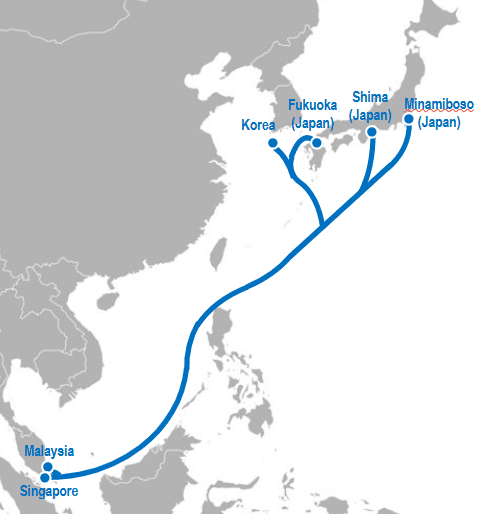
This week, NTT DATA Group, Sumitomo Corporation, and JA Mitsui Leasing have formed a new joint venture, Intra-Asia Marine Networks Co., Ltd. (I-AM NW), to build and operate a new submarine cable system that will link Japan and South Korea to Malaysia and Singapore.

The 8,100km Intra-Asia Marine Cable (I-AM Cable) will have an initial capacity of 320Tbps and is set to cost roughly $1 billion.

Planned landing sites in Japan are concentrated to improve resilience against natural disasters, with stations proposed in Chiba, Mie, and Fukuoka prefectures, while single landing points are planned in Malaysia, Singapore and South Korea.

“The launch of I-AM NW marks a significant step in strengthening Asia’s digital infrastructure,” explained Yoshio Sato, CEO at I-AM NW. “This project reflects our commitment to delivering reliable, flexible connectivity solutions that empower businesses and drive digital transformation across the Asia-Pacific region.”

Network diagram for I-AM Cable

Network diagram for I-AM Cable

The new I-AM Cable comes as part of a wave of new high-capacity submarine builds across Asia aimed at easing congestion and meeting growing data flows between East and Southeast Asia. Recently completed projects include the Bifrost cable, linking Singapore and Indonesia to the USA, and Softbank’s Asia Direct Cable that connects China (Hong Kong SAR and Guangdong Province), Japan, the Philippines, Singapore, Thailand, and Vietnam. Many more are expected to be completed in the next couple of years, including the Apricot cable, joining Japan, Taiwan, Guam, the Philippines, Indonesia, and Singapore, and the the long-awaited Sea-Me-We 6 cable, that connects Singapore all the way to France.

The system is currently is scheduled to be ready for service in early fiscal year 2029, with additional expansions to the Philippines and Taiwan planned for the future.

How is the submarine cable landscape changing in 2026? Join the discussion with over 1,500 experts at Submarine Networks EMEA

Also in the news
World Communication Award Winners 2025
Ofcom clears the way for satellite-to-smartphone services
LG Uplus’s AI voice call app glitch leaks user data
Virgin Media O2 gives Chelsea stadium a mobile infra upgrade

News

The upgrades will provide customers with more reliable service during busy football matches

O2 has carried out a targeted upgrade to its mobile network in and around Stamford Bridge, aiming to improve connectivity for the tens of thousands of fans who attend Chelsea FC matches and other events at the west London stadium.

The development will reportedly increase mobile capacity and performance across the stands, concourses, and hospitality areas.

The upgrades included the optimisation of the rooftop site within Stamford Bridge and the installation of new and upgraded small cells in the surrounding streets. O2 says these measures were intended to reduce congestion at peak times, making it easier for supporters to share photos and video, use mobile ticketing, and make contactless payments before, during, and after matches.

Following these upgrades, visitors are reportedly using more than twice as much data on match days and experiencing roughly four times higher speeds.

“Stamford Bridge is an iconic stadium with extremely high demand on matchdays. By optimising our network inside the ground and in the surrounding areas, we are giving O2 customers a more reliable mobile experience so they can enjoy every moment, from kick-off to the final whistle,” said Steven Verigotta, Director of Mobile Delivery at Virgin Media O2.

The Stamford Bridge improvements form part of Virgin Media O2’s wider Mobile Transformation Plan, which focuses on expanding 4G and 5G coverage, rolling out small cells in dense urban locations and tackling known network bottlenecks along transport routes and at major venues.

The operator has also been deploying spectrum it acquired from Vodafone UK last year, a move it says underpins capacity enhancements nationwide.

Keep up to date with all the latest telecoms news with the Total Telecom newsletter

Also in the news
World Communication Award Winners 2025
Ofcom clears the way for satellite-to-smartphone services
LG Uplus’s AI voice call app glitch leaks user data

Starlink gets FCC clearance for 7,500 Gen2 satellites

News

The completed deployment would take the total number of Starlink satellites in orbit to almost 20,000

The US Federal Communications Commission (FCC) has approved the launch and operation of 7,500 next-generation (Gen2) Starlink satellites by SpaceX.

The decision doubles the number of Gen2 satellites previously approved, bringing the total to 15,000.

SpaceX currently has around 9,400 satellites in orbit, roughly 6,200 of which are Gen2. These new satellites, equipped with upgraded communications technology, should deliver greater coverage and service quality for customers.

“This FCC authorization is a game-changer for enabling next-generation services,” said FCC chairman Brendan Carr. “By authorizing 15,000 new and advanced satellites, the FCC has given SpaceX the green light to deliver unprecedented satellite broadband capabilities, strengthen competition, and help ensure that no community is left behind.”

The approval, published Friday 9, was in fact only partial, with SpaceX having initially applied to deploy 22,000 Gen2 satellites in total.

“We defer authorization of the remaining 14,988 proposed Gen2 Starlink satellites, including satellites proposed for operations above 600 km,” explained Carr in the FCC’s ruling.

In addition to approving new satellite launches, the FCC also agreed to allow most of the new satellites to operate in slightly lower obits than their predecessors, between 340km and 485km above the planet’s surface. This, SpaceX claims, should allow for improved coverage and lower latency compared to existing Starlink devices, which orbit at around 500km.

Perhaps more importantly, it will also reduce orbital congestion. The 500–600km range is one of the busier regions of orbital space, occupied by a multitude of active satellites (with many more planned) and debris from previous projects. Orbital collisions at this height could theoretically cause a chain reaction, leaving a wasteland of debris that takes years fall back to Earth and burn up in the atmosphere.

The possibility of this so-called ‘Kessler Syndrome’ was thrown into sharp relief late last year, when one of Starlink’s satellites suffered a ‘kinetic accident’, seemingly caused by an internal error, which caused its partial breakup and pushed it 4km out of its planned orbit. Starlink says this defunct satellite will harmlessly burn up in the atmosphere by the end of the month.

To mitigate further riks, Starlink says it will also reduce the orbits of around half of its existing devices (around 4,400 satellites), in additon to the newly launched satellites. This will both to lower the possibility of collisions and to reduce the time orbital debris takes to clear from years to weeks.

SpaceX has also received approval to operate its devices in the Ku-, Ka-, V-, E-, and W-band frequencies, supporting both Fixed Satellite Service (FSS) and Mobile Satellite Service (MSS), and an Equivalent Power Flux Density (EPFD) waiver, which allows signals to be delivered at higher intensity. Combined, this should allow Starlink to deliver gigabit-speed services more consistently. These measures will also serve as a key enabler for Starlink’s next wave of direct-to-device (D2D) capabilities, including voice and data services.

As part of the approval process, SpaceX has pledged to launch and make operational 50% of the total Gen2 satellites by December 1, 2028, with the remainder launched by December 2031.

Keep up to date with all the latest telecoms news with the Total Telecom newsletter

Also in the news
World Communication Award Winners 2025
Ofcom clears the way for satellite-to-smartphone services
LG Uplus’s AI voice call app glitch leaks user data

Odido revives €1.1bn IPO plan

News

The move would value the company at around €7 billion

The joint owners of Dutch telco Odido, Apax Partners and Warburg Pincus, are reportedly looking to take the company public, according to reports.

Sources say the move would value the business at around €7 billion, with the initial public offering (IPO) potentially raising €1.1 billion through the share sale.

The launch would come almost a year after the telco’s owners shelved a previous plan for an IPO.

Odido has around 8 million mobile subscribers. It also has around 1 million fixed broadband customers, which it serves via wholesale deals with Open Dutch Fiber, Delta Fiber, Glaspoort, and KPN.

Apax and Warburg were reportedly exploring launching an IPO for Odido in January 2025, having hired Barclays Plc, Goldman Sachs Group Inc. and Morgan Stanley to lead the process. However, this plan ultimately fell through due to market chaos related to US president Donald Trump’s tariff implementation.

Now, the global economic environment has somewhat settled, leading Apax and Warburg to reconsider the IPO, which could be initiated as early as this month.

However, anonymous sources with knowledge of the matter speaking to Bloomberg emphasise that no decision has yet been made and the IPO may not proceed.

Odido (then T-Mobile Netherlands) was acquired by investment firms Apax and Warburg for €5.1 billion in 2021. The company was rebranded as Odido in 2023.

Keep up to date with all the latest telecoms news with the Total Telecom newsletter

Also in the news
World Communication Award Winners 2025
Ofcom clears the way for satellite-to-smartphone services
LG Uplus’s AI voice call app glitch leaks user data

Image source: Odido

Brady updates mobile labelling solutions to tackle telecom network maintenance challenges

Contributed Article

Versatile mobile labelling printers allow installers to clearly label inventory regardless of environmental conditions

Telecom engineers and field crews can now print durable cable identification on site, according to labelling specialist Brady, which has updated its mobile labelling offerings to target the needs of network maintenance and installation.

Brady’s portable printers are capable of producing specialised labels for a wide range of engineering needs, from self-laminating cable labels, flags, sleeves, engraved plate replacements and Velcro-compatible BradyGrip tags. These labels are designed to remain attached and legible on cables and components for up to 20 years.

The printing devices have been built with rugged operating environments in mind, from outdoor cabinets and manholes to poles and antenna masts, and have subsequently been designed to withstand UV exposure, dust and moisture, as confirmed by in-house laboratory testing.

A second strand of the product set is a vehicle inventory and asset-tracking capability. Using passive, battery-free UHF RFID labels, the location of tools and consumables in a service vehicle can automatically be verified or flagged as missing using an RFID reader in the vehicle itself. In this way, engineers can dramatically reduce the time spent looking for misplaced equipment and save money on expensive replacements.

Long-lasting labelling has become more important as operators face denser fibre deployments and stricter traceability requirements. Unambiguous cable identification can reduce repair times and avoid accidental cuts during network works – a practical efficiency and risk-reduction benefit for operators juggling plant complexity and contracted field teams.

Brady provides a downloadable cable-identification guide aimed at helping installers meet labelling standards and streamline on-site printing workflows. The vendor positions its mobile printers as a way to avoid the delays and errors associated with pre-printed labels. For network managers evaluating field tools, durability claims and independent test data will be key to assessing whether mobile printing delivers net savings in maintenance and fault-repair operations.

Brady manufactures every element of its labelling systems, including labels, printers and software, and its offerings are already used by large telecom operators in France, Germany, Italy and the UK.


Interested in reliable identification solutions to keep telecom cables identified for up to 20 years?

Discover more here!

Iran jams Starlink, enters fourth day of internet blackout


News

‘Military grade’ signal jamming is reportedly being used to cripple the satellite constellation’s effectiveness

Today, Iran is heading into the fourth day of complete internet shutdown, which human rights agencies say is being used to mask the violent suppression of protestors.

On December 28 last year, rapid hyperinflation of the Iranian rial saw shopkeepers implement a general strike, which soon spiralled into nationwide protests. With demonstrations gaining momentum at the start of 2026, the state implemented a nationwide internet blackout on January 8.

These measures coincided with violent crackdowns on protesters by government troops, with security forces opening fire on unarmed civilians on Friday.

The Human Rights Activists News Agency reports 544 deaths since the protests began, with over 10,600 people having also been arbitrarily detained.

The blackout itself has seen Iran’s internet traffic plummet. According to internet traffic observation company NetBlocks, Iran has seen a 98% drop in connectivity to the outside world.

The shutdown was largely facilitated by Iran’s Telecommunication Infrastructure Company (TIC), which controls Iran’s international gateways. The company has issued “withdrawal” messages to global routers, effectively making Iranian IP addresses unreachable from outside the country.

Mobile services from the likes of MCI and Irancell have also been frozen.

Internet shutdowns by authoritarian regimes are commonplace; the Taliban, for example, imposed a two-day blackout back in September, ostensibly to ‘prevent immorality’. These measures are typically heavy-handed and indiscriminate, generally impacting everyone in the affected area. As such, these shutdowns are rarely maintained for long, since doing so brings the area to a grinding halt.

The blackout in Iran, is somewhat more sophisticated, with some high-ranking officials, members of state-run media services, and members of critical businesses reportedly been issued whitelisted SIM cards, which retain access to the internet through dedicated channels. This allows state propaganda to continue to be broadcast; the X (Twitter) profile for Iran’s head of state, Sayyid Ali Khamenei, for example, remained heavily active late last week.

Iran has long been working towards building an internal internet service akin to that China’s ‘Great Firewall’, which cuts off users’ access to major Western platforms like Googe, Facebook, and YouTube, allowing for greater levels of censorship and media control. While the country’s existing internet architecture is not quite so pervasive, it could still allow for a more stratified shutdown, which analysts suggest could extend its duration.

“If they end up implementing a whitelist, and it works as planned it may enable them to operate in some kind of degraded state for an extended period of time,” internet analyst Doug Madory told The Guardian. “What they’re doing is trying to set this up so that they don’t have to turn everything back on. They want just the bare necessities to be able to communicate and then shut everything else off.”

But while government propagandising may be able to proceed uninhibited, the day-to-day operation of the country’s economy is at a standstill. From digital point-of-sale transactions in local shops, to services like hospitals and schools,

“This ‘kill switch’ approach comes at a staggering price, draining $1.56 million from Iran’s economy every single hour the internet is down,” Simon Migliano, head of research at Top10VPN, told Forbes.

Efforts to circumvent the blackout via Elon Musk’s satellite service Starlink are also proving unsuccessful. During protests in 2022, Starlink served as a major lifeline for Iranian protestors, being widely used to communicate during blackouts. As a result, reports suggest that tens of thousands of Starlink terminals have been smuggled into the country in recent years to counter government control.

The same report, however, says that Starlink is being effectively blocked by the government, potentially by ‘military grade’ jammers. Around 30% of Starlink’s Iranian traffic was disrupted in the early hours of the protests, later rising to over 80%.

Today, Iran’s foreign minister has told foreign diplomats that the internet shutdown has helped bring the protests “under total control”, though messages and video content emerging from Tehran shows that the protests are ongoing.

Keep up to date with all the latest telecoms news with the Total Telecom newsletter

Also in the news
World Communication Award Winners 2025
Ofcom clears the way for satellite-to-smartphone services
LG Uplus’s AI voice call app glitch leaks user data

Siemens and NVIDIA pledge to build ‘fully AI-driven, adaptive manufacturing sites’


News

Siemens and NVIDIA are broadening their strategic alliance to develop an ‘Industrial AI operating system’, which they aim to make the heart of AI-powered manufacturing

Siemens and NVIDIA said they are widening a strategic partnership to build what they described as an “Industrial AI operating system” that combines NVIDIA’s AI infrastructure with Siemens’ industrial hardware and software.

The companies announced the expansion at CES 2026, saying they would target the complete industrial products and production lifecycle, from product design and simulation to deployment and operations.

The programme will reportedly begin with the deployment of an AI-driven, adaptive manufacturing site at Siemens’ Electronics Factory in Erlangen, Germany, slated to start in 2026. This, the companies said, will serve as a blueprint for further AI factories.

According to the announcement, factories would run an “AI Brain” integrating software-defined automation, industrial operations software and NVIDIA Omniverse libraries to analyse digital twins. This would allow operational changes to be tested in a virtual environment first, then delivered across the site in near real time.

“Together, we are building the Industrial AI operating system – redefining how the physical world is designed, built, and run – to scale AI and create real-world impact,” said Roland Busch, President and CEO of Siemens AG.

“Generative AI and accelerated computing have ignited a new industrial revolution, transforming digital twins from passive simulations into the active intelligence of the physical world,” added Jensen Huang, founder and CEO of NVIDIA. “Our partnership with Siemens fuses the world’s leading industrial software with NVIDIA’s full-stack AI platform to close the gap between ideas and reality — empowering industries to simulate complex systems in software, then seamlessly automate and operate them in the physical world.”

The partnership involves a significant coupling of the companies’ technologies, with Siemens expanding support for NVIDIA CUDA-X libraries and AI physics models, while NVIDIA will provide infrastructure, simulation libraries, models, frameworks, and blueprints. The result, the companies hope, will be the delivery of larger, more accurate simulations more quickly. They also hope to advance “generative simulation” with technologies such as NVIDIA PhysicsNeMo and open models to produce autonomous digital twins capable of real-time engineering and optimisation.

Siemens also plans to add AI-assisted features to its existing tools, such as layout guidance and debug support to improve engineering productivity.

A number of customers, including  Foxconn, HD Hyundai, KION Group, and PepsiCo, are already evaluating the companies new capabilities, according to the company press release.

Financial details of the deal were not revealed.

Keep up to date with all the latest telecoms news with the Total Telecom newsletter

Also in the news
World Communication Award Winners 2025
Ofcom clears the way for satellite-to-smartphone services
LG Uplus’s AI voice call app glitch leaks user data

ASA bans Vodafone’s ‘Nation’s Network’ ads following EE complaint


News

The decision comes following complaints from EE that the advert could mislead customers

The Advertising Standards Authority (ASA) has ruled that Vodafone’s use of the slogan “The Nation’s Network” in a series of UK adverts was potentially misleading, and has banned the campaign, finding the tagline could be read as an unsubstantiated claim of comparative superiority over rival mobile networks.

In its announcement, the ASA concluded the phrase could be interpreted by consumers to mean Vodafone offered more reliable connectivity or wider coverage than other providers, a claim the regulator said Vodafone had not adequately proven.

The six banned ads spanned television, online video, and outdoor posters released across 2025.

These ads had resulted in numerous complaints, most notably from EE, which argued the slogan implied objective network advantages without clear, verifiable evidence to support such a comparison.

Vodafone defended the line as a reflection of its brand heritage rather than a direct technical comparison, but the ASA said that a “significant minority” of consumers were likely to interpret the wording as a factual claim about performance versus other UK networks.

The ASA has instructed Vodafone to avoid implying comparative superiority unless specific claims were supported by relevant and verifiable features.

Vodafone is no stranger to tussles with the ASA over advertising language. In fact, it was only last year that the ASA had banned a similar advert on the Vodafone website (showed during December 2024) that used the contentious ‘The Nation’s Network’ slogan on the Vodafone website. At the time, the ASA warned Vodafone about using language that could be implied to contain a comparative claim – a warning that Vodafone clearly did not heed.

Prior to this, the company also had a trio of adverts banned in 2024 for claiming that “millions of BT customers across the UK” could “switch from BT to Vodafone and get the same broadband for less”. The ASA ruled that Vodafone could not credibly promise customers the same experience,

Ultimately, as is often the case with these advertising clashes, the result is somewhat moot. The ads in question have long since stopped running, replaced by a more recent campaign. Similarly, the ASA has no real power to impose penalties, financial or otherwise, on companies that break advertising standards, even if those companies are repeat offenders; it can only elevate the issue to higher regulatory bodies, like Ofcom, which would require yet another investigation.

Thus, the ruling today represents little more than a rap on the knuckles. It is in the mobile operators’ best interest to push the envelope with their marketing claims and it seems likely we will see another breach from Vodafone or its rivals before too long.

Keep up to date with all the latest telecoms news with the Total Telecom newsletter

Also in the news
World Communication Award Winners 2025
Ofcom clears the way for satellite-to-smartphone services
LG Uplus’s AI voice call app glitch leaks user data