Verizon gains full access to C-band after satellite exodus


News

The operator has gained access to all of the spectrum it purchased at auction roughly four months ahead of schedule

Back in 2021, Verizon paid a whopping $45.5 billion at auction for 5G spectrum in the C-band, planning on using it at the backbone of their national 5G network.

However, there was a catch: some of the spectrum was currently being used by satellite operators, like Intelsat and SES, to provide video and radio services.

Thankfully, this issue had been foreseen well in advance by the Federal Communications Commission (FCC), which had introduced a plan in 2020 offering the satellite players incentives totalling almost $10 billion to clear the C-band spectrum quickly by December 2023. Since then, most satellite operators have moved swiftly to migrate their services off the C-band and therefore collect the sizable payouts.

Now, the roughly four months before the deadline for the satellite players to shift their services, Verizon has announced that the migration process is complete, and it now has access to the entirety of its C-band spectrum holdings.

As a result, it will begin to rollout the additional spectrum across the country, noting that this will allow 5G customers in some parts of the country double or even triple the current bandwidth.

“Early access to the remainder of the C-band spectrum puts us another four months ahead of schedule from our original projections. This additional spectrum will make 5G Ultra Wideband available to even more Americans and will open up more availability of our home and business broadband solutions,” said Joe Russo, EVP & President of Global Networks and Technology for Verizon. “The more spectrum we deploy on our network, the more capacity we add for our customers to connect.”

Making use of the newly freed-up spectrum is seemingly a simple task, with the operator’s existing 5G RAN only requiring a simple software update to integrate the additional airwaves.

Verizon had initially deployed 60MHz of C-band spectrum across 46 markets in 2022, a total that slowly expanded as the satellite operators gradually migrated away from the C-band. Now, full access to the company’s C-band holdings means the operator can provide a minimum of 140MHz of spectrum across the contiguous US, with an average of 161MHz.

In 158 markets in the US ­­– covering almost 40 million people – customers will have access to the full 200MHz of spectrum.

What impact will additional C-band spectrum have on 5G consumers in the US? Join the discussion at Connected America 2024, live in Dallas, Texas

Also in the news:
Cisco to buy-out Telenor from Working Group Two JV
Poland’s ‘largest ever’ broadband subsidy draws 300 applications
Italian government signs MoU to take minority stake in TIM’s NetCo 

Saudi resort to host zero-carbon 5G network

Saudi Arabian service provider Zain and Red Sea Global (RSG), a multi-project developer, have unveiled what they call the world’s first zero-carbon 5G network at the Six Senses Southern Dunes resort at The Red Sea Project on the west coast of Saudi Arabia.

The Red Sea, as the project is known, is a vast land and property project focusing on luxury and ecotourism to attract visitors to the Red Sea coast. It is expected to be completed by 2030. Six Senses Southern Dunes is set to open during the first phase of development of The Red Sea, which is on track to be completed by the end of 2023.

The zero-carbon 5G network, designed exclusively for The Red Sea, will bring guests the highest speeds for 5G connectivity in the region and be powered by 100% renewable energy from over 760,000 solar panels that Red Sea Global has built to power the entire 28,000 square kilometre destination.

Designed using innovative 3D printing technology, the project will achieve three primary goals: preserving the environment, reducing emissions by utilizing renewable energy, and mitigating visual distortion. In addition the towers have been built to blend harmoniously with the landscape.

The creation of the 5G network aligns with Vision 2030’s goals of elevating clean energy reliance, curbing carbon emissions, and safeguarding the environment. Vision 2030 is a government programme that aims to increased economic diversification.

Due to open its doors to its first guests later this year, The Red Sea will consist of 50 resorts, offering up to 8,000 hotel rooms and more than 1,000 residential properties across 22 islands and six inland sites once completed. The destination will also include luxury marinas, golf courses, entertainment, F&B, and leisure facilities.

Red Sea Global is a closed joint-stock company wholly owned by the Public Investment Fund (PIF) of Saudi Arabia.

MORE ARTICLES YOU MAY BE INTERESTED IN…

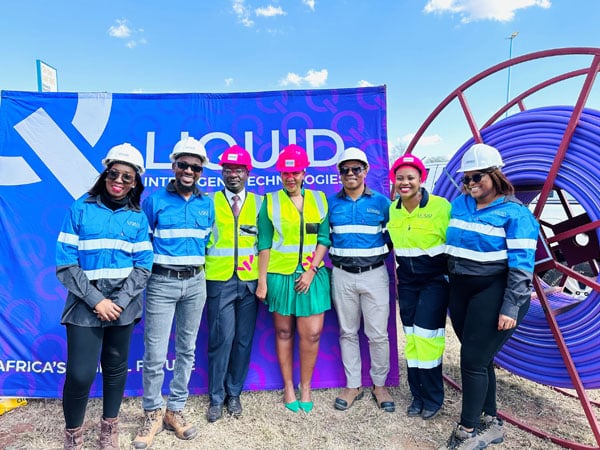
Liquid Intelligent Technologies launches the Gaborone Metro Ring

Liquid Intelligent Technologies has launched the Gaborone Metro Ring, a high-capacity, high-speed, and secure telecommunication network that will empower local businesses to deliver a huge boost to Botswana’s economic growth.

The Metro Ring is being rolled out in two phases and aims to benefit hundreds of businesses in its initial phase, with further connections planned for phase two. “The launch of the first phase will reduce tariffs for local and international data products, making it more accessible to small and medium businesses that have previously been disadvantaged as compared to the larger enterprises,” says Odirile Tamajobe, Managing Director of Liquid Intelligent Technologies Botswana.

Increased access to high-speed fibre connectivity is critical to improving telecommunication services for businesses and individuals, and will also bring about substantial social and economic benefits. By providing an extensive and efficient telecommunication network, this project plays a vital role in the growth and expansion plan of the region.

It will also generate employment opportunities and contribute to the overall development and expansion of the national economy. Specifically targeting high-density areas of Gaborone, this project is set to revolutionise telecommunications and support the surging demand for high-speed internet as an increasing number of local businesses continue their digital transformation journeys. 

“This project is a major milestone in Botswana realising its potential as one of Africa’s growing economic hubs. The completion of the first phase reinforces Liquid’s commitment to meeting the growing demand for connectivity and aligns with our vision of a digitally connected Botswana in which no one is left behind,” states Tamajobe.

The project also supports the government’s strategic plan, Botswana Vision 2036, to elevate the country’s economic status from upper-middle-income to high-income within the next 13 years. The Metro Ring represents a significant achievement in Gaborone’s telecommunications infrastructure, showcasing the successful collaboration between the public and private sectors to advance technology for the benefit of Botswana.

MORE ARTICLES YOU MAY BE INTERESTED IN…

Verizon strikes $2.1bn Managed Network Services deal with HCLTech


News

The partnership will see HCLTech become Verizon Business’s “primary Managed Network Services (MNS) collaborator”

This week, Verizon Business has announced a major partnership with Indian ICT firm HCLTech that onlookers suggest could be worth up to $2.1 billion.

The deal will combine Verizon’s networking power and solutions with HCLTech’s MNS capabilities, with HCLTech leading post-sale implementation and ongoing support for Verizon Business customers. This includes helping them incorporate new technologies like 5G, SD-WAN, and SASE into their own operations and consumer offerings.

“HCLTech is a widely recognized industry leader for Managed Network Services, and with their IT service expertise and ongoing support of our enterprise networking deployments, Verizon Business can modernize our service delivery and simultaneously heighten our focus on helping customers incorporate next-generation technology like 5G, SD-WAN and SASE into their operations and their own customer offerings,” said Kyle Malady, CEO of Verizon Business. “IT/OT convergence is the future of data-centric business operations, and with the fast-accelerating pace of digitalization, customers need a well-coordinated delivery framework to realize that future.”

As part of the deal, a number of Verizon’s Business Global Customer Operations will officially join HCLTech to oversee operations.

For Verizon, this deal is seen as a way to revitalise the sluggish results of its fixed line business, offering the company’s business customers a modernised, flexible, and ultimately more attractive delivery framework.

According to Verizon SVP Scott Lawrence, the deal will begin to “unlock value” as early as the end of this year, with grater integration expected from 2024 onwards.

Want to keep up to date with all of the latest developments in the US telecoms sector? Join the industry in discussion at Connected America 2024

Also in the news:
Polish operators line up for 5G spectrum auction
TDS considers ‘strategic alternatives’ for UScellular
O2 Slovakia and Slovak Telekom to share mobile networks 

Brazil to collaborate with Japan on open RAN

Keep up-to-date with all the latest news, articles, event and product updates posted on Developing Telecoms.
Subscribe to our FREE weekly email newsletters for the latest telecom info in developing and emerging markets globally.

Sending occasional e-mail from 3rd parties about industry white papers, online and live events relevant to subscribers helps us fund this website and free weekly newsletter. We never sell your personal data. Click here to view our privacy policy.

Cisco to buy-out Telenor from Working Group Two JV


News

Cisco is set to pay Telenor $150 million for its 44.6% in the business 

This week, Cisco has signed a $150 million deal to acquire Norwegian company Working Group Two (WG2) from Telenor Group.  

Core network software specialist WG2 was spun out as a separate entity from Telenor in 2017, with the Norwegian operator retaining a significant stake in the business. At the time, additional investors included telecoms equipment specialist Cisco and digital infrastructure investor Digital Alpha.  

Now, six years later, Telenor is selling its entire 44.6% stake in the business to Cisco, which will become WG2’s sole owner. 

WG2 is a cloud-native mobile service platform provider, which offers mobile operators a cloud-based core network to increase product innovation and reduce time to market through authentication, provisioning, voice, messaging, and data services. 

According to Cisco, the acquisition will help them further develop their recently announced Mobility Services Platform. The Platform combines 5G, edge, and cloud technologies to deliver an as-a-service option for service providers, to help them build and manage new Internet of Things (IoT) networks. 

“Built for simplicity, innovation, and efficiency, WG2’s platform uses the web-scale playbook and operating models, which makes it a natural fit with our Mobility Services Platform,” said Cisco Senior Vice president Masum Mir 

“And with WG2 and the Cisco Mobility Services Platform, we’ll be able to boost our service edge deployment and API first strategy for application development partners, enterprise customers and service provider partners.”  

The acquisition is subject to standard regulatory approval and is set to close in Cisco’s first fiscal quarter of 2024. 

Want to keep up to date with all the latest news from the international telecoms sector? Click here to receive Total Telecom’s daily newsletter direct to your inbox  

Also in the news:
Polish operators line up for 5G spectrum auction
TDS considers ‘strategic alternatives’ for UScellular
O2 Slovakia and Slovak Telekom to share mobile networks 

Poland’s ‘largest ever’ broadband subsidy draws 300 applications


News 

The government hopes to use a combination of public and private funding in order to shrink the nation’s digital divide 

According to a statement from the Polish Ministry of Digitalisation, 307 applications have been submitted for a portion of the PLN  9 billion ($2.22 billion) of funding available for national broadband projects.  

Of these, 64 are applications to cover 187 areas of Poland that the government has declared ‘white spots’ – areas that have no internet access at all. 

Alongside the EU-linked government funding, the private sector is expected to contribute at further PLN 750 million ($185.2 million) to fund the broadband projects. 

According to the Polish government, this will be on the country’s largest ever investment in broadband expansion.  

Poland launched the Operational Programme Digital Poland (POPC) in 2014, which carries out public broadband funding, and since then has covered more than 2 million households with broadband. In addition, over PLN 4 billion ($990 million) has been invested into broadband coverage for underserved communities. 

Poland’s national broadband plan, which was updated in 2020, aims to achieve broadband speeds of at least 100Mbps for everyone in the country, and at least 1Gbps for socio economic drivers such as schools and transport hubs. It also seeks to ensure 5G connectivity is available on all major communication routes and in major urban areas. 

In tandem with the POPC, the country has launched for the Nationwide Education Network, which aims at providing all schools in Poland (about 19,500 locations) with free internet with speeds of at least 100 Mbps. 

Want to keep up to date with all the latest news from the international telecoms sector? Click here to receive Total Telecom’s daily newsletter direct to your inbox  

Also in the news:
Polish operators line up for 5G spectrum auction
TDS considers ‘strategic alternatives’ for UScellular
O2 Slovakia and Slovak Telekom to share mobile networks 

Airtel Kenya earmarks US$150m to expand network

Keep up-to-date with all the latest news, articles, event and product updates posted on Developing Telecoms.
Subscribe to our FREE weekly email newsletters for the latest telecom info in developing and emerging markets globally.

Sending occasional e-mail from 3rd parties about industry white papers, online and live events relevant to subscribers helps us fund this website and free weekly newsletter. We never sell your personal data. Click here to view our privacy policy.