China smartphone market declines in Q3

Keep up-to-date with all the latest news, articles, event and product updates posted on Developing Telecoms.
Subscribe to our FREE weekly email newsletters for the latest telecom info in developing and emerging markets globally.

Sending occasional e-mail from 3rd parties about industry white papers, online and live events relevant to subscribers helps us fund this website and free weekly newsletter. We never sell your personal data. Click here to view our privacy policy.

Mobile taxes make news – again – in Zimbabwe and Nigeria

Two stories – from Zimbabwe and Nigeria – again illustrate the often complicated relationship between Africa’s mobile operators and its tax collectors.

In what might be good news for Zimbabwean operators – and customers – the Zimbabwean central bank has proposed removing a 2% tax on mobile money and digital transactions, saying it will boost electronic payments in the country.

Zimbabwe imposed the tax on mobile money, electronic, and bank transfer transactions in 2019.

However, as ITWeb Africa points out, the mobile money tax is proving a good source of income for the government at the moment, although operators may be heartened by the fact that not only the central bank but the Zimbabwe National Chamber of Commerce wants an end to the mobile money levy.

There’s less (potentially) positive news for pan-African operator the MTN Group, which has been ordered to pay US$72.6 million in back taxes for the period between 2007 and 2017, in Nigeria, its biggest market.

The order was issued this week by Nigeria’s Tax Appeal Tribunal in Lagos, and follows a long-running story that began in 2021 when the Federal Inland Revenue Service (FIRS) issued a VAT assessment of US$93.5 million to MTN Nigeria in July 2021, which included US$72.5 million in principal liability and US$21million in penalties and interest on the principal sum.

Following an MTN Nigeria objection a revised assessment was issued. A second objection followed and was refused in June 2022. Now, the Nigerian Tax Appeal Tribunal has ruled in favour of FIRS and ordered MTN to settle the assessed tax liabilities.

The MTN Group is reportedly currently considering its response.

MORE ARTICLES YOU MAY BE INTERESTED IN…

German regulator called upon to address fibre network overbuild woes


News

The Verband kommunaler Unternehmen (German Association of Local Public Utilities, VKU) said the regulator should force Deutsche Telekom to provide regular information about its fibre network expansion plans to prevent overbuild

This week, the head of the VKU, Ingbert Liebing, has called upon Klaus Müller, head of the Federal Network Agency (Bundesnetzagentur, BNetzA) “to intervene boldly now and oblige Telekom to provide regular information about its expansion plans in the next 12 months”.

The VKU holds that the opacity of Deutsche Telekom’s fibre rollout plans are having a negative impact on the nation’s fibre-to-the-home FTTH rollout, making it hard for rival operators to know where they can profitably invest.

“Hundreds of reports from overbuilding show that strategic overbuilding is by no means a niche phenomenon, but rather that strategic overbuilding, as practiced by Telekom, is slowing down the nationwide expansion of fibre optic networks throughout Germany,” said Liebing.

The VKU reports that 62% of its member companies have been overbuilt or changed plans due to the threat of being overbuilt; in the worst cases, rival operator’s network expansions have been cancelled entirely as a result of Deutsche Telekom’s overbuild plans.

BNetzA itself has reportedly received almost 300 complaints about overbuild since monitoring the situation at the beginning of July.

Deutsche Telekom, naturally, say they are simply competing fairly, as allowed by the current regulatory framework, arguing that they already face fierce competition in the fibre market.

Earlier this month, a WIK report on the matter commissioned by BNetzA found that, while some urban parts of the country could feasibly support the deployment of two or more adjacent networks, in suburban and rural areas overbuild would likely result in more costly and delayed rollouts.

“In order to expand a comprehensive fiber optic network and achieve the federal government’s expansion goals, clear regulatory steps are now urgently needed to counter the strategic structure of the dominant company,” said Jürgen Grützner, MD of the Association of Providers of Telecommunications and Value-Added Services (VATM), commenting on the report.

Is the German regulatory framework doing enough to accelerate the fibre rollout across the country? Join the operators in discussion at this year’s Connected Germany conference live in Munich

Also in the news:
The power of hybrid workforces: The imperative of cloud communications and a mobile-first approach
Shared Rural Network facing two-year delay
Ice Norway doubles down on Mavenir with cloud-native IMS deal

Huawei’s vision for the future: 5G and beyond

Huawei, a global leader in technology and telecommunications, is propelling the industry into a new era with the announcement of the world’s first comprehensive suite of solutions for 5.5G technology.

This comes at a time when the adoption and utilisation of 5G by businesses and consumers has surged and continues expanding into new experiences, new connections, and new applications, noted Cao Ming, President of Wireless Solution at Huawei, during an International Media Roundtable at the 14th Global Mobile Broadband Forum held in Dubai in October.

This 5.5G network boasts remarkable features, including a 10 Gbps downlink, 1 Gbps uplink, a huge capacity of 100 billion-level connections, and native intelligence. “Huawei is at the forefront of innovation to ensure the solutions help operators deliver full-scenario tenfold capabilities and enable ultra-high energy efficiency, spectrum utilization, and O&M efficiency » said Cao. Speaking to journalists from across the world, Cao stressed the potential of this technology and the change it can usher into our societies.

A Network Beyond Expectations

Telecommunications companies worldwide have been deploying 5G networks at an accelerated rate, far surpassing the pace of any previous generation of mobile communications technology. Over the past five years, approximately 260 commercial 5G networks have been deployed globally, and the global 5G user base has reached an impressive 1.5 billion individuals.

The most exciting aspect of 5G lies in its capabilities, explained Cao. “The network’s strength, being ten times more potent than its 4G predecessor, is driving remarkable advancements in high-definition videos and cloud gaming. The limitations experienced during video playback, gaming, and HD video calls on 4G networks are gradually becoming a thing of the past, thanks to 5G. This represents just the beginning of 5G adoption, » he replied to a question on how 5G will benefit the gaming industry.

Indeed, with the upgrade of experiences, connections, and services, it is the time for 5.5G – a network which features capabilities of 10 Gbps downlink, 1 Gbps uplink, 100 billion-level connections, and native intelligence.

To help operators build 5.5G networks efficiently and enable full-scenario ten-fold capabilities, Huawei is releasing the industry’s first 5.5G solutions. Five fundamental technological pillars support these enhancements, explained Cao:

  • Ultra-wideband: A capability to accommodate wide-range non-contiguous bands , reducing the need for deploying multiple pieces of equipment and thereby lowering deployment costs.
  • Multi-band: Huawei’s solutions offer the ability to support multiple bands using one box, drastically reducing deployment costs and antenna space, which translates to lower tower rental costs.
  • Multi-antenna technology: This technology significantly enhances spectral efficiency, leading to an improved user experience and reduced spectrum licensing costs for telcos.
  • Energy efficiency: Innovative solutions aimed at minimizing energy consumption during varying traffic loads, ensuring a greener and more sustainable network.
  • IntelligentRAN: Advanced, intelligent network management to reduce the complexity and costs associated with operations and maintenance, enhancing network efficiency and user experience.

These pillars of innovation collectively empower 5.5G networks to deliver on their promises, ensuring a future-ready, efficient, and user-centric network.

In the realm of cellular Internet of Things (IoT), two mainstream 5.5G IoT technologies, Red Cap and passive IoT, have gained traction, with module developers and chipset manufacturers actively rolling out their offerings.

Redefining User Experience

In the past, video-related services, including video calls and games, predominantly operated in 2D. However, with the advent of 5G, a shift towards 3D and extended reality (XR) services is becoming evident. “The rise of 3D services and applications will exert substantial demand on network capabilities”, noted Cao.

As 5.5G networks are set to bring robust capabilities, telcos and various businesses can broaden their scopes, providing an opportunity for content providers, device manufacturers, and chip makers to expand their business horizons and identify new revenue streams. The potential for growth and innovation in this domain is vast, explained Cao.

However, as 5G adoption continues at an unprecedented pace, concerns have arisen about the need to upgrade existing infrastructure. Cao stated that Huawei is committed to helping operators evolve their networks seamlessly to protect the investments of telcos.

Readiness of Countries

Talking about the future uses of 5.5G technology, Cao stressed that the technology is rapidly gaining momentum worldwide and is on the brink of accelerated commercialisation. « Several factors contribute to this large-scale commercialisation. Release 18, slated to be frozen next year, will mark the completion of the 5.5G specification, affirming the industry’s readiness for the imminent transition. Moreover, 5.5G chipsets and devices have already hit the market, exemplified by Qualcomm’s release of the 5G Advanced chipset with a 10 Gbps downlink capacity, » noted Cao.

Regarding spectrum readiness, 20 countries worldwide have already auctioned the millimeter wave, paving the way for substantial progress in 5.5G deployment. The sub-6 gigahertz band is scheduled for discussion and identification in November this year at the World Radiocommunication Conference (WRC 23) in Dubai.

Cao noted: « The Middle East is expected to maintain its leading position in the 5.5G era. There have been many collaborations and initiatives like the MoU and innovative projects between Huawei and leading operators in the Middle East for the past one year, showcasing the region’s commitment to embracing and leveraging the potential of 5.5G technology. »

On the digital divide across geographies, Huawei realises that the development of technology is uneven in different territories. While the first wave 5G markets – including the Middle East, Europe, China, and countries in the Asia Pacific – deployed 5G nearly five years ago, countries in Africa are not at the same pace. Some critical points along the deployment journey of 5G include ecosystem maturity and market development.

Cao added that Huawei has been collaborating in different regions and hopes that through the efforts, countries and regions can enjoy the convenience brought by 5G sooner.

Empowering Industries through 5.5G

One of the pivotal aspects of 5.5G’s evolution is its transformative impact on various industries. The business-to-business (B2B) capabilities of 5G networks have already been embraced on a massive scale in the 5G era. Cao shared a few examples from China where fully connected factories are leveraging 5G to drive digitalisation within their operations.

Industries like automobile manufacturing are primed for significant enhancements, Cao stated. 5G and 5.5G technologies offer the potential to revolutionise productivity and facilitate digital transformation within the industry. “Huawei envisions a future where ICT solutions will enable automakers to build better, smarter vehicles, ensuring a seamless integration of technology into the automobile sector, » Cao said.

Huawei’s foray into the realm of 5.5G technology represents a significant leap forward for the telecommunications industry. As 5G adoption accelerates and industries continue to embrace digital transformation, the advent of 5.5G promises an even more connected and technologically empowered future.


MORE ARTICLES YOU MAY BE INTERESTED IN…

Harnessing 5G, 5G-Advanced, and Indoor Digitalisation: Unleashing Innovation in the UAE and Beyond

In a world defined by rapid technological advancements, the convergence of 5G, cloud infrastructure and artificial intelligence (AI) is transforming the way we live and work.

Huawei’s 14th Global Mobile Broadband Forum (MBBF) 2023 in Dubai, UAE, provided some useful insights into the latest developments as industry leaders announced groundbreaking innovations and shared experiences from their respective industries and geographies.

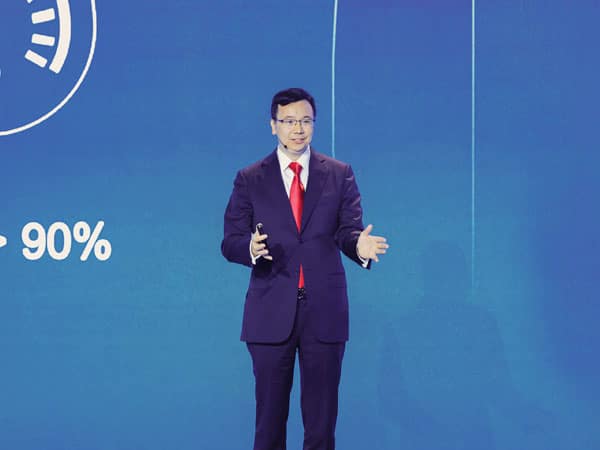
Heading up the programme, Yang Chaobin, Board Member and President of ICT Products & Solutions at Huawei, unveiled LampSite X, a next-generation 5G indoor digital product solution that promises to redefine the indoor digital experience.

LampSite X has been designed and configured by Huawei to help operators open up new business spaces and move towards greater digital intelligence. Yang announced that LampSite X brings unrivalled 5.5G capabilities indoors for the first time, thereby comprehensively upgrading indoor digitalisation.

With the explosive growth of mobile traffic, 80% of which is generated indoors, the need for advanced digital indoor capabilities is clearly strong. High-density indoor environments such as shopping malls, airports, railway stations and stadiums require a new paradigm. Huawei claims that LampSite X’s unique Distributed Massive MIMO technology enables a peak throughput of over 10 Gbps, offering not only unprecedented speeds but also the first-ever 5.5G 10 Gbps experience indoors. With the industry’s smallest and lightest design, paired with dynamic energy-saving capabilities, Huawei believes LampSite X is a game-changer in the world of indoor digitalisation.

The LampSite X series boasts a volume as small as 1L and weight of just 1kg, meaning it can be deployed with unparalleled flexibility in a wide range of settings. Yang stated: « This product is the only one in the industry to combine mmWave and sub-6 GHz, paving the way for ultra-high performance, diverse capabilities and minimal energy usage. »

“These capabilities extend to ultra-high uplink speeds, high-precision positioning down to sub-meter levels, low latency in milliseconds, and IoT integration. The unique ‘0 Bit 0 Watt’ solution ensures round-the-clock dynamic energy savings, maximizing efficiency.”

According to Yang, Huawei believes LampSite X will become a catalyst for digital transformation in both consumer and industry applications. In consumer scenarios (to-C) LampSite X enhances the end-user experience by increasing traffic and creating new business opportunities for operators. Giving an example from Hong Kong, Yang said: “In the 10 Gbps business districts, LampSite X has driven a 20 percent increase in traffic, leading to new and innovative business models.”

In business scenarios (to-B), Yang claimed the product’s multi-dimensional digital indoor capabilities are transforming smart factories, increasing efficiency and dramatically reducing production times.

Cao Ming, President of Wireless Solutions at Huawei, launched the industry’s first full-series solutions for 5.5G. “5.5G is well-timed to support new experiences, connections and services,” said Cao, highlighting that “Huawei’s full-series 5.5G solutions will help operators deliver full-scenario tenfold capabilities and enable ultra-high energy efficiency, spectrum utilisation and O&M efficiency.”

“5.5G has arrived just in time to upgrade the connections of people, homes, things, vehicles and industries. Huawei’s full-series 5.5G solutions can help operators efficiently build 5.5G networks thanks to continuous innovations across five categories of basic capabilities: broadband, multi-band, multi-antenna, intelligent and green,” Cao concluded.

From the operator viewpoint, Khalid Murshed, Chief Technology and Information Officer at Etisalat by e&, shed light on the UAE telecom landscape. He highlighted how the operator has embraced 5G, cloud infrastructure and AI integration, and positioned itself as a global leader in broadband technology.

Bocar Ba, CEO and Board Member of SAMENA Telecommunications Council, highlighted the crucial role of 5G in driving digital transformation across the Middle East, particularly in the Gulf Cooperation Council (GCC). He recognised the collaborative efforts of regional governments, technology players and operators in advancing 5G development.

“Digital transformation in the Middle East is multifaceted. In the oil and gas industry, IoT devices, sensor systems, AR, VR, robotics control and automated guided vehicles are being deployed, reshaping the sector” observed Ba.

The education sector, too, is experiencing a technological revolution, alongside smart manufacturing, agriculture, smart buildings and mobility. Bocar stressed that the technological changes are having a positive impact on job creation, productivity and well-being across the GCC.

“The next phase of 5G, referred to as 5G Advanced, is on the horizon” said Bocar. “It promises to offer new opportunities, including enhanced user experiences, extended reality, real-time industrial automation and financial transactions.”

He highlighted the need for additional investment if the massive connectivity goals of 5G and 5G Advanced are to be fully realised across the GCC.

Regulatory agility is another critical aspect of driving 5G advancement, according to Bocar. “The agile regulatory approach is essential for addressing IoT standardisation and emerging challenges.”

The convergence of 5G, cloud infrastructure, and AI is ushering in a new era of digitalisation, both in the UAE and beyond.

MORE ARTICLES YOU MAY BE INTERESTED IN…

5G 3300-3600MHz spectrum nets Argentina over US$875 million

Keep up-to-date with all the latest news, articles, event and product updates posted on Developing Telecoms.
Subscribe to our FREE weekly email newsletters for the latest telecom info in developing and emerging markets globally.

Sending occasional e-mail from 3rd parties about industry white papers, online and live events relevant to subscribers helps us fund this website and free weekly newsletter. We never sell your personal data. Click here to view our privacy policy.