Unlock the Power of KVMs as VPS Engines with SERVERware 4.5

Are you a UC provider seeking an alternative to traditional LXCs (Linux Containers)? 

Look no further, because SERVERware 4.5 has introduced a game-changing feature that allows Kernel-based Virtual Machines (KVMs) to serve as versatile VPS engines, revolutionizing your virtualization experience.

SEE WHAT ELSE IS NEW IN SERVERware 4.5

Performance Meets Security

KVM VPSs may offer slightly different performance levels compared to LXC-hosted ones, but what sets them apart is their superior security options.

While LXC relies on shared resources and potentially exposes your clients to security risks, KVM ensures that each VPS operates in its fully virtualized environment. This is a superior approach to partitioning resources and safeguarding your clients’ data. 

In today’s security-conscious business landscape, this is a game-changer. Your clients’ data and operations remain protected by high-level safeguards, offering you the peace of mind and confidence you need to excel in the UC provider arena.

Empower Your Clients with Efficiency

With KVM hosted VPSs, your clients can still enjoy all the core functionalities they’re accustomed to. From easy replication and seamless backups to flexible removal options, managing VPSs is highly efficient. 

SERVERware 4.5 ensures that your clients have the tools they need to succeed, making you their go-to provider.

Demystifying KVM – Your Competitive Edge
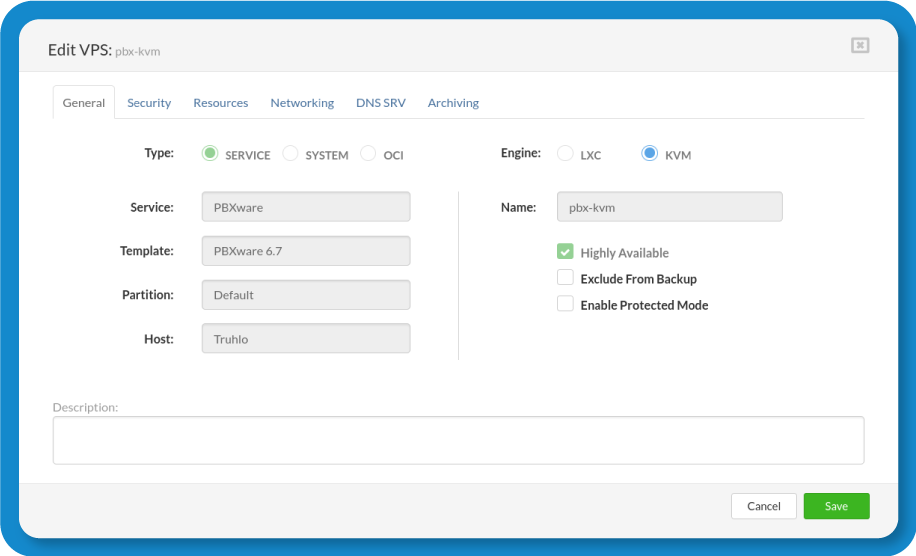
KVM, short for Kernel-based Virtual Machine, is aimed to be an integral part of SERVERware’s diverse technology.

It’s based on Firecracker, an open-source virtualization technology designed explicitly for creating and managing secure, multi-tenant container services. This technology provides better isolation, enhanced security, and a competitive edge for your business.

The Power of Open Standards

SERVERware’s implementation of KVM allows you to run unmodified Linux containers as VPSs, including popular options like PBXware and Docker containers fetched as OCI images from Docker Hub and similar sources. 

Plus, you have the freedom to pack and distribute service software using open standards and tools, empowering your business like never before.

Better Isolation, Less Exposure

With KVM, each VPS becomes a fully emulated or virtualized machine, offering better isolation and reduced exposure to malicious software or user behavior. 

VPSs using KVM as their engine can now safely change engines from LXC to KVM, be replicated, taken over, backed up, restored, moved between hosts, or change partitions. KVM VPSs even provide call stats and secure web browser access through the TTY terminal.

Expanding Horizons with Virtual Networks
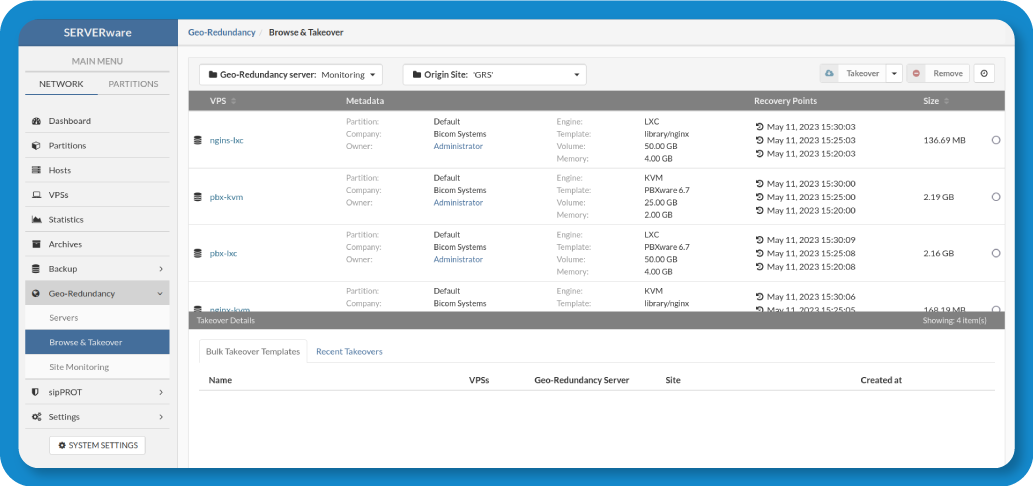
SERVERware doesn’t stop at security and performance. We’ve added support for virtual networks for KVM VPSs, enhancing connectivity options for your clients. 

Moreover, KVM VPSs can now fetch PBXware licenses, just like their LXC counterparts. In short, all the functionalities available for VPSs running on LXC engines are seamlessly accessible with KVM engines as well.

Leveraging OCI for Endless Possibilities

The Open Container Initiative (OCI) opens the doors to a world of possibilities. It’s an open format for distributing and running software services, enabling your clients to host a richer range of ready-to-run services on SERVERware. 

Whether it’s web servers, databases, or VOIP services like PBXware, OCI empowers you to expand your service offerings and support your operations more efficiently.

Streamlined Service Delivery

The ability to switch to KVM virtualization per VPS offers enhanced security and isolation for applications, making it perfect for security-focused businesses. 

By providing a secure hosting environment and isolating applications, potential security vulnerabilities can be prevented from spreading. This enables you to cater to a broader range of clients and their unique security needs.

Hybrid Cloud Solutions

Enterprises can leverage SERVERware’s infrastructure features to create hybrid cloud solutions that can run both containerized and non-containerized workloads. 

This flexibility allows for more efficient resource utilization and cost savings, making SERVERware a versatile choice for businesses of all sizes.

Unleash the Potential

In summary, SERVERware 4.5’s KVM as VPS Engines feature is your ticket to unleashing your UC provider potential. 

With enhanced security, seamless functionality, and endless possibilities, you can attract a broader client base and grow your UC provider business like never before.

Get in touch to find out more about KVM and everything that SERVERware 4.5 brings to you.

CONTACT US

Neos Networks adds data centres in London and Manchester


Press Release

Neos Networks, one of the UK’s leading connectivity providers, today announced that it has added two new key UK data centres to its UK-wide fibre network, as it fast approaches reaching 100 on-net data centres. This proactive investment in the expansion of its data centre estate sees Neos connect two highly significant sites in London and Manchester, enabling more businesses to take advantage of its high capacity infrastructure.

The first site connected and now live is the Equinix MA5 data centre in Manchester which makes Neos one of the first to offer services out of that location. The second site, Telehouse South (THS), located in London Docklands and now the largest facility offered by Telehouse will come on-net in the coming months. Both data centres will be diversely connected with fibre and 100Gbps enabled, providing UK businesses with secure, reliable, high capacity connectivity services that meet their business needs.

Equinix MA5 opened in the spring of last year and occupies a key strategic location in Greater Manchester that acts as the gateway to the North. It joins 11 other Equinix data centres that Neos has on-net across its UK estate, as well as nine other sites across Manchester. MA5 boasts the highest level of security offering in the world, and it will be highly influential in the continued development of Manchester’s fast-growing technology scene. The attractive new interconnection hub also offers remote geo-redundancy for the UK’s capital.

THS is also expected to see huge demand for connectivity due to its location and support for one of the most critical interconnection points in the UK. It is in close proximity with Telehouse North and Telehouse North Two, where Neos experiences some of its highest demand for connectivity services.

“We continue to invest in our data centre offering, expanding the reach of our network to bring critical, core connectivity to more UK businesses. And these two new locations will be highly significant in complementing the growth of the UK’s two biggest cities,” said Matt Rees, Chief Technology Officer, Neos Networks.

“We see huge demand for high capacity services from the Telehouse sites that we’ve brought on-net to date, providing reliable, resilient and secure connectivity to help power the UK’s financial services industry in London’s Canary Wharf. And with Manchester at the heart of the UK’s digital tech scene, ensuring the availability of scalable, reliable connectivity is essential for digital services innovation and establishing the UK’s technology leadership. We know just how important the right connectivity solutions are to fostering environments where UK businesses can thrive.”

Services at these new locations will be available via the company’s LIVEQUOTE portal which provides prospective and existing customers with a quoting, ordering and price comparison service matching its own network against leading third-party offerings. Neos also provides its services to businesses directly or through its network of resellers and partners.

How is the UK’s connectivity landscape evolving in 2023? Join the industry in discussion at Connected North 2024

Also in the news:
Reflections on the Connected Britain Awards 2023
Ericsson to sue Lenovo in ongoing 5G patent battle
KKR makes a binding offer on TIM’s fixed network 

Senegal’s first satellite launch planned for this year

According to a number of press reports, Senegal is now preparing for the launch of its first satellite, initially scheduled for 2021 and postponed to 2023 due to the Covid-19 pandemic.

The Ecofin news agency says that late last week the country’s Ministry of Higher Education, Research, and Innovation (MESRI) announced that the satellite would be delivered on 10 November. The launch date will then be announced by the government.

The construction of this satellite, which will be called GAINDESAT, results from a partnership agreement signed with the Centre Spatial Universitaire de Montpellier (CSUM).

CSUM is a leading European centre dedicated to bringing together resources and skills in the engineering, production, operation, testing and application of nanosatellites. It offered its assistance to the Senegalese engineers and technicians who built GAINDESAT.

This initiative is part of the implementation of Senegal’s national space programme called SENSAT, which aims to aid the country’s socio-economic development through the design and operation of space tools.

SENSAT and CSUM will partner with the digital platform RIDE!space to integrate the satellite into Vigoride, an orbital transfer vehicle (OTV) supplied by Momentus, a company that offers space infrastructure and transportation services.

Last May the Senegalese government announced that it was finalising the construction of a space control centre in partnership with France’s Centre national d’études spatiales and aerospace company ArianeGroup. The centre will be used to prepare the satellite for launch.

With the help of GAINDESAT Senegal aims to enhance its ability to address critical challenges such as disaster management and agricultural productivity by harnessing the potential of satellite technology and artificial intelligence.

MORE ARTICLES YOU MAY BE INTERESTED IN…

Airtel Uganda delays close of IPO

Keep up-to-date with all the latest news, articles, event and product updates posted on Developing Telecoms.
Subscribe to our FREE weekly email newsletters for the latest telecom info in developing and emerging markets globally.

Sending occasional e-mail from 3rd parties about industry white papers, online and live events relevant to subscribers helps us fund this website and free weekly newsletter. We never sell your personal data. Click here to view our privacy policy.

BT sews together multiple cloud providers with ‘Global Fabric’ offering


Press Release

BT today announced a brand-new international network, enabling business customers to innovate at pace. The new network connects the multiple clouds businesses use for their applications and data with users, such as customers and employees, and will allow them to take advantage of the new wave of digital automation and AI.

Global Fabric, as the new network will be known, represents a generational shift in technology, based on a network-as-a-service (NaaS) technical and commercial model. Like the cloud itself, it is designed to be flexible, scalable and resilient both in the quality of connectivity and the convenience of pay-as-you-use. By combining the power of cloud and networks, customers can optimise application performance, user experience and cost.

They will be able to choose the right type of connectivity for their applications and workloads and proactively manage the routes these take as they move across the network. With this control, customers can achieve the best applications performance, manage costs and address growing regulatory requirements for data in transit.

The new high-capacity, fully programmable network is built with state-of-the-art equipment offering improvements in efficiency, sustainability and resilience. BT estimates that when fully rolled out, Global Fabric will use 79 per cent less electricity than its current global networks (see Notes to editors). This means customers on the new network will be able to reduce their Scope 3 carbon emissions.

Its digital orchestration and e-commerce-like interface enable customers to “shop” for connectivity. It will be pre-integrated with more than 630 digital service providers and over 700 datacentres. This covers the world’s largest public cloud providers, private clouds, network, software-as-a-service (SaaS), and secure access service edge (SASE) solutions — all available at the click of a button.

Jan Hein Bakkers, Senior Research Director, IDC, said: “Organisations realise that the network is a critical foundation for their digital-first and cloud-centric strategies. With the launch of Global Fabric, BT addresses their need to transform their networks. IDC research shows that organisations should adopt a secure and sustainable platform that provides the flexibility, manageability, scalability, and cost effectiveness that can support the right end-user experience for each application. Communications service providers that can deliver performant connectivity solutions with these attributes will be well placed to succeed.”

Chris Sharp, Chief Technology Officer, Digital Realty, said: “Global Fabric is a great example of how service providers should be innovating and will offer enterprises new options for connecting to Digital Realty, the world’s largest data centre platform. By building a cloud-centric network and locating its PoPs inside our world-leading carrier neutral facilities (CNFs), BT will be able to offer its customers terrific speeds with low latency while helping them minimise their environmental impact.”

Brenden Rawle, Senior Director Business Development EMEA at Equinix said: “We welcome BT’s launch of Global Fabric, which builds on its Connected Cloud Edge solution launched with Equinix last year. We enjoy a great partnership with BT and look forward to working together to connect customers to the doorstep of the cloud with a vast and varied choice of potential partners and other SaaS providers, in the Equinix location of their choice.”

Bas Burger, CEO, Business, BT, said: “Global Fabric will future proof customers’ connectivity by providing flexibility to ensure they’re always connected so they can always be productive. They’re facing a new wave of digital revolution with AI, IoT and automation driving demand for simplicity and better multi-cloud connectivity. Customers can achieve better total costs, boost app performance and user experience, all while complying with regulations and mitigating cyber threats. Global Fabric means multi-cloud works better on BT.”

Also in the news:
Reflections on the Connected Britain Awards 2023
Ericsson to sue Lenovo in ongoing 5G patent battle
KKR makes a binding offer on TIM’s fixed network 

Ericsson to sue Lenovo in ongoing 5G patent battle


News

According to Ericsson, Lenovo has refused to negotiate a suitable licensing agreement for over a decade 

Ericsson has filed a lawsuit against Lenovo and its mobile phone subsidiary Motorola, accusing it of a potential infringement of its 5G patent portfolio in 11 areas. 

Ericsson claims that two companies have not been able to agree on the terms of various licenses for over a decade, yet Lenovo continues to use its technology. Therefore, Ericsson has concluded that both Lenovo and Motorola Mobility are in breach of patent law. 

The Swedish telecoms equipment specialist said it first contacted Lenovo back in 2008, notifying the company that some of its products – which today includes mobile phones, tables, laptops and personal computers – were using Ericsson’s 2G and 3G intellectual property (IP).  

Ericsson reportedly offered Lenovo a cross-licencing agreement to settle the matter in 2010, which would see both parties grant licences for each other’s IP and Lenovo paying a net sum to Ericsson for both current and historical usage of these patents.  

Lenovo, however, asked that past royalty fees owed to Ericsson be waived for the unlicenced products already sold by Lenovo – terms which were not agreeable to Ericsson, leaving the two at legal loggerheads ever since. 

“Ericsson’s annual investments in R&D of around $4 billion have led to our leading global position in 5G and a leading 5G patent portfolio. The possibility for fair compensation through patent licensing is important to ensure new investments in innovation that benefit our customers and consumers everywhere,” said Ericsson in a statement.  

Patent licencing is a major money maker for Ericsson and lawsuits of this kind are, as a result, far from uncommon. 

At the end of last year, Ericsson announced that it has ended its long-running 5G patent battle with Apple, with experts estimating that the news will result in Apple having to pay Ericsson around $100 million per quarter. This has helped Ericsson to record a huge increase in patent licensing revenues, which totalled $289 million in this second quarter of this year compared to $132 million this time last year. 

Want to keep up to date with all of the latest international telecoms news? Sign up for Total Telecom’s daily newsletter 

Also in the news:
Revolutionizing industries: The impact of intelligent transformation
SES choose T-Systems head as new CEO
“Optimising for flexibility”: Ciena talks network design at Connected Britain 

Kazakhstan and Starlink partner to connect rural schools

Keep up-to-date with all the latest news, articles, event and product updates posted on Developing Telecoms.
Subscribe to our FREE weekly email newsletters for the latest telecom info in developing and emerging markets globally.

Sending occasional e-mail from 3rd parties about industry white papers, online and live events relevant to subscribers helps us fund this website and free weekly newsletter. We never sell your personal data. Click here to view our privacy policy.