“Optimising for flexibility”: Ciena talks network design at Connected Britain


Interview

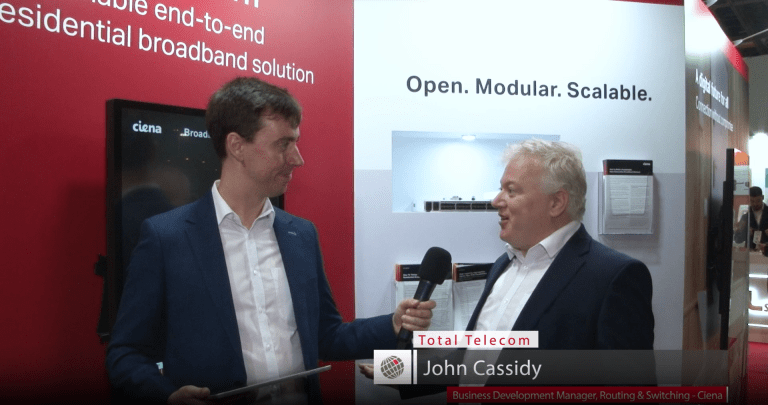
At Connected Britain 2023, we caught up with John Cassidy, Business Development Manager at Ciena to discuss the company’s recent acquisitions and its focus on creating flexibility for its customers

The past year has seen Ciena move in a new and interesting direction, with recent acquisitions making their residential fibre-to-the-home offerings more holistic than ever before.

“We’ve done a series of acquisitions over the past year. We acquired Benu, which is our virtualised BNG solution, and we’ve also acquired Tibit, which is our micro-OLT solution – it’s an OLT on a plug,” explained Cassidy. “We’re trying to show that when you combine these with our routing platform, which has been established for around 12 years, you have a whole end-to-end solution to offer our customers.”

“We’re trying to compress the business cases so you can get to places you couldn’t get to before,” he explained. “For example, in rural areas, the fact that you’ve got a one box solution to get to your customers really tightens the cost base. That’s a key advantage and brings a lot of flexibility.”

You can watch the full Connected Britain interview from the link below

[embedded content]

Also in the news:
VEON closes the door on Russia
Telefonica considers stake sale of Telefonica Tech
FCC fines DISH $150,000 after failure to decommission satellite as planned


Leaked docs show T-Mobile planning to migrate customers to more expensive tariffs


News

Customers will be automatically upgraded to a potentially more expensive tariff unless they opt out

This week, rumours have been confirmed that T-Mobile is seeking to shift some of its mobile subscribers onto new plans in November.

This is not simply a case of sunsetting older mobile contracts, but rather a wider migration across a large portion of T-Mobile’s subscriber base, moving many customers to newer – and often more expensive – mobile plans.

According to leaked documentation posted on Reddit, customers on selected plans will be migrated as follows:

  • Magenta (will be switched to Go5G)
  • One (will be switched to Go5G)
  • Simple Choice / Select Choice (will be switched to Magenta or Essentials Select)
  • Simple Choice Business (will be switched to Business Unlimited Advanced)

While for some customers this shift will not result in an increase of cost, others will likely see their subscription rise in price by between $5 and $10 per month.

The changes are expected to take effect in November, with customers informed of the change via SMS and email from October 17.

Those wishing to opt out will need to do so by contacting support services after receiving this notification.

The timing of this shift by T-Mobile is no coincidence. Back in 2020, as part of the agreement to acquire rival operator Sprint, T-Mobile promised that it would continue to offer “the same or better rate plans” for at least three years. Now, three years on, it seems the operator has little qualms about making changes that will drive up prices for their customers.

The operator will surely argue that these newer plans come with benefits that are more than worth the extra expense, but this seems unlikely to placate disgruntled customers paying for additional features that they never asked for.

How is the US mobile market evolving? Join the industry in discussion at Connected America 2024 live in Dallas, Texas

Also in the news:
VEON closes the door on Russia
Telefonica considers stake sale of Telefonica Tech
FCC fines DISH $150,000 after failure to decommission satellite as planned
Mitigating climate risks through automated network design


VIEWPOINT

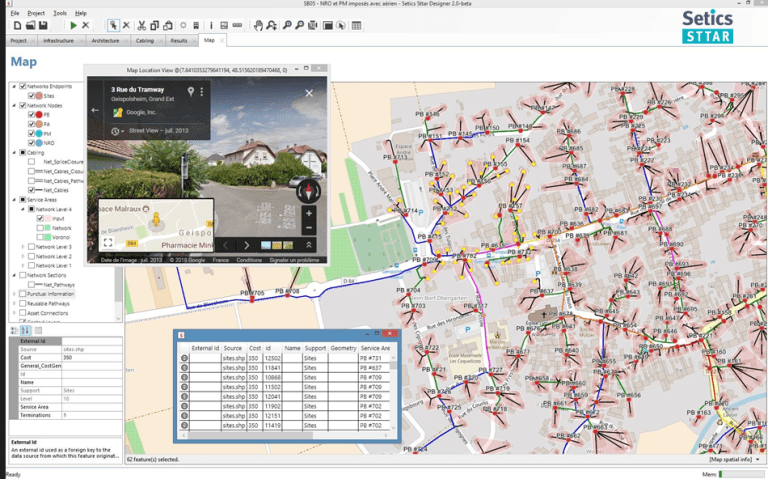
There is no secret, climate change has become a worldwide threat. Parts of the infrastructure that forms the backbone of the Internet, from fiber optic cables to colocation facilities, is at risk of being flooded and knocked offline during the next few decades as a result of it.

Our experience, specifically in Saint-Martin island clearly stresses the need to carefully plan cable routes and landing station locations factoring in a range of local hazards and how those are affected by climate change.

In fact, following hurricane Irma in September 2017, the entire island’s infrastructure was devastated, and Setics Sttar was called to action during the reconstruction phase.

The new infrastructure took into consideration these multi-factorial risks and aerial polls were replaced with underground infrastructure where appropriate.

Setics Sttar has helped engineers in over 30 countries to configure climate risks into the automated network design and assess the cost of such projects.

To learn more, please watch the below video.

 [embedded content]

Factor Climate Risk in your FTTH Network Design – Request a Demo Now

Paratus enhances cross-border connectivity for Mozambique

Keep up-to-date with all the latest news, articles, event and product updates posted on Developing Telecoms.
Subscribe to our FREE weekly email newsletters for the latest telecom info in developing and emerging markets globally.

Sending occasional e-mail from 3rd parties about industry white papers, online and live events relevant to subscribers helps us fund this website and free weekly newsletter. We never sell your personal data. Click here to view our privacy policy.

MTN South Sudan taps Tecnotree for digital transformation

Keep up-to-date with all the latest news, articles, event and product updates posted on Developing Telecoms.
Subscribe to our FREE weekly email newsletters for the latest telecom info in developing and emerging markets globally.

Sending occasional e-mail from 3rd parties about industry white papers, online and live events relevant to subscribers helps us fund this website and free weekly newsletter. We never sell your personal data. Click here to view our privacy policy.

10 Gbps City – Enabling New Growth for the Digital Economy

At Ultra-Broadband Forum 2023 (UBBF 2023), which kicked off on 12th October in Dubai, the 10 Gbps City Initiative was launched jointly by the UAE Telecommunications and Digital Government Regulatory Authority (TDRA), Omdia, etisalat by e&, MTN South Africa, Huawei, and others.

This initiative calls for the construction of fully connected 10 Gbps cities to provide ubiquitous network experience, accelerate the digital-intelligent transformation of industries, and boost digital productivity.

During a keynote speech, speakers shared the advanced concepts involved in implementing the 10 Gbps City. Eng. Saif Bin Ghelaita, Executive Director for Technology Development Affairs of the TDRA, pointed out that governments should play a leading role in the construction of ultra-broadband infrastructure to ensure inclusive and universal digital services and bridge digital divides in the intelligent world. Local governments and regulators can accelerate the formulation of supportive policies for 10 Gbps City pilots.

Richard Mahony, Vice President of Omdia, noted that the 10 Gbps City is a new type of infrastructure critical to implementing national digital strategies and boosting the digital economy. The construction of 10 Gbps cities involves delivering 10 Gbps to individuals, homes, enterprises, and campuses. It also involves 400GE/800GE converged transport networks and AI DCNs related to the preceding four 10 Gbps access scenarios.

Many cities around the world have released their 2030-oriented digital economy strategies. Cities such as Beijing, Shanghai, Hangzhou, and Riyadh are actively exploring ways to implement 10 Gbps City and 10 Gbps Society to unleash the new momentum of the digital economy.

MORE ARTICLES YOU MAY BE INTERESTED IN…

HOW CAN COMPANIES OPERATING IN THE MOBILE ECOSYSTEM BE MORE SUSTAINABLE?

This Industry Viewpoint was authored by Gerrit Jan Konijnenberg, Mobile Ecosystem Forum (MEF)

Over the next ten years, we must dramatically reduce carbon dioxide (or equivalent gases – collectively known as CO2e) levels or we will be unable to keep global temperatures from rising above 1.5 degrees Celsius compared to pre-Industrial levels. Passing that tipping point will make it incredibly difficult to bring climate change under control. … [visit site to read more]

Axian Telecom raises stake in Free Senegal to 80%

Keep up-to-date with all the latest news, articles, event and product updates posted on Developing Telecoms.
Subscribe to our FREE weekly email newsletters for the latest telecom info in developing and emerging markets globally.

Sending occasional e-mail from 3rd parties about industry white papers, online and live events relevant to subscribers helps us fund this website and free weekly newsletter. We never sell your personal data. Click here to view our privacy policy.

BT connects the skies with UK’s first Drone SIM


Press Release

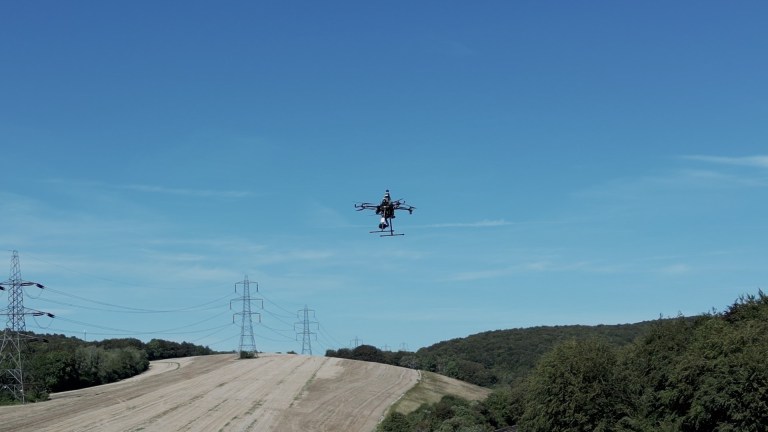
BT today announces the launch of the UK’s first Drone SIM to unlock the true potential of beyond visual line of sight (BVLOs) drone operation across the UK.

Designed to function at altitude using the EE network, Drone SIM offers unlimited data plans and continuous connectivity in the sky. Drone SIM is built to endure vibration, temperature and humidity extremes, supporting all-season drone use. BT business customers will be the first to benefit from the Drone SIM which has the potential to transform industries, from urgent delivery of medical supplies to infrastructure monitoring and transportation of goods.

Using BT Group’s EE network, Drone SIM benefits from high priority and ultra responsive connectivity, enabling safety, control, telemetry and realising ultra-high definition (UHD) video streaming at altitude. This enables drone users to capture detailed, survey quality imagery and video for a wide range of purposes, from search and rescue to infrastructure inspection.

Drone SIM is pushing the limits of drone flight. With the largest geographic coverage in the UK, uncrewed aerial vehicles (UAVs) can now fly significant distances at their full capability whilst remaining in constant communication with their remote pilots and safety systems; a dramatic shift from a world where they were limited by line-of-sight radio transmission or local Wi-Fi. This innovation presents a key opportunity across industry, from urgent delivery of medical supplies to infrastructure monitoring and transportation of goods.

Etc., the Digital start-up and incubation arm of BT Group, has demonstrated its role in innovating the drone industry through historic relationships, such as its £5 million deal with Altitude Angel to help build the UK’s first drone superhighway. The launch of Drone SIM follows a series of successful trials and development by the Etc. team. Trials include critical infrastructure inspection with drone technology provider sees.ai, plus the ability to test BVLOS mission safety standards in an integrated airspace with turnkey Uncrewed Aerial System providers Skylift. Drone SIM has also powered a UK-first drone medical delivery trial with aerial logistics specialist Skyfarer.

Dave Pankhurst, Director of Drones, BT, said, “Following the successful trials of our Drone SIM over the past year, this announcement is a huge stepping stone in bringing drone connectivity to businesses across the UK, unlocking potential for more efficient processes, business transformation and, with the ability to power search and rescue missions and medical deliveries, helping to save lives.”

Eduardo Aldaz-Carroll, Chief Technology Officer, sees.ai, states “It’s vitally important to inspect our critical national energy infrastructure. Drones offer significant benefits by increasing the speed, efficiency and consistency of data capture so we can predict the future state of the asset with reduced risk and environmental impact. It’s great to be working with BT Group to develop the technologies required to roll out BVLOS drone inspection and monitoring at scale.”

Nick Ruggles, Chief Technology Officer, Skylift states, “BT‘s Telecoms Grade C2 links have halved our deployment setup times. With recurring costs at just 14% of other systems and virtually zero infrastructure expenses, this is a game changer for us”.

Georgia Hanrahan, Chief Operations Officer at Skyfarer commented, “With the Drone SIM powering BVLOS flight, we can take a 20 minute flight between two hospitals and reduce this to a more direct 8 minute flight. Perfect for time-sensitive deliveries. We estimate a wider scale roll out nationwide could reduce our delivery time by 60% compared to road transport”.

Drone SIM is available today via www.bt.com/drones

What role will mobile connectivity play in unlocking the potential of the drone industry? Join the discussion at this year’s Total Telecom Congress live from Amsterdam

Also in the news:
VEON closes the door on Russia
Telefonica considers stake sale of Telefonica Tech
FCC fines DISH $150,000 after failure to decommission satellite as planned