

HYLAN now has new majority ownership, although it’s hardly ‘new’. CEO and Chairman Robert DiLeo and President and Vice Chairman John DiLeo Jr. have announced the acquisition of a bigger stake in the turnkey engineering and construction company. … [visit site to read more]
12
Avr, 2024
Introducing 4.6: Making The Ideal Set Of Tools Even Better
One of our goals when designing features for our products at Bicom Systems is to ensure they are what our clients ultimately want, and we make sure that remains the case.
4.6 emphasizes this as we have gone back and improved or outright overhauled several long-standing features in order to bring them up to modern standards.
Additionally, we have introduced several new quality-of-life features to enhance the overall client experience with both SERVERware and sipPROT.
Here is what we have in store for you this time around.
sipPROT
Bicom Systems’ beloved SIP attack protection module has received an overhaul to a majority of its features, making them more intuitive, be it visually or mechanically, as well as a number of new features aimed at enhancing its functionality.
The sipPROT Dashboard Reimagined
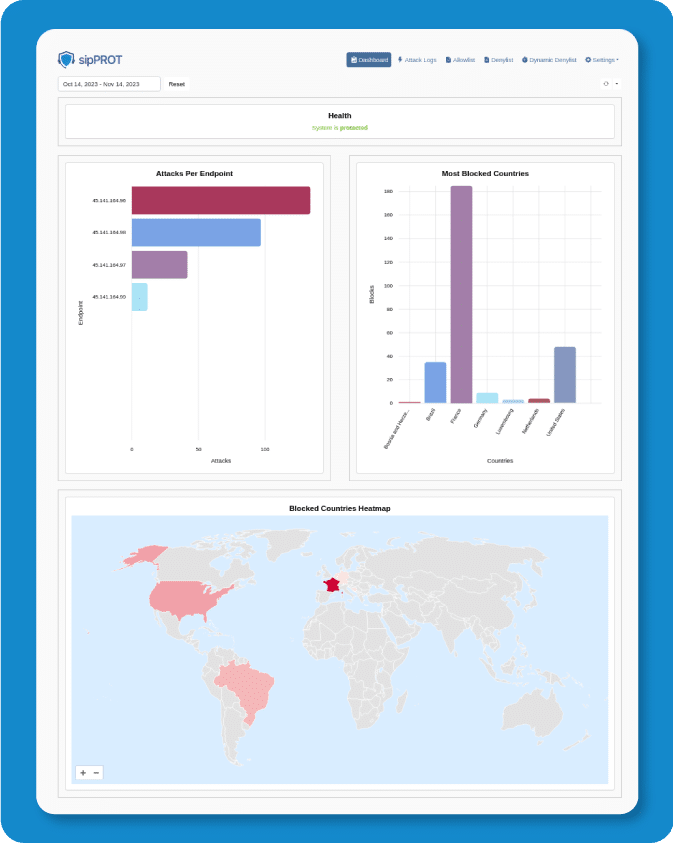
The first, and much needed feature that was added to sipPROT’s arsenal is the dashboard, allowing users to have all of the important operational data displayed in one location from firewall status to graphs showcasing the number of attacks per endpoint and the spread of blocked IPs per country with the corresponding world map visual distribution.
Attack Logs
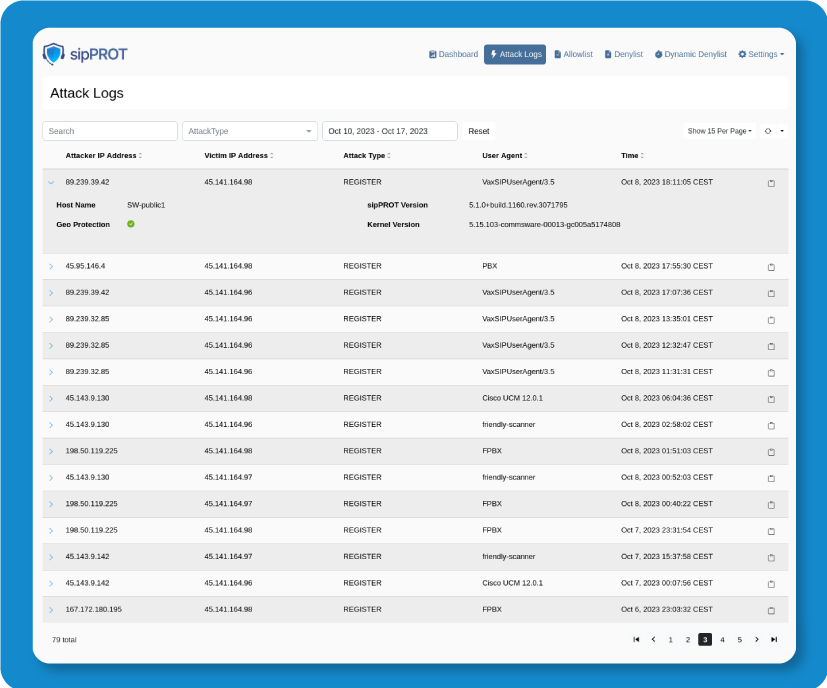
The “Attack Logs” tab serves as the main risk coordination tool for admins, displaying the SIP attack log on the current system with each individual instance being populated with the relevant information: the attacker’s and victim’s IP addresses, the type and time of attack, and the User Agent with more information available when the dropdown arrow found next to each log is clicked on.
This simplified layout helps provide more intuitive insight into overall system security and should help improve attack pattern recognition.
This should also affect both response time and deployed safety measure quality, helping attack instances get resolved at a much quicker pace.
Dynamic Denylist Improvements
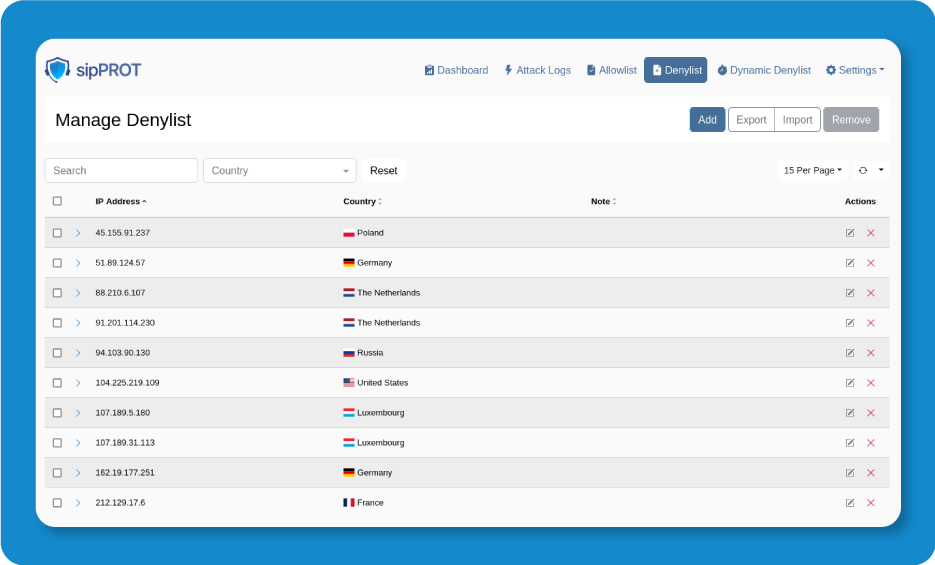
While the “Allowlist” and “Denylist” tabs remain largely unchanged, the “Dynamic Denylist” tab has seen some further refinement in reducing tedious manual input across all hosts when an address gets dynamically blocked by having that process automated by the system, in essence, having all hosts share a singular dynamic denylist.
Additionally, it too now shows the User Agent tied to the blocked address’ device.
The New Settings Menu
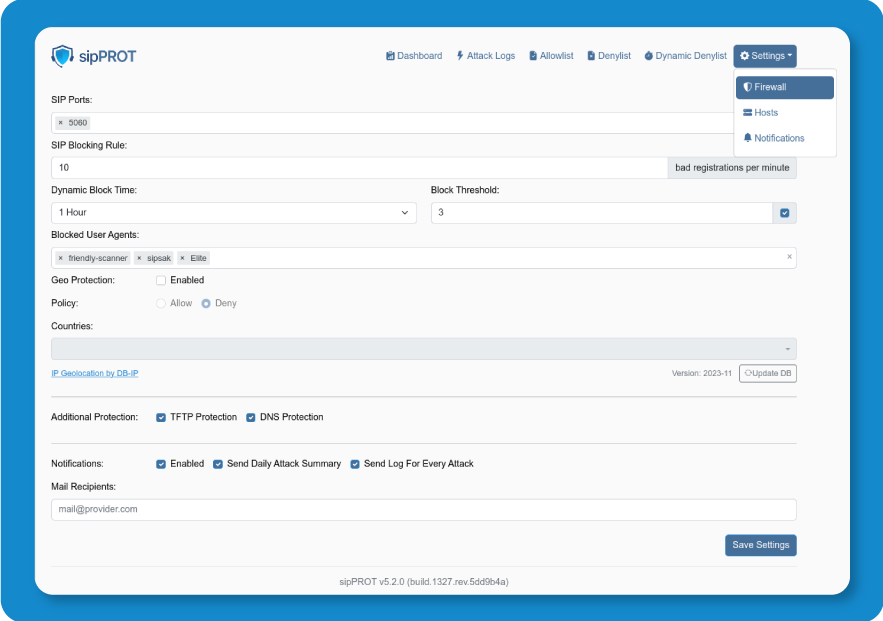
The settings menu has been split across three different segments:
– The General Settings menu under the “Firewall” segment
– The “Hosts” segment
– And The “Notifications” segment
This was done in order to introduce further clarity into what each setting corresponds to and to make adjustments easier and less confusing than before.
Firewall
The General Settings provided under the “Firewall” segment contain relevant information for each host on the cluster as well as tools that help admins provide necessary adjustments to improve the health of both sipPROT and the Geo-IP service with greater flexibility.
Hosts
The “Hosts” segment serves the purpose of listing out relevant information on all hosts found within the cluster, containing the host name and IP address, what Kernel and sipPROT version they are running as well as the activity status of both Geo protection and sipPROT per host, and an “Actions” button that allows easy host removal for hosts with inactive sipPROT protection.
Additionally, there is a shortcut that leads to the “Attack Logs” tab at the end of each host line, providing admins with easy access to attack log activity for the corresponding host and an easier overview of attack activity.
The very top of the “Hosts” segment contains the relevant license information for added clarity on sipPROT expiry date and host allotment on the active license.
Notifications
Finally, the added “Notifications” segment contains the SMTP setting configurations for sipPROT notifications.
These further tie themselves to a section of the “General Settings” in the “Firewall” segment where admins can designate the relevant notification recipients and the type of notification that they will receive.
That said, attack notifications will still go out, regardless of notification setting setup in this section.
SERVERware
Whereas sipPROT has received a full overhaul of its layout, SERVERware received subtler, but equally relevant quality-of-life changes to existing systems, and a few new features for users to play around with.
API Token Generation
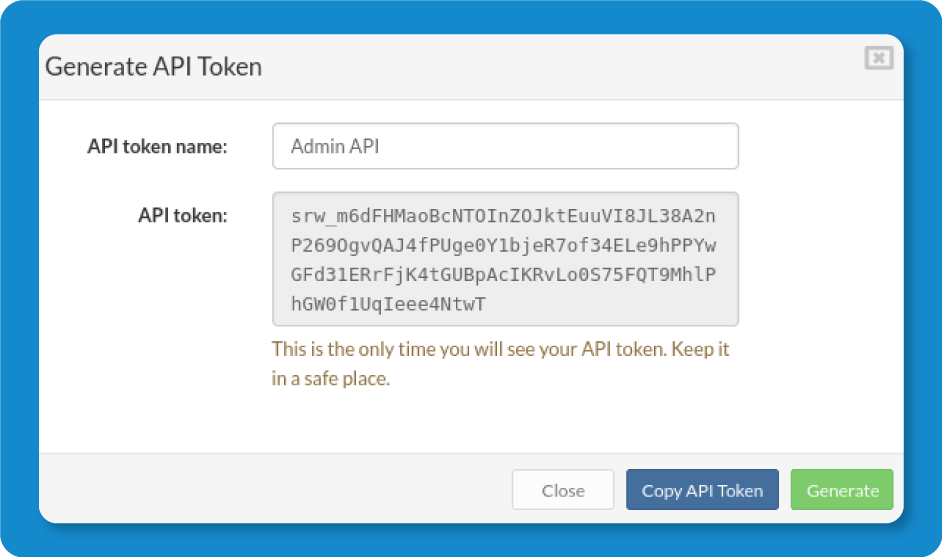
One of the biggest additions to SERVERware’s feature list in v4.6 is undoubtedly the ability to generate user-specific API tokens with all of their permissions tied to them.
A total of 10 can be generated per user with an email notification being sent out each time one is generated for security purposes to make the user aware of potentially unsanctioned token generation activity.
The interface for this feature will display a list of all tokens tied to the user, their creation date and last use date as well as the option to revoke all tokens, or on an individual basis.
All actions performed by the tokens will be documented in the Audit Log, giving admins insight on their use and whether its purpose was abused or not in case of issues down the line.
Improved Replication Scheduling
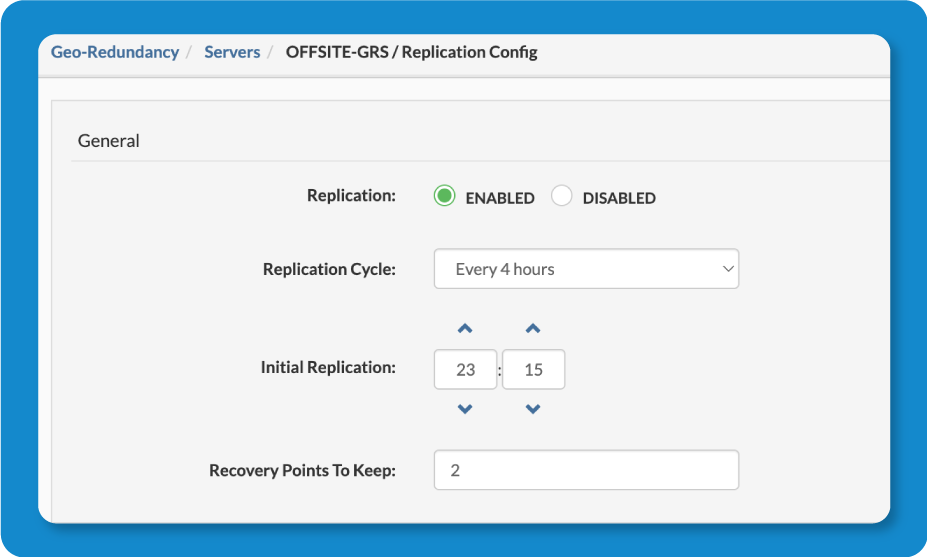
As for the quality-of-life features, the most relevant one helps cut down time on replication scheduling by allowing admins to set up the exact time they want server replication cycles to occur with a 2 hour minimum gap between each cycle, helping them align it better to prevent extra server load during peak operating hours.
And More…
While v4.6 was more centered around sipPROT’s design overhaul, we still should not neglect the efforts that have gone into improving existing SERVERware features from our team.
Apart from the ones mentioned above like API token generation and improved replication scheduling, we have:
• The ability to edit VPS MAC addresses through the GUI
• The ability to refresh the SERVERware license through the Controller CLI
• The ability to exclude clones from backup cycles
• The ability to add users to partitions directly upon user creation
• Improving awareness of bandwidth problems during replication cycles with added notifications
• Fixes to a good number of existing bugs, improving performance for both SERVERware and sipPROT across the board
The overall changes introduced with v4.6 were intended to enhance and simplify server administration and we hope that reflects in the efforts of our teams.
We are sure to continue our efforts in developing a platform that satisfies the needs of your clients while retaining its intuitive design throughout and we are looking forward to showing you more of what we have in store, but more on that in our future releases.
Until then, we hope to have met your expectations and that both you and your clients remain satisfied.
12
Avr, 2024

Converge ICT says Bifrost, SEA-H2X cables may be delayed to 2025
Executives at Philippine broadband provider Converge ICT Solutions have reportedly said that two major international subsea cable networks it’s participating in are behind schedule and may not be completed until next year.
According to media reports, the Bifrost Cable System and the South-East Asia Hainan-Hong Kong Express Cable System (SEA H2X) – which were originally scheduled to be finished this year – are taking longer to roll out than expected.
Business World reports that Converge CEO Dennis Anthony H. Uy said the company has had trouble acquiring the necessary permits in places like Indonesia, while Converge chief operations officer Jesus Romero said that rough weather conditions were also a factor.
Romero said the worst-case scenario is that the cables will be finished by the first quarter of 2025, adding that “it could be late this year or early next year,” the report said.
The Bifrost cable – designed with a capacity of 10.4 Tbps – aims to connect Singapore, Indonesia, the Philippines, Guam, Mexico and California over a total span of 19,900 km, including branches. The 5,000-km SEA H2X project – with a design capacity of 160 Tbps – will connect Hainan, China, and Hong Kong SAR with the Philippines, Thailand, East Malaysia and Singapore, with options to extend to Vietnam, Cambodia, Indonesia and the Malaysian peninsula.
Converge is a consortium partner in SEA H2X, along with China Mobile International, China Unicom Global, and PP Telecom. Converge joined Bifrost in 2021 after striking a deal to acquire an Indefeasible Right of Use (IRU) from Keppel Midgard Holdings (KMH) for one fibre pair on the system. KMH and Converge also agreed to jointly develop the Bifrost branch that will land in Davao, for which Converge also has an IRU.
MORE ARTICLES YOU MAY BE INTERESTED IN…
12
Avr, 2024

Samoa bans Starlink kit imports as SpaceX awaits licence approval
Samoa’s Office of the Regulator (OOTR) has reportedly placed a temporary ban on imports of Starlink kits until SpaceX’s application for a licence to offer LEO satellite broadband services to consumers in Samoa is approved.
According to a report in the Samoa Observer, the OOTR issued the ban following reports that a number of residents have purchased Starlink services via overseas markets like Australia and New Zealand, and brought Starlink kits into Samoa to use the service at home or at their business.
People who import Starlink units generally say they do so because it’s cheaper, faster and available compared to local broadband services, the report said.
Regulator Lematua Gisa Fuatai Purcell said that anyone found to be bringing Starlink kits into Samoa will have their equipment confiscated at the border. For people who imported Starlink kits prior to the ban for business purposes, they will be required to bring them to the OOTR for type approval, after which they’ll be given a licence to use the kit for business for a period of 12 months, the report said.
Part of the problem also lies in last month’s news that Starlink received clearance from the cabinet last month to operate in the country.
According to another report from Talamua Online News, OOTR held a public forum earlier this week clarifying that Starlink’s clearance from the cabinet to operate in Samoa is only to provide connectivity for healthcare and education facilities via a partnership with local service provider Bluwave Wireless.
Purcell confirmed that SpaceX has submitted an application for a license to operate in Samoa, and that the application is being processed and likely to be approved, the report added. She also said Starlink had selected Bluwave as its local agent for other satellite services beyond the healthcare and education sector.
Until that happens, use of Starlink services by individuals remains illegal in Samoa. Anyone who doesn’t being their kits in for type approval and continues to use them before Starlink is officially licenced to offer services in Samoa will face prosecution, the report said.
MORE ARTICLES YOU MAY BE INTERESTED IN…
11
Avr, 2024

Xavier Niel sets eyes on Ukraine with Datagroup-Volia acquisition
News
The deal is the first major investment by a new and outside entrant since Russia’s invasion of Ukraine in 2022
French billionaire and owner of European telco group iliad, Xavier Niel, has announced today that he will acquire Datagroup-Volia, Ukraine’s leading fixed telecom and pay TV provider, through his investment firm NJJ.
According to NJJ’s press release, the acquisition, which is for an undisclosed sum, has already received regulatory approval.
Datagroup-Volia is 96.13% owned by a fund managed by US private equity firm Horizon Capita and 3.87% by Datagroup-Volia CEO Mykhaylo Shelemba.
Once acquired, NJJ will merge Datagroup-Volia with Lifecell, the country’s third-largest and fastest-growing mobile operator, pending the regulatory green-light on the latter’s acquisition.
The newly combined company will then be led by Shelemba and will provide mobile connectivity to 10 million Ukrainians.
Its fixed network will cover four million premises across the country.
Back in January, NJJ confirmed the acquisition of Turkcell’s various Ukrainian units (including Lifecell), for $500 million. This deal is still subject to regulatory checks, including the go-ahead from the Ukrainian competition authority.
In a statement this week, Xavier Niel described the move as “a significant step towards the creation of a national Ukrainian telecom champion.”
“Ukraine is home to an impressive tech sector with innovation in artificial intelligence, a high degree of digitalisation and technological affinity. We are confident that our landmark transaction will serve as a signal to others that the time to invest in Ukraine is now, to support the rebuilding of the country and realize its potential,” he continued.
Keep up to date with all of the latest telecoms news from around the world with Total Telecom’s daily newsletter
Also in the news:
Digi Spain sells 6m FTTH accesses to Onivia
Vodafone’s 5G standalone network now connects around half the German population
Broadband poles no problem for Brits says new study
Metro Bytes: Uniti, GPC, Comcast Business, Fibwi
Four bits of last mile news of interest to keep up with: … [visit site to read more]
11
Avr, 2024

BEAD funding: Challenges and opportunities with NCTA’s Rick Cimerman
Interview
At Connected America 2024, we met with Rick Cimerman, VP, External & State Affairs Lead at NCTA – The Internet & Television Association, to discuss the pivotal role of federal funding in advancing broadband connectivity across the United States
Highlighting the implications of the Broadband Equity and Access and Deployment (BEAD) Act, Cimerman underscored the importance of targeted investment and strategic partnerships in addressing the nation’s connectivity gaps. Cimerman also stresses the need for efficient deployment, regulatory clarity, and workforce development to maximize the impact of these funds.
Through collaboration between federal, state, and industry stakeholders, Cimerman outlines a pathway towards achieving comprehensive broadband access for all Americans.
Highlights:
- State proposals for funding allocation are currently under review, with implementation expected to start by early 2025.
- It’s important to keep the focus on expanding to unserved areas before underserved areas.
- The best path forward is to partner with experienced cable broadband providers who have the experience and knowledge to deliver projects on time and on budget.
- Federal government agencies need to reduce deployment barriers while avoiding new regulatory burdens like net neutrality rules.
- It will be critical skill shortage through workforce development and training programs.
- Broadband expansion holds transformative potential for communities nationwide.
Cimerman emphasised the urgency of getting broadband expansion right and the profound impact it can have on communities across the nation. Through strategic investment, regulatory clarity, and collaboration, stakeholders can bridge the digital divide and ensure equitable access to broadband for all Americans.
You can watch our full interview with Rick from the link below:
What impact will BEAD funding have in creating a more connected America? Join the discussion with the cable operators at this year’s Broadband Communities Summit live in Houston, Texas
11
Avr, 2024

Viettel launches AI-ready data centre in Hanoi
Vietnamese telecoms firm Viettel reportedly inaugurated its new data centre in Hoa Lac Hi-tech Park in Hanoi on Wednesday, claiming it to be one of the largest such facilities in Vietnam to date.
According to the state Vietnam News Agency (VNA), the new Viettel data centre has racks “with a capacity of three times higher than the average in Vietnam”. The report also said the Hoa Lac data centre connects to five subsea fiber cable lines, and is the first data centre in Vietnam to commit to using renewable energy for 30% of its electricity consumption. The data centre also complies with TIA 942 standards, and features five layers of physical security, the report said.
While the report provided no details on capacity or power, it does say the new Viettel data centre is designed to handle the compute and capacity demands of artificial intelligence (AI) apps and services.
Viettel has been delving into AI for several years now. In July 2022 it joined Nvidia’s Partner Network via an MoU, under which Viettel is accessing Nvidia resources to accelerate research and implementation of its AI technology in robotics, computer vision, natural language process, digital twins, and other areas.
The Vietnamese government is also looking at promoting the country as a regional hotbed for AI development. On Thursday, VNA reported separately, the Ministry of Science and Technology (MoST) proposed that the government approve a national strategy on AI research, development and application by 2030. In February, the Vietnamese government approved a national data strategy that it says will serve as a foundation for domestic AI development.
Viettel chairman and general director Tao Duc Thang said that with the launch of the latest data centre, Viettel now owns and operates a total of 230,000 servers in 11,500 racks using 81,000 square meters of floor space and 87MW of electricity.
He also said Viettel plans to invest an additional VND10 trillion (US$400.88 million) to expand its combined data centre capacity to 17,000 racks by 2025, and another VND40 trillion to reach 34,000 racks by 2030, the report said.
MORE ARTICLES YOU MAY BE INTERESTED IN…
Wednesday Bytes: Windstream, DataVerge, Megaport, DataBank, STACK
Two bits of data networking news, and two green financing deals: … [visit site to read more]
10
Avr, 2024

Telefonica trialling 5G RedCap in Germany
News
The new Reduced Capability (RedCap) technology could open the door for a greater integration of IoT devices with existing 5G networks
Telefonica Deutschland has revealed it has successfully trialled 5G RedCap devices in its commercial 5G network in Munich.
RedCap, a key part of standardisation body 3GPP’s Release 17, is aimed at supporting the IoT over mobile networks.
It has three major advantages over existing IoT connectivity technologies (such as 4G LTE or NB-IoT):
- higher peak data rates, able to support data hungry IoT devices like video surveillance cameras or smart grid monitoring;
- lower latency, perfect for IoT devices that need near-real-time data transmission;
- and improving the battery life of devices thanks to improved efficiency and reduced complexity.
To access this benefits, IoT devices will need to be equipped with 5G RedCap-compatible radio module. The 5G network itself, on the other hand, will not need any modification – thought 5G standalone (SA) architecture will be required.
Telefonica itself launched 5G SA in Germany in October last year, saying the upgraded 5G network already covers 90% of the German population.
“5G RedCap can bring new momentum to the Internet of Things. The technology closes a gap between the previous 4G network and high-performance 5G applications in the IoT sector,” explained Mallik Rao, Chief Technology & Information Officer of Telefonica Deutschland.
“O2 Telefónica has successfully trialled the integration of 5G RedCap devices in the network. With our network, we are creating the technical prerequisites for connecting millions of devices efficiently and cost-effectively. It will be crucial to see how the market, the product world and digital applications develop.”
Telefonica says that it is already working with device and module manufacturers to help accelerate the development of the 5G RedCap-capable IoT device ecosystem. These devices are expected to be commercially available in 2025.
Will 5G RedCap prove a catalyst for growth in the German IoT industry? Join the operators in discussion at this year’s Connected Germany event live in Germany
Also in the news:
Digi Spain sells 6m FTTH accesses to Onivia
Vodafone’s 5G standalone network now connects around half the German population
Broadband poles no problem for Brits says new study