LemFi brings remittance services to Kenyans abroad

Remittances are in the news yet again, this time in the shape of LemFi, a cross-border payment solution that allows people in the diaspora to send and receive funds back home. LemFi has announced that it has secured the approval of the Central Bank of Kenya (CBK) to operate remittances in Kenya.

LemFi, formerly Lemonade Finance, provides a mobile app that enables Kenyans in other countries to send money home. As the Techpoint Africa news service explains, Kenyans in the United Kingdom, the US and Canada, for example, can send funds to Kenya in minutes via financial institutions such as M-Pesa, mobile money wallets, and bank accounts, with no fees.

The LemFi app also provides a Kenya shillings wallet offering, allowing users to fund their accounts with mobile money and to open accounts. Users can exchange their shillings for a number of foreign currencies including US dollars and British pounds.

In Nigeria LemFi is licenced by the Central Bank of Nigeria as an International Money Transfer Operator. This enables it to directly partner with banks to deliver its services and conduct inbound money transfers to Nigeria in line with regulations. It also operates in Ghana and recently signed a new deal with Visa’s Cross-Border Solutions division to expand its operations into new global markets like China, India, and Pakistan.

With the new Kenyan licence, the company says it can focus its resources and efforts on providing secure and efficient services while adhering to CBK’s regulatory framework.

LemFi is part of a burgeoning and highly competitive remittance market. Less than a month ago we reported that, in LemFi’s home market of Nigeria, neobank Kuda had won a licence allowing it to offer remittance and multi-currency wallet services to Africans living in Canada.


MORE ARTICLES YOU MAY BE INTERESTED IN…

Smart’s new eSIM push lets Philippines prepaid users keep number

PLDT wireless subsidiary Smart Communications on Thursday launched a new push to drive adoption of eSIM among prepaid subscribers by allowing them to keep their existing number when they make the switch.

Under the latest promotion, Smart Prepaid subscribers can upgrade their physical SIM to an eSIM for a fee of Php99 (around US$1.75) and keep the same number.

Smart is also hoping to entice non-Smart prepaid users to switch to its service, saying that they can switch their physical SIM to a Smart Prepaid eSIM at no charge.

In both cases, subscribers must have an eSIM-compatible smartphone, and they have to go a Smart stores to make the switch.

According to Smart’s head of Prepaid, Lloyd R. Manaloto, Smart prepaid customers need to bring their current physical SIM and a valid government ID. Non-Smart have to obtain their Unique Subscriber Code from their current network provider, and submit required documents such as a valid government ID, a screenshot of their current balance, and a signed application form, among others.

Smart launched its prepaid eSIM service in July 2023, but up to now, subscribers couldn’t keep their old number. Jerome Y. Almirante, head of Innovations and Digital Services at Smart, said this is the first eSIM service in the Philippines that lets prepaid customers keep their old number.

“By being able to upgrade their physical SIM to an eSIM while keeping their number, mobile users avoid the usual hassles that come with having a new number – from tediously informing your contacts to painstakingly updating apps and online accounts linked to your number,” Almirante said. “With this new capability in place, we’re making it a lot easier and more convenient for subscribers of all networks to finally enjoy the many benefits of eSIM technology.”

Smart’s rival Globe Telecom began offering a prepaid eSIM for local users last month via its GlobeOne App after a six-month delay. However, for the time being, only iOS users can access the eSIM option in the app, according to Unbox.ph, and users must change numbers.

Globe has been offering prepaid eSIMs to tourists and business travellers visiting the Philippines since the end of last year. That eSIM is available for iOS and Android phones.

MORE ARTICLES YOU MAY BE INTERESTED IN…

How does the increased adoption of GenAI impact data security for telcos? 


Insight  

At MWC this year, we caught up with Ari Banerjee, Senior Vice President at Netcracker Technology, to discuss the importance of data security as telcos increasingly adopt Generative AI (GenAI) solutions 

Undoubtedly, the biggest topic at this year’s MWC was GenAI and the many ways telcos are looking to incorporate it into their businesses, both to increase efficiency as well as generating new revenues. But in order for telcos to fully embrace AI effectively, a successful digital transformation of the telcos themselves is paramount. 

“What we’re seeing with our customers is that first you need to really digitally transform yourself. You need to have the right data,” says Banerjee.  

“So, data transformation becomes a precursor to any AI ML (machine learning) strategy, because at the end of the day, if you have garbage data – duplicate data and old legacy data – it just doesn’t match up with services. You are not going to be able to use AI in the right way.” 

Even when a digital transformation has successfully been undertaken, the issue of data security still looms. As more and more companies adopt the use of GenAI, data security will become more of a problem. EY’s Global head of telecoms declared the issue the biggest risk in the entire telco sector for 2024, because the rise of GenAI is putting a strain on data governance. For example, much of the data fed into GenAI models is highly sensitive and cannot be shared to the public cloud. 

Netcracker are tackling this complexity through their GenAI Telco Solution, which was launched last September. Functioning alongside the telco GenAI models (such as large language models [LLMs]), GenAI users, and the telco BSS/OSS databases, this solution supplements the GenAI model with real-time instructions to elicit the most relevant responses, and protects sensitive customer data from public models. 

Thus, Netcracker are playing the key role of an integrator, allowing telcos to make use multiple LLMs and SLMs (small language models), each specialised for a specific purpose. 

“Somebody in the middle needs to be able to take the best parts of it and then interface that and use that with the information from the network information databases […] and provide the right contextual information, whether to the internal team who’s dealing with let’s say, BSS/OSS operations, or the external teams, which is your customer,” Banerjee explained. 

“This is one of the most exciting areas for this new technology,” said Banerjee. “Providing the right contextual offer to the customer through an automated channel.”   

You can check out our full interview with Ari Banerjee, Senior Vice President at Netcracker from the link below: [embedded content]

CMA launches Phase 2 investigation of Vodafone–Three merger


News

The UK’s antitrust watchdog said the operators had declined to offer remedies to the Authority’s competition concerns

Today, the Competition and Markets Authority (CMA) has announced that it will launch a Phase 2 investigation into the £15 billion merger between Vodafone UK and Three UK, a move that would shrink the number of mobile players in the market from four to three.

The regulator said last month that it was considering launching this full-blown investigation into the merger, saying that the companies had “made a number of claims about how their deal is good for competition and investment” without providing “sufficient evidence to date to back these claims”.

At the time, the CMA offered the operators five days to suggest remedies to assuage these concerns. Now, a little more than a week later, the regulator has announced the investigation will proceed, noting that both Vodafone and Three declined to propose concessions to ease the CMA’s competition fears.

In a joint statement, Vodafone and Three said that this decision by the CMA was expected and that they remained confident the merger was in the interest of UK customers.

“This was an expected next step in the process and is in line with the timeframe for completion that we set out from the outset,” said the statement. “Vodafone UK and Three UK remain confident that the transaction will drive stronger competition in the mobile sector and give customers and businesses a step-change in network quality, speed, and coverage from day one.”

Results from this new investigation are expected in September.

How would the Vodafone–Three merger impact the UK mobile market? Join the telecoms ecosystem in discussion on market dynamics at Connected North live in Manchester

Also in the news:
FCC rejects SpaceX’s request for spectrum
Amazon invests $2.75 billion in AI startup Anthropic
T-Mobile gets green light to appeal class action lawsuit

India delays spectrum auction to June as election looms

Keep up-to-date with all the latest news, articles, event and product updates posted on Developing Telecoms.
Subscribe to our FREE weekly email newsletters for the latest telecom info in developing and emerging markets globally.

Sending occasional e-mail from 3rd parties about industry white papers, online and live events relevant to subscribers helps us fund this website and free weekly newsletter. We never sell your personal data. Click here to view our privacy policy.

stc and Huawei completed the MENA region’s first-ever long-haul 800G live network trial


VIEWPOINT

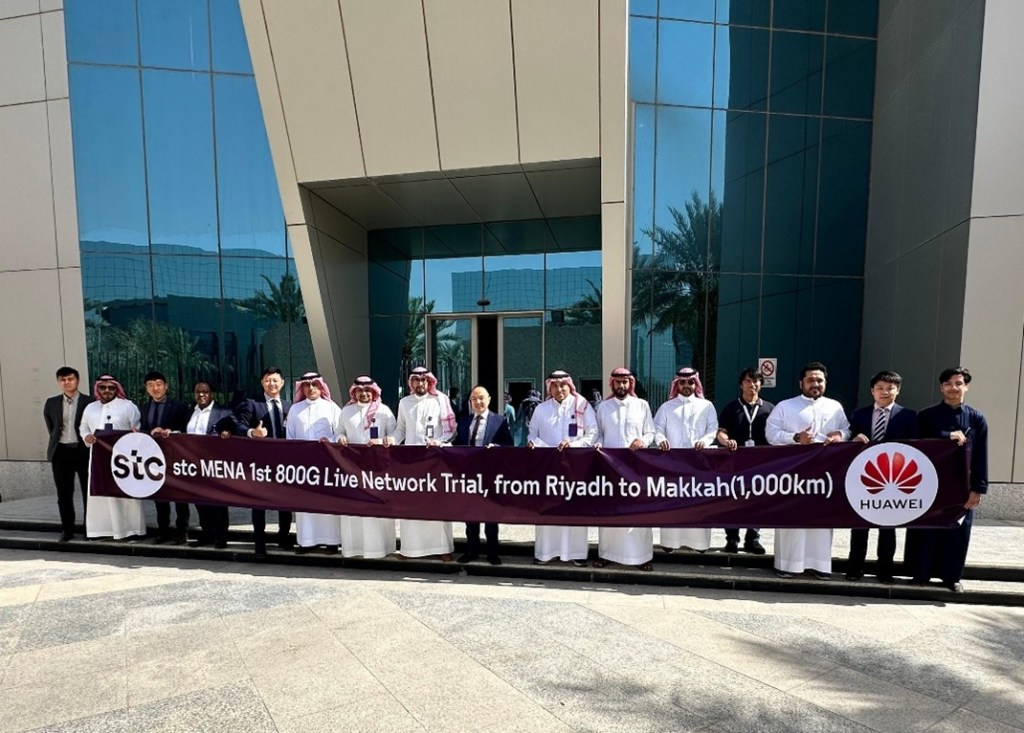
[Riyadh, Saudi Arabia, March 28, 2024] stc Group, the leading operator in the Kingdom of Saudi Arabia, partnered with Huawei to complete the MENA region’s first-ever long-haul 800G/channel trial in its live optical network. This successful live network trial with connection over 1,000 kilometers, from Riyadh to Makkah, of state-of-the-art processing and transporting capacity proves the 800G solution is ready for scale deployment across Saudi Arabia, driving the Kingdom and the MENA region’s digital transformation.

stc Group and Huawei completed long-haul 800G/channel live trial in dense wavelength-division multiplexing (DWDM) network

As a result of this successful trial, stc Group networks can now transport more data throughput for every wavelength deployed and extend across longer distances without generation, reducing power and transport costs, and supporting efficiency standards across stc Group’s infrastructure.

The high-performance 800G/channel optical module, empowered by a built-in high baud bandwidth modulator and super 16QAM modulation with a Channel-Matched Shaping (CMS) 2.0 algorithm, established connection over 1,000 kilometers in a live Colorless-Directionless-Contentionless (CDC) network, proving the stc systems can monitor and sustain complex link environments in real-time, optimizing network transmission performance.

stc has been committed to offering excellent experience to all customers with state-of-the-art technologies and solutions. The 800G channel trial project is the result of stc’s focus on maximizing fiber capacity and optical network efficiency, making it possible to deliver up to 64Tbps single fiber capacity to meet ever-increasing bandwidth demand from all users, and reduce the per bit power consumption by more than 50% compared with 100G channel. The trial shows that stc is strengthening its partnership with Huawei in the ultra-high-speed optical transmission field.

On the importance of the trial’s milestone, Huawei’s President of Optical Transmission Domain, Victor Zhou, commented: “This long-haul 800G live trial in the stc network is a significant milestone in the ultra-high-speed optical industry. Huawei will continue to innovate and cooperate with stc in optical networks, providing leading and sustainable optical solutions for optimal user experiences.”