Keep up-to-date with all the latest news, articles, event and product updates posted on Developing Telecoms.
Subscribe to our FREE weekly email newsletters for the latest telecom info in developing and emerging markets globally.

Keep up-to-date with all the latest news, articles, event and product updates posted on Developing Telecoms.
Subscribe to our FREE weekly email newsletters for the latest telecom info in developing and emerging markets globally.
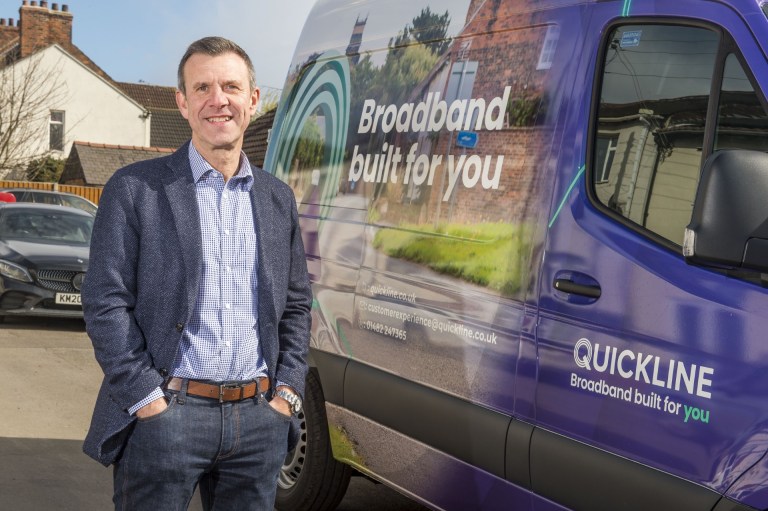
Founded in 2006, Quickline’s mission is to get rural communities connected “to a world of possibilities,” according to the website. The company is based in East Yorkshire and focuses on connecting local communities in Yorkshire and Lincolnshire with fixed wireless access and, more recently, full fibre technology.
The company today serves “more than half a million homes”, a figure which is set to increase quickly thanks to a new £250 million debt facility package secured earlier this month. The funding, which takes the form of a £125 million term loan, a £100 million debt guarantee, and a £25 million term loan provided by NatWest, will reportedly allow Quickline to expand its network to 190,000 additional locations.
“UKIB and NatWest, who we’ve done the deal with, they see the opportunity in rural areas – they see that these areas are being left behind,” explained Quickline CEO Sean Royce, who joined the company back in 2021. “They’re seeing an operator who was laser focused about trying to build where nobody else is building. And that’s really important point today in the UK.”
Royce joined the company as Managing Director in 2021, having spent over 30 years at Hull based ISP KCOM. In 1999, KCOM was floated on the stock exchange, and was the most successful float of that year, at the height of the dot com bubble. Royce oversaw KCOM’s completion of Hull’s whole fibre rollout, which remains the only city in the UK where full fibre is ubiquitously available.
A challenging broadband market
The new funding no doubt comes as welcome relief for Quickline in a market that has seen its purse strings tighten in recent years, following a surge of investment at the start of the decade.
“It is a very, very difficult sector right now. Sentiment is poor in the fibre sector particularly,” said Royce, noting that capital was much more available four years ago and investors less risk averse.
“Money was cheap and there was lots of it around […] There was this opportunity to build full fibre networks in the UK because the incumbent was distracted with BT support and buying EE. They won’t say that, but that’s exactly what they were doing!”
This positive financial environment saw the rise of over 100 altnets across the UK, which today serve roughly 2 million customers.
The boom of investment was not to last long, however. In the past two years, interest rates have soared and altnet investment has largely dried up as a result.
“Investors get nervous about returns in a market like that,” said Royce.
Full fibre and the rural divide
Today, around 65% of the UK has access to full fibre connectivity, a figure that is rising steadily thanks to the efforts of Openreach, Virgin Media O2, and the altnet community. The vast majority of these deployments are in population-dense urban areas where deploying infrastructure can be more cost effective. Rural areas, on the other hand, typically represent a far less appealing prospect for operators, with deployments being more expensive and logistically challenging for far fewer potential customers.
This lack of quality connectivity in small communities, Royce says, can be hugely detrimental, even resulting in their complete abandonment in some cases.
This is especially true for communities smaller than villages, such as tiny hamlets already lacking nearby access to services like GPs, banks, and public services.
“These little villages will wither and die, and we’re trying to regenerate the rural north of England. The first building that Quickline connected (in Escrick, North Yorkshire) did not even have mains gas!” joked Royce.
Deploying fibre under these conditions comes with a considerable number of challenges, from working on difficult terrain to the red tape associated with crossing privately owned land. This means Quickline’s build rate is never going to achieve the same speed as its more urban-focussed rivals – Openreach, for example, regularly passes 40,000 additional premises a week.
Nonetheless, Royce notes that progress remains steady, with Quickline expecting to pass between 500 to 1,000 rural premises a month.
Perhaps even more important is that, in 9 out of 10 of these locations passed, Quickline is the only provider to offer gigabit capable connectivity.
For Royce, this hints at a potential future for the broadband industry where – following considerable consolidation – the market is split into a small number of national players and rural broadband specialists.
Transforming communities beyond connectivity
Beyond simply rolling out broadband infrastructure to rural locations, a large part of Quickline’s business is engaging with and improving the communities they serve; in fact, Quickline has an internal team fully dedicated to this purpose. It has a company programme, aimed at supporting and sustaining rural communities by investing in their future. Named QFutures, it is focussed on three Es: education, enriching livelihoods, and the environment. It has brought over £13 million in social value to the two counties in which Quickline operates in the last year.
“It’s not just is a couple of apprenticeships and a few laptops,” Royce jokes. Earlier this month, for example, Quickline announced a £150,000 partnership with The Prince’s Trust, a charity founded by the King that supports young people facing challenges such as unemployment. Over the next three years, Quickline’s investment will support a range of programmes, equipping young people in South Yorkshire with digital skills to further their chances of employment.
The Road Ahead for Rural Connectivity
As the UK continues to grapple with the digital divide between urban and rural areas, Quickline is positioning itself as a critical player in bridging that gap.
The future of rural connectivity will depend on a combination of continued investment from both public and private sectors, technological innovation, and strategic partnerships across the industry. As these dynamics evolve, the extent to which rural areas can keep pace with their urban counterparts will be a key factor in shaping the UK’s digital landscape.
Join Sean Royce speaking on the ‘Customer uptake’ panel at this year’s Connected Britain, 11-12 September in London. Tickets are available here.


Keep up-to-date with all the latest news, articles, event and product updates posted on Developing Telecoms.
Subscribe to our FREE weekly email newsletters for the latest telecom info in developing and emerging markets globally.

Keep up-to-date with all the latest news, articles, event and product updates posted on Developing Telecoms.
Subscribe to our FREE weekly email newsletters for the latest telecom info in developing and emerging markets globally.
Recently, South Africa MTN and Huawei jointly launched the Ultra-Long-Haul (ULH) 400G optical transport backbone project, aiming to establish high-bandwidth, low-latency, and high-reliability connections between cities in the country, laying a solid foundation for South Africa’s digital and sustainable development, and Leaping towards the F5.5G era.
MTN South Africa, in collaboration with Huawei, has successfully achieved the first ULH 400G commercial link from Cape Town to Bloemfontein. In 2024, it will further expand the deployment of ULH 400G in the backbone links to create ultra-high-speed connections between cities, in order to meet the escalating capacity demands of 5G, home broadband, and enterprise users. Meanwhile, the high-dimensional backbone sites in the network will be transformed into the latest Optical Cross-Connect (OXC) solution, which not only supports the evolution of the existing network to the 400G+ generation, but also enhances energy efficiency to meet the future capacity requirements of the massive data demand in Africa and accelerate the achievement of the goal of a complete average reduction of 50% in carbon emissions by 2030.
ULH 400G and 800G are the critical technologies of the F5.5G industry. The ULH 400G solution employed in this project adopts built-in high baud modulators and QPSK modulation. With the unique Channel-Matched Shaping (CMS) 2.0 algorithm, the transmission distance is increased by 20%, meeting the large capacity and ultra-long-distance transmission requirements of national backbone networks and transnational backbones.
Takalani Ligudu, Senior Specialist in Core Fibre and Transmission at MTN SA, said: “The Ultra-Long-Haul 400G deployment with Huawei is a result of MTN’s purpose to enable the benefits of a modern connected life for everyone. MTN has been committed to leading digital solutions for South Africa’s progress by using industry leading technologies to deliver superior network services”.
“400G solutions can not only bring more bandwidth, but also bring lower per-bit power consumption. ”Victor Zhou, president of optical transmission domain at Huawei, pointed out: “We will continue to support MTN to build a F5.5G All-Optical Premium Transmission Network, laying a foundation for the country’s digital economy and ensuring optimal user experience.”
This joint effort by MTN in South Africa and Huawei has set a new standard for the development of the communication industry in the African region and also injected new momentum into the global push towards the F5.5G generation.
This Industry Viewpoint was authored by David Idle, CPO at Bigleaf Networks
Reliable internet access has become an essential component of modern life, powering businesses, education, and healthcare. Unfortunately, a significant gap continues between urban and rural communities in the United States. … [visit site to read more]

A second big data centre story this month has come from the Democratic Republic of Congo as it inaugurates a US$30 million data centre from Raxio Group, said to be Africa’s leading carrier-neutral Tier III data centre operator.
Located in Limete on the southeast of Kinshasa, the two-storey Raxio DRC1 spans 1,542 square metres and is the country’s largest data centre.
DRC1’s modern design can house up to 400 racks and can reliably deliver 1.5MW of IT power to customer equipment. The 24/7 ‘always-on’ facility is located along key fibre routes, delivering best-in-class colocation and connectivity services.
Multiple paths for power and cooling systems underpin the centre’s Tier III certification, while the usage of cutting edge components guarantees what are described as unmatched levels of efficiency and a commitment to sustainability principles.
The project was announced in 2021 and broke ground on construction in early 2023.
Robert Mullins, CEO of Raxio Group says: “DRC is one of Africa’s largest and fastest-growing markets with an existing latent demand for digital products and services that is forecast to soar in the coming years. With this facility, we are providing the critical infrastructure essential to supporting the digital economy and enhancing connectivity – and we expect to expand our presence in DRC through additional capacity and new facilities in years to come.”
The DRC launch aligns with the government’s Plan National du Numerique to make expansive digitalisation a catalyst for economic growth, competitiveness and social inclusion, while enabling a range of public and private sector cloud-based digital services.
The provision of data centres is one of the key pillars of the government plan, improving the digital landscape through reduced latency for real-time applications and providing a reliable backbone for mobile and internet connectivity.
This is not the only recent major data centre news from DRC. Less than two weeks ago we reported that the first phase of OADC Texaf Digital, a joint venture between African data centre company Open Access Data Centres (OADC) and TEXAF, a major long-term investor in the economy of the Democratic Republic of Congo, was live in Kinshasa.
Neterra, a global communications service provider, has achieved carbon neutrality for 2023 and has been officially certified by the international organization Verra. This significant accomplishment is the result of the company’s dedicated efforts to reduce its carbon footprint and invest in sustainable projects.
The Verra certification confirms that Neterra has offset 74 tons of carbon dioxide by supporting the “Reduced Emissions from Deforestation and Degradation in Keo Seima Wildlife Sanctuary” project in Cambodia. This project meets the CCB-Biodiversity Gold and CCB-Gold standards, highlighting its positive impact on biodiversity.
The project covers 167,000 hectares of protected dense forest and a 297,000-hectare buffer zone, home to the indigenous Bunong people and rare, endangered plant and animal species. It also hosts one of the largest remaining populations of Asian elephants. By supporting this project, Neterra contributes to the preservation of Keo Seima’s unique ecosystem and the reduction of greenhouse gas emissions.
“Achieving carbon neutrality is a strategic goal for Neterra, and we are incredibly proud to see the results of our efforts. This marks the third consecutive year of reporting zero emissions. We will continue to strive for a more sustainable future, support projects with a positive environmental impact, and seek new ways to reduce our ecological footprint,” said Neven Dilkov, founder and CEO of Neterra.
Neterra set its ambition to become a carbon-neutral company at the beginning of 2021. Since then, it has been purchasing and using 100% clean energy for its operations and implementing comprehensive measures. Neterra has built a solar park for its own needs and plans to implement a similar project at its Data Center Park in Stolnik (SDC Stolnik).
The company’s fleet consists of electric or hybrid vehicles, and all documentation processes are digital, eliminating the need for paper. In the offices, Neterra ensures that only reusable dishes and utensils are used—no single-use or plastic items are purchased or provided. Employees also actively participate in reforestation initiatives, planting thousands of trees to help restore Bulgarian forests.
Some automation, some optical, some energy, and some funding: … [visit site to read more]

Keep up-to-date with all the latest news, articles, event and product updates posted on Developing Telecoms.
Subscribe to our FREE weekly email newsletters for the latest telecom info in developing and emerging markets globally.