Huawei Tong Wen: 6G Needs Real Innovation to Reshape Mobile Industry


Viewpoint

Dr. Wen Tong, CTO, Huawei Wireless

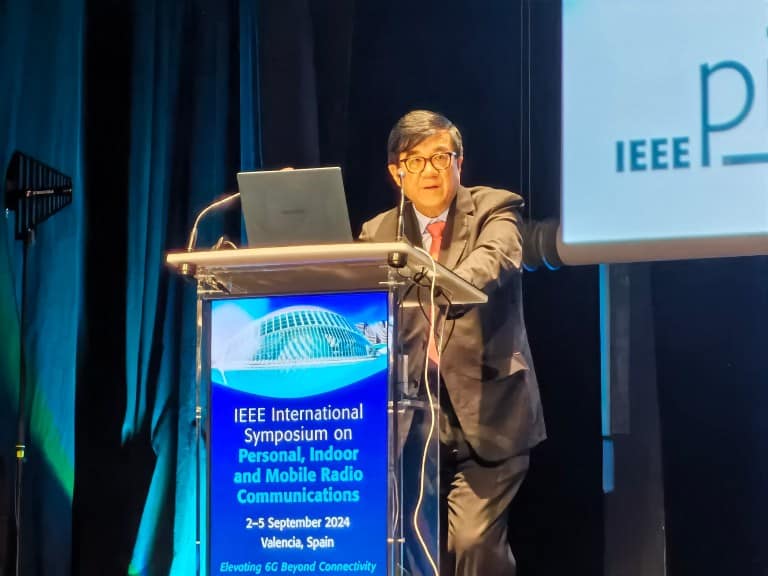
At the IEEE PIMRC conference held on September 4, 2024, Dr. Tong Wen, Huawei Wireless CTO, presented his views on the development direction of the 6G industry. Titled with “The Architectural Framework for A-RAN and A-Core”, Dr. Tong Wen pointed out, “6G will not be a simple upgrade of 5G, it should integrate AI revolution for the past 20 months, so to reshape the wireless industry and take it to the next height.”

5G is a success and 6G is on track. Dr. Tong Wen shard the timetable of 6G standard. The first 6G standard discussion will start in 3GPP in 2025 and the first version of 6G standard will be frozen in 2030. In a nutshell, after 6 years, there will be a global 6G standard and the mobile industry ecosystem will rally to go to market.

However, 6G is a long-term game plan, its technology and standard should support the innovations during the future decade from 2030 to 2040. From the investment point of view, 6G technology also should have a long-shelf time, which is not a replicate of 5G technology, but an incremental generation of wireless.

At the conference, Dr Tong Wen elaborated on 6G Standardization Direction and Innovations Driving 6G Standardization.

First, 6G is a true generational technology disruption.

Currently, AI revolution is profoundly changing every aspect of our work and life, 6G for sure should consider the emerging AI revolution happed now and future. Therefore, we need to re-examine the new possibilities and potential for the mobile industry for the time-frame 2030 and beyond. Therefore, 6G standard, key technologies, and network architecture should be re-defined based on application scenarios and requirements from 2030 to 2040.

The 6G standard needs to adopt the disruptive technologies to enable a true generational capability improvement. Specifically, in terms of core network, RAN, and terminals, the day-one 3GPP 6G standard must have the original technologies and major air interface features to drastically improve network performance and energy saving, to deliver 10 to 30 times better user experience, 3 times more intrinsic spectral efficiency and energy efficiency.

In summary, 6G is not the continuation or upgrade of 5G technologies, it is also not another way to implement 5G. Instead, 6G is a new generation of capabilities, it should generate new values for the consumers.

Second, 6G should embrace the AI revolution with an OOM Quantum Leap 

Twenty years ago, the Internet was an enabler of the latest technology. Wireless industry embraced the Internet and achieved great business success. Today, AI is becoming the enabler of the latest technologies. It is no doubt that 6G should embrace AI. Thus, the 3GPP 6G standardization process needs to fully digest the disruptive changes of the AI technologies.

  • On the core network side, using Agentic-AI-based technology to re-architect 6G-Core to achieve full automation for the 6G-Core including generation, operation, and maintenance. 6G-Core is a new and beyond 5G SBA to support the primitive capabilities of 6G AI, Sensing and NTN.
  • On the RAN side, AGI and embodiment-AI will be the mainstream AI applications in 2030-2040. The industry needs to further study AGI and embodiment-AI, not just the current Generative-AI. Therefore, it is too early to draw conclusions on the 6G air interface design about how to supports 6G AI.
  • On the UE side, 6G UEs must support the “Full AI” function. The 6G transformation from 5G technologies will be difficult if 6G UE can not adapt to the rapid development of AI and sensing capabilities from 2030 to 2040. 

Third, 6G architecture should be a continuous innovation to create a bigger market

5G has proved its market success in the past years, and 5G technology is evolving into 5G-Advanced. In the next 5 years or more, 5G and 5G-Advanced can meet the customer requirements and will continue to deliver the value to the operators and protect their 5G investment.

Therefore, 6G technologies should not overlap and duplicate with 5G, as well as to compete with the 5G market space and waste operators’ investment. Instead, 6G technologies should create innovative industry values and expand the market space for the mobile industry.

Simply reusing 5G network architecture without generational and fundamental innovation, will limit the mobile industry’s aspiration and imagination to dive the innovation in the 6G era. In particular, to reuse the 5G core network will hinder the innovation in AI.

Fourth, 6G user device calls for a breakthrough

The breakthrough of terminal technologies is the key if not the only factor for mobile device evolution. In 2007, iPhones enabled the mobile broadband industry development with a phenomenal market success. It is hard to imagine that smartphone will continue to drive mobile industry beyond 2030.

Therefore, new breakthroughs must be made in terminal technologies in the 6G, and 6G system must be prepared for terminals in the 6G era.

In the end, Dr. Tong Wen further clarified the relationship between 5G and 6G: “ 6G must be an innovative generational technology, instead of a simple extension of 5G technology. Now, 5G deployment is rolling out globally, and the current market demand and requirement can be met by 5G-Adavanced. This will protect the investment of operators, and continue to expand the market space. To duplicate 5G technologies for 6G, is essentially a pseudo-6G technology, which is not the best use of investment for operators. We should not underestimate the capabilities of 5G-Advanced for current market, and we should not underestimate the potential of 6G.”


Telesonic and Hotspot Network poised to enhance Nigerian connectivity

Two positive announcements for Nigerian connectivity have made headlines in the past week – one from pan-African operator Airtel Africa’s recently established fibre unit, Telesonic, and one from Hotspot Network Limited, a leading last-mile connectivity and telecom tower operator in Nigeria.

Telesonic has been granted three telecom licences by the Nigeria Communication Commision (NCC). The Techpoint Africa news service explains that the National Long Distance licence, valid for 20 years, will enable Telesonic to offer long-distance telecommunication services within Nigeria, allowing the company to establish and maintain the necessary infrastructure for connecting calls and data across different parts of the country.

However, the licence does not permit the holder to offer international long-distance services or function as an internet access provider directly to end users.

The Internet Service Provider licence, valid for five years, will enable the company to offer internet services to customers and establish and operate its own independent network for delivering these services. 

The Sales & Installation Major licence, also valid for five years, allows Telesonic to engage in the sale, installation and maintenance of telecommunications equipment.

All three licenses are effective from 1 July this year. Airtel Africa announced the launch of Telesonic in February 2024.

A week before this announcement, Hotspot Network and Solarkiosk Solutions, a provider of off-grid solar energy access, entered into a joint venture (JV) to implement energy and connectivity solutions in rural Nigerian communities.

The Hotspot-Solarkiosk JV is established both as an Energy Service Company (ESCO) and an Engineering, Procurement and Construction (EPC) contractor, dedicated to delivering state-of-the-art technology solutions and services for connectivity and solar energy in Nigeria.

The first focus will be on providing solar energy for Hotspot´s telecom tower network to enhance internet access and connectivity in remote Nigerian villages, as well as implementing Solarkiosk’s proprietary E-HUBB technology, which leverages solar power to distribute essential goods and services to underserved communities.

The joint venture will use proprietary remote monitoring and remote control, and IT technology to ensure seamless operations and enhanced service delivery. E-HUBB will serve as a platform for introducing telecommunication and solar products and services to rural markets.

The JV will also reportedly offer innovative energy solutions to private sector and government clients in Nigeria, addressing the increasing demand for renewable energy amid rising energy prices.

MORE ARTICLES YOU MAY BE INTERESTED IN…

AT&T signs new deal with Nokia for fibre network kit 


News 

The companies say that the deal will “accelerate future-ready fibre broadband growth” across the US 

Nokia has signed a multi-year deal with AT&T to help upgrade and expand its fibre network. 

Over the next five years, Nokia will supply AT&T with fixed broadband equipment to improve its current infrastructure and support future network growth. Nokia’s solutions will also help automate AT&T’s network operations. 

“Fibre plays a crucial role in providing the foundation for the services we offer to our customers. This expansion will not only enhance broadband access for millions of customers but also sets the stage for the next wave of digital innovation, including Industry 4.0, smart cities, IoT applications, and ultra-high-definition streaming,” said Chris Sambar, Head of Network at AT&T in the announcement. 

“Our fibre solution opens the door to a full range of PON technologies available on the same platform and fibre,” said Sandy Motley, President of Fixed Networks at Nokia.  

“This includes 10/25G PON today and eventually 50/100G PON in the future. Ultimately this can help operators like AT&T make the most of their existing fibre broadband networks today and in the future. Together, we’re paving the way for a more connected and responsible future,” she continued. 

Just nine months ago, Nokia lost out to rival equipment maker Ericsson when AT&T selected the latter as their Open RAN equipment supplier.  The $14 billion deal will result in Nokia equipment in AT&T’s network being replaced with Ericsson tech in certain areas, with the new Open RAN gear aiming to carry 70% of AT&T’s wireless traffic by the end of 2026..  

This major loss contributed to recent rumours that Nokia was considering selling or spinning off its mobile networks business, which could be valued at around $10 billion, with Samsung mentioned as a potential buyer. Speaking to Bloomberg, people familiar with the matter said the interest has come “amid increasing pressure to find new growth in the troubled telecom equipment sector.”  

Nokia has been quick to quash these rumours, saying that its mobile network business remains a core part of its overall strategy.
Join Nokia at next week’s Connected Britain, 11-12 September in London. Get last minute discounted tickets here. 

Also in the news:
Coastguard’s emergency network gets an upgrade from Telent
AT&T fined nearly $1m over 911 failings
How will the CityFibre–Sky deal really affect BT?
 

Maxis partners with HPE to support Malaysian enterprise customers

Malaysian communications service provider Maxis has announced the latest addition to its managed services portfolio by becoming a managed service provider (MSP) for multinational information technology company Hewlett Packard Enterprise (HPE) in Malaysia.

Maxis says it will now be able to leverage HPE Aruba Networking Central with AIOps (artificial intelligence for IT operations) in networking offerings supplied by its Maxis Business division for enterprise customers.

This, it explains, will enhance user experience and enable more efficient, secure and intelligent ICT services such as private 4G LTE and 5G networks, software-defined wide area networks (SD-WAN) and business Wi-Fi.

HPE Aruba Networking Central with AIOps powers security-first AI networking by delivering AI-powered analytics, end-to-end automation and orchestration, and advanced security for optimisation of both network performance and protection.

This solution can help businesses to proactively identify issues, reduce manual troubleshooting, and continuously optimise network performance to improve user experience.

As for cybersecurity, the partnership will augment Maxis Business’ overall value proposition to customers by ensuring the delivery of even more secure networking solutions in an ever-evolving threat landscape.

With HPE Aruba Networking’s Zero Trust Security foundation, the trustworthiness of every user and device within the network is continuously verified to enhance security. The architecture leverages powerful AI capabilities to profile connected devices, supporting identity-based policy orchestration throughout the network.

As Prateek Pashine, Chief Enterprise Business Officer of Maxis, explains: “This partnership enriches Maxis Business’ existing range of managed network services, providing businesses with the choice of leading networking and security solutions tailored to their specific enterprise requirements. This includes HPE’s wide range of solutions spanning access to edge to core networking, with built-in security.”

Magic Hsu, General Manager of HPE Aruba Networking for Southeast Asia, Taiwan, Hong Kong, and Macau adds: « With the increasing adoption of cloud-based networking, enterprises are shifting towards virtualised, software-defined networking solutions delivered as a service. Our partnership with Maxis will conquer today’s reshaped digital transformation complexities faced by Malaysian enterprises with a security-first, AI-powered offering to deliver secure, distinctive experiences from edge to campus to data centre to the cloud with a Zero Trust, AI-driven foundation.”

Maxis Business provides a wide range of solutions and managed services for businesses of all sizes. These include 4G and 5G mobile connectivity, fixed connectivity, internet of things (IoT), cloud and cybersecurity solutions.

MORE ARTICLES YOU MAY BE INTERESTED IN…

Room to breathe: TalkTalk secures £400m refinancing deal


News

TalkTalk has been struggling with debt for several years, with the total currently standing at nearly £1 billion

TalkTalk has announced that it has signed a binding agreement on a refinancing deal that was first revealed last month.

The deal saw shareholders – including founder Sir Charles Dunstone, Toscafund, and Ares Management – agree to inject an additional £170 million into the business, in addition to the £65 million invested last month.

The deal also included the transfer of assets including Virtual1 subsidiary and the customer bases of Ovo and Shell, bringing the total refinancing to over £400 million.

The agreement will enable TalkTalk to extend the repayment deadlines for its Revolving Credit Facilities (RCF), originally due in November 2024, and its Senior Secured Notes (SSN), which were set to mature in February 2025. The new agreement will push the debt maturities out to September 2027, giving the company more time to shore up its finances.

The deal was expected, with TalkTalk’s Chief Financial Officer James Smith confirming last month that “we are making constructive progress and are confident of a near term agreement which will ensure the group is well capitalised going forward.”

The company will now move forward with implementing this refinancing agreement, with the transaction expected to be completed in the coming months.

In related news, last month it was reported that Macquarie, who had been in discussions to acquire a £450 million stake in TalkTalk’s wholesale unit, PlatformX, had walked away from the deal. Reports have suggested that it could reopen negotiations if TalkTalk’s financial situation improves.

“The Company has entered into a binding lockup agreement in support of the transaction with its major shareholders, RCF banks and a group of SSN holders, which together hold approximately 70% of the Company’s secured debt,” read TalkTalk’s statement.

Join the conversation on the UK connectivity market at this year’s Connected Britain, 11-12 September in London. Get tickets here! 

Also in the news:
Vodafone deploys 5G private network at Czech nuclear power plant
Ogi received £45m funding to aid expansion
Musk’s Brazilian bust up sees Starlink accounts frozen

Drop FDD for TDD, says regulator to Qatar’s operators

Keep up-to-date with all the latest news, articles, event and product updates posted on Developing Telecoms.
Subscribe to our FREE weekly email newsletters for the latest telecom info in developing and emerging markets globally.

Sending occasional e-mail from 3rd parties about industry white papers, online and live events relevant to subscribers helps us fund this website and free weekly newsletter. We never sell your personal data. Click here to view our privacy policy.