Madagascar’s mobile money operators slam transaction tax plan

Madagascar’s three mobile money operators – MVola, Orange Money and Airtel Money – have denounced plans by the government’s Directorate General for Taxes (DGI) to tax mobile money transactions, which they say will discourage financial inclusion and harm the economy.

The DGI announced last Thursday it is looking to introduce a 0.5% tax on all mobile money transactions above MGA150,000 (a little over US$32.00), which it said will generate MGA143 billion in tax revenue per year.

According to a joint statement from MVola, Orange Money and Airtel Money published on the Ecofin news agency website, the actual tax revenue would be far less, as it would actually reduce usage of mobile money services. 

MVola, Orange Money and Airtel Money said families would see fees for money transfers increase by up to 5x, and while fees for merchant payments would increase by much as 10x. That would cause the number of active mobile money users to drop 30% immediately, and decrease the value of transactions 60% within six months, they said. There are currently around 23 million mobile money users in Madagascar.

Reduced usage of mobile money services would also impact the 164,000 distribution agents (cash points) operating in the country, the operators said.

In essence, mobile money operators claim the tax would encourage people to switch back to cash, which goes against the financial inclusion efforts promoted by the Central Bank of Madagascar, as well as the government’s own digitalisation initiatives.

Among other things, taxing mobile money would slow down digitization of the economy, increase security risks, reduce the traceability of transactions (which would also make it more complicated to collect tax revenue), reduce foreign exchange inflows and discourage local and international investment, the operators said.

MVola, Orange Money and Airtel Money also noted that similar tax schemes in other countries such as Tanzania, Ghana, Cameroon and Central African Republic that have seen similar results.

Mobile money operators said that if the government wants to increase tax revenues, it should accelerate large-scale adoption of mobile money services. The resulting boost in total transaction volumes and value of merchant payments would in turn accelerate digitalization and boost the digital economy.

“This digitization will contribute to the formalization of the economy and generate increased tax revenues, of the order of MGA100 billion,” the operator statement said.

MORE ARTICLES YOU MAY BE INTERESTED IN…

Ezditek Breaks Ground on Data Center Facility in Riyadh to Provide a Foundation for AI and Cloud Innovation in the Kingdom of Saudi Arabia

Riyadh, Kingdom of Saudi Arabia, 19 November 2024 – Ezditek, a leading expert in data center and digital infrastructure services in the Kingdom of Saudi Arabia (KSA), has broken ground on its flagship data center facility, RUH01, in Riyadh to provide a sustainable and scalable foundation for local digital transformation. The facility will be located in the world’s biggest female university, Princess Nourah Bint Abdulrahman University (PNU) on a 35,000+ sqm plot and is expected to go live by Q1 2026. 

RUH01’s strategic location provides an ideal entry point for hyperscalers, cloud providers and enterprises looking to establish a presence in the KSA with direct access to major carriers. RUH01 will reach 100% of public and enterprise customers in the Saudi central region and deliver a maximum capacity of 24 MW. 

“As one of the most vastly developing and transforming cities in the world, Riyadh provides a natural hub for digital transformation. It is the heart of the KSA’s rapidly expanding technology sector, and this makes it the perfect location for our flagship data center,” said Ibrahim Almulhim, CEO at Ezditek. “We’re matching experience with delivery across the Kingdom. Breaking ground on RUH01 marks a critical milestone in our mission to make it simple and efficient for organizations to grow their local presence in the KSA.”

RUH01’s capacity to reach 90% of Saudi population within 25 milliseconds enables it to serve growing demand for rapid connectivity. The facility supports digitalization by enhancing the Kingdom’s data sovereignty and strengthening its position as a global digital hub. It will host Saudi Arabian Internet Exchange (SAIE), available at 100+ GBPS of speed to reduce latency and improve localization of content and traffic. 

“We’re committed to ensuring the region’s cloud, connectivity and AI needs are met while advancing the Kingdom’s Vision 2030 goals. RUH01 matches AI-enablement with sustainability, enabling customers to benefit from emerging technologies and meet ESG goals,” said Almulhim. We’re ready to meet scaling demand for future-ready data center facilities as we affirm our on-the-ground presence in the Kingdom and commitment to minimizing environmental impact.”

Ezditek is focused on delivering high-capacity infrastructure to support local connectivity needs in the AI-era. The construction of RUH01 follows the launch joint venture with Gcore to deploy an ‘AI Factory’, which can be used for building, training, and deploying generative AI solutions locally and across the globe.

About Ezditek

Ezditek is a leading Saudi Arabian company specializing in the development and operation of state-of-the-art data centers. With a proven track record in delivering scalable and energy-efficient data center solutions, Ezditek plays a key role in supporting the Kingdom’s growing digital economy. Learn more at Ezditek.com.

Carr Named to Lead FCC

Carr Named to Lead FCC

We try to stay out of politics here and that’s not going to change today. But the telecommunications and internet infrastructure sector in the US will soon see a shift in regulatory leadership. Brendan Carr has been named by the incoming administration as the next FCC Chairman. … [visit site to read more]

India’s new favorite smart device in 2025: 5G-AI connected cars

5G connected cars are expected to be an increasingly hot item for India’s smart-device consumers next year as new models include 5G IoT connectivity and onboard GenAI as default technologies, says a new research report.

According to Techarc’s India Connected Consumer Report 2025, Indian consumers are still buying smart devices such as smart home appliances and smart speakers, but they aren’t using them much. On average 27% of respondents have stopped or reduced using at least one of the smart devices they own, usually due to poor user experience or perceived lack of value for money.

The study found that consumers are interested in spending money on devices that offer a better value proposition in terms of features, quality and experience, and one category currently generating the most interest is connected cars.

Around 55% of respondents said that they have come across news or information about smart/connected cars in recent times, while 73% said that smart/connecvity features will be either an “extremely important” or “important influence on their next car purchase, the report said.

According to Techarc, all of the 22 automobile OEMs in India have centred their core strategies around connected cars. Starting next year, passenger cars launched in India will offer 5G IoT connectivity, onboard GenAI, cloud connectivity and multiple displays across different price segments. Most cars priced INR2 million (around US$23,700) and above will feature 5G connectivity and GenAI by default.

Techarc expects telematics, vehicle maintenance, audio/video conferencing and infotainment apps to be the big early use cases for connected cars in India.

“With connectivity and the technologies it brings to the cars, the future of automobile sector will be fundamentally determined by the auto-technologies that will influence the overall experience, performance, comfort, safety and entertainment available to the drivers as well as the passengers,” said Techarc auto-tech sector analyst Sadat Ahanger. “So far, such features were seen as luxury or high-end experiences. But starting 2025, many of these will become mainstream for cars in India.”

The Techarc report also said India’s connected car segment could turn the country into the largest 5G IoT market in the world in next two to three years, as the local automotive sector is leapfrogging 4G in favor of 5G, which is available in most populated areas across the country.

The report is promising news for telcos looking for new 5G monetisation opportunies, including connected cars. Last month, Bharti Airtel’s B2B arm Airtel Business launched a partnership with automaker Kia India to provide IoT connectivity solutions for its next-gen connected-car platform, Kia Connect 2.0.

MORE ARTICLES YOU MAY BE INTERESTED IN…

Struggling altnet Spring Fibre sold to Harmony Networks 


News 

The altnet has collapsed under mounting debt pressure 

UK altnet Spring Fibre, has been sold to Harmony Networks for £1.5 million, the company has announced. The sale reflects the challenges smaller broadband providers face in scaling operations and competing with larger players in the UK’s full-fibre rollout. 

Founded in 2019 with the ambition of rolling out gigabit broadband to one million premises across the UK, Spring Fibre initially sought to position itself as a key player in the UK’s fibre race. The company’s rollout officially began in Lincolnshire in 2021, with the company having raised £150 million to fuel its expansion. 

Progress, however, was mired by rapidly growing operational costs and stiff regional competition. To date, Spring Fibre has only succeeded in passing 12,000 UK premises with full fibre.  

The extent of the company’s financial woes only became apparent recently, with a report from the Telegraph confirmed that Spring Fibre was on the brink of collapse, with its debt pile standing at £11 million, and had made a loss of £3.8 million in 2022. 

“While we can confirm we’ve had a significant level of interest, including indicative offers for the business, we don’t today have an offer that provides the necessary liquidity in the time we have available,” said Gareth Greppellini at the time. 

 “Unfortunately, with this in mind, we have taken the difficult decision to file a notice of intention [to appoint administrators],” he added. 

At the time, Greppellini said discussions with potential purchases were still ongoing with the aim of reaching a deal that “maximises value for the business”. 

On Friday, a buyer was finally announced with civil engineering and utility construction contractor Harmony Networks agreeing to buy the altnet for £1.5 million, representing a considerable loss for Spring’s investors. 

The acquisition highlights the challenging economic environment for the UK’s broadband altnets, where smaller players are struggling to maintain financial viability while deploying infrastructure in underserved areas. 

The sale also highlights broader issues within the market, including the sustainability of large expansion plans and the financial pressures faced by new entrants. As competition intensifies, Spring Fibre’s story reflects the difficulties of maintaining momentum in a crowded and capital-heavy industry, and foreshadows the sectors inevitable consolidation.  

Keep up to date with the latest international telecoms news by subscribing to the Total Telecom daily newsletter    

Also in the news:
VMO2 launches UK’s first 5G standalone small cells in Birmingham
BT says Labour’s budget will cost company £100m
Vodafone Spain and Telefonica complete FibreCo deal 

Zong 4G says digital channels account for 40% of recharges

Keep up-to-date with all the latest news, articles, event and product updates posted on Developing Telecoms.
Subscribe to our FREE weekly email newsletters for the latest telecom info in developing and emerging markets globally.

Sending occasional e-mail from 3rd parties about industry white papers, online and live events relevant to subscribers helps us fund this website and free weekly newsletter. We never sell your personal data. Click here to view our privacy policy.

Gangster Granny! Meet Daisy: O2’s new weapon against scammers 


News 

“It’s a bad day to be a scammer,” said VMO2 in its announcement

O2 has unveiled its new, unique weapon in its fight against scammers: Daisy, an AI-powered assistant designed to keep fraudsters talking and waste their time. As part of Virgin Media O2’s “Swerve the Scammers” campaign, Daisy’s mission is to distract scammers with realistic, rambling conversations, helping protect potential victims while raising awareness about fraud.

Developed with the help of popular YouTube scambaiter Jim Browning, Daisy can independently handle scam calls. Her lifelike conversations, peppered with stories about family or hobbies like knitting, have kept fraudsters on the line for up to 40 minutes. By doing so, she prevents scammers from targeting real people and highlights common tactics used in fraud.

Research from O2 shows that 67% of Brits are worried about being targeted by scammers, with one in five experiencing fraud attempts weekly. While 71% would like to fight back, over half (53%) said they wouldn’t engage directly due to the time it takes. Daisy bridges that gap, acting as a tireless scambaiter on behalf of consumers.

“The newest member of our fraud-prevention team, Daisy, is turning the tables on scammers – outsmarting and outmanoeuvring them at their own cruel game simply by keeping them on the line,” said Murray Mackenzie, Director of Fraud at Virgin Media O2 in a press release.

“But crucially, Daisy is also a reminder that no matter how persuasive someone on the other end of the phone may be, they aren’t always who you think they are. With scammers operating fulltime call centres specifically to target Brits, we’re urging everyone to remain vigilant and help play their part in stopping fraud by forwarding on dodgy calls and texts to 7726 for free.”

—- 

Below are O2’s tips to stay vigilant and safe from scammers: 

‘STOP: If you receive a call out of the blue for someone claiming to be from O2, think about what you’re being asked to do. Does it feel right? Are you being asked for personal data or a code over the phone? If you have any suspicion that you might be speaking to a scammer, the best thing to do is hang up and call us back by dialling 202 from your O2 phone.

SEND to 7726: Worked out you might have spoken to or received a text from a scammer? Don’t just ignore it, take a few seconds to forward on to 7726. It spells SPAM on your phone’s keypad and is the free number to use to report to us so we can investigate. It helps keep you safe and allows us to block fraudsters numbers and prevent or shut down similar scams faster in future.

SPEAK OUT: Let your friends and family know about the scam. By telling others, you can help keep them safe and ensure they’re never caught off guard.’

Keep up to date with the latest international telecoms news by subscribing to the Total Telecom daily newsletter   

Also in the news:
Verizon extends US defence contract in $98m deal
Top 5 stories from Broadband Communities last week
UScellular sells spectrum to AT&T for $1 billion


The intelligent revolution: Making the digital economy intelligent


Contributed Article

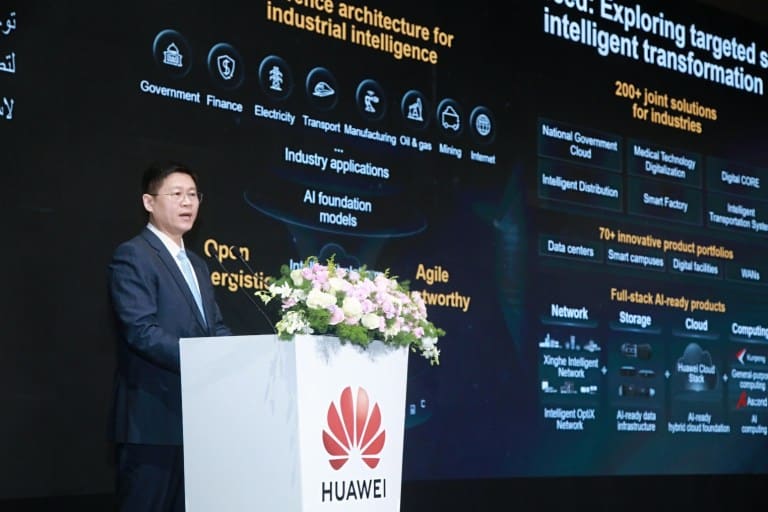
At this year’s GITEX conference in Dubai, Huawei’s Corporate Senior Vice President Li Peng discussed how enterprises are embracing technologies like AI to revolutionise their business models

The term ‘digital transformation’ has been at the heart of conversations at GITEX for over a decade. This year, however, the rapid development of disruptive technologies like AI saw discussions move beyond how to simply connect and digitalise business functions, instead focusing on how to analyse, interpret, and automate them.

This was the key theme in the opening speech of Huawei’s Li Peng at this year’ GITEX conference, who called this emerging ‘intelligent economy’ the “main engine of global economic growth”.

“More and more enterprises are using AI to boost productivity and reduce operating costs. This opens the doors for more innovate business models and a better customer experience,” he explained.

Game-changing AI is already making an impact

The extent to which AI is already being used by enterprises should not be underestimated. A recent study from IBM found that 42% of enterprise companies are already actively deploying AI in their business, with a further 40% saying they are currently exploring the new technology.

From the manufacturing sector to the finance industry, the use of AI is helping enterprises to leverage more data points than ever before, driving efficiencies through automation and generating novel – and more personalised – services and revenue streams.

Huawei’s All Intelligence strategy

Of course, fully embracing AI and the benefits of more intelligent operations requires high quality digital infrastructure. To this end, last year Huawei launched its ‘All Intelligence’ strategy, aimed at providing the technological backbone behind this enterprise transformation. This strategy focusses not only on further developing technology, such as compute power, AI-ready cloud solutions, AI chips, and autonomous driving technology, but also expanding collaboration with the wider ecosystem.

According to Li, this strategy is already bearing fruit.

“We also released a reference architecture for the intelligent transformation of industries. It is collaborative, open, agile, and trustworthy, and can help to guide the transformation process,” explained Li. “In practice, the architecture is already producing results. Over the past year, we’ve used it to develop many industry-specific solutions. We have also published over 100 case studies for different organizations to use during their transformation process.”

For Li, one of the keys to success here is understanding that each partner enterprise is unique, with specific requirements and challenges to overcome. Whether helping Cote d’Ivoire’s Ministry of Transportation build a traffic analysis platform or improving connectivity for over 1,000 government agencies in 33 Middle Eastern and African countries, effective collaboration between partners has been key to success.

“Our partnerships are growing fast in the enterprise market. To date, more than 47,000 partners have joined us. This year alone, our partnerships have grown by more than 18%,” said Li. “We have also built 14 OpenLabs worldwide to support joint innovation with local solution partners.

Big or small, intelligence for all

It is worth noting here that Huawei is not only working with largescale enterprises when it comes to intelligent transformation.

“There are so many SMEs that want to go digital and intelligent too,” says Li, noting that Huawei is “doing everything we can to help our partners serve them more independently, easily, and effectively”.

“We provide our partners with scenario-based, lightweight solutions, more marketable products, and efficient digital platforms. We also provide support in R&D, sales, marketing, supply, and services, giving our partners end-to-end business enablement,” he added.

In one example, Huawei and South African IT company BCX built a cloud management platform to serve more than 100 SMEs, allowing them to lease or buy network services, supporting their operations and management while reducing CAPEX by over 20%.

Finally, Li highlighted the importance of nurturing the digital skills that will allow the next generation to leverage intelligent digital technology effectively. Working alongside universities, Huawei has set up numerous ICT Academies in partner markets. So far, these academies have trained more than 36,000 ICT engineers and 1,000 developers in Egypt, while in Saudi Arabia, over 32,000 students have received ICT training, and 6,500 professionals have obtained Huawei ICT certification.

“Digital and intelligent transformation should not be a privilege for the few. It should be a benefit for all,” Li concluded.

Also in the news:
Mobily and Telecom Egypt to deploy Red Sea submarine cable 
CMA set to approve Vodafone–Three merger
SK Telecom announces “AI Infrastructure Superhighway”