

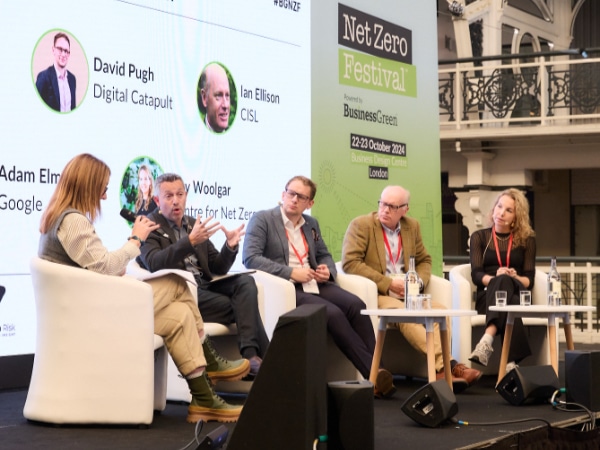
At the recent Net Zero Festival in London, the role of AI in the transition towards net zero was the subject of a panel discussion that brought together key thinkers in the sector.
Adam Elman, Head of Sustainability for EMEA at Google, joined Ian Ellison, Associate Director of the Cambridge Institute for Sustainability Leadership, and Izzy Woolgar, Director of External Affairs at the Centre for Net Zero, to discuss how AI is helping enable the switch to more sustainable energy.
Elman explained that AI is a transformational technology that has the ability to bring huge benefits to people and to society, but noted that it is not actually ‘new’, noting: “At Google, we’ve been integrating AI into products and tools for the last decade – if you were using Google Search five years ago, or Google Translate or Google Maps, you’ve been using AI.” However, he noted that the technology has evolved in ways that will allow it to have an impact on climate action. Acknowledging that there are concerns over how AI is used and how it will affect society, Elman argued that AI represents huge opportunities from both a business and a climate change perspective.
Ellison agreed, claiming that AI’s role in the net zero transition will be absolutely critical. “If you look at Net Zero, the SDGs, we’re far behind the curve. AI brings the tools to the table that allows us to close some of the gap thoughtfully, carefully and recognizing risks.” He noted that AI can provide better access to data and deliver faster education, allowing better dissemination of messaging around sustainability concerns across business.
Woolgar noted that AI has a significant track record in delivering innovation in the field of science, which underlines its potential for the net zero transition. “AI’s optimisation capability is really important. We are transitioning from an energy system that was quite top down and static to one that’s very dynamic and decentralised, and that requires optimisation so that we know where the sun’s going to be shining or the wind’s going to be blowing, and we can compare accordingly on the supply side but also on the demand side. What happens when lots of people adopt electric vehicles or heat pumps? How can we plan accordingly? Keeping that supply and demand in balance is absolutely critical.”
Acknowledging that AI is putting constraints on energy systems, Woolgar said that a wider perspective is essential, citing the International Energy Agency’s recently published World Energy Outlook which details what will happen in terms of electricity demand between now and 2030. This forecasts how much energy the adoption of various technologies – such as heat pumps and electric vehicles – will account for, and she noted that data centres represent a very small share of this. There are constraint issues on a local network basis, such as when data centres are clustered together, which they often are, so grids will need to be built out to facilitate supply, but more importantly, grids and data centres must operate with greater flexibility. She noted that Google aligns its compute loads to periods with an excess of solar or wind, allowing the data centre to “soak up” the renewable power which would otherwise be wasted by running their systems at a more optimal time.
When pressed on the negative effects of AI, Elman conceded that Google’s carbon emissions have increased by 20% within five years as a result of AI adoption, and that this must be mitigated to ensure sustainable growth. He noted that Google is committed to a Net Zero target of 2030, and that its emissions growth slowed last year, but agreed that there is still work to do. He argued that Google had long acknowledged that emissions would increase in the short term around AI adoption, but this would be offset by the long-term reductions. He conceded that trusting tech companies on such pledges was a tall order, but argued that the investments Google is making in its infrastructure and solutions will help it to reach its targets. Elman stated that by 2030, Google aims to have achieved a massive 50% reduction in emissions, with the remaining 50% mitigated via “high quality carbon removals”.
Pressed on the increasingly stringent requirements for ESG reporting, Elman agreed that corporate reporting must be traceable, and that while AI could reduce the administrative burden of this, ultimately it would still require a manual effort as AI reporting would not be robust enough. “There’s a raft of AI solutions and platforms that are being built to help with… the macro level reporting, but then there’s more granular opportunities.” One example is deforestation regulation – using cloud and geospatial capabilities, AI can deliver real time, granular location-based information to companies, enabling smoother forest management to help them track and manage their goals and commodities around areas such as sustainable farming.
Ultimately, Elman was upbeat about the prospects for the green AI landscape, noting that in addition to mitigation, AI presents huge opportunities for adaption and resiliency in the face of climate change. With the right policies in place, AI will be able to play a huge role in advancing net zero.