Smartphone shipments have for the first time surpassed feature phone stock in Africa, showcasing the rise in adoption of more advanced handsets across the region.
Analyst house IDC detailed in its report smartphone units grew 17.9% year-on-year reaching 20.2 million units in the first quarter of this year, as feature phones declined 15.9% to 18.8 million units.
IDC senior research analyst Arnold Ponela noted South Africa and Nigeria, the largest smartphone markets in Africa, drove growth due to popularity of Chinese brands. Kenya was the third-largest smartphone market in Africa by driving sales growth with financing schemes.
Transsion, which houses the Tecno, Itel and Infinix smartphone brands was the leading smartphone vendor in Africa due to its “compelling entry-level portfolio” that are “tailored” to the African market. However, Samsung and Xiaomi gained market share on the previous quarter, driven by mid-range ($200 to $400) models. Market share numbers were not broken down by IDC.
Shipments of mid-range smartphones increased in Q1 while sub-$100 devices declined, “indicating a growing consumer preference for feature-rich models”.
Looking ahead for this year, IDC predicted the smartphone market in Africa will see 5.7% YoY growth in 2024. Growth is expected to sustain over the next five years.
« Africa remains a market with a high share of feature phones, although they are expected to gradually decline as the transition to smartphones gains momentum, » said IDC Research Manager, Akash Balachandran.
“This shift, coupled with rising demand, will be the key driver of overall growth in the smartphone market. Persistent inflationary pressures and escalating macroeconomic uncertainties may cause short-term fluctuations but will not impede the long-term transition. »
Indonesian operator Telkomsel says it has completed the first validation of Wi-Fi 7 in Indonesia together with the Ministry of Communication and Information (Kominfo) as it makes plans to adopt the technology for its fixed broadband services.
Telkomsel said on Thursday that it has carried out trials of Wi-Fi 7 with Kominfo and several unnamed global technology partners, which it says opens up opportunities for internet speeds of up to 10 Gbps, as well as more user capacity, lower latency, and better energy savings.
“In trials along with Low Power Indoor (LPI) device specifications, the functionality and capabilities of Wi-Fi 7 have demonstrated performance and stability that can significantly improve the network experience and exceed expectations,” Telkomsel said.
Wi-Fi 7 (a.k.a. 802.11be) promises theoretical peak download speeds of over 40 Gbps. Like its predecessor, Wi-Fi 6E, Wi-Fi 7 uses the 2.4-GHz, 5-GHz and 6-GHz bands. Unlike Wi-Fi 6E, Wi-Fi 7 allows wider bands for 5 GHz and 6 GHz, as well as multi-link operation that enables channels to be combined for faster speeds and more efficient performance. However, while Wi-Fi 7 is backwards compatible with Wi-Fi 6E, users need WiFi 7 routers and devices to get the full benefits of the latest version.
Telkomsel VP of Technology Strategy and Consumer Product Innovation Ronald Limoa said Wi-Fi 7 was a core technology that can complement home internet network solutions by increasing smoothness and efficiency to provide a better network experience in homes or offices.
While Telkomsel says it’s completed the first validation of Wi-Fi 7 in Indonesia, it’s not the first service provider in the country to announce it will adopt it. On May 30, multinational ISP MyRepublic teamed with Chinese vendor ZTE to launch what they said was the first Wi-Fi 7 product in Indonesia. ZTE and MyRepublic said they would collaborate to promote commercial implementation of Wi-Fi 7.
MyRepublic Indonesia, which is owned by Indonesian conglomerate Sinar Mas, first launched services in the country in 2015 and currently offers ISP services in 45 cities and 61 regencies.
A report from engineering firm TXO says that over $7 billion-worth of unused copper cabling could be recovered in the next decade
In most developed markets around the world, copper telecoms networks are increasingly becoming a thing of the past, replaced by much more effective fibre optic cables.
But while this copper is unlikely to find reuse in major telecoms networks, it is growing increasingly important in other sectors, such as for electric vehicles and renewable energy infrastructure. In fact, the value of copper has soared by over 50% compared to pre-pandemic levels, spurred by growing demand and reduced mining outputs. Experts predicting that demand for the metal will continue to increase steadily, increasing by more than 50% by 2040.
Now, a new report from engineering firm TXO has shed light on just how much money the telcos’ legacy copper networks could be worth. According to the report, the telecoms companies could expect to recover up to 800,000 tons of copper by 2035, worth up to $7 billion at today’s prices.
The scale of this opportunity is certainly not lost on the telcos, which have been accelerating their recovery efforts in recent years. Openreach in the UK, for example, says they will recover 200,000 tons of copper over the next 15 years.
Unearthing the cables and preparing them for sale can be a time-consuming and costly endeavour, but with copper prices this high it remains highly profitable.
“Recovering the copper cables generates a net income, even after the costs of extracting the cables and processing them,” Openreach told Bloombergin an emailed statement.
It is worth noting that digging up network copper also represents a huge opportunity for thieves, one that costs telcos around the world millions of dollars every year. While this issue is shrinking as networks transition to fibre, it remains a major challenge in less developed markets.
At this year’s Submarine Networks EMEA event, we caught up with Thomas Soerensen, Vice President, Global Sales at Ciena, to discuss the ever-changing submarine cable landscape and some of the key technologies driving change in 2024
The rise of AI is a major focus this year at the Submarine Networks EMEA conference. What impact do you think this is set to have on the submarine cable ecosystem?
AI is contributing to increased data and capacity requirements which, in turn, will contribute to the ongoing growth in the submarine cable market.
I believe AI will improve network performance and efficiencies for all service providers. Here are some examples I think will be really important:
Advanced network monitoring and fault detection: With AI, providers can analyse data from multiple sources in real-time to rapidly pinpoint faults to minimise downtime.
Predictive maintenance: AI analytics can help predict equipment failures and facilitate proactive maintenance planning before issues occur. This helps optimize resource allocation, reduce opex costs, and maximise the lifespan of critical infrastructure.
Automated network planning and optimisation: AI algorithms can optimise the design and routing of submarine cable networks, considering cost, traffic patterns, and environmental impact. This will help streamline network planning processes, enhance efficiency, and expedite the deployment of new cable systems.
Security/Intelligent threat protection: AI can analyse network traffic patterns, detecting anomalies and locate potential threats or unauthorized activities.
Is this shift in AI primarily being driven by hyperscalers? What do you think of their continued role in the subsea industry?
Hyperscalers are currently leading the industry by building massive amounts of AI infrastructure in and between their data centres, initially for consumer-centric applications. Hyperscalers are often at the forefront of technological innovation, driving the adoption of emerging technologies and the development of new solutions to continually advance the submarine networking industry now and into the future. This is evidenced by a handful of hyperscalers representing over 70% of all used international traffic, as per analysts from TeleGeography.
Earlier this year you upgraded the Sea-Me-We-4 cable to increase its capacity. Tell us more about this process and why it’s important?
The Europe-to-Asia route, where SEA-ME-WE 4 is situated, is experiencing a major digitalisation push, resulting in extreme capacity demands. To support growing demand for more bandwidth across this route, SEA-ME-WE 4 is leveraging Ciena’s GeoMesh Extreme submarine network solution to increase capacity from 65Tb/s to 122Tb/s.
The Ciena upgrade is helping optimise the resources of the SEA-ME-WE 4 cable, enhancing its capabilities through improvements in network capacity, flexibility, and durability. Importantly, this will allow the cable system to maintain pace with voracious global demand for bandwidth, protect terabits of traffic, and ensure optimal network availability.
We’ve seen some cable outages in recent months, caused by both environmental and man-made events. What needs to be done to make submarine network connectivity more resilient?
The seabed can be a hostile environment for power and telecom submarine cables. Although unpredictable natural disasters, like undersea earthquakes and landslides, can cause widescale damage, most submarine cable faults are due to humans, such a fishing nets or anchors snagging submarine cables in the seabed, especially in shallower waters where cables are not buried or armoured.
Protecting undersea cables takes the entire ecosystem and Ciena is committed to driving greater network resilience and reliability. And, while we cannot regulate (or educate) Mother Nature, we can regulate and educate people involved in marine activities such that they are aware of nearby submarine cables and take appropriate precautions.
Organisations like the International Cable Protection Committee (ICPC) play an important role in promoting submarine cable protection and resilience via cross-industry collaboration and liaising with entities across the industry, governments, and academia to holistically understand submarine cables and the environments where they are installed. About 98% of all submarine telecom cables are represented in the ICPC, as are power cable owners, offshore renewables developers, cable ship owners, cable operators, cable manufacturers, and other stakeholders. Together, committee member decision makers and regulators can engage with the broader industry to share technical expertise, especially around critical permitting processes.
And, as we’ve discussed already, through the use of advanced software, powered by AI, operators can also leverage new network monitoring tools to detect potential faults, analyse traffic patterns, and identify anomalies, threats, or unauthorised activities.
What’s the next big breakthrough for optical networking technology?
There are many exciting developments in the optical space – it is part of the reason I love working at Ciena!
Ciena has a long history of leadership in optical and our WaveLogic innovations have enabled an incredible 20-times increase in data traffic over fibre and a more than 90% reduction in Watts/Gbps in our customers’ networks.
So, when you ask me what the next breakthrough is in optical, I must say it is WaveLogic 6!
WaveLogic 6 will be the first coherent optic solution to support up to 1.6Tb/s single-carrier wavelengths for metro ROADM deployments, up to 1Tb/s for transoceanic links, and energy-efficient 800G pluggables across 1,000km distances.
WaveLogic 6 also helps address operator’s sustainability goals because WL6 leverages state-of-the-art, lowest power technologies to help network providers make faster progress towards these targets.
With the increasing role of AI in various industries, how is Ciena integrating AI technologies into its digital infrastructure solutions, and what benefits does the company foresee for its customers?
Our software portfolio (Navigator Network Control suite and Blue Planet Intelligent Automation) uses sophisticated analytics which collect detailed real-time performance metrics from network devices and turn that data into actionable insights.
Now we are going even further with AI, Machine Learning (ML), and the scale of cloud resources, to deliver precise, predictive analysis based on vast quantities of data. This helps our customers better optimise the way they build and operate their networks. For example, they’re able to proactively do network maintenance before issues occur or fine-tune capacity allocations before performance degrades.
As confirmed by working with industry experts, AI network builds are expected to be complex, and data centres are going to be spread around the world due to various constraints like power, regulation, latency, and data privacy. To address this reality, Ciena has solutions specifically designed to enable global data centre networks and their management functions.
The next step is to automate operations – so called AI-driven closed-loop operations. Overall, with AI, our customers can operate their networks more cost-effectively and improve customer satisfaction, giving them a competitive edge.
Telcos are not making enough money from their networks, and this, coupled with the continued uncertainty about the source of future revenues, has resulted in major headcount reductions. The rollout of AI-enabled process automation is already underway, aimed at replacing manual tasks and serving customers more efficiently. This has been cited as a contributing factor to the large numbers of layoffs announced during 2023.
The theme of customer-centric evolution among telecoms service providers continues as a major topic of conversation but with little, if any, causal evidence of becoming real any time soon.
Tolerated not loved
Historically, incumbent telcos dominated home markets for years, with few competitive threats and few incentives to change from a supplier-focused culture (inward looking) to a customer-focused culture (outward looking). Network access was provisioned, often in weeks rather than days, and the network proved largely reliable and available, so in that sense customers declared themselves ‘satisfied’ when asked.
Once equipment was installed on the customer premises and connected to the network, it usually worked well, its primary purpose being to connect devices over wide areas allowing communication and exchange of information.
Customers were dissatisfied, however, with high prices; slow responsiveness; slow speeds; poor integration and lack of compatibility with other services; poor internal organisational coordination; lack of agility and flexibility; hard-to-access and helpdesks; and few alternative options.
Continuous improvement
Over the last thirty years, or more, customer-centricity has been talked about in terms of listening to and acting on ‘the voice of the customer’, which is not unreasonable. Customer satisfaction indices sought to capture the effectiveness of programmes aimed at providing an outstanding customer experience, or through mapping customer journeys or by developing trusted partnerships for digital transformation.
In response programmes of continuous improvement were set-up to adjust processes or programmes to help address the incessant negative feedback in highlighted areas, with varying degrees of success.
Out of the box thinking
However, little changed until everything changed. The root cause of major change was not the declared intent of telcos to be customer-focused but the ‘disruptive competition’ such as that seen by the launch and success of the internet, Google, the iPhone, and social media, for example. Competent entrepreneurs saw the opportunity gap and filled it with truly dramatic consequences.
“The electric light did not come from the continuous improvement of the candle,” as Oren Harari famously said.
A notable consequence of this disruptive thinking is the striking emergence of an entirely new competitive landscape. The networks supporting the prolific new era of competitive offers is owned and operated by the telcos. Coupled with the dual tasks of supporting the explosion of growth in network traffic volumes and at the same time finding ways to make money to survive, the telcos are now forced to either adapt or die. Network operators have been too slow to transition to the nimbler service organisations they aspire to become.
Time to flourish not flounder
The world has changed, not just technologically, but environmentally, economically, regulatory and politically, and at these boundaries of change the telcos ought to position themselves to flourish not flounder. Adapting to a changing environment underpins evolutionary change. The closer the fit to the environment the more successful the organisation. When the environment changes so must those organisations who find themselves negatively impacted, so they can claim, reclaim, or retain an advantage over competitors.
Heedless of pending threats for too long and blindsided by the myriad of emergent newcomers, the telcos have remained largely risk averse, technology-centric, process-orientated, and hierarchical in the way they are managed.
Transformation through reinvention
Consequently, they are reinventing themselves under the banner of telecoms reimagined. If others can so successfully add value to customers from the provision of new innovative equipment and over-the-top services, why can’t the telecoms providers do the same?
Many now define themselves as systems integrators or service organisations. The term telecom, largely, has been lost completely from the company brand name.
As the competitive landscape continues to evolve so does the fate of the incumbent and challenger telecoms providers, whatever their evolving names. It is time for them to evaluate what it really means to evolve towards a customer-centric culture. It is far more than a name or logo modification, or digital transformation initiative poorly done. Further, disruptive change stemming from cloud computing, artificial intelligence, and data analytics accelerates daily, challenging the industry once more to step-up and do better to capture the hearts and minds of customers.
By working more collaboratively with customers, prospective customers, and third-party partners, as well as with its own workforce, more tailored innovative solutions are expected to emerge and, potentially, catalyse transformation.
Integration of employee experience with customer experience
Customer expectations and preferences evolve continuously. New services that offer a compelling value proposition, from a trusted name, are usually the first to be embraced, but too often the telcos are still seen as pricey and pushy rather than responsive and caring. The employee experience, as well as the customer experience, must be measured, integrated, and enhanced.
It is only employees who can deliver the customer value proposition, even if the vehicle of delivery these days is, in part, a robot. A robot has intelligent design behind it.
By giving a voice to employees’ leaders create culture change
An empowered, engaged workforce working together as a team is transformative.
Aligning employees in the direction the business expects to travel is a leadership task. People resist change, it is human nature. Yet it is essential that employees align to meet the evolving strategic objectives of the company, as set-out by top-level leaders. Leaders must point everyone in the direction of customer-centricity for sustainable profitable growth. In the telecom industry silo, maintenance gets in the way. It reduces cooperation and encourages intransigence. It is the cultural barriers that hold back an organisation from transforming to outfox competitors, rarely a technological one.
Correlation is not causation
Current customer and employee experience and satisfaction metrics are vastly inadequate to capture the evolution of an organisation towards a customer-centric culture. It is time to depart from the heavy emphasis placed on correlated measures of satisfaction as a means of identifying priorities for improvement, and from the simplistic thinking that a single metric on ‘willingness to recommend’ a supplier or an ‘overall satisfaction’ rating can capture what is needed for transformative change.
Metrics that identify the causal links between customer experiences and sustainable profitable growth are required and must be fully integrated with the employee experience.
It is only by accurately monitoring the willingness and ability of the entire workforce, to be fully engaged and empowered, on behalf of the customer, that a customer-centric culture emerges.
ZTE Corporation, a global leading provider of integrated information and communication technology solutions, recently released the company’s Sustainability Report 2023, detailing its strategies, actions and progress in green innovations, social contributions and corporate governance.
As a Driver of Digital Economy, ZTE has been releasing sustainability reports for 16 consecutive years, highlighting its unwavering commitment to sustainable business.
Xu Ziyang, CEO at ZTE, stated in the report: « We uphold the Human-Centric and Tech for Good philosophy, and constantly explore new fields, applications, and value of digital and intelligent transformation. Together with global customers, partners, investors, and people from all walks of life, we will build a digital and intelligent ecosystem, making efforts and contributions to promote industrial revolution, accelerate social development, and enhance the well-being of all humanity. »
The report highlights ZTE’s dedicated efforts in building its digital intelligence capabilities and continuous innovation in underlying technologies. The company has been enhancing its investments in main business fields, including chipset, algorithm, architecture, database and operating system. As of 2023, ZTE has filed over 89,500 patent applications and obtained over 45,000 granted patents globally. Additionally, ZTE has been advancing phygital innovation, successfully implementing benchmark projects in multiple industries to promote high-quality development across diverse sectors.
Driving green innovations to shape an eco-friendly ecosystem
ZTE is committed to green development, driving green innovation to shape an eco-friendly ecosystem. This commitment is underpinned by four dimensions: green operations, green supply chain, green digital infrastructure and green empowerment, contributing to net zero emission.
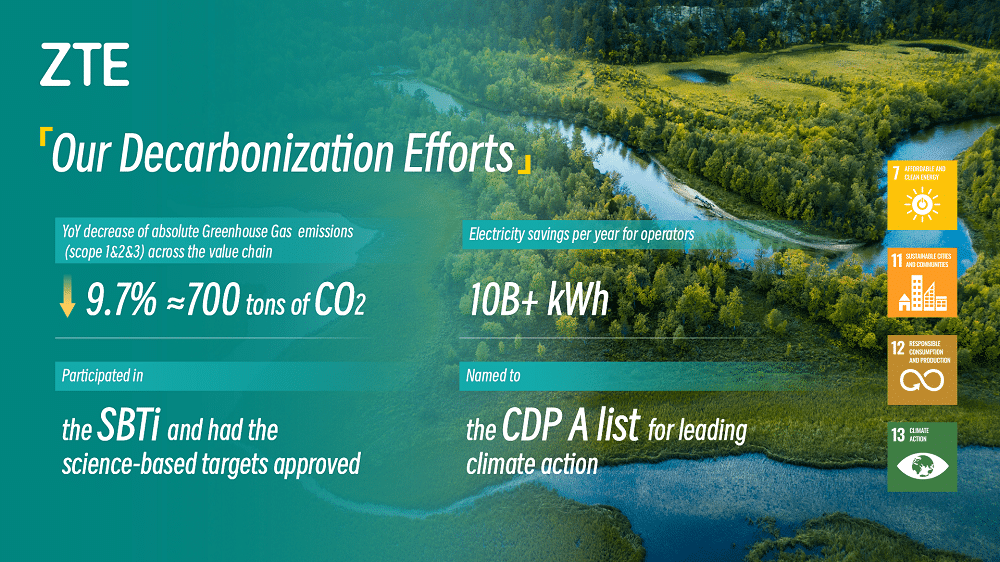
In green operations, ZTE achieved a 9.7% YoY decrease of absolute GHG emissions (scope 1&2&3) throughout the value chain, a 14.58% YoY decrease in the physical intensity of GHG emissions during the use and maintenance phases of the company’s sold telecom products, and over 700% YoY growth of PV power generation installed capacity in 2023.
In terms of green supply chain, the company has completed carbon reduction audit for more than 150 suppliers, and achieved a 3.26% reduction in carbon emissions intensity through its green logistics efforts. Moreover, ZTE was rewarded « National Level Green Supply Chain Management Enterprise » and ZTE Heyuan Base was recognized as a « National Green Factory » in 2023.
For green digital infrastructure, ZTE currently holds over 650 green patents, has conducted carbon footprint assessments for 101 products, encompassing all product categories. The company has helped global operators save more than 10 billion kilowatt-hours in electricity consumption annually.
In the realm of green empowerment, ZTE has introduced a green precision cloud-network solution based on its « Digital Nebula » architecture. Collaborating with over 1000 global top industry partners across diverse sectors, the company has launched more than 100 application scenarios for 5G+ innovative green initiatives. Through these efforts, the company continues to support various industries in their digital transformation and sustainability goals, promoting cost reduction, efficiency improvement, and quality enhancement to drive energy conservation and emission reduction.
Thanks to its sustained efforts in green development, ZTE’s science-based targets, achieving greenhouse gas emissions reduction in line with the 1.5°C temperature rise limitation pathway and reaching net-zero emissions by 2050 at the latest, have been approved by the Science Based Targets initiative (SBTi) in April 2024. This makes ZTE the first large-scale ICT tech company in China to receive official approval for both near-term and long-term GHG emission reduction targets and to make CDP A List for leading climate action, the highest level of recognition for corporate environmental transparency and performance. Additionally, the company recently unveiled « ZTE Zero-Carbon Strategy » white paper at ZTE Sustainable Development Forum, outlining the implementation roadmap of its zero-carbon strategy, demonstrating the company’s commitment to collaborating with various sectors to advance global zero-carbon endeavors.
Embracing Tech for Good to bridge global digital divide
Xie Junshi, Executive Vice President and Chief Operating Officer at ZTE, said: » ZTE incorporates sustainability and ESG into corporate operations and governance, sticks to the philosophy of Tech for Good, and takes on the responsibility and role of a leading ICT player, to bridge the digital divide and enable connectivity and trust everywhere. »
As a global enterprise, ZTE has been engaging in building high-performance « superb networks » across over 100 countries and regions, facilitating the bridging of global digital divide. ZTE has been actively responding to the International Telecommunication Union’s (ITU) call for support in global digital transformation efforts through its Partner2Connect (P2C) Digital Coalition and was recognized as one of the first P2C Champions by ITU. Specifically, ZTE pledged to construct ICT infrastructure annually for Least Developed Countries (LDCs), Landlocked Developing Countries (LLDCs), and Small Island Developing States (SIDS) by 2025, and to dedicate 50,000 hours of ICT lectures globally for the benefits of local workforces in need, as part of its efforts to drive global meaningful connectivity.
Supplier capability building is key for ZTE to ensure supply chain resilience and product quality. In 2023, the company released the SPIRE 2.0 strategy to boost resilience of its supply chain, and carried out diverse training programs to promote capability enhancement of suppliers, jointly contributing to sustainable development.
ZTE puts people first and front, prioritizing the welfare and development of its employees and fostering a nurturing and inclusive workplace environment. In 2023, the average training hours per employee reached 144.7. ZTE was honored with LinkedIn MostIn Awards – Global Talent Magnet Employer in 2023, recognizing its global talent attraction efforts.
ZTE actively fulfills its corporate social responsibility by engaging in public welfare initiatives worldwide, including educational support, medical aid, and care for vulnerable groups. As of 2023, the company has registered 10,754 employee volunteers, accumulating a total of 29,024 volunteer hours. The company’s influence on green development was further extended through welfare activities. For example, the pilot project of forest management and carbon sequestration, which marked milestone progress of the « ZTE Ecosystem Conservation Fund, » was successfully implemented.
Strengthening corporate governance to build a highly resilient organization
ZTE places significant emphasis on internal controls, compliance, social credibility, and business continuity management (BCM). The company continually enhances its corporate governance system, standardizes operations, and ensures continuous and robust business performance.
In 2023, ZTE successfully passed the re-certification audit of the company’s anti-bribery management system and maintained the ISO 37001 Anti-Bribery Management System certification. It conducted 214 joint Business Continuity Plan (BCP) drills in high risk fields. Additionally, the company continuously improves its quality management system. In 2023, ZTE Global Certification and Testing Center conducted 1,372 safety tests throughout the year with a test pass rate of 100%.
As a member of the United Nations Global Compact (UNGC) and the Global Enabling Sustainability Initiative (GeSI), ZTE’s achievements in sustainable development and ESG have gained widespread recognition. For instance, ZTE was selected in UNGC Private Sector Case Studies for achieving Sustainable Development Goals (SDGs) in 2023, and has been included in the FTSE4Good Index Series for eight years and Fortune China ESG Impact List for three consecutive years. Additionally, ZTE was honored among Top 30 ESG Excellence Practices in China and recognized as 2023 IDC China Sustainable Development Pioneer Case.
Moving forward, ZTE will remain committed to its vision « To Enable Connectivity and Trust Everywhere, » leading the way in digital innovation to ensure that the benefits of innovations reach all industries and sectors, contributing new momentum to sustainable development.
For more details of ZTE Sustainability Report 2023, please download:
This Industry Viewpoint was authored by Iceotope’s Dr. Kelley Mullick
Artificial intelligence (AI) is transforming our interactions with technology. From personalized streaming recommendations to autonomous vehicles, it is pervasive and rapidly evolving, and requires support from the digital infrastructure industry to continue its meteoric adoption. This raises a critical question: How are data center operators managing the impact of AI on their operations? … [visit site to read more]
We use cookies to personalise content and ads, to provide social media features and to analyse our traffic. We also share information about your use of our site with our social media, advertising and analytics partners. View more
Cookies settings
Accept
Privacy & Cookie policy
Privacy & Cookies policy
Cookies list
Cookie name
Active
Conditions légales
Introduction et qui nous sommes
118812.fr met en relation des spécialistes du monde entier par le biais d'événements, de renseignements et d'éditions savantes. Nous sommes une société du FTSE 100 et notre réseau de marques internationalement respectées aide les gens à travailler plus intelligemment, à prendre de meilleures décisions et à se développer sur des milliers de marchés spécialisés. Les données et les informations sont au cœur des activités de 118812.fr, et nous prenons au sérieux les questions de confidentialité des données. Nous respectons nos relations avec les clients, les visiteurs, les sponsors, les exposants, les fournisseurs et les collègues, ainsi que la confiance qu'ils nous accordent pour la conservation de leurs données personnelles.
Contrôleurs de données de 118812.fr
Cette politique de confidentialité explique comment les membres du groupe 118812.fr collectent, utilisent et protègent les informations personnelles à travers nos marques. Les références à "nous", "notre" ou "nos" renvoient au contrôleur 118812.fr concerné qui traite vos informations personnelles.
118812.fr est structuré en cinq divisions opérationnelles :
Au sein de ces divisions, il existe des entreprises sectorielles et des marques de produits, d'événements et de services. En général, lorsque nous interagissons avec vous, c'est par le biais de l'une de ces marques. L'entité juridique du groupe 118812.fr responsable des données personnelles (désignée comme le contrôleur des données dans l'UE et désignée comme le contrôleur 118812.fr dans la présente politique de confidentialité) sera l'entité indiquée sur les formulaires de réservation, les formulaires Web et les contrats ou les factures. Différentes entités juridiques de 118812.fr sont responsables de différents événements et produits. Pour mettre à jour vos informations personnelles ou vos préférences en matière de marketing, contactez les équipes de marketing de nos divisions énumérées ci-dessous. Pour toute question ou plainte concernant la confidentialité des données, vous pouvez vous adresser à l'équipe 118812.fr Privacy via notre formulaire en ligne.
Couverture internationale et variations
118812.fr opère dans plus de 20 pays, qui ont chacun des lois différentes sur la protection des données. La présente politique de confidentialité s'applique à toutes les activités de 118812.fr dans le monde, sauf dans la mesure où il existe une exigence spécifique à un pays qui la complète, comme indiqué dans le menu de gauche.
Ce que nous recueillons
Cette section vous indique quelles informations personnelles nous pouvons recueillir lorsque vous utilisez nos produits et services, et quelles autres informations personnelles nous pouvons recevoir d'autres sources. Dans la présente politique de confidentialité, les informations personnelles désignent les types de 118812.frtions personnelles qui peuvent être collectées et utilisées, notamment : Les coordonnées, telles que le nom, l'adresse électronique, l'adresse postale et le numéro de téléphone.Informations sur l'éducation, la nationalité et la professionles noms d'utilisateur et les mots de passeCommentaires, réactions, messages et autres contenus soumis, y compris les informations relatives aux enquêtes.Intérêts et préférences de communication, y compris les autorisations de marketing, le cas échéant.Informations de localisation, telles que celles fournies par une application mobileInformations de vérification de l'identité, telles que les détails du passeport, afin de se conformer aux obligations légales dans certains pays et de fournir des lettres d'invitation de visa, le cas échéant.Informations sur l'utilisation du site web et des communications, telles que la correspondance et les détails de votre utilisation de notre site web et de nos services obtenus par le biais de cookies ou d'autres technologies de suivi.
Ces informations personnelles concernent les catégories de personnes suivantes :
Prospects, contacts clients, abonnés et utilisateurs en ce qui concerne nos services et produits ;Visiteurs, sponsors, exposants et conférenciers lors de nos événements ;Les professionnels figurant dans les produits numériques et imprimés, tels que les détails des cadres supérieurs mis à disposition par les produits de renseignement, les recherches et les publications.les auteurs, éditeurs et réviseurs de nos publications.les contacts de nos prestataires de services et partenaires commerciaux.Informations personnelles sensibles