ZTE extends AI integration across its terminal device portfolio

ZTE Corporation has unveiled a range of new, AI-enabled devices during MWC2025 in Barcelona, under the banner of its « AI for All » product strategy.

They include a new full-screen smartphone and devices catering for the gaming, photography, fashion and music markets, as well as a lineup of AI-enabled fixed-wireless access (FWA) and mobile broadband (MBB) products featuring 5G-Advanced and Wi-Fi 7.

ZTE says it is creating a  “full-scenario intelligent ecosystem” connecting person. vehicle and home, with a goal to ensure that every consumer can benefit from the efficiency, enhanced functionality and “emotional resonance” brought by AI.

In cooperation with its long-established global partners, including Qualcomm, Unisoc and Google, ZTE is committed to integrating world-leading AI capabilities across its smartphone and FWA & MBB product lines, explained Ni Fei, SVP of ZTE Corporation and President of ZTE Mobile Devices.

nubia expanding ZTE’s global market presence

In the AI era, smartphones are evolving into a comprehensive intelligent platform that seamlessly integrates connectivity, interaction, services, and entertainment, explained Fei. AI‘s most significant benefit is to upgrade the user interaction, with intelligent agents replacing traditional apps as the main consumer interface

« By seamlessly connecting multi-modal architectures with advanced AI large-language models (LLMs), we are transforming how users interact with technology across photography, gaming, translation, and AI generated content.” 

Working with Google, ZTE is accelerating AI transformation in overseas markets, where all new products under its nubia brand will integrate Gemini, Google’s AI model, combined with Google Cloud’s scalable, secure, and high-performance infrastructure, says Fei.

ZTE says it has seen overseas smartphone shipments surge by over 60% since 2024, with notable market share gains across Latin America, Southeast Asia, Africa, and Europe. 

nubia is now present in more than 30 countries and regions, and is “accelerating its global expansion with AI-driven devices offerings” fueled by gaming- and photography-centric product portfolios as well as “elevated product tiers, expansive sales channels, an enriched ecosystem, and strengthened localized marketing efforts,” says the company.

ZTE introduces “world-first” AI-powered FWA & MBB products

In the FWA and MBB market, ZTE points to partnerships with more than 130 operators in over 100 countries, and shipments amounting to more than 250 million devices globally, including 7 million 5G FWA & MBB units. The latest report from international consultancy firm, TSR, ranks ZTE as world No.1 in the FWA & MBB market, while ABI Research recognizes ZTE as the overall leader, top innovator, and top implementer in its 5G Fixed Wireless Access (FWA) CPE Vendor Competitive Assessment report.

ZTE’s full-stack AI FWA solution incorporates six core AI-driven features: AI Multi-Scenario Application, AI QoS Management, AI Voice Control, AI Application Recognition, AI Children Protection, and real-time AI Network Optimization, says the company.

First of the three new AI FWA & MBB products unveiled during MWC2025, the ZTE G5 Ultra is a 5G-Advanced device capable of delivering peak speed of up to 19Gbps. It supports tri-band Wi-Fi 7, dual 2.5Gbps network ports, and integrates AI voice control and AI QoS management. By leveraging advanced AI algorithms, the ZTE G5 Ultra dynamically optimizes network performance, ensuring seamless connectivity for online gaming, 4K streaming, and remote work, says ZTE.

Secondly, the ZTE G5 Max Wi-Fi is a  Wi-Fi 7/mmWave FWA device supporting both Sub-6GHz and mmWave carrier aggregation with peak speeds of up to 10Gbps. Featuring a 30dBi ultra-high-gain antenna design, it ensures stable signal reception at up to 6km coverage in outdoor environments, dramatically improving both downlink and uplink speeds, and decreasing power consumption, according to ZTE.

Finally, the ZTE U60 Pro is claimed to be the world’s fastest Wi-Fi 7 5G Mobile device, capable of delivering peak speeds of 3.6Gbps. A 10,000mAh battery supports up to 16 hours of working time, and dual-band Wi-Fi 7, fast charging, and reverse charging capabilities provide convenient power-sharing for other mobile devices.

All three products support ZTE’s GIS (Green, artificial Intelligence, Security) product philosophy, which uses AI-driven technologies to optimize network performance, says the vendor. Key features include Green Energy Efficiency, with AI-driven energy-saving strategies that learn from user behavior to optimize power consumption; AI-Powered Intelligence, with ZTE’s AI Super Antenna, ensuring reliable connectivity even in weak signal areas; and Smart Network Optimization, which dynamically allocates bandwidth to improve efficiency and reduce congestion.

Partnership-driven FWA & MBB leadership

All three FWA & MBB products feature Qualcomm’s Dragonwing FWA Gen 3 platform with the Snapdragon X75 5G Modem-RF System, and promise to set a new benchmark in 5G performance, energy efficiency, spectrum flexibility and connectivity, says ZTE.

“FWA provides a cost-effective and flexible alternative to wired broadband enabling high-speed internet access in underserved parts of the world and remote areas,” said Rahul Patel, Group GM Connectivity, Broadband and Networking at Qualcomm Technologies.

Qualcomm’s collaboration with ZTE has been instrumental in driving innovation and excellence, and in the FWA market, the two companies have  together achieved remarkable milestones including the development of cutting edge AI-based FWA solutions, said Patel.

“This is the power of partnership. ZTE has consistently demonstrated its leadership in the FWA marketplace maintaining a strong position for many years. ZTE’s expansive portfolio backed by Qualcomm’s advanced AI-driven technology solutions showcases the two companies’ dedication to innovation and commitment to excellence in the FWA market.”

MORE ARTICLES YOU MAY BE INTERESTED IN…

Zambia brings data-driven decision-making to tourism

The Zambia Tourism Agency (ZTA) and operator Airtel Zambia have signed what the two groups describe as a landmark memorandum of understanding (MoU) to enhance tourism planning and development using anonymised telecommunications data.

The aim of this strategic collaboration is to provide critical insights into visitor movement trends, enabling data-driven decision-making to promote and develop Zambia’s tourism sector.

In order to make this happen, Airtel Zambia will supply aggregated and anonymised data on traffic movement in designated tourism areas. The company emphasises that it will also ensure full compliance with data privacy regulations and maintain strict confidentiality for subscribers.

By analysing these insights, ZTA says it will gain a clearer understanding of visitor trends, peak travel periods, and mobility patterns, ultimately leading to more effective tourism strategies and policies.

ZTA Chief Executive Officer, Mr Matongo Matamwandi, explains: “In the tourism sector, performance is typically measured through international tourist arrivals, domestic tourist visits, tourism receipts, hotel occupancy rates, length of stay and tourist spending. While the Ministry of Tourism is currently working on a Tourism Satellite Account (TSA) to provide a more structured measurement of the sector’s contribution to GDP, ZTA has sought alternative methods to measure domestic tourism performance. This partnership with Airtel will enable us to access domestic tourism data through mobile phone analytics, supplementing existing data sources from heritage sites, museums, and national parks, which do not provide a comprehensive picture of domestic tourism activities.”

Among major attractions in Zambia are the Zambezi River, safari experiences, and, of course, Victoria Falls.

MORE ARTICLES YOU MAY BE INTERESTED IN…

Liberty Global in talks to acquire Vodafone’s stake in Dutch JV VodafoneZiggo 


News 

The two companies formed the JV back in 2016 

Liberty Global has entered into talks with Vodafone over a potential acquisition of Vodafone’s stake in Dutch joint venture VodafoneZiggo, Bloomberg has reported. 

VodafoneZiggo is a Dutch telco company formed as a joint venture (JV)  between Vodafone Group and Liberty Global in 2016. The JV is spit equally between the companies. It was formed as a merger between Vodafone’s mobile services and Ziggo’s broadband and television operations in the Netherlands. 

The potential deal, which has been in negotiations for several months, could see Vodafone’s stake valued at over €2 billion. If the acquisition proceeds, Liberty Global would gain full control over VodafoneZiggo. 

The move does not come as a total surprise. Speaking at the Goldman Sachs’ European Communacopia Conference in September last year, Liberty Global Chief Executive Officer Mike Fries said despite the success of the JV, “seven years is a long time for a joint venture. So, we need to think about where we’re going with that business.” 

All three partied have declined to comment on the report. 

Keep up to date with the latest international telecoms news by subscribing to our newsletter, three times per week into your inbox 

Also in the news:
Vodafone and Ericsson cut 5G energy bill by a third in latest ‘sleep mode’ trials
Startup Stories: Introducing automation and observability specialist Telaverge Communications
Shock U-turn as Jio and Airtel both sign up for Starlink

Huawei embroiled in European Parliament bribery scandal  


News 

The investigation, which has led to multiple arrests and searches across Europe, has raised concerns about foreign interference and political integrity in the EU 

This week, Belgian authorities have arrested several people as part of a corruption investigation related to the European Parliament and Chinese tech giant Huawei. 

It has been confirmed that a large-scale investigation is ongoing into potential corruption, forgery, and money laundering occurring “very discreetly” since 2021.  

More than 100 officers carried out 21 searches in Belgium and Portugal, while one arrest was made in in France. Officials also sealed offices within the European Parliament belonging to two suspected parliamentary assistants.  

The probe alleges that Huawei offered luxury gifts, paid travel, and event invitations “under the guise of commercial lobbying” while seeking to directly influence European politics. In some cases, the investigators claim, remuneration was even provided for taking specific political positions.  

 It is also believed that some payments have been disguised as business expenses or sent through third parties.  

According to Belgian newspaper Le Soir, which organised the investigation along with fellow paper Knack and investigative website Follow the Money, one of the central figures in the probe is Valerio Ottati, a Belgian–Italian lobbyist who joined Huawei in 2019. Before becoming the company’s EU public affairs director, he worked as an assistant to two Italian MEPs involved in EU–China relations. 

Huawei has strongly denied the allegations, with a spokesperson saying, “Huawei has a zero-tolerance policy towards corruption or other wrongdoing, and we are committed to complying with all applicable laws and regulations at all times.” 

Huawei has faced various bans and restrictions across Europe due to concerns over threats to national security, allegations of corruption. Countries such as the UK, Germany, France and Sweden have all implemented bans of Huawei infrastructure in mobile networks. The European Commission emphasised its security concerns over Huawei’s involvement in Europe’s 5G networks. The European Commission itself has not yet commented, but EU Commission spokesperson Thomas Regnier warned that the “security of our 5G networks is obviously crucial for our economy.”  

“Huawei represents materially higher risks than other 5G suppliers…a lack of swift action would expose the EU as a whole to a clear risk,” he continued. 

Keep up to date with the latest international telecoms news by subscribing to our newsletter 

Also in the news:
Vodafone and Ericsson cut 5G energy bill by a third in latest ‘sleep mode’ trials
Startup Stories: Introducing automation and observability specialist Telaverge Communications
Shock U-turn as Jio and Airtel both sign up for Starlink

Zayo Buys Fiber Biz From Crown Castle

Zayo Buys Fiber Biz From Crown Castle

Zayo has won the competition to acquire Crown Castle’s fiber business, fulfilling the rumors that have been spilling out since January. On Friday, the infrastructure provider announced that it has entered into a definitive agreement to acquire Crown’s fiber assets, customers, etc for $4.25B. Meanwhile, in a parallel but separate deal, EQT will acquire Crown Castle’s small cell business. … [visit site to read more]

Industry Spotlight: GTT SVP of Product Engineering Gary Sidhu on Networks  and the AI Revolution

Industry Spotlight: GTT SVP of Product Engineering Gary Sidhu on Networks  and the AI Revolution

With the rise of AI has come vast investments in new data centers around the world.  But still getting less attention is how all that AI infrastructure will be connected to itself and to everything else.  But network operators are definitely gearing up to take on the challenge.  With us today to talk about GTT’s approach is Gary Sidhu, SVP for Product Engineering. … [visit site to read more]

‘Adapt or die’: VOX Solutions’ message to telcos in the age of AI


Interview

We caught up with Ehsan Ahmadi, CEO of VOX Solutions, to discuss the many monetisation opportunities offered by AI and why telcos must evolve to take advantage

You founded VOX Solutions back in 2010 – how has the industry changed since then and what has that meant for VOX?

The telecom industry used to be a walled garden. Now? It’s a battlefield. Traditional telcos aren’t just competing with each other anymore, they’re up against tech giants, AI-driven platforms, and cloud-based disruptors. If you’re not innovating, you’re dying.

VOX Solutions saw this shift early. We’ve been building automation, AI-driven and smarter monetisation solutions such as A2P Voice/flash call monetisation, A2P SMS monetisation and Ad-tech to help telcos survive, and thrive, in a market that’s evolving at warp speed.

Monetisation is still a huge problem for telcos. Where do you see them going wrong?

Too slow. Too bureaucratic. Too stuck in the past.

Telcos are sitting on a goldmine of data and infrastructure, but many still operate like it’s 1999. Meanwhile, tech companies are eating their lunch with cloud platforms, AI, and over-the-top (OTT) services.

The future belongs to those who move fast, automate ruthlessly, and leverage AI to unlock new revenue. Telcos that don’t evolve will become dumb pipes, just infrastructure for others to profit from.

What is your approach to tackling these problems at VOX? How big are the potential financial benefits here?

Simple: AI + Data + automation = massive efficiency and revenue.

We help MNOs stop leaving money on the table. Every call, every message, every data point is a monetisation opportunity if you have the right tech. We’re turning telcos into AI-powered revenue machines, optimising every aspect of their operations.

The financial upside is huge. The telco industry is a multi-trillion-dollar space. Those who adapt will dominate. Those who don’t… won’t exist.

You’ve been incorporating AI and machine learning in your solutions for years – what’s your take on how AI can impact telcos’ monetisation efforts?

AI isn’t the future, it’s the present. And if you’re not using it, you’re already behind.

Telcos have massive amounts of untapped data. AI turns that into money, automating fraud prevention, optimising pricing, and creating entirely new revenue streams. This isn’t about small improvements; it’s about rewiring the industry.

At VOX Solutions, we don’t just use AI, we build with it at the core. Our goal is simple: make AI the engine that increases telco profitability.

The telecom industry continues to change rapidly – what do you think MNOs’ business models will look like in 10 years, and what role do you see VOX playing in that transformation?

In 10 years, telcos won’t be telcos. They’ll be AI-driven digital platforms.

Voice, SMS, and data bundles? That’s the past. The future is automation, AI, Ad-tech, API, IoT and services we haven’t even imagined yet. The winners will be those who evolve into tech companies, not just connectivity providers.

VOX Solutions is making sure MNOs don’t just keep up, they lead. We’re building the AI-powered tools that will redefine what a telco can be. The next decade belongs to those who think big and move fast.

Can you give examples of successful and unsuccessful MNOs? What sets them apart?

The difference between success and failure in telecom is simple: adapt or die.

At VOX Solutions, we’ve helped 20+ MNOs boost their EBITDA by over $100 million — that’s an average of $5 million per operator, improving margins by 5%. These are the MNOs that embrace AI, automation, and new monetisation strategies. They move fast, optimise aggressively, and win.

On the flip side, we’ve seen plenty of MNOs that refuse to evolve. Some claim they’ll build in-house solutions — but never do. Others just don’t bother at all. The result? Declining revenue, shrinking margins, and a slow death. If they don’t change course, they’ll either collapse or get taken over by stronger MNOs at distressed prices.

This industry doesn’t wait for anyone. The question is: will you lead or be left behind? If you’re ready to scale revenue, optimise efficiency, and future-proof your business, let’s talk.


You can learn more about Vox Solutions here

FBA CEO defends rural fiber subsides at Connected America


News

By: Brad Randall, Broadband Communities

The Fiber Broadband Association CEO pushes back against rhetoric questioning the feasibility of subsidizing rural fiber at Connected America.

Gary Bolton, the CEO of the Fiber Broadband Association, was outspoken in defense of rural fiber broadband subsidization at Connected America in Dallas this week.

Bolton’s comments came in response to another panelist during a keynote discussion on Day 2 of Connected America, titled “Fiber for Everyone?”

“You hear this rhetoric about, why would you spend $100,000 pulling fiber to a home that’s only worth $125,000,” he said. “Well, I’ll tell you why. Because the reason it costs $100,000 to get that fiber is because there’s no infrastructure to that home.”

Bolton said once fiber is provided to rural residences it operates as a complete game-changer.

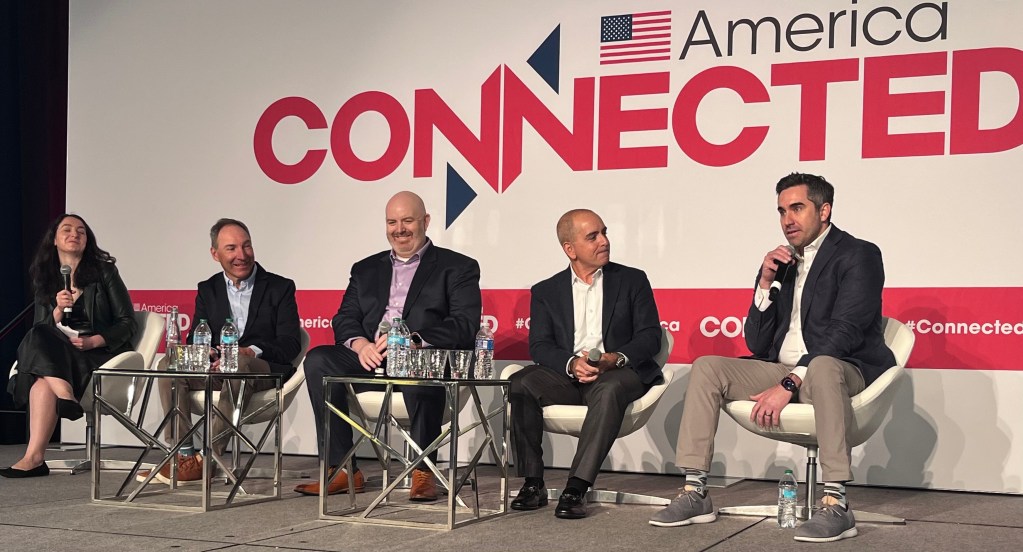
(L to R) Patience Haggin, of the Wall Street Journal, moderates “Fiber for Everyone?,” a keynote panel at Connected America 2025. She’s joined by Gary Bolton, the CEO of the FBA, Cameron Kilton, the CTO of Nextlink Internet, Jose Espinel, an SVP at Comcast, and Tom Monahan, a VP at AT&T.

“So, if you were able to put this fiber infrastructure all the way to this home that might be rural low income, well guess what? That rural low-income home now has access to world class healthcare, world class education, jobs, and all of a sudden that low-income house becomes a middle-income house,” Bolton passionately stated.

Bolton’s comments came in response to those from Cameron Kilton, Nextlink Internet’s CTO.

‘We’ll never get to 100 percent fiber’

“Despite our best efforts, despite program fundings, we’ll never get to 100 percent fiber,” Kilton said, adding that he doesn’t like to use the word “never” often. “It’s just not realistic.”

Kilton also said he believes “it’s not financially responsible for the government to go spend $150,000 a passing.”

He further suggested that Starlink-provided connectivity could be a more viable option for off the beaten path rural residents.

Additionally, Kilton said fiber networks are providing more bandwidth than customers need.

From his experience, Kilton said peak usage for a family of eight is 22 megabits per second.

“Is it nice to have a big, giant download pipe,” Kilton asked. “Of course it is. Everything comes a little bit faster when you need it.”

He said uses beyond 22 to 25 megabits per second for families are “not often unless you have a big download.”

‘This is a fantastic investment’

In his response to Kilton’s comments, Bolton also addressed what fiber in rural areas does for communities, allowing them to erect cell towers and provide reliable cell service.

“So, now this rural area that has zero connectivity has cell service,” he said. “Now that you have fiber, cell service, and a middle-income home, other homes start to be developed. Now you have economic development.”

Bolton said fiber in rural communities can also help those communities generate taxable revenue. He predicted revenue generated would exceed the cost of the subsidies to build fiber.

“So, this is a fantastic investment,” he said of fiber.

Evidence for fiber’s value as an investment should be derived from the results of the Rural Electrification Act, Bolton argued.

“Then, all of a sudden, you start to see everybody, all Americans, start to move up in their quality of life,” he said.

Learn more about Broadband Communities Summit 2025 in Houston.

Also, click here to subscribe to the Broadband Communities newsletter.

ZTE’s 5G-A minimalist private network solution helps live broadcasting enter the mature commercial wireless era

At MWC Barcelona 2025, ZTE won the « GSMA Foundry Innovation Award » at the GLOMO Awards 2025 for its Minimalist Private 5G-A solution.

The award demonstrates ZTE’s technological leadership and outstanding contribution to the digital transformation of the cultural and entertainment industry, and further indicates its unlimited potential in future live broadcast transformation.

The annual GLOMO Awards represents the industry’s most prestigious accolade. With a judge panel comprising over 260 global analysts, media professionals, and industry experts this year, the GLOMO Awards 2025 celebrates individuals and companies that drive innovation and showcase excellence in the rapidly growing mobile industry. The minimalist private 5G-A solution integrates 5G-A micro base station, namely MiCell, with NodeEngine – a base station computing engine, enabling efficient and reliable deployment of private networks, injecting new momentum into entertainment services, and successfully earning this prestigious recognition. For instance, in large-scale VR experience scenarios, users no longer need to carry heavy equipment to enjoy stable, real-time VR rendering. In the media broadcasting industry, photographers can completely free themselves from cable constraints, flexibly capturing live footage.

MWC Barcelona 2025: Creating a 5G-A Wireless Broadcasting Milestone

During MWC 2025, ZTE collaborated with GSMA’s official media platform Mobile World Live (MWL) to achieve the first 5G-A-powered expo live broadcast. In this partnership, ZTE deployed the minimalist 5G-A private network architecture, providing high-performance signal coverage through indoor MiCell micro stations, and ensuring footage continuity during camera movement using their exclusive 5G-A SuperMIMO technology.

interview 600

On-site test revealed an average wireless air interface latency of just 4ms, with end-to-end service latency (including encoding and decoding) under 100ms, delivering picture quality indistinguishable from wired solutions. The MWL directing team exclaimed: « Photographers can freely move around to capture footage, making viewers feel as if they’re actually there – this is a revolution in broadcasting technology! » Additionally, the NodeEngine enabled « one-hop » from the shooting site to the broadcast center, eliminating the necessity of public network transmission and effectively enhancing both transmission efficiency and security. This broadcast not only validated 5G-A’s high reliability but also showcased the unlimited possibilities of wireless broadcasting to the world.

5G-A Minimalist Private Network: Technical Architecture and Wireless Evolution Path

The core of ZTE’s 5G-A solution lies in using « simplification » to solve complexity. Traditional private network deployments require independent core networks and complex wiring, while ZTE’s solution reuses existing 5G base station infrastructure, deeply integrating millimeter wave, edge computing, and cloud computing technologies to achieve lightweight deployment with « 0 additional core network. »

This architecture reduces deployment costs by 40% while supporting uplink speeds of up to 2Gbps per camera and maintaining stable end-to-end latency at the 100ms level, perfectly accommodating 4K/8K ultra-high-definition broadcasting requirements. For example, during the 2025 CCTV Spring Festival Gala broadcast, the 5G-A distributed MiCell and NodeEngine deployed throughout the studio worked collaboratively, enabling « one-hop » data transmission to the broadcast center with an average air interface latency of just 4ms. This completely eliminated the challenges of switching between wired and wireless systems, successfully achieving the first-ever 4K wireless broadcast on television screens in the Gala’s 43-year history.

Certainly, the success of this technology is inseparable from ZTE’s continuous investment in R&D. In 2024, its R&D expenses reached 24.03 billion yuan, accounting for 20% of revenue. This high-intensity innovation investment has provided solid support for the commercial implementation of 5G-A technology.

Furthermore, the core of ZTE’s 5G-A Minimalist Private Network solution lies in « simplification » and « efficiency. » Its characteristics can be summarized in three points:

  1. Minimalist architecture: Multi-scenario 5G-A devices can be selected as needed to quickly achieve high-quality network coverage; NodeEngine offers plug-and-play functionality, significantly reducing private network deployment costs and time frames.
  2. Outstanding performance: Supports uplink speeds of up to 2Gbps per camera with end-to-end latency at the hundred-millisecond level, fully meeting 4K/8K ultra-high-definition broadcasting and switching requirements.
  3. Security and reliability: Data is locally offloaded without public network transmission, and the dedicated network mode has gained high recognition in the broadcasting industry.

Throughout the evolution from traditional wired to wireless broadcasting, ZTE has consistently been a leader. From the first vertical screen wireless broadcast experiment at the 2024 CCTV Spring Festival Gala, to achieving television 4K wireless broadcasting in 2025, to the commercial implementation of multi-camera at the Malaysia National Games, each step marks the broadcasting industry’s journey from « fixed » to « free. »

5G-A Broadcasting Technology in Depth: The Synergistic Evolution of Light Compression Codec and Computing Engine

The innovative highlight of ZTE’s 5G-A broadcasting technology lies in the synergy between « shallow compression codec » and « base station-level computing engine. » If the minimalist architecture is the skeleton of 5G-A, then the « shallow compression codec » and « computing engine » are its nerves and blood vessels. Shallow compression technology preserves original image quality with a 1:10 compression ratio, increasing single-camera bit-rate to 880Mbps at 4K resolution, while the computing engine enables real-time data processing through edge computing. The combination significantly reduces transmission pressure, lowering bandwidth requirements by 80% compared to traditional wireless solutions without compromising image details.

In this process, the base station-level computing engine plays an indispensable role. The NodeEngine achieves data offloading through edge computing, compressing encoding/decoding and transmission latency to the hundred-millisecond level. During the Hangzhou Asian Games, this technology combined with 1.6GHz ultra-wide bandwidth equipment allowed one single base station to support dozens of 8K live broadcasts with a downlink peak rate of 25Gbps, providing foundational support for XR immersive viewing and multi-angle switching. The « integrated computing-network nomadic base station » jointly launched by ZTE and China Telecom can be rapidly deployed in temporary venues to meet the sudden demands of large events. Technical officials from the Asian Games Organizing Committee described it as « redefining the flexibility of smart venues. »

From the Spring Festival Gala to the International Arena: the Global Practice of 5G-A Wireless Live Broadcast

The success of the technology has effectively promoted the expansion of the market, and domestic successful cases have laid the foundation for the technology to go overseas. In 2024, the vertical screen live broadcast of the Spring Festival Gala jointly organized by ZTE and CCTV won the double first prize of the « Blooming Cup » Competition hosted by the Ministry of Industry and Information Technology, and the judges evaluated it as « the perfect balance of picture quality and efficiency ».

In 2025, CCTV Spring Festival Gala used 5G-A wireless camera for the first time for large-screen 4K TV live broadcast, marking the biggest technological breakthrough in 43 years. The 5G-A minimalist private network deployed by ZTE covers the entire venue through MiCells, 5G-A Super MIMO technology ensures zero switching of camera movement, and AI beam tracking achieves accurate signal guarantee.

In terms of technical details, 4K shallow compression codec enables a single camera bit rate of 880Mbps and an air interface delay of only 4ms. The technical director of the station revealed: « The wireless camera and the wired camera work together seamlessly, and the audience can’t even tell which images are from wireless shooting. » In addition, the three 4K wireless cameras deployed in the corridor outside the studio provide multi-angle interviews and live broadcasts for many media.

On the international stage, the 2024 Malaysia National Games (SUKMA) is a key event. ZTE, in conjunction with CelcomDigi and U Mobile, has achieved the first wireless live broadcast of national-level events, with seamless multi-camera images. RTM (Radio Televisyen Malaysia) commented: « This is a milestone in the history of sports broadcasting. »

At the opening ceremony, the photographer walked around the stadium with a 5G-A backpack, and the 6-hour live broadcast was always smooth. Ahmad, technical director of the RTM, said: « The wireless camera allows us to capture perspectives that were previously impossible, such as close-ups of athletes’ sprinting feet and enthusiastic reactions from the audience. » During the event, ZTE’s solution also supported low-altitude drone aerial photography and multi-camera follow-up shooting of water events, presenting an « immersive viewing feast » for the audience.

During the 2023 Hangzhou Asian Games, ZTE and China Telecom cooperated to build the world’s largest 1.6GHz bandwidth 5G-A network. A single base station supports dozens of 8K live broadcasts, with a downlink peak rate of 25Gbps. In the venue, the dynamic collaborative Reconfigurable Intelligent Surface (RIS) optimizes signal coverage, and XR services support immersive viewing for thousands of people.

It is worth mentioning that the « integrated computing-network nomadic base station » launched by ZTE can be quickly deployed in temporary venues to meet the sudden needs of large-scale events such as the opening ceremony. The technical official of the Asian Games Organizing Committee commented: « 5G-A not only improves the quality of live broadcasts, but also promotes the comprehensive upgrade of smart venues. « 

Unlimited Possibilities: from Stages to the Future of Thousands of Industries

The mature commercial use of ZTE’s 5G-A live broadcast technology has brought far-reaching impacts to industries such as entertainment, sports, education, and tourism. At the same time, we have noticed that the value of 5G-A technology is far more than the stage and the stadium.

The technology also extends to low-altitude economy, Internet of Vehicles, telemedicine and other fields. In the field of low-altitude economy, the tele-sensing integrated base station jointly developed by ZTE and Nanjing Telecom has realized the real-time return and precise positioning of drone aerial images; in the Internet of Vehicles scenario, the « 5G-A vehicle-ground system » of Shanghai Metro Line 4 has a carriage return rate of 15Gbps, laying the foundation for smart transportation. Even education, tourism, medical care and other fields have ushered in innovation due to the ubiquitous connection and ultra-low latency of 5G-A – museum visitors can immerse themselves in exhibitions through AR glasses, and doctors performing remote operations can get nearly real-time operation feedback.

From the podium in Barcelona to the stadium in Kuala Lumpur, from the studio in Beijing to the smart venue in Hangzhou, ZTE’s 5G-A minimalist private network and live broadcast technology continue to break boundaries and reshape the global live broadcast ecosystem with the « Innovative wireless solution ».

MORE ARTICLES YOU MAY BE INTERESTED IN…

2025 – The Year of Practical AI: Chain of thought is more powerful, productive, & present in our everyday lives

2025 – The Year of Practical AI: Chain of thought is more powerful, productive, & present in our everyday lives

This Industry Viewpoint was authored by Rajiv Papneja, CTO of Prodapt

Expect many enterprises to realize ROI from their AI investments

This year will be about taking the AI impact from Proof to Value. Businesses will lay a sharp focus on measuring the impact of AI adoption. A new range of customer success KPIs will emerge. For example, … [visit site to read more]