DZS and Summit Technology Solutions have partnered to deliver hyper-fast fibre optic broadband connectivity to Africa’s tallest building.
DZS, a specialist in access, optical and cloud-controlled software defined solutions, has announced that its integration partner Summit Technology Solutions (STS), an information technology and business solutions provider serving the Middle East, North Africa, and Asia, will leverage DZS Access and Subscriber EDGE technology over fibre as the security and smart network (SSN) infrastructure for the Iconic Tower and Crescent Tower projects in Egypt’s New Administrative Capital, which is being developed by Administrative Capital Urban Development (ACUD).
With a total height of 400 metres and 77 floors scheduled for multi-use occupancy in 2024, including the ultra-luxury Raffles hotel, the Iconic Tower is the tallest building in Africa.
The Crescent Tower will stand at the heart of the Central Business District in the New Administrative Capital and house the luxury Fairmont Cairo New Capital City hotel.
The SSN infrastructure consists of hyper-fast next generation fibre optic broadband connectivity, security cameras, gates and other access systems, and smart sensors and various Internet of Things (IoT) applications, both within and connecting the towers.
The New Administrative Capital, also known as the New Cairo Capital City, is a planned urban community located 35 kilometres east of Cairo that will be the first smart, connected city in Africa. It will house Egypt’s central government offices, the presidential palace, foreign embassies, financial headquarters and numerous businesses and educational institutions, and will be home to approximately seven million residents.
DZS has been involved in delivering hyper-fast connectivity to the New Administrative Capital since 2021.
UK alternative network providers (altnets) are experiencing mixed fortunes. On the positive side, the likes of Gigaclear and CityFibre continue to bullishly celebrate their continued expansion, whilst others are falling foul of tough economic conditions – most recently Broadway Partners who went into administration at the end of May.
The situation isn’t eased by the consumer concerns over whether they can trust an altnet.
New research published by comparison website Uswitch found that only 15% of broadband customers answered positively when asked “Do you know what a broadband alternative network altnet is?” and only one-in-three consumers said they would consider using a new or unfamiliar provider.
Ernest Doku, telecoms expert at Uswitch.com, commented “The main challenge altnets face is that no one knows who they are. So, when they offer lower prices with incredible advertised speeds, consumers understandably may find it hard to be sure if they can trust them over the big names who have been around for decades.”
The irony of the situation will not be lost on the altnets. Most broadband customers (61%) would like to see more variety and choice in terms of broadband providers in their local area and altnets are well positioned for the current economic climate, generally offering consumers better value for money (up to three times more performance per £ according to Uswitch) – but still consumers are wary.
Today Chancellor Jeremy Hunt meets with economic regulators to discuss how to protect consumers from the impact of high inflation, so maybe this is the moment for altnets to shine? Certainly, this is the view of YouFibre’s CEO, Jeremy Chelot, who commented “Alternative networks like YouFibre and Hyperoptic are working hard to offer consumers ultrafast internet at fair prices and it’s time for them to make their voices heard.”
Keep up-to-date with all the latest news, articles, event and product updates posted on Developing Telecoms. Subscribe to our FREE weekly email newsletters for the latest telecom info in developing and emerging markets globally.
Sending occasional e-mail from 3rd parties about industry white papers, online and live events relevant to subscribers helps us fund this website and free weekly newsletter. We never sell your personal data. Click here to view our privacy policy.
President Joe Biden and Vice President Kamala Harris have announced how the $42.5 billion Broadband Equity, Access and Deployment (BEAD) funds will be divided among U.S. states and territories
President Biden, Vice President Harris and Secretary of Commerce Gina Raimondo announced the allocations at the White House on Monday June 26. “What this announcement means for people across the country is that if you don’t have access to quality, affordable high-speed Internet service now – you will, thanks to President Biden and his commitment to investing in America,” Raimondo said. Mitch Landrieu, Senior Advisor to the President and White House Infrastructure Coordinator said, “simply put, high-speed Internet is a necessity in today’s society” and emphasized that the Biden-Harris administration is “committed to leaving no community behind”.
Drawing comparisons to President Franklin Roosevelt’s 1936 Rural Electrification Act, the Biden administration acknowledged that the goal of providing high-speed internet to all Americans is “bold” but by no means impossible. The BEAD program is part of President Biden’s sweeping Infrastructure Investment and Jobs Act (IIJA) and aims to close the digital divide.
The money allocated to each state was determined by the Federal Communications Commission’s (FCC) national broadband availability maps. An initial version of the map was published in November and was followed by a challenge process. States, internet service providers, and other parties were able to officially challenge the accuracy of the FCC’s data. The second version of the map was released May 30 and the NTIA used this to determine how to divide BEAD funds.
A senior administration official reported that the maps show that 8.5 million locations in the U.S. and its territories – about 7% of the country – do not have access to high-speed internet. Once states receive formal notice of their allocation on June 30, they will have six months to submit initial proposals for how they will spend the funds.
State governments will coordinate with county and local governments to formulate spending plans and correct any additional errors in availability data. After the NTIA approves states’ initial plans, state authorities can access 20% of their allocated funds. The remaining 80% will be available after states submit their final plans in spring 2025.
Tyler Cooper, editor-in-chief of BroadbandNow, said that “there weren’t any shockers” in terms of allocation amounts. Texas won the largest allocation at $3.31 billion – unsurprising given the vast scale of the state and the number of rural areas outside of the main urban hubs. California is set to receive $1.86 billion, closely followed by Missouri ($1.74 billion), Michigan ($1.56 billion), and North Carolina ($1.53 billion). All 50 states, along with Washington D.C. and Puerto Rico, will receive at least $100 million.
President Biden also stressed that the BEAD program will create new jobs for Americans as there are requirements for construction materials to be American-made. While the Build America, Buy America Act, part of IIJA, aims to stimulate the U.S. economy and create jobs, there are concerns that the requirement could delay broadband deployment efforts. Paul Atkinson, CEO of Optical Network Business at STL wrote on Telecoms.com that, as admirable as the intentions are behind Build America, Buy America, putting limitations on the production and supply of equipment will slow the rollout of American broadband networks, especially in the case of fiber optic networks.
You can hear more about investment in US broadband at next year’s Connected Americawhich is being held in Dallas on March 12 & 13 2024 – secure your place here!
Indian operator Vodafone Idea (aka Vi) says it is in advanced talks with various network vendors for finalisation of its 5G rollout strategy and has concluded device testing of all major OEMs on its upcoming next-generation mobile broadband network.
According to comments in its latest annual report, Vodafone Idea says it remains committed to ramping up 4G coverage and introducing 5G services “once funding is in place”.
The company has pointed to 5G clusters in Delhi and Pune where it has partnered with various OEMs to test the compatibility of available 5G handsets.
As India’s Economic Times points out, rival operators Bharti Airtel and Reliance Jio have been expanding their 5G coverage since last October with both now looking to launch next-generation services nationally by December 2023.
By contrast, Vodafone Idea has yet to announce its 5G launch timeline, most likely due to the ongoing fundraising issues mentioned in the report. It has been trying, with limited success, to raise around 200 billion rupees via a mix of debt and equity for over a year. That’s about US$2.44 billion, though gross debt is more than ten times that figure at about $25.5 billion.
In the report, Vodafone Idea’s chairman Ravinder Takkar cited another problem: that telecom tariffs remain unsustainable, and need to increase significantly to generate reasonable returns for operators to promote investments.
Also, of course, the company still has some creditors to appease. For example, another story in the Indian press says that tower company Indus Towers has said Vodafone Idea is now paying 100% of its current monthly charges but won’t be able to clear outstanding dues without its pending fundraising.
Vodafone Idea accounts for around 40% of Indus’s revenue. Its total dues to Indus are estimated at around 70 billion rupees (about US$854 million).
The GSMA have announced the addition of China Mobile, China Telecom and China Unicom to the Open Gateway initiative, a global network of operators using Application Programmable Interfaces (APIs) to provide universal access to operator networks.
The aim is to help developers and cloud providers enhance and deploy services more quickly across operator networks via single points of access. Early test programmes have centred on areas including online financial crime and more immersive gaming experiences.
Mats Granryd, Director General of the GSMA said “This will help unlock further value from 5G connectivity which will flow into the global economy and strengthen future investments, bringing transformational benefits of connectivity to all,”
Li Jun, EVP, China Telecom, said “We believe collaboration and common frameworks between mobile operators, developers and cloud providers will create new opportunities and drive forward new industries and experiences.”
Whilst Gao Tongqing, EVP, China Mobile, said they were “committed to opening up network capabilities and driving positive contributions to promoting the development of the digital economy.”
Launched earlier this year, there are now 29 signatories to the MoU including America Movil, AT&T, Axiata, Bharti Airtel, BT Group, China Mobile, China Telecom, China Unicom, Deutsche Telekom, Du, e& Group, KDDI, KPN, KT, Liberty Global, MTN, Omantel, Orange, Singtel, Swisscom, STC, Telecom Argentina, Telefónica, Telenor, Telstra, TIM, Veon, Verizon and Vodafone.
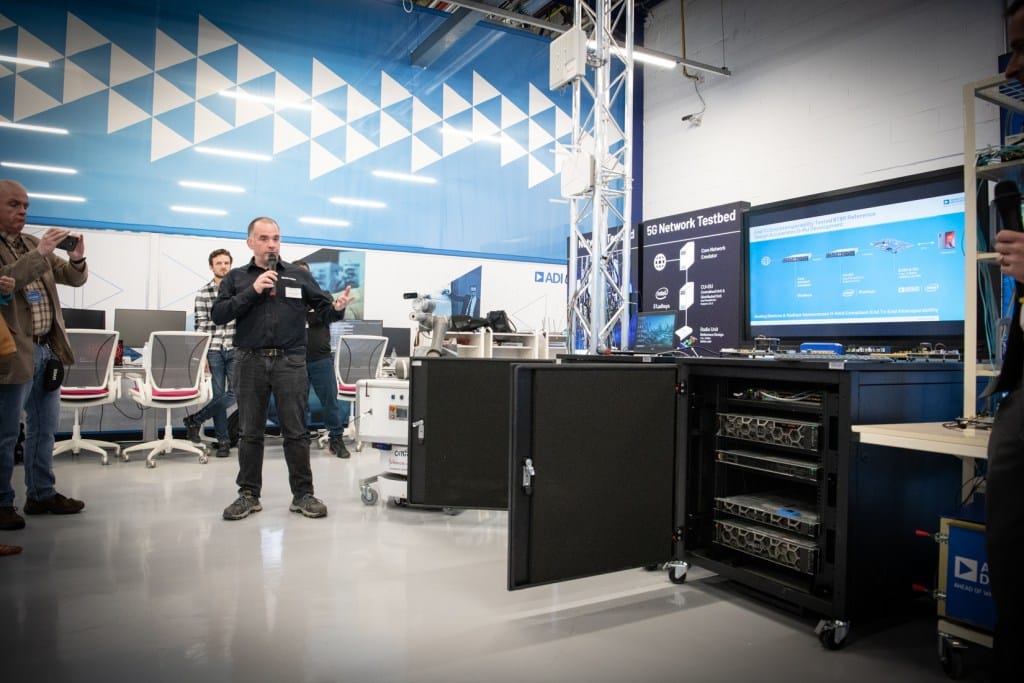
At a press tour of Analog Devices (ADI)’s Catalyst facility in Limerick, Ireland, the semiconductor specialist walked visitors through numerous tech demonstrations, from telco innovations to connected cars
Geopolitics and the semiconductor subsidy boom
Last month, semiconductor specialist ADI announced it would be investing €630 million to expand its operations in its European HQ in Limerick, Ireland. The influx of funding is set to triple the site’s fabrication capacity over the coming two years, as well as expanding the site’s workforce by around 600 people.
The funding comes as part of the European Union’s Important Projects of Common European Interest on Microelectronics and Communication Technologies (IPCEI ME/CT) initiative, one of a number of funding schemes designed to help develop Europe’s domestic chip industry. Undoubtedly the most significant of these schemes is the European Chips Act, which pledges to deliver over €43 billion of project-driven investment until 2030, with the ultimate goal of increasing Europe’s semiconductor production capacity to 20% of the global market.
This surge in European investment has led to a boom in European semiconductor projects, drawing interest from major players like TSMC, Samsung, and Intel. Indeed, just earlier this week, Intel announced a $32 billion investment to open two chip fabs in Germany, as well as another $4.6 billion to build a fab in Poland – all of which are being subsidised with EU and government funding.
But for ADI’s head of Systems & Technology, Cloud & Communications, Joe Barry, this geopolitical focus on chip technology and the resulting funding is no reason to change strategy.
“We were one of the first companies to secure some of the funding really targeted at building up wafer fabrication in Europe. This is definitely driven by the desire to have more resilience and control,” explained Barry. “But while the funding is nice, this doesn’t really affect our strategy. We operate on a hybrid manufacturing model, where we have our own manufacturing but outsource certain pieces. We’ll continue to do this as we continue to scale to meet rising demand.”
ADI’s Catalyst Centre shows the scope of cross-industry innovation
Following the announcement of ADI’s new investment in Limerick, journalists were last week invited to take a tour of the adjoining ADI Catalyst Centre – a €100 million ‘collaboration accelerator’ launched last year as a focal point for customers, business partners, and suppliers to co-create new solutions with the semiconductor specialist.
The tour shone light the enormous breadth industries impacted by ADI’s technology, including telecoms solutions, automotive advances, wearables/extended reality consumer devices, and smart factory tech.
In the telecoms space, key demonstrations included an open radio unit (O-RU) reference design platform, including ADI’s fifth generation 8T8R RadioVerse® System on Chip (SoC), which offers customers an end-to-end solution that allows for hardware and software customisation for macro and small cell RUs.
ADI suggests that this comprehensive reference design will help accelerate the development of Open RAN solutions and promote the evolution of Open RAN ecosystem.
The company also had its chip technology on show in the context of 5G Massive MIMO (multiple input multiple output). Working alongside Marvell Technology, the latest MIMO solution demonstrated power savings of 40% versus competing solutions, not only making the solution more sustainable, but also considerably lighter, allowing for faster deployment.
Key to these energy savings was the solution’s microsleep capabilities. According to ADI, 20% of telco base stations carry 80% of network traffic at any one time, meaning large portions of the network are consuming power while unused. By rapidly switching these elements of the RU on and off as needed, as well as optimising scheduling, sites can ultimately reduce their power consumption significantly.
With the RAN consuming between 70% and 80% of the network’s total power usage, its clear to see how widespread adoption of this technology could lead to significant cost savings for operators.
Conquering the energy challenge
Joe Barry, VP of Systems & Technology, Cloud & Communications at ADI
Following the demonstrations, Barry explained why reducing energy consumption was such a critical focus for the company.
“Our customers’ customers are ultimately operators and whatever challenges they face are ones we face – that means energy consumption. In recent years, energy consumption has grown very significantly as an operating cost, so [the operators] are looking for ways to control that,” he said. “5G was a major step forward in terms of picojoules per bit, but when you’re facing an exponential growth curve these things catch up with you very quickly.”
Reducing power consumption is a major challenge for the semiconductor industry itself. Moore’s Law – a long-held tenant of the industry that the number of transistors in integrated circuits will double every two years as they become more complex – remains broadly accurate and these more powerful chips are typically more energy hungry.
This can be combatted in a number of ways, with Barry pointing to two areas of focus: static and dynamic power usage.
The static power consumed by the chips can be somewhat countered architecturally and algorithmically – essentially helping to optimise the power usage of the chip itself. But perhaps more important here is the dynamic savings, throttling energy usage in intelligent ways so that the device only consumes a high amount of energy when it really needs to.
“Both static and dynamic power savings are a technical challenge. Bringing down the static power requires a lot of innovation in terms of the algorithm and linearising power amplifiers to get more efficiency. Meanwhile, saving power dynamically requires turning things on and off very quickly – and high-power circuits don’t like being turned on and off very quickly! – so there’s a challenge here too in terms of efficiency and not degrading components,” he explained.
Looking to the future, these energy challenges are only going to grow as the user demand for connectivity continues to increase and we move forward towards the 6G era.
“In theory, 6G radio will potentially quadruple the number of antennas and the bandwidth used to meet the demand. If we stay on this trajectory, we’ll be looking at two-times or three-times the power consumption, which simply isn’t viable,” said Barry. “We need to innovate even more and that is an industry-wide effort. This is race we can win, but it has to be done through collaboration.”
Is the telecoms industry doing enough when it comes to building sustainable networks? Join the operators in discussion at this year’s Total Telecom Congress live in Amsterdam
We use cookies to personalise content and ads, to provide social media features and to analyse our traffic. We also share information about your use of our site with our social media, advertising and analytics partners. View more
Cookies settings
Accept
Privacy & Cookie policy
Privacy & Cookies policy
Cookies list
Cookie name
Active
Conditions légales
Introduction et qui nous sommes
118812.fr met en relation des spécialistes du monde entier par le biais d'événements, de renseignements et d'éditions savantes. Nous sommes une société du FTSE 100 et notre réseau de marques internationalement respectées aide les gens à travailler plus intelligemment, à prendre de meilleures décisions et à se développer sur des milliers de marchés spécialisés. Les données et les informations sont au cœur des activités de 118812.fr, et nous prenons au sérieux les questions de confidentialité des données. Nous respectons nos relations avec les clients, les visiteurs, les sponsors, les exposants, les fournisseurs et les collègues, ainsi que la confiance qu'ils nous accordent pour la conservation de leurs données personnelles.
Contrôleurs de données de 118812.fr
Cette politique de confidentialité explique comment les membres du groupe 118812.fr collectent, utilisent et protègent les informations personnelles à travers nos marques. Les références à "nous", "notre" ou "nos" renvoient au contrôleur 118812.fr concerné qui traite vos informations personnelles.
118812.fr est structuré en cinq divisions opérationnelles :
Au sein de ces divisions, il existe des entreprises sectorielles et des marques de produits, d'événements et de services. En général, lorsque nous interagissons avec vous, c'est par le biais de l'une de ces marques. L'entité juridique du groupe 118812.fr responsable des données personnelles (désignée comme le contrôleur des données dans l'UE et désignée comme le contrôleur 118812.fr dans la présente politique de confidentialité) sera l'entité indiquée sur les formulaires de réservation, les formulaires Web et les contrats ou les factures. Différentes entités juridiques de 118812.fr sont responsables de différents événements et produits. Pour mettre à jour vos informations personnelles ou vos préférences en matière de marketing, contactez les équipes de marketing de nos divisions énumérées ci-dessous. Pour toute question ou plainte concernant la confidentialité des données, vous pouvez vous adresser à l'équipe 118812.fr Privacy via notre formulaire en ligne.
Couverture internationale et variations
118812.fr opère dans plus de 20 pays, qui ont chacun des lois différentes sur la protection des données. La présente politique de confidentialité s'applique à toutes les activités de 118812.fr dans le monde, sauf dans la mesure où il existe une exigence spécifique à un pays qui la complète, comme indiqué dans le menu de gauche.
Ce que nous recueillons
Cette section vous indique quelles informations personnelles nous pouvons recueillir lorsque vous utilisez nos produits et services, et quelles autres informations personnelles nous pouvons recevoir d'autres sources. Dans la présente politique de confidentialité, les informations personnelles désignent les types de 118812.frtions personnelles qui peuvent être collectées et utilisées, notamment : Les coordonnées, telles que le nom, l'adresse électronique, l'adresse postale et le numéro de téléphone.Informations sur l'éducation, la nationalité et la professionles noms d'utilisateur et les mots de passeCommentaires, réactions, messages et autres contenus soumis, y compris les informations relatives aux enquêtes.Intérêts et préférences de communication, y compris les autorisations de marketing, le cas échéant.Informations de localisation, telles que celles fournies par une application mobileInformations de vérification de l'identité, telles que les détails du passeport, afin de se conformer aux obligations légales dans certains pays et de fournir des lettres d'invitation de visa, le cas échéant.Informations sur l'utilisation du site web et des communications, telles que la correspondance et les détails de votre utilisation de notre site web et de nos services obtenus par le biais de cookies ou d'autres technologies de suivi.
Ces informations personnelles concernent les catégories de personnes suivantes :
Prospects, contacts clients, abonnés et utilisateurs en ce qui concerne nos services et produits ;Visiteurs, sponsors, exposants et conférenciers lors de nos événements ;Les professionnels figurant dans les produits numériques et imprimés, tels que les détails des cadres supérieurs mis à disposition par les produits de renseignement, les recherches et les publications.les auteurs, éditeurs et réviseurs de nos publications.les contacts de nos prestataires de services et partenaires commerciaux.Informations personnelles sensibles