IOEMA announces new North Sea submarine cable 


News

The company was founded in 2023 after four years of project development 
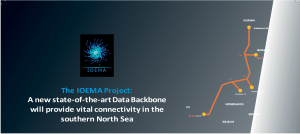
On day one of the Submarine Networks EMEA Conference in London, IOEMA Fibre unveiled its new submarine cable connecting Northern Europe. 

The 1400km long repeatered cable will span across five key markets in Northern Europe: the UK, The Netherlands, Germany, Denmark and Norway. It will be made up of a trunk route that connects Dumpton Gap in the UK with Kristiansand in Norway, and three branches connecting Eemshaven in The Netherlands, Wilhelmshaven in Germany, and Blaabjerg in Denmark. 

It is multi-core with 48 fibre pairs, giving 27-29 Terabits per fibre pair, and an overall minimum capacity of 1.3 Pb/s. 

Arelion has been selected as the infrastructure on Denmark shores, and will expand connectivity towards Esbjerg and Copenhagen through their network. EWE TEL and Relined Fiber Network are joint landing partners in Germany, and both companies will provide backhaul routes to Hamburg, Berlin and eventually further. 

Eurofiber and QTS are the landing parties in Eemshaven, The Netherlands and will reuse the existing infrastructure of the former TGN Northern Europe cable. Eurofiber will provide redundant backhaul connectivity to Groningen, Amsterdam, Frankfurt, Hamburg, Rotterdam and Brussels through its fibre network. 

Colt Technology Services will accommodate the IOEMA cable at its landing point in Dumpton Gap. 

“After 5 years of development and observing the market in Northern Europe, it became evident that diverse routes are needed to provide the redundancy for the increasing data demand in the Nordics,” said Eckhard Bruckschen, CTO of IOEMA Fibre Ltd. 

“We are proud to start this project together with our landing partners and provide further connectivity across Europe and beyond,” he continued.

“By increasing capacity, performance, and resilience across Northern Europe, the IOEMA project will have a profound impact on digital connectivity for this region and beyond. We’re excited and honoured to be playing a key role in bringing this ambitious vision to reality.” said Annette Murphy, Chief Commercial Officer at Colt. 

It’s not too late to get tickets for day 2 of Submarine Networks EMEA in London – get them here! 

Also in the news:
Digi set to buy OTE’s Telekom Romania
Billionaire Xavier Neil ponders Millicom acquisition
EU-funded Global Gateways projects on show at Submarine Networks EMEA 2024

  

Industry players unite to spread 5G in Ghana

Reliance Industries-owned Radisys, Nokia and Tech Mahindra united with the Ghanian government to launch a shared infrastructure JV to spread affordable 5G across the West African nation.

In a joint statement, other partners of the JV were detailed including telecom solutions provider K-NET, along with mobile network operators AT Ghana and Telecel.

The companies have partnered to form JV company Next-Gen InfraCo (NGIC). The Ghanian government awarded 5G licences to NGIC, and it is expected to launch 5G services across Ghana in the next six months, with scope to expand to other parts of Africa.

NGIC will build a nationwide 4G/5G network and stakeholders claimed it will be the first 5G mobile broadband shared infrastructure entity to build one.

MNO partners such as AT Ghana and Telecel, will work with NGIC to launch affordable 4G/5G fixed wireless access customer premise equipment and smartphones this year.

Uptake of 5G can enhance the daily lives of Ghanaians through digital services education, healthcare and mobile finance, which is the aim of the NGIC.

Inspired by India

Ursula Owusu-Ekuful, Minister for Communications and Digitalization for the Republic of Ghana, said: “The creation of a shared 5G Mobile Broadband Infrastructure is critical for delivering affordable, high-speed data access to the people of Ghana and help achieve our Digital Ghana vision.

“The creation of NGIC as a neutral, shared platform, accessible to all mobile network operators and tower companies, will help to expand 5G services rapidly across the country. We are inspired by India’s digital infrastructure and low-cost mobile data usage and keen to replicate it in Ghana.”

Mikko Lavanti, Nokia SVP of Middle East and Africa, added: “Ghana holds immense potential for mobile broadband growth on the back of an unmet demand for connectivity. Establishing an Open Access Network like NGIC will foster innovation and create numerous opportunities across various sectors.”

MORE ARTICLES YOU MAY BE INTERESTED IN…

Graystone Strategy advises Coop Mobile in its historic MVNO licence bid

Graystone Strategy, specialist consultants in mobile and virtual mobile networks, announces today that it is acting as the principal advisor to The Channel Island Cooperative (Coop) and its proposed launch of Coop Mobile. As Sure progresses the purchase of Vodafone Airtel, the launch of a new MVNO is part of a remedial plan to ensure consumer choice is protected in the Channel Island’s mobile market.

Acting as the principal strategic and commercial advisor to the Coop, Graystone Strategy has helped Coop secure its wholesale contract with Sure and leverage the capabilities of its mobile network infrastructure, manage the regulatory process, develop the detailed business and investment case, and formulate the initial customer propositions.

The Jersey Competition Regulatory Authority will now initiate a public consultation about the merger and the proposed MVNO. Provided the consultation concludes favourably, and the Guernsey Competition Regulatory Authority provides approval, it’s intended that Coop Mobile will launch 12 months later. If awarded the licence, Coop Mobile will provide residents in the Channel Islands with a third choice for competitive mobile deals and give those who are also Coop members a multitude of perks when they shop in retail stores.

Graystone was selected as special advisor because the team has extensive knowledge of launching and running retail MVNOs, particularly those used to stabilise markets following a significant merger.

Mark Cox, CEO of Channel Islands Coop, said the advice from Graystone Strategy was invaluable as it negotiated its strategic deal with Sure: “Our strategic agreement with Sure represents a significant alliance, providing us with a low-risk, cost-effective way to enter the local mobile market. It was therefore imperative we had a compelling proposition and the right commercial terms in place to make it a success for our members and the wider market.”

“Graystone’s in-depth knowledge in launching MVNOs has underpinned our approach to bidding for a licence. Thanks to their involvement, we have developed an offer that enhances our commitment to giving loyal members great value for money and leverages our existing membership and retail footprint.”

Globally, retail MVNOs have seen remarkable success, with notable examples from the UK’s leading supermarkets. James Gray, managing director of Graystone Strategy, believes there is huge scope to replicate the success in the Channel Islands: “We’re very excited to be working with the team at the Coop on what will be an historic move for the industry. I believe this is a superb opportunity to bring innovative and competitive mobile deals to the Channel Islands.”

“As a team, we’ve worked with most of the UK’s major supermarkets on their MVNO offers and several of us have launched and run MVNOs. We have used our collective experience and expertise to guide the Coop to a credible business case that’s built around the customer. I wish them every success with their MVNO strategy,” he adds.

More information about the proposed MVNO can be found here https://www.sure.com/jersey/latest-news/2024/sure-and-channel-islands-coop-agreement-paves-way-for-mobile-revolution/

LATAM sees third quarter of smartphone growth

Smartphone shipments in Latin America surged 23.3% year-on-year in Q1 due to retailers moving to clear inventory, and Chinese vendors pushing aggressively.

Counterpoint Research did not disclose exact figures but claimed that this was a third consecutive quarter of YoY growth in the region, a “strong sign of market recovery”.

Senior Research Analyst, Tina Lu said: “Part of the growth was due to the sell-in declining in most markets in Q1 2023 to clear inventory, while in Q1 2024, operators and retailers were building inventory for Mother’s Day.

“Demand for smartphones was also fuelled by the Chinese OEMs increasingly getting aggressive with their promotions for 4G models and price discounts. All this defied the traditional seasonality and showed that the region’s sales channels were confident enough about the demand to build some inventory.

Growth in Mexico and Venezuela led the charge in LATAM but most markets saw double digit YoY growth. Argentina was noted to see a plunge in shipments by 62% due to its ongoing economic crisis. Counterpoint predicted that the Argentinian market will “continue to be soft” in Q2 and Q3.

“This will principally affect Samsung and Motorola. The grey market in the region continued to grow, fuelled by high import duties in many countries,” said Lu.

Rankings

Samsung saw an 8.5% decline YoY due to competition from Xiaomi and Honor, but remained LATAM market leader with 31% share particularly in the US$100-US$249 price bracket.

Motorola placed second with 21% share a slight increase YoY from 20%. Third was Xiaomi with 14% (up by 2%) and other vendors collectively made up 34% of the market (up from 26%).

Honor was noted to rank in the top five shipping vendors for three quarters consecutively despite entering LATAM only two years ago.

MORE ARTICLES YOU MAY BE INTERESTED IN…

Telkom shareholders approve Swiftnet tower selloff to Actis

Keep up-to-date with all the latest news, articles, event and product updates posted on Developing Telecoms.
Subscribe to our FREE weekly email newsletters for the latest telecom info in developing and emerging markets globally.

Sending occasional e-mail from 3rd parties about industry white papers, online and live events relevant to subscribers helps us fund this website and free weekly newsletter. We never sell your personal data. Click here to view our privacy policy.

EU-funded Global Gateways projects on show at Submarine Networks EMEA 2024


Contributed Article

Digital connectivity infrastructures, and in particular submarine cables, are one of the priorities of the European Commission. With the Connecting Europe Facility (CEF) Digital Programme, the EU aims to leverage public and private investments in digital connectivity infrastructures of common European interest.

The European Health and Digital Executive Agency (HaDEA) will join this year’s Submarine Networks EMEA conference, with HaDEA’s Director Marina Zanchi (pictured) presenting the latest accomplishments and the role of the Agency in supporting the strategy of the Commission in this area on the first day of the conference.

According to Marina Zanchi: “CEF-Digital has invested €277 million in backbone projects, and we will soon announce a further investment of at least €90 million this year. This commitment is underpinning a vision, that we call the Digital Global Gateways. It is not just about funding backbone networks within the EU. It is also about being better connected globally.”

CEF Digital supports the deployment of strategic backbone networks as part of the Digital Global Gateways strategy of the EU, contributing to strengthen the quality and resilience of connectivity between EU countries, as well as third countries. The first three sets of calls for proposals were launched in 2022 and 2023 for projects on backbone connectivity. HaDEA accompanies all of the 30 funded projects, which cover a wide range of geographical areas and actions, from marine surveys in Greenland to the deployment of long-distance cables in the Mediterranean and Atlantic areas.

Most of these projects will be present at the at Submarine Networks EMEA 2024 conference. The European Health and Digital Executive Agency (HaDEA) will also have a booth showcasing funded projects and providing information on how to apply for funding to potentials applicants.

Browse EU-funded projects on the Funding & Tenders portal where more information is available, and get inspired.

HaDEA was established by the European Commission to implement actions that strengthen Europe in the domains of health, food safety, digital technologies and networks, industrial capacities, and space.

Come and visit us at Stand 2 at Submarine Networks EMEA 2024! Get your tickets today 

South Korea to invest $19 billion in semiconductor industry 


News

The president confirmed this week that the industry is “the most important foundation for making our people’s lives richer” 

South Korea President Yoon Suk Yeol has announced that the country will spend a record 26 trillion won ($19 billion) on a support package for its chip businesses, saying the semiconductor industry is a vital sector for the national economy. 

The investment will come through the state-run Korea Development Bank and will support for infrastructure deployment, R&D, and tax relief, which the government hopes will boost domestic companies in the global chip race. 

“As we all know, semiconductors are a field where all-out national warfare is underway. Win or lose, that depends on who can make cutting-edge semiconductors first,” Yoon said in a speech on Thursday. 

“The success of the chip industry depends on system semiconductors. Korea’s fabless firms’ global market share is insignificant. The gap between our foundry players and global leaders is too wide,” he continued. 

This new pledge dwarfs the 9.4 trillion won ($6.94 billion) the President announced last month to support AI and semiconductor development by 2027.  

Combined, all of these investments drive towards the country’s goal of becoming a top-three global player in AI technology and achieving a global market share of 10% for system semiconductors by 2030. 

In January, the country also announced plans to develop a new semiconductor production cluster near Seoul, further galvanising its chip production efforts. The new cluster will be completed through investments of 622 trillion won ($472 billion) from companies such as Samsung and SK Hynix, who combined already produce and sell 60% of the world’s memory chips.  The investment will take place gradually and is expected to be completed by 2047. The government says the funds will help to create 3 million jobs. 

Keep up to date with the latest international news by subscribing to the Total Telecom daily newsletter 

Also in the news:
UK government conditionally approves £15bn Vodafone–Three merger
Nokia and Vodafone trial Open RAN with Arm and HPE
T-Mobile and Verizon to buy US Cellular, reports say

Vodacom and Orange mull African infrastructure sharing agreement  


News 

The partnership could help reduce costs and increase rural connectivity  

Major African network operators Orange and Vodacom are in discussions over an Africa infrastructure sharing deal, according to a report from Bloomberg. 

Anonymous sources hint that the two companies are seeking sharing agreements in their overlapping markets, including Egypt and the Democratic Republic of Congo. This would allow both operators to increase their coverage in affected countries and reduce the need to build additional infrastructure in some areas. 

In addition to this sharing agreement, the two companies are also reviewing other opportunities to work together, according to the sources.  

“Our aim is to potentially alleviate the costs of rollout and rural connectivity, helping to address cost to communicate and narrow the digital divide,” a Vodacom spokesperson said to Bloomberg. 

The deal is not yet finalised and could still fall through, said the sources.. Vodacom did, however, confirm that it will detail the specifics of the deal once they have been made. 

The report notably suggested that Vodacom is also in talks with other African operators over similar sharing deals, but again these are yet to be finalised. 

As Vodacom celebrated its 30th anniversary this month, it also passed the milestone of 200 million customers across eight countries, which was confirmed last week during its annual results publication for the year ended 31 March 2024. 

The group’s revenue increased 26.4% up to R151 billion ($8.2 billion) as a result of data revenue and new services (including financial services); however, the company faced challenges such as start-up losses in Ethiopia, higher interest rates, and foreign exchange losses.  

The company’s deeper dive into financial services has helped it reach 78.9 million financial services customers, transacting $1.1 billion a day. 

“This was a year characterised by strong commercial momentum, despite facing several precarious economic headwinds, including a 20% higher effective interest rate and foreign exchange rate pressures,” said CEO Shameel Joosub in the investor’s call. 

Keep up to date with the latest international news by subscribing to the Total Telecom daily newsletter 

Also in the news:
UK government conditionally approves £15bn Vodafone–Three merger
Nokia and Vodafone trial Open RAN with Arm and HPE
T-Mobile and Verizon to buy US Cellular, reports say