HGC launches DCI clusters to offer data centre connectivity across SEA

Hong Kong-based HGC Global Communications (HGC) says it has officially launched data centre interconnect (DCI) clusters in key data hubs across Asia to position itself as a major regional provider of in-country and inter-country data centre connectivity.

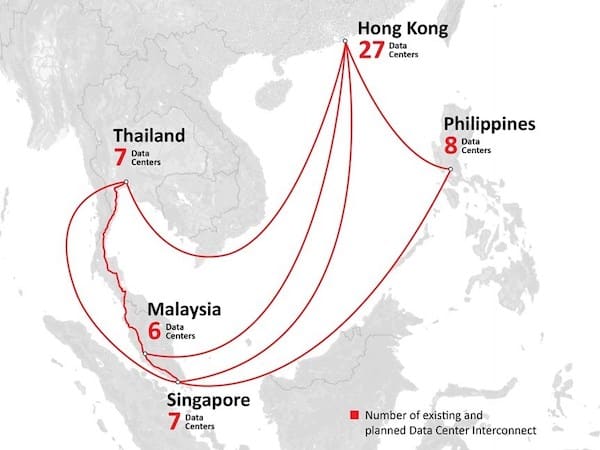
Having launched DCI solutions in Malaysia, the Philippines and (most recently) Thailand, HGC aims to combine those DCI clusters with mature DCI hubs in Hong Kong and Singapore to offer an extensive DCI infrastructure connecting major data centres across Southeast Asia.

The DCI clusters currently comprise existing and planned six data centres in Malaysia, seven in Thailand and Singapore (each), and six in Malaysia, as well as 27 in Hong Kong.

Earlier this week, HGC beefed up its data centre PoP in the Philippines by joining PLDT Enterprise’s Vitro Partner Network (VPN), which enabled it to expand its footprint to the new Vitro Sta. Rosa data centre.

HGC plans to leverage its DCI infrastructure to enable in-country and inter-country connectivity for enterprise solutions customers from Africa, the Americas, Europe and the Middle East looking to enter the region.

The DCI clusters will be offered to its carriers partners, who will be able to integrate them with their own networks and DCI infrastructure.

HGC said the clusters will also enable it to offer customized low-latency cross-border connectivity, ICT services, and cybersecurity solutions to its own customers. Such services include IP-related services, AMS-IX’s internet exchange solution, and HGC’s “Eyeball-as-a-Service” (a platform that leverages 5G edge computing to enable OTT players, content providers and e-commerce companies to expand their geographical footprints quickly).

“Our unique strengths in Asia, combined with our global reputation and network, position this solution to effectively address the challenges of shifting the emerging economies to modernize inclusively in the rapidly digitalising era,” said Ravindran Mahalingam, SVP of HGC’s international business in a statement.

MORE ARTICLES YOU MAY BE INTERESTED IN…

Intelsat claims major milestone with Nigerian backhaul service launch

Keep up-to-date with all the latest news, articles, event and product updates posted on Developing Telecoms.
Subscribe to our FREE weekly email newsletters for the latest telecom info in developing and emerging markets globally.

Sending occasional e-mail from 3rd parties about industry white papers, online and live events relevant to subscribers helps us fund this website and free weekly newsletter. We never sell your personal data. Click here to view our privacy policy.

KT announces restructuring, cuts jobs 


News 

The move is part of a new strategic direction devised by the company’s new CEO, Kim Young-seop, who has been in the role since August 

South Korean telco Korea Telecom (KT) has announced a major restructuring programme as part of an increased focus on AI and cloud services.  

This strategic shift involves the establishment of two new subsidiaries and significant changes to the company’s workforce. 

According to the newspaper Business Korea, the company will create two new subsidiaries – “tentatively” named KT OSP and KT P&M – and implement a large-scale voluntary retirement scheme for employees with over 10 years of service or those nearing retirement. 

A board meeting was held this week to decide on the final details of the subsidiaries, which are set to be properly established in January next year.  

KT OSP will reportedly focus on field operations and network management, with an initial capital investment of 71 billion won ($52.7 million), while KT P&M will focus on customer service, with a smaller capital base of 10 billion won ($7.4 million). Nearly 3,800 employees will be transferred to these new businesses, which are set to begin operations on January 1, 2025.The reallocation of affected employees is expected to begin as early as this month. 

Alongside this restructuring, KT says that its voluntary retirement scheme will begin from next month. Exactly how many jobs are expected to be cut was not specified, but the total number of employees affected by the reallocation and voluntary retirement could reach “up to 5,700”, suggesting that around 2,000 jobs could be eliminated.
As part of its broader strategy, KT is investing heavily in AI and cloud sectors. The company has partnered with Microsoft to co-develop AI models and data center infrastructures, with a joint investment of 2.4 trillion won over the next five years. This move aligns KT with industry trends, as other telecom companies like SK Telecom are also investing in AI and offering early retirement programs. 

In related news, this week KT and Samsung have been chosen by the Korean Navy to deploy a private 5G network as part of its ‘Smart Naval Port’ project. The project, which is the first of its kind at a Korean naval base, began this summer with the goal to complete deployment by the end of next year.  

“The companies will build a more intelligent and fully independent network infrastructure to provide seamless coverage and enhanced connectivity for the Republic of Korea Navy 2nd Fleet,” the press release stated. 

The new ICT network will have use cases including intelligent security monitoring and battleship operation management.   

Keep up to date with the latest international telecoms news by subscribing to the Total Telecom daily newsletter   

Also in the news:
Singtel becomes latest telco to launch AI cloud services
South Korean telcos accused of collusion, may face fines of $4bn
Hexatronic: Innovation will be needed to reach rural customers 

Huawei and e& aim for transformation of voice services

Keep up-to-date with all the latest news, articles, event and product updates posted on Developing Telecoms.
Subscribe to our FREE weekly email newsletters for the latest telecom info in developing and emerging markets globally.

Sending occasional e-mail from 3rd parties about industry white papers, online and live events relevant to subscribers helps us fund this website and free weekly newsletter. We never sell your personal data. Click here to view our privacy policy.

AWS and e& ink $1bn cloud deal 


News 

The deal is set to drive cloud innovation across the Middle East 

UAE based operator e& has announced a $1 billion strategic partnership with Amazon Web Services (AWS) to drive cloud innovation across the Middle East. The collaboration follows AWS’s launch of its second Middle East cloud region in 2022, which was backed by a $5 billion investment.

The partnership combines AWS’s sovereign cloud infrastructure with e&’s network, catering to the public sector and regulated industries such as healthcare, finance, and oil and gas. The goal is to deliver cloud solutions that align with regional regulations, addressing the demand for secure and scalable infrastructure. There is an increased demand for cloud infrastructure services in the region, an issue that this partnership will directly address. 

The agreement between the two companies will see them accelerate digital transformation in the region, providing services like AI, cybersecurity, and networking. This will benefit both large enterprises and small businesses, with access to AWS’s services and marketplace helping companies modernise their operations. 

To do this, e& will use AWS’s technology to enhance its platforms, such as the streaming service Starzplay Arabia and the multi-service app Careem. e& also plans to expand its AI capabilities and smart home services, offering more customer-focused innovations. 

“This initiative aligns with the UAE’s Vision 2031, aimed at positioning the nation as a global economic hub while driving digital transformation across key sectors,” said Tanuja Randery, Vice President of EMEA at AWS in the press release. 

“Our investment in developing the skills of UAE nationals will have a positive impact on the region’s economic growth and technological leadership,” he continued. 

“Our partnership with AWS is a game-changer for our customers. By combining AWS’s advanced cloud capabilities with e&’s local expertise, we will empower businesses across the region with the tools and infrastructure to accelerate their digital transformation and become more agile to scale as they innovate faster,” echoed Salvador Anglada, CEO of e& enterprise. 

Keep up to date with the latest international telecoms news by subscribing to the Total Telecom daily newsletter  

Also in the news:
Singtel becomes latest telco to launch AI cloud services
South Korean telcos accused of collusion, may face fines of $4bn
Hexatronic: Innovation will be needed to reach rural customers 

Introducing 4.7: Polish And Reorganization

While new features are an important part of every product, ensuring that these new features either support existing features or are compatible with them stands as an additional priority when handling a product.

These two aspects are what version 4.7 aims to achieve, and here is what it has done to facilitate them.

The first set of changes revolve around VPS functionality.

VPS snapshots

VPS

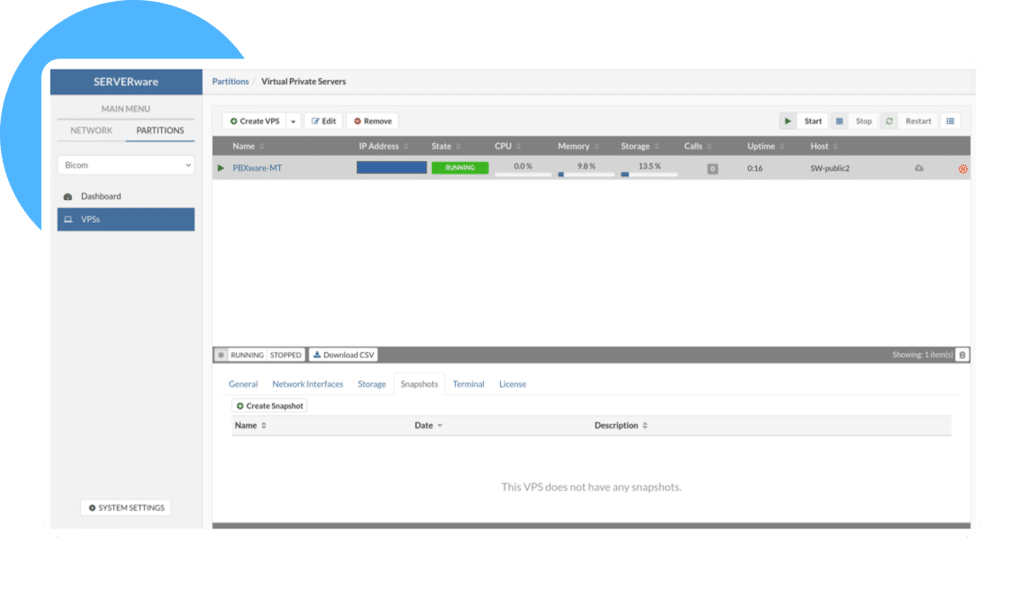
One of the more important changes comes with the ability to create VPS snapshots of datasets from a particular moment of a VPSs operation that can be used to roll the server back to the snapshot in case of an emergency.

While any number of snapshots can be created, and while they don’t take up a lot of space upon creation, leaving older snapshots around for too long will gradually start cutting into available storage space.

Additionally, it’s worth noting that snapshots get deleted 15 days post creation to combat said problem.

The rollback function provides a number of advantages, particularly in tasks involving maintenance, upgrades and file recovery, allowing users to safeguard their systems and perform upgrades without having to worry about their servers breaking.

IMPORTANT NOTE: VPS snapshots aren’t a replacement for existing SERVERware data backup and recovery options.

VPS volume shrinking

volume shrinking

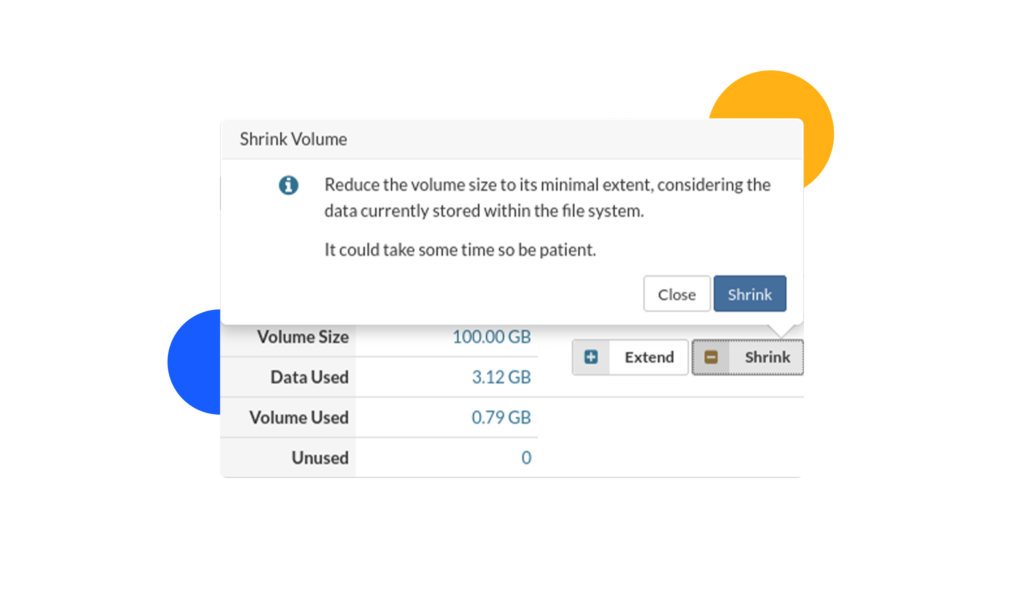
The second change in the VPS spectrum revolves around VPS volume sizes where we’ve implemented the ability to automatically decrease the committed size of a volume based on how much space is utilized, allowing admins to further free up and optimize resources for other operations if necessary.

It’s worth noting that this feature can only be performed when the VPS isn’t in operation.

template in serverware

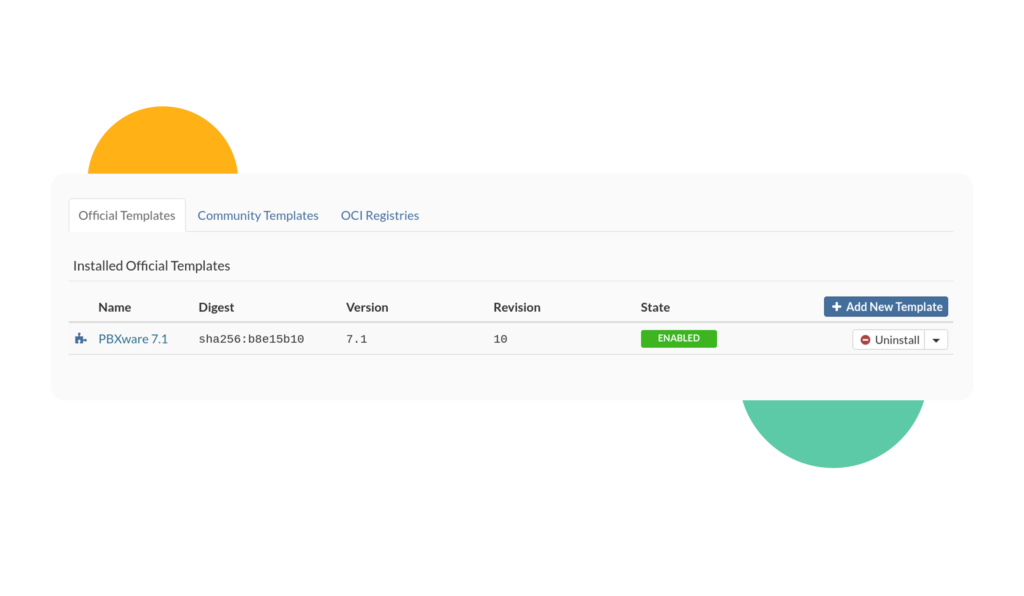
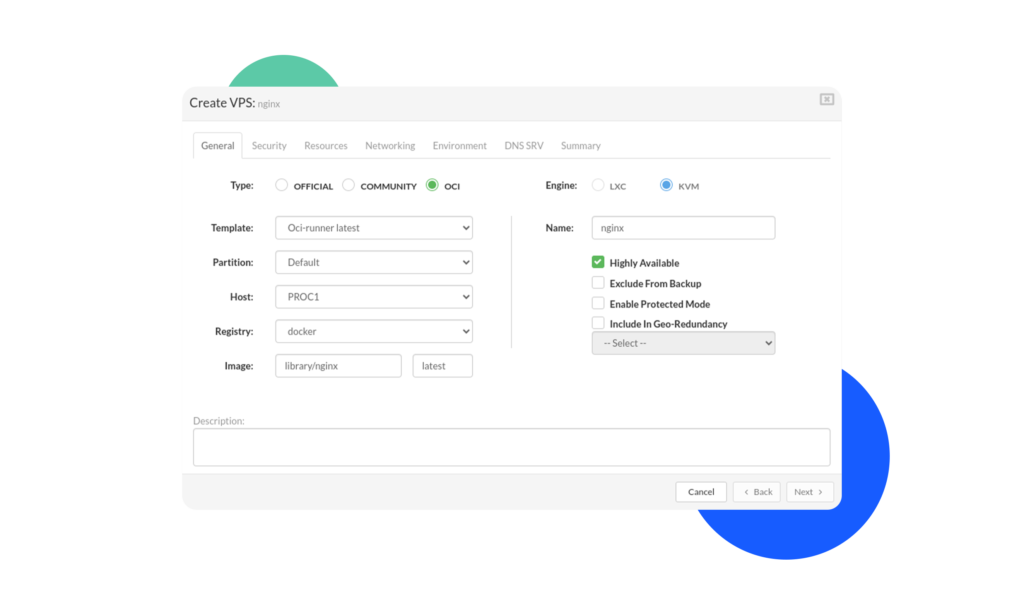
One other major change that v4.7 brings to SERVERware is our template restructure, sorting existing templates into clearer categories: official, community and third-party.

Official templates are ones created, maintained and supported by Bicom inc. whereas the third party ones are not.

The community templates are considered third party, but are still hosted on the Bicom Systems repository, chosen based on internal and external feedback. However, it’s worth noting that Bicom isn’t liable for their maintenance or continued support with future releases.

Additionally, all templates now comply with the OCI standard, making their implementation and management much easier going forward as well as improving overall system security.

OCI imges

In regards to the management side of things, OCI deployment has been made easier with the restructure of the OCI deployment window, allowing admins to install, update, and remove templates from a single point, providing a more intuitive and less cumbersome experience.

replication in serverware

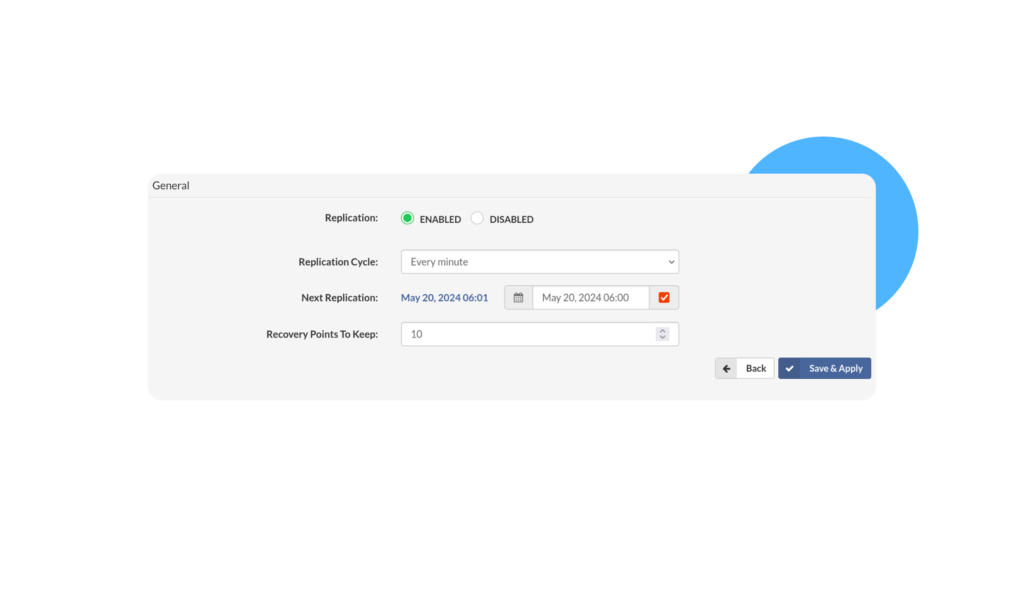
The final major change that comes with SERVERware’s 4.7 version is the ability to add processing hosts from remote locations while still enjoying SERVERware’s geo-redundancy and data backup capabilities.

All of this is reflected in the “Recent replications” window where admins can get an overview of which host the replication is running from, the replication’s duration, and data transferred alongside other, potentially relevant data.

Moreover, 4.7 also provides admins with more flexible replication scheduling options, allowing them to set when they want the first server replication to start.

Alongside these major changes, we’ve also been hard at work ironing out any kinks and squashing bugs that were present prior, ensuring a smoother experience with both SERVERware and sipPROT alike.

The SERVERware team has also done a number of DNS cache improvements to minimize any issues with the VPS or potential outages.

For more detailed information regarding all the changes, you can check out the full v4.7 release notes.

We are sure to continue our efforts in developing a platform that satisfies the needs of your clients while retaining its intuitive design throughout and we are looking forward to showing you more of what we have in store, but more on that in our future releases.

Until then, we hope to have met your expectations and that both you and your clients remain satisfied.


Airtel Business partners with Kia for next-gen connected-car platform

Keep up-to-date with all the latest news, articles, event and product updates posted on Developing Telecoms.
Subscribe to our FREE weekly email newsletters for the latest telecom info in developing and emerging markets globally.

Sending occasional e-mail from 3rd parties about industry white papers, online and live events relevant to subscribers helps us fund this website and free weekly newsletter. We never sell your personal data. Click here to view our privacy policy.

Google signs nuclear power AI deal in world first 


News 

The huge growth of AI, particularly generative AI, has skyrocketed tech company’s energy usage

Google has signed the world’s first nuclear energy agreement with Kairos Power to supply nuclear power to meet its electricity demand for AI. 

The financial details of the deal were not disclosed, not where the plants are to be built. The first reactor is expected to go online by 2030, with more to follow by 2035. The deal aims to support the growing electricity demands of AI technologies, which are driving scientific and business advancements. Nuclear energy provides reliable, 24/7 power and helps cut carbon emissions, aligning with Google’s energy goals. 

Kairos Power’s reactors use a safe, molten-salt cooling system and ceramic fuel to generate power more efficiently. Their design allows for faster construction and easier deployment. The company has already started building its first demonstration reactor in Tennessee. 

This nuclear deal is part of Google’s broader strategy to expand clean energy options, adding to their previous investments in solar, wind, and geothermal power. Google aims to power all of its operations—data centers, offices, and more—with carbon-free energy every hour of every day by 2030. 

“Nuclear solutions offer a clean, round-the-clock power source that can help us reliably meet electricity demands with carbon-free energy every hour of every day,” said Michael Terrell Senior Director of Energy and Climate in a company blog post. 

“The grid needs new electricity sources to support AI technologies that are powering major scientific advances, improving services for businesses and customers, and driving national competitiveness and economic growth,” he continued. 

Keep up to date with the latest international telecoms news by subscribing to the Total Telecom daily newsletter 

Also in the news:
Singtel becomes latest telco to launch AI cloud services
South Korean telcos accused of collusion, may face fines of $4bn
Hexatronic: Innovation will be needed to reach rural customers