

Some FTTx, some fixed wireless, some data center development, and some funding: … [visit site to read more]

Some FTTx, some fixed wireless, some data center development, and some funding: … [visit site to read more]

Keep up-to-date with all the latest news, articles, event and product updates posted on Developing Telecoms.
Subscribe to our FREE weekly email newsletters for the latest telecom info in developing and emerging markets globally.

The Nigerian government has signed an agreement with Ericsson to collaborate on developing and deploying 5G technology. The memorandum of understanding (MoU) was signed during a government visit to Ericsson’s headquarters in Stockholm late last week, led by Nigeria’s Vice President Kashim Shettima.
Ericsson has been operating in Nigeria since 1978, helping to deploy networks, including the country’s first mobile network in 2001. Now, this new partnership aims to support Nigeria’s telecoms sector entry into the 5G era, improving public services and driving economic progress.
The MoU includes plans for knowledge-sharing, establishing innovation hubs, and boosting digital skills in Nigeria, although specific commitments and financial details of the partnership were not disclosed.
At the signing, Vice President Shettima was joined by key government figures, including Communications, Innovation and Digital Economy Minister Dr. Bosun Tijani and Foreign Minister Yusuf Maitama Tuggar, alongside other senior officials. The delegation was hosted by Patrick Johansson, Ericsson’s Head of Middle East and Africa, who highlighted Ericsson’s leadership in 5G and its potential to enhance Nigeria’s digital competitiveness.
“It was an honor to show the Vice President, and his delegation colleagues, Ericsson’s leadership in 5G and technology capabilities at first-hand. We look forward to working in close partnership with the Nigerian government to develop the innovation potential of 5G for Nigerian businesses, citizens and for national digital competitiveness,” said Johnson in a statement.
Keep up to date with the latest international telecoms news by subscribing to the Total Telecom daily newsletter
Also in the news:
Singtel becomes latest telco to launch AI cloud services
South Korean telcos accused of collusion, may face fines of $4bn
Hexatronic: Innovation will be needed to reach rural customers

 The data center business is not a monolithic collection of servers and power, there are many types of facilities out there making up the broader infrastructure ecosystem. One of the longest running but too often neglected in the AI era is that of the carrier hotel and interconnection hub. With us today is John Bonczek, CRO at 1547 Critical Systems Realty. Early on in 1547 CSR’s development we had the company’s CEO and Managing Director J. Todd Raymond here for a chat about their plans. Let’s find out what the company has been up to since. … [visit site to read more]

The Intelsat 33e geostationary high-throughput satellite (HTS) covering Europe, Africa, the Middle East and parts of the Asia-Pacific experienced a permanent power failure on Saturday and has since broken up.
According to a statement from Intelsat, the satellite “experienced an anomaly on October 19” that resulted in loss of power, consequently cutting service to all customers.
Intelsat said in the statement that while it was working with the satellite’s manufacturer, Boeing Space Systems, to address the problem, “we believe it is unlikely that the satellite will be recoverable.”
On Sunday, in a post on X (formerly Twitter), U.S. Space Command confirmed that Intelsat 33e had broken up, and that it was “currently tracking around 20 associated pieces.”
Intelsat 33e’s payload included C-band, Ku-band and Ka-band transponders. The C-band spot beams covered Europe, Central Africa, Middle East, Central South Asia, eastern China, part of southeast Asia and Australia. A wide C-band beam covered sub-Saharan Africa.
The Ku-band spot beams covered most of Europe, Africa, the Middle East and Asia. The Ka-band transponder had a single beam covering those regions.
Intelsat said It is in contact with all affected customers as well as third-party providers to mitigate service interruptions while it looks for back-up connectivity options within its satellite fleet.
Intelsat 33e – which occupied the 60 degrees East orbital slot – was launched in August 2016, but didn’t enter service until January 2017 due to a problem with its primary thruster. The satellite was designed with a lifespan of 15 years, but that was reduced by 3.5 years after another propulsion problem occurred during orbit tests.
Intelsat 33e was the second of Intelsat’s EpicNG HTS satellites to be launched following Intelsat 29e, which was launched in January 2016. Intelsat 29e lasted a little over three years before developing a fuel leak, which eventually resulted in total loss of the satellite in April 2019.

Recent months have seen tensions flare between Elon Musk and Indian telecoms moguls Mukesh Ambani and Sunil Bharti Mittal continue, with the trio clashing over the nation’s satellite spectrum policy.
Back in 2021, India’s Department of Telecoms (DoT) announced that it was considering auctioning spectrum for satellite broadband players, going against the industry standard of simply allocating the frequencies.
This week, however, the issue appears to be resolved, with the Indian communications minister Jyotiraditya Scindia confirming that the government has no plans to auction satellite spectrum, as feared by Musk.
The idea of auctioning satellite spectrum was controversial from the beginning. Detractors argued that the heavy price tags likely to be attached to the spectrum would dissuade smaller players from participating in the auction and provide the deep-pocketed mobile giants Reliance Jio and Bharti Airtel with an unfair advantage.
Both Jio and Airtel have major satellite ambitions for India, with the market estimated to be worth $1.9 billion by 2030. Reliance’s Jio Platforms formed a joint venture with satellite operator SES back in 2022, aiming to launch their own satellite broadband services as Reliance Jio Satellite Communications. Airtel, meanwhile, is partnered with Eutelsat to use its OneWeb constellation, in which Airtel has been an investor since 2021.
As such, it should come as little surprise that the owners of Jio and Airtel – Mukesh Ambani Sunil Mittal, respectively – have been vocal proponents for the auction strategy. They argue that commercial satellite broadband players serving urban customers should be forced to pay for spectrum in the same way that traditional wireless operators do.
There is also an element of speed to market here. Both Jio and Airtel’s commercial satellite offerings are far less mature than Musk’s Starlink, hence there is a risk of Starlink capturing the lion’s share of the market before its rivals can adequately react. With the Indian government increasingly insistent on keeping control of the telecoms and tech industries in the hands of domestic companies, this outcome would likely be unacceptable.
Nonetheless, the comments from the Indian communications minister this week suggest it is unlikely that the government will eschew the conventional wisdom of the International Telecommunication Union and will stick with the typical allocation method.
Musk was quick to praise the decision earlier this week, saying thank you in a Tweet:
Much appreciated! We will do our best to serve the people of India with Starlink.
— Elon Musk (@elonmusk) October 15, 2024
.
Keep up to date with the latest international telecoms news by subscribing to the Total Telecom daily newsletter
Also in the news:
Singtel becomes latest telco to launch AI cloud services
South Korean telcos accused of collusion, may face fines of $4bn
Hexatronic: Innovation will be needed to reach rural customers

Vantage Towers is considering the sale of its Spanish assets, according to a Bloomberg article published today, citing people familiar with the matter.
According to the article, the company is working with Morgan Stanley to assess the interest of potential buyers. If successful, the TowerCo’s Spanish infrastructure assets could fetch around €1 billion at sale, although discussions are still at a very early stage, according to the sources.
The new comes just one day after reports were published suggesting that Vantage is currently clashing with its largest customer, Vodafone Spain, over annual pricing.
Zegona Communications, who purchased Vodafone Spain earlier this year for €5 billion, are reportedly considering terminating its long-term contract with Vantage over the prices being charged to use its towers. After “months in tense negotiations”, Zegona is reportedly asking Vantage to reduce its annual fees by at last €50 million, while alo exploring its options with alternative tower companies. Companies approached by Zegona reportedly include Cellnex, American Tower Corp, and Orange’s tower company Totem.
If Zegona were to switch contracts, this would be highly unusual, as deals are usually decades-long, with large fines if broken. However, sources suggest Vodafone Spain could still potentially save money by becoming the second tenant on an alternative provider’s infrastructure.
All the aforementioned companies have declined to comment.
Keep up to date with the latest international telecoms news by subscribing to the Total Telecom daily newsletter
Also in the news:
Singtel becomes latest telco to launch AI cloud services
South Korean telcos accused of collusion, may face fines of $4bn
Hexatronic: Innovation will be needed to reach rural customers
Nokia has laid off nearly 2,000 employees in China, about 20% of its workforce in the country, with plans to cut an additional 350 jobs in Europe, according to a Reuters report citing two sources familiar with the matter.
Speaking to Reuters, a Nokia spokesperson confirmed that discussions are underway regarding the European layoffs but declined to comment on the situation in China.
As of December 2023, Nokia employed 10,400 people in Greater China and 37,400 in Europe, according to its annual report.
The reduction in these workforces are part of a previously announced plan to cut up to 14,000 jobs globally by 2026, aiming to save between €800 million and €1.2 billion. By 2026, Nokia plans to have reduced its workforce from around 86,000 employees to between 72,000 and 77,000.
This job cutting process has already begun in a number of key markets, with hundreds of job losses announced earlier this year in the company’s home market of Finland, as well as the US and other markets.
“Resetting the cost base is a necessary step to adjust to market uncertainty and to secure our long-term profitability and competitiveness,” said Nokia’s CEO, Pekka Lundmark in Q3 last year.
Nokia’s sales in China have declined since Western countries began banning Huawei in 2019, leading to reduced contracts for both Nokia and rival Ericsson. Sales in China, which was once Nokia’s second-largest market, have dropped from 27% of the company’s net sales in 2019 to less than 6% in the latest quarter.
Despite this, Nokia still has offices in Beijing, Shanghai, Hong Kong, and Taiwan, and serves major clients like China Mobile.
On Thursday, Nokia reported a 9% rise in its Q3 operating profit, primarily due to cost-cutting measures. However, its net sales fell short of expectations, causing a 4% drop in share value.
Lundmark has stated that the cost-cutting measures will not impact Nokia’s research and development, and the company is slightly ahead of its savings schedule.
Want to keep up to date with all of the latest international telecoms news? Sign up for Total Telecom’s daily newsletter
Also in the news:
Addressing the growth imperative: Pressure building on EMEA telcos
KT announces restructuring, cuts jobs
Vodafone Idea’s long awaited 5G launch targeted for March 2025

Four significant infrastructure moves we will have to keep an eye on from this week’s news: … [visit site to read more]
Hormuud Telecom strengthened its EVC Plus mobile money platform by making it interoperable with MyBank and Agro Bank, with plans to onboard more banks in 2025.
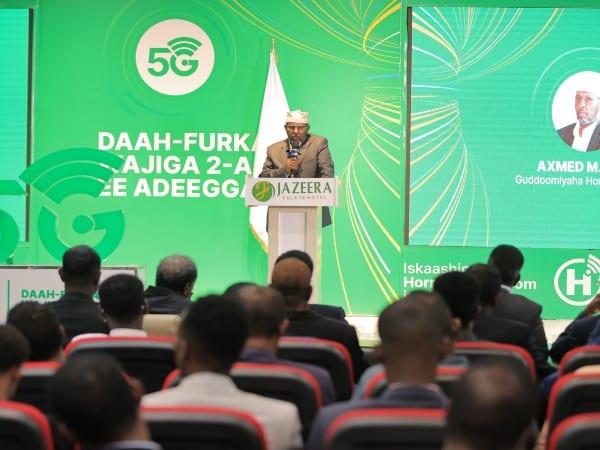
Responding to questions from Developing Telecoms, Hormuud Telecom CEO Ahmed Yusef (pictured) described this deal as the first of many towards achieving full interoperability between financial platforms and institutions in Somalia.
“For full interoperability, we need to ensure that every mobile money platform and banking system allows for seamless transactions,” said Yusef.
The partnerships represent a “critical step” in building trust between citizens and financial institutions, promoting financial stability. Somalia, having suffered decades of civil war that decimated its economy, saw a rise in mistrust toward institutions.
EVC Plus customers will now be able to perform banking functions with MyBank and Agro Bank directly from their mobile devices.
The Somalian Central Bank launched the National Payment System in 2021, laying the necessary groundwork for integration between banks and mobile money providers.
According to the Central Bank, 70% of Somalians use mobile money, while only 15% have a traditional bank account. Hormuud reports that around 90% of Somalis now use mobile money platforms.
Hormuud Telecom is also working with the GSMA to extend its mobile services to remote areas in Somalia, connecting the last segment of unbanked Somalis.
Hormuud’s CEO Yusef stated that making EVC Plus compatible with formal banking services enhances financial inclusion. “Small businesses can access credit, aid beneficiaries can build financial histories, and cross-border transactions become easier for everyone. This is a significant step toward a fully interconnected financial system in Somalia,” Yusef said.
Hormuud Telecom currently has four million customers on its EVC Plus mobile money platform.