Vodafone, Qualcomm, and Xiaomi clock 1.8 Gbps 5G download speeds


Press Release

Vodafone, Qualcomm Technologies, Inc. and Xiaomi continued their innovative streak with the successful test in Germany and Spain of a new 5G technology capable of download speeds close to 1.8 gigabits-per-second (Gbps) using a new smartphone.

Specifically, they tested enhanced technology which improves the way data and video is transmitted from the radio network over 5G to a customer’s mobile device. Called 1024 quadrature amplitude modulation (QAM), it is a step up from today’s system (256 QAM) since it packs together more data into each transmission, leading to faster download speeds.

This increase in speed and data throughout will ultimately lead to greater network capacity, freeing up additional bandwidth at mobile sites to improve the overall experience for customers.

1.8 Gbps Peak Speed

Using Xiaomi’s smartphone, the Xiaomi 14 Ultra, equipped with its latest Snapdragon® X75 5G Modem-RF System, Vodafone engineers recorded excellent results. In Germany, the team measured a throughput improvement on the commercial network of around 20% over a distance of up to 600 meters, and at its 5G test centre in Ciudad Real, Spain, they achieved peak 5G download speed of nearly 1.8 Gbps. Theoretically, 1.8 Gbps could provide a capacity gain of up to 25% in ideal conditions.

The technology, which Vodafone expects to become more widely available during 2025, is suited to supporting multiple customers close to a mobile site in busy areas such as a shopping centre or high street.

Wave of Innovation

Alberto Ripepi, Chief Network Officer of Vodafone, said: “Vodafone is at the forefront of the next wave of innovation in 5G. Our customers will benefit from a head start when the next generation smartphones become more widely available, and we can offer our technical expertise to partners and other providers through our new commercial model.”

Dino Flore, Vice President, Technology of Qualcomm Europe, Inc. added: “The successful trials conducted in Germany and Spain with Vodafone and Xiaomi are proof that we are continuing to push the boundaries of what is possible with 5G technology.”

Guoquan Zhang, General Manager of Xiaomi Software Department, said: “We are honored to have collaborated with Vodafone and Qualcomm on this achievement. It demonstrates how Xiaomi is actively driving and showing innovation in the 5G space.”

This latest technological breakthrough follows news earlier this year that the same three companies achieved upload speeds of up to 273 megabits-per-second (Mbps) using another innovative technology. This is more than double the average uplink speed of today’s smartphones and home broadband services.

Efficiency Gains

Industry body 3GPP has defined the 1024 QAM technology, helping operators make further efficiency gains using existing spectrum whilst providing greater speeds for customers even among bandwidth-hungry digital services.

For the test, Vodafone engineers used 1024 QAM with a Time Division Duplexing (TDD) spectrum band – a way to send and receive data within pre-determined time slots on the same frequency (3.5 GHz in this instance). 3.5 GHz spectrum can benefit from 1024 GAM because it has been widely assigned for 5G and associated mobile broadband applications. Vodafone will continue to test drive 1024 QAM-compatible networking equipment and devices ahead of their commercial deployment later.

Join the operators in discussion at this year’s Connected Germany conference live in Munich

Also in the news:
Australian Government and AWS Collaborate to Strengthen country’s Cybersecurity
Solving congestion challenges in FTTP deployment
Vodafone Invests £120m in AI Chatbot ‘SuperTOBi’

SoftBank buys Graphcore, targets further AI investments


News

SoftBank founder Masayoshi Son said earlier this year that AI will be SoftBank’s ‘next big bet’ when it comes to technology

This week, Japanese conglomerate SoftBank has announced the acquisition of struggling UK-based AI chipmaker Graphcore.

Official financial details have not been disclosed, but anonymous sources speaking to the Financial Times valued the deal at $600 million.

Graphcore creates specialised AI chips, known as intelligence processing units, which can be used to train and operator AI large language models.

This is the same type of chip technology that has seen rival chip company Nvidia soar to around $3 trillion earlier this year.

Unlike Nvidia, however, Graphcore has struggled significantly to commercialise its technology. Valued at $2.8 billion back in 2020, Graphcore has since failed to sell its products at scale, noting “lower hardware sales to key strategic customers”. In 2022, the company recorded just $2.7 million in sales, 46% lower than in 2021, and booking a pre-tax loss for the year of $205 million.

As a result, 2023 saw Graphcore undertake cost cutting measures, cutting 20% of its workforce and closing its operations in Norway, Japan, and South Korea. At the time, the company said there was ‘material uncertainty’ over the company’s survival and called for fresh funding.

Now, as part of SoftBank, Graphcore will reportedly have all the resources it needs to return to full force.

“Demand for AI compute is vast and continues to grow,” said Graphcore’s co-founder and chief executive, Nigel Toon. “There remains much to do to improve efficiency, resilience, and computational power to unlock the full potential of AI. In SoftBank, we have a partner that can enable the Graphcore team to redefine the landscape for AI technology.”

SoftBank itself has been stepping up its focus on AI for over a year now, with Son saying earlier this year that “realising ASI (Artificial Superintelligence)” was “his only focus”. He has also said the company is ready to invest roughly $9 billion a year in AI and is prepared for largescale dealmaking in the future.

Keep up to date with all of the latest telecoms news with Total Telecom’s daily newsletter! Sign up here

Also in the news:
Australian Government and AWS Collaborate to Strengthen country’s Cybersecurity
Solving congestion challenges in FTTP deployment
Vodafone Invests £120m in AI Chatbot ‘SuperTOBi’

DRC records increase in mobile users

Keep up-to-date with all the latest news, articles, event and product updates posted on Developing Telecoms.
Subscribe to our FREE weekly email newsletters for the latest telecom info in developing and emerging markets globally.

Sending occasional e-mail from 3rd parties about industry white papers, online and live events relevant to subscribers helps us fund this website and free weekly newsletter. We never sell your personal data. Click here to view our privacy policy.

Laying the Foundation for AI with High-Quality Network Data

Laying the Foundation for AI with High-Quality Network Data

This Industry Viewpoint was authored by David Cottingham, CTO at IQGeo

As the fiber broadband industry evolves, operators face increasing pressure to adopt emerging technologies to stay competitive. McKinsey’s report, “The AI-native telco: Radical transformation to thrive in turbulent times,” underscores the potential of AI and Machine Learning (ML) to drive growth and disruption within the telecom sector. AI promises substantial benefits, including infrastructure that self-heals, touchless customer service, hyper-personalization, and automated marketing. However, its successful implementation hinges on the quality of underlying fiber network data. … [visit site to read more]

Zambian mobile operators struggle with 14-hour power blackouts

A telecoms lobby group in Zambia has warned that lengthy power blackouts caused by load shedding over the past year is taking its toll on the quality of mobile services across the country.

According to a statement released earlier this week, the Global System for Mobile Association of Zambia (GSMAZ) – which comprises MTN Zambia, Airtel Zambia and Zamtel – load shedding blackouts initiated by state-owned power utility ZESCO now last as long as 14 hours a day.

That’s having an unsustainable impact on the over 3,500 mobile towers connected to the ZESCO grid, as the towers are equipped with only four hours of backup power, which is causing “a huge cost variance not only for the fuel and generator maintenance but also for the associated fuel delivery logistics” for mobile operators, the GSMAZ said.

« Though backup power is available at these sites through generators, instances when there is electricity downtime, and extended load shedding hours, our provision of quality of service is compromised as the generators now require constant refueling and more frequent servicing cycles, » the group added.

The blackouts are largely a side-effect of severe climate change in Zambia, which has caused Lake Kariba – formed by the Kariba Dam, which generates electricity for Zambia and Zimbabwe – to lose 98% of its water, according to a January 2023 report from LifeGate Daily.

Early last year, ZESCO – which supplies energy to over 80% of Zambia – responded by increasing the length of power blackouts from six hours to 12 hours to keep the power grid from failing completely, the report said.

The GSMAZ said it recognised that climate change is having a major and unprecedented impact on all levels of life in Zambia, but added that the telecoms sector “is one of Zambia’s key economic enablers for sustained business growth and social development.”

The GSAMAZ statement added that mobile operators are working with tower providers, regulators and other stakeholders to find sustainable solutions to the problem, to include solar-powered backup solutions in the medium to long term. The group also apologized for the inconvenience to customers.

Load shedding is a common practice across much of the African continent as national power grids struggle to keep up with growing demand for electricity. It’s also a perennial headache for mobile operators who have been forced to invest and innovate to find ways around the problem.

In South Africa, where rolling blackouts are so common that state power utility Eskom recorded a record 280 days of blackouts last year, MTN said in March 2023 it would invest US$84.3 million to install solar power, batteries and generators at base stations (as well as investing in extra security to keep people from stealing them) to reduce reliance on Eskom.

Earlier this year, MTN said it would invest another US$101.3 million by the middle of the year in generators, batteries and renewable energy to counter the effect of Eskom load shedding.

In August last year, Vodacom signed a deal with Eskom to enable “virtual wheeling”, which would essentially allow Vodacom to secure energy from independent power producers using Eskom’s infrastructure without all the complexity that usually involves.

Vodacom said at the time it aims to source all of its electricity demand from renewable energy sources by 2025.

MORE ARTICLES YOU MAY BE INTERESTED IN…

Ooredoo, Qatar Airways and Google Cloud announce major initiative

Keep up-to-date with all the latest news, articles, event and product updates posted on Developing Telecoms.
Subscribe to our FREE weekly email newsletters for the latest telecom info in developing and emerging markets globally.

Sending occasional e-mail from 3rd parties about industry white papers, online and live events relevant to subscribers helps us fund this website and free weekly newsletter. We never sell your personal data. Click here to view our privacy policy.

Sparkle Activates a New Point of Presence in Rome at Aruba’s Hyper Cloud Data Centre

Rome, 10 July 2024

Sparkle, the first international service provider in Italy and among the top global operators, and Aruba S.p.A, Italy’s leading provider of cloud, data centre, hosting, e-mail, domain registration and PEC (certified email) services, announce the activation of the new Sparkle’s Point of Presence (PoP) at the Hyper Cloud Data Centre of Aruba, the largest data centre campus in Rome, to be inaugurated soon. 

The agreement between Aruba and Sparkle reinforces Rome as a global connectivity hub between Europe, Africa, the Middle East and Asia thanks to the connection with BlueMed, Sparkle’s new cable that increases connectivity in the Mediterranean basin by linking various countries – including France, Greece, Israel and Italy – with landings in Rome, Genoa, Palermo and Golfo Aranci. BlueMed is an integral part of the Blue & Raman Submarine Cable Systems project. In partnership with Google and other operators, the project is set to establish a new digital infrastructure between Europe, Africa, the Middle East and Asia with extension as far as India, and is among the first projects being implemented on the IMEC (India-Middle East-Europe Economic Corridor) set up at the G20 summit in September 2023.

Designed with an “open cable system” and “open landing station” architecture, BlueMed ensures maximum openness to other operators and the development of internet traffic interconnection ecosystems. With four fibre pairs and a capacity of over 25 Terabits per second (Tbps) per pair, BlueMed offers operators and businesses high-speed, high-performance international connections from Rome to all of Sparkle’s destinations worldwide.

Sparkle’s new PoP was activated at Aruba’s Hyper Cloud Data Centre (IT4), a technology campus located at the Tecnopolo Tiburtino, a district where more than 150 companies operate, ranging from aerospace to ICT, in an environment designed also to support the growth and development of new companies and start-ups. The data centre campus covers an area of 74,000 m² and, when fully operational, will include five independent data centres for a total of 30 MW of IT power, the first of which (DC-A) is already ANSI/TIA Rating 4 certified. Designed to the highest standards of resilience and infrastructure quality, the new hub will use renewable energy, cooling systems and highly efficient equipment.

With the activation of the new PoP integrated with BlueMed, we intend to respond to the needs of companies and operators that require large international interconnection capacities,” said Enrico Bagnasco, CEO of Sparkle. “We bring Rome closer to the world’s major connectivity exchange points thanks to a unique, low-latency route to Marseille and Palermo, integrated with the main submarine cables crossing the Mediterranean and other destinations in Sparkle’s global network.”

Stefano Cecconi, CEO of Aruba commented: “We share with Sparkle the aim of serving companies and operators, that need large capacities, with not only connectivity but also space and power within state-of-the-art data centres that are large enough to support even the most ambitious growth plans. Being able to host a Sparkle PoP, with the availability of BlueMed, is an important building block in the consolidation of our data centres as strategic assets at a national and European level, and is perfectly in line with our carrier neutral philosophy. This approach is designed to allow customers to enjoy, in maximum autonomy, extremely reliable and high-performance internet connection solutions, and to foster the development of interconnections that benefit the entire ecosystem, making Rome an additional connectivity hub and an IT and cloud service delivery centre for the capital and all Central and Southern Italy.”

The new PoP – which already hosts important international players – adds to the four existing points of presence in Rome, increasing the capillarity of the metropolitan ring, a protected and redundant system fully integrated with Sparkle’s Tier-1 global IP network “Seabone”. Network operators, ISPs, OTTs, content and application providers can benefit from the range of IP and data services offered by Sparkle, including DDoS Protection – that gives customers the option to self-protect their networks from attacks – and Virtual NAP – which provides virtual access to leading Internet Exchange Points (IXPs) without the need to build proprietary infrastructure.

About Sparkle

Sparkle is TIM Group’s Global Operator, first international service provider in Italy and among the top worldwide, offering a full range of infrastructure and global connectivity services – capacity, IP, SD-WAN, colocation, IoT connectivity, roaming and voice – to national and international Carriers, OTTs, ISPs, Media/Content Providers, and multinational enterprises. A major player in the submarine cable industry, Sparkle owns and manages a network of more than 600,000 km of fiber spanning from Europe to Africa and the Middle East, the Americas and Asia. Its sales force is active worldwide and distributed over 33 countries.

Find out more about Sparkle following its X and LinkedIn profiles or visiting the website tisparkle.com


About Aruba S.p.A.  

Aruba S.p.A. (http://www.aruba.it), founded in 1994, is Italy’s leading provider of cloud, data centre, hosting, e-mail, domain registration and PEC (certified email) services. The company, with wholly Italian capital, has 16 million users and manages a vast infrastructure distributed on 7 data centres that includes 2.7 million registered domains, 9.8 million e-mail accounts, 9 million PEC accounts and thousands of customer IT infrastructures. Aruba PEC and Actalis are the group’s two Certification Authorities, accredited with AgID (Agenzia per l’Italia Digitale) for the provision of qualified services. Aruba’s infrastructure is also qualified by ACN (National Cybersecurity Authority) to handle ordinary, critical and also strategic PA data. In 30 years of activity, Aruba has developed extensive experience in the design and management of high-tech data centres, owned and distributed throughout Italy. The largest is located in Ponte San Pietro (BG) and features green-by-design infrastructure and facilities that comply with the highest security standards in the industry (Rating 4 ANSI/TIA-942, ISO 22237), to which is added the Hyper Cloud Data Centre in Rome, which covers 74,000 m² in the area of the Tecnopolo Tiburtino and at full capacity will include 5 independent data centres. Aruba implements energy-efficient solutions in its data centres, demonstrating its commitment to sustainability and, in addition, produces clean energy through photovoltaic plants and hydroelectric power plants. The infrastructure network also extends across Europe, with a proprietary data centre in the Czech Republic and partner facilities located in France, Germany, Poland, and the United Kingdom.

For further information, please visit https://www.aruba.it/and social networks Facebook, X and LinkedIn 


Sparkle Media Contacts

sparkle.communication@tisparkle.com

X: @TISparkle


Aruba Media Contacts

Megan Cowlbeck/Lorna Miller 

aruba@rlyl.com

Red Lorry Yellow Lorry for Aruba   

Vodafone CTO details gen AI plan

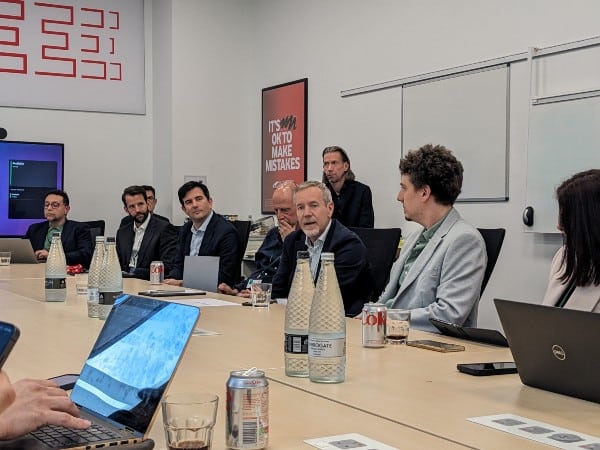
Vodafone Group CTO Scott Petty (third, from right) laid out how AI has the potential to fundamentally change the economic landscape of the internet, but developing markets will be slow to see this change, due to challenges such as low smartphone uptake and lack of fundamental infrastructure to drive the resource intensive “hyped” technology.

Speaking at a media briefing in London at Vodafone’s global headquarters, the chief technology officer called generative AI “probably the most overhyped technology for many years in our industry” despite its landscape shifting potential.

“Hopefully, we’re reaching the peak of those inflated expectations because we’re about to drop into a trough of disillusionment as companies really struggle to go from POCs [proof of concepts] from gen AI and create real scale benefits across large organisations,” said Petty.

There are a host of challenges that make tapping into gen AI “difficult to do”. Petty detailed Vodafone is adopting a “partnership model” whereby Vodafone taps the “largest hyper scaler producers” of AI, instead of building from the ground up by installing graphics processing, installing them in data centres, and building its own large language model (LLM).

Vodafone announced in January a 10-year strategic partnership with Microsoft to leverage AI and enhance its operations across its global footprint.

This is the right approach he argued as the latter would leave the operator perpetually behind as the technology is rapidly evolving. Also, tapping into public LLMs such as Open AI’s platform would expose the operator to data privacy challenges.

Vodafone developed and “fine-tuned” LLMs for generative AI applications in multiple areas to streamline business processes, boost employee productivity and upgrade its chatbot TOBi.

In total, Vodafone has built 600 models with traditional AI and machine learning for various use case stemming from financial modelling to network prediction, and they have “delivered a lot of value”.

The key to getting gen AI right is quality of data, said Petty. Vodafone has been pooling its data ocean since 2016 which now totals 24 petabytes. By doing so, LLMs can deliver accurate answers and avoid AI data hallucinations, which is when a LLM reads a pattern of data to give nonsensical or inaccurate answers.

Vodafone developed and experimented with an AI-powered FAQ search tool for contact centre agents which only produced results at an accuracy rate of only 25%, this was how Vodafone recognised its data quality was “crap” said Petty.

“We hadn’t been lifecycle managing so we were answering iPhone 15 questions with iPhone 13 data, we weren’t managing the infrastructure that goes behind that. So a key critical success factor in generative AI is your data management, data quality, data accuracy, and the way that the organisation manages that data. The tooling that you apply on top of that it’s important but it’s actually the data quality that that makes a massive difference to that model,” said Petty.

Reshaping the economic model of the internet

By getting AI right with the correct architecture and guard rails in place, Petty said in the coming years there will be a “fundamental change in the internet and the way we use it to serve customers and as a channel to market”.

He pointed to Apple’s recent announcement of installing Open AI’s ChatGPT LLM into its iPhones, and how other smartphone manufacturers have been pushing in this direction. This will change how people access the internet, as consumers will be using AI as their “primary agent” to the internet.

“Generative AI capabilities running on the device have the potential to fundamentally reshape the economic model of the internet that we have today.

“The economic model on the internet today is really simple. You go to a search box, you type something in and depending on who paid the most money or did the best search engine optimisation, you’re presented with a set of results that dictate what you do and from that is driven the whole advertising economic model that sits behind the internet,” Petty explained.

The executive highlighted how consumers can circle with a stylus an image on screen of a Samsung device, which can then produce purchasing options, as an example of a “different digital channel.”

In a potential world where people are circling images or talking to LLMs to replace the billions of daily ‘Google searches’, “I can’t use search engine optimisation to present Vodafone as the best experience. I need to interface into the LLM or the bot running on the device to present the experience with Vodafone is better than it is with other operators,” said Petty.

Lack of infrastructure in developing markets

The AI revolution and the fundamental landscape change it could deliver will trickle slowly down to emerging markets, as many expect.

Petty said availability of infrastructure such as data centres from hyper scalers to support any next generation technology is “not as well deployed”.

“We build more capabilities in our own data centres using the same technology but hosted in our models. We have very strong financial services business in Africa, with M-PESA and we’re applying gen AI capabilities to our financial services business, which we don’t have in Europe. So there are different areas and different focus points that we use [gen AI in].

He highlighted another challenge, one that has been a constant in emerging markets, and that’s availability of smartphones.

“Africa still has huge proportion of the population that don’t have smartphones and therefore chat is not an effective interface for them, they still use USSD as an interface.  There’s a lot of differences in those [emerging] markets. How they apply the framework and the architecture [for AI] is still the same, but the use cases we build is different.”

Vodafone’s chief technology officer laid out the initial plan on operator group will be tapping into AI but warned to manage expectations as it is not the silver bullet operators are looking for, yet. But to truly harness AI and have meaningful impact to operations, Petty warned solid ground work is needed in governance, data and partnerships.  

The TM Forum’s CEO Nik Willetts revealed recently that only a handful of operators have successfully used AI to affect their bottom-line, but even then, these would have been small gains, for now.

How AI will affect developing markets remains to be seen. But if investment into the technology continues at this rapid rate, new innovations to boost lower to middle income nations could be here before we know it.  

MORE ARTICLES YOU MAY BE INTERESTED IN…

VIAVI partners with Telecom Infra Project for Open RAN testing


News

Article by Bradford Randall, originally published on Total Telecom’ sister site, Broadband Communities

Viavi Solutions Inc., also known as VIAVI, has announced a strategic partnership with the Telecom Infra Project (TIP) to expand Open Radio Access Network (Open RAN) testing capabilities for VIAVI’s Automated Lab-as-a-Service for Open RAN, also known as VALOR.

The efforts, according to VIAVI, were made possible by a $21.7 million grant from the National Telecommunications and Information Administration (NTIA) Public Wireless Supply Chain Innovation Fund.

According to the company’s July 8 release, the money helped fund the creation of VALOR, which “provides a pathway to certification in the U.S. for new entrants, startups, and academia.”

“By bringing VALOR’s test-as-a-service capabilities to TIP, VIAVI advances the mission of TIP’s OpenRAN Project Group and enhances the broader industry’s ability to implement and certify Open RAN technologies,” the release stated.

As part of the partnership, VALOR, which “offers cloud-based and virtual testing capabilities critical for modern, scalable network performance assessments,” will be incorporated into TIP’s system performance certification program.

Dr. Sameh Yamany, the chief technology officer at VIAVI, said the partnership addresses deployment challenges faced by vendors.

“This initiative aims to reduce market fragmentation, create supply chain efficiencies, and build marketplace confidence through standardized testing and certification processes​,” Yamany said.

With the announcement, VALOR has become the first of TIP’s authorized test labs, according to VIAVI’s release.

Kristian Toivo, TIP’s executive director, said end-to-end testing, like that provided by VALOR, “ensures that Open RAN systems meet high-performance standards and are robust enough to handle real-world network complexities, thereby maintaining service quality and reducing downtime.”

Toivo said VALOR’s Open RAN virtual testing environment bring new capabilities to TIP’s community.

“This strategic engagement fosters innovation, improves supply chain resilience, and accelerates the global adoption of Open RAN technologies, offering operators more flexible, cost-effective, and high-performance network solutions​,” Toivo said.

As a result of the partnership, TIP plans to leverage VALOR’s capabilities to help build a performance certification framework to promote industry alignment, according to VIAVI’s release.

To get content like this delivered to your inbox, subscribe to the Broadband Communities newsletter.