

News from four regional fiber projects in four different parts of the US to keep up with: … [visit site to read more]

News from four regional fiber projects in four different parts of the US to keep up with: … [visit site to read more]

Connectivity between New York City and New Jersey is a critical piece of the nation’s infrastructure. But it has been a while since we’ve seen new infrastructure built across the Hudson River. Yesterday that changed as Global InterXchange announced it’s new carrier neutral dark fiber deployment has officially gone live. … [visit site to read more]

Targeting an important market of which all Indian operators would no doubt like a slice, Vodafone Idea’s enterprise arm, Vi Business, and digital financial services provider PayU have entered into a strategic partnership to offer bespoke digital payment solutions to Indian micro, small, and medium enterprises (MSMEs).
The two companies say the partnership will combine Vi Business’s digital transformation solutions and PayU’s expertise in digital payments and financial services solutions to offer a comprehensive suite of services designed to address the growing needs of MSMEs.
Vi Business and PayU say they will provide MSMEs with payment solutions, an offers engine, buy-now-pay-later (BNPL) options, and WhatsApp integration eliminating the need for redirection between apps or websites.
Vi Business, as part of its dedicated MSME programme, ReadyForNext is also offering an exclusive range of productivity and collaboration digital tools tailor-made for MSMEs at special prices. The products include location tracking, Google Workspace, personal cloud storage and mobile security solutions.
Vi Business, formerly known as Vodafone Idea Business Services, says it brings a range of enterprise-grade services and solutions to support the growing needs of its business customers ranging from small home offices to large multi-national companies.
Operating in more than 50 markets and home to 43 different nationalities, in addition to providing advanced e-commerce payment solutions for nearly half a million global merchants, PayU says it is also one of the world’s top global fintech investors, as well as a leading provider of consumer credit solutions in emerging markets.
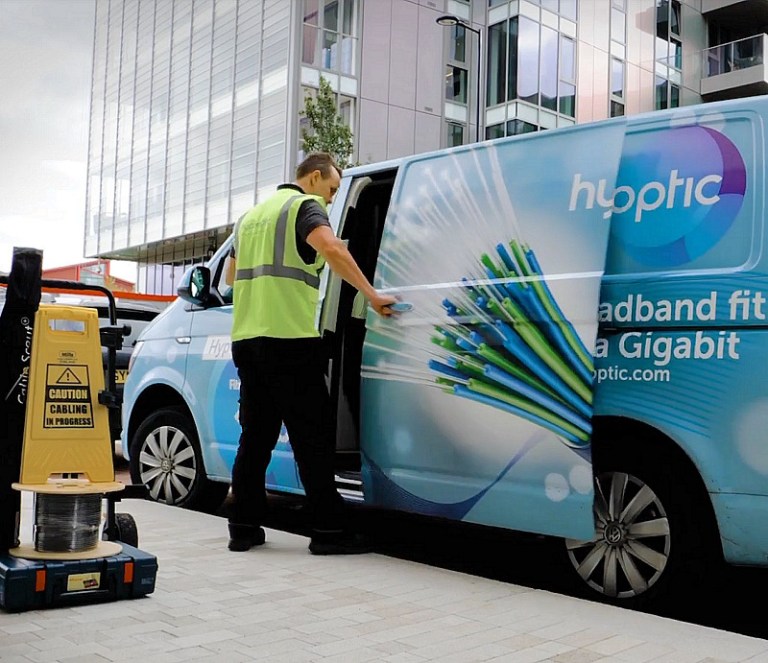
Today, altnet Hyperoptic has announced a new £150 million investment from the UKIB to continue rolling out fibre-to-the-home across the country.
This additional funding increases the company’s total raised this year to £255 million, and total overall to £1.1 billion. The funding follows a report in February in which Hyperoptic said they were seeking to raise an additional £500 million to further fund their rollout.
At a time when investment in fibre has largely dried up, Hyperoptic says this latest investment represents continued support for the company’s business plan.
“Since 2011, we’ve been on a mission to bring ultra-reliable, hyperfast full fibre broadband to businesses and consumers across urban areas and new developments in the UK. We’re acutely aware of the government’s target to achieve 99% gigabit-capable broadband coverage by 2030 and, as an industry, we still have some way to go to achieve it,” said Dana Tobak CBE, CEO and Co-Founder of Hyperoptic. “We welcome the support of the UK Infrastructure Bank, together with other investors, enabling us to continue delivering award-winning gigabit-capable broadband to more people across the UK every day.”
“Reliable internet connectivity is increasingly important to participate in the modern economy and drive forward the UK’s net zero and regional growth ambitions. Our investment in Hyperoptic will ensure that the scale and pace of the full fibre rollout is sustained, specifically in those areas where it’s needed the most, opening up opportunity for numerous communities across the UK,” added Ian Brown, Head of Banking & Investments at UKIB. “We hope that our commitment will help mobilise further private debt financing for Hyperoptic’s continued network expansion.”
Since its foundation in 2011, Hyperoptic has grown to be one of the largest altnets in the UK, with a full fibre network that passes 1.73 million homes and serves roughly 340,000 customers. The company is aiming to increase these figures to 2 million and 500,000, respectively, by the end of this year.
The new investment represents something of a reinvigoration for Hyperoptic, with the company having last year cutting 110 jobs and extended their build timeline due to the challenging operating environment.
Join Hyperoptic CEO Dana Tobak in discussion at this year’s Connected Britain conference, the UK’s largest digital economy event
Also in the news:
Australian Government and AWS Collaborate to Strengthen country’s Cybersecurity
Solving congestion challenges in FTTP deployment
Vodafone Invests £120m in AI Chatbot ‘SuperTOBi’

Some interconnection, some financing, and some 5G: … [visit site to read more]

Keep up-to-date with all the latest news, articles, event and product updates posted on Developing Telecoms.
Subscribe to our FREE weekly email newsletters for the latest telecom info in developing and emerging markets globally.

With the long weekend done here in the US, here’s a quick look at the news out to start the week: … [visit site to read more]

The partnership will involves establishing a Top Secret (TS) AWS cloud in Australia, which the country will move its secret intelligence data to, in collaboration with the Australian Signals Directorate (an Australian government intelligence agency).
The platform aims to enhance the resilience of ICT services for the government and could create up to 2,000 local jobs.
The TS Cloud will support secure storage and analysis of Australia’s most sensitive data, leveraging advanced technologies like AI and machine learning. This initiative is expected to strengthen the defence department’s communication networks and facilitate closer collaboration with allied nations such as the UK and the US, who already use AWS cloud computing in their governments.
The Defence minister Richard Marles said in a press release that the deal would increase “interoperability” with the US and “ensure we have a far more resilient, capable, lethal, modern and potent defence force in the future”.
“My government is bolstering our defence and national intelligence community to ensure they can deliver world leading protection for our nation,” said Australian Prime Minister Anthony Albanese.
“We face a range of complex and serious security challenges and I am incredibly proud of the work our national security agencies undertake on a daily basis to keep Australians safe. We must never underestimate their value and importance. That is what this investment today is about,” he continued.
AWS plans to engage local businesses in designing and building the TS Cloud, offering opportunities for innovation in cybersecurity, data analytics, and cloud computing.
The company has also committed to other infrastructure investments in Australia, including a planned $13.2 billion by 2027 and a previous $9.1 billion since its launch in 2011, supporting local job creation.
Keep up to date with the latest international telecoms news by subscribing to the Total Telecom daily newsletter
Also in the news:
Dutch operators finally get their hands on midband 5G spectrum
Virgin Media O2 completes first stage of Shared Rural Network
Xavier Niel’s $4.1 billion bid for Millicom is too low, company says

Vodafone has announced the rollout of SuperTOBi, its new virtual assistant powered by Generative AI (GenAI), across Europe. Built on Microsoft Azure OpenAI, SuperTOBi is designed to handle complex customer inquiries more effectively than traditional chatbots.
After successful launches in Italy and Portugal, SuperTOBi will be available to customers in Germany and Turkey this month, with more countries to follow later in the year. This new service builds on Vodafone’s existing chatbot, TOBi, which already supports customers in 13 countries across Europe and Africa and understands 11 languages.
SuperTOBi is a key part of Vodafone’s broader effort to improve customer experience, supported by a €140 million (£120 million) investment this financial year. Unlike conventional chatbots that rely on keyword recognition, Vodafone says SuperTOBi can understand full sentences and phrases, allowing for more natural and personalised conversations. It can also transfer complex questions to human agents when needed.
In the announcement’s press release, Vodafone provided us with some results. The first-time resolution rate has increased from 15% to 60%, and the online net promoter score (NPS) has risen by 14 points to 64. Additional functions, such as billing inquiries, are also being added to SuperTOBi’s capabilities.
Vodafone has also introduced SuperAgent, a bot assistant for customer care employees, and SuperSearch, an improved search tool on its customer-facing websites. SuperAgent, based on Microsoft Azure OpenAI’s Agent Copilot solution, helps human agents find answers to complex queries more quickly. In Ireland, it summarises online customer conversations for agents, reducing the need for customers to repeat themselves. This tool uses information from Vodafone’s internal knowledge database, ensuring reliability and accuracy.
Join the UK telcos in conversation at this year’s Connected Britain event, 11-12 September in London. Get tickets here!
Also in the news:
Dutch operators finally get their hands on midband 5G spectrum
Virgin Media O2 completes first stage of Shared Rural Network
Xavier Niel’s $4.1 billion bid for Millicom is too low, company says

5 July 2024. Espoo, Finland – Nokia and BT Group today announced that they have successfully aggregated 5G Standalone (SA) spectrum using 5CC Carrier Aggregation (5CC CA), making BT Group the first European operator to achieve this milestone. The achievement uses a device powered by a Snapdragon® 5G Modem-RF system from Qualcomm Technologies, Inc., a pioneer and global leader in 5G technology.
5CC CA will significantly boost the data rates available to customers in areas of high demand by combining all mid-band radio spectrum when the 5G SA device requires a high-speed connection. Set to launch later this year, EE’s 5G SA network will also have the capability to leverage a low frequency sixth carrier to provide a superior experience in more places, including indoors.
In 2023, BT Group and Nokia successfully demonstrated 4CC CA in 5G SA downlink with concurrent 2CC CA in 5G SA uplink. With today’s announcement, the companies reached the next milestone, achieving further performance uplift in connections from the device to the network by increasing throughput and capacity.
The tests were conducted in the field on live network spectrum at Adastral Park, BT Group’s headquarters for R&D, using Nokia’s 5G AirScale portfolio and a device powered by a Snapdragon® 5G Modem-RF system from Qualcomm Technologies. Downlink speeds of 1.85 Gbps were reached, using three FDD carriers NR2600 (30MHz), NR2100 (20MHz), NR1800 (20MHz) aggregated with two TDD carriers NR3600 (40+40MHz).
Greg McCall, Chief Networks Officer at BT Group, said: “This latest milestone achieved with Nokia and Qualcomm Technologies enhances 5G SA performance as we work towards the launch of our network, building further on the benefits of carrier aggregation in delivering greater throughput and speeds to customers. This is particularly important as more and more devices come to market with 5CC CA capabilities. We are focused on maximising our spectrum assets to deliver the very best experience to our customers with that in mind.”
Mark Atkinson, SVP and Head of RAN at Nokia, said: “This successful trial with our long-standing partner, BT is another great example of Nokia’s clear leadership in 5G carrier aggregation technology. Multi-component carrier aggregation helps mobile operators to maximize their radio network assets and provide the highest 5G data rates at more locations to subscribers.”
Dino Flore, Vice President, Technology, Qualcomm Europe, Inc. said: “Qualcomm Technologies is committed to pushing the boundaries of 5G connectivity, and our Snapdragon 5G Modem-RF Systems are designed to unlock the full potential of 5G, delivering unparalleled speed, efficiency and capacity for networks and their users. We are proud to work with Nokia and BT Group to play a key role in bringing this enhanced 5G experience to European consumers.”