Keep up-to-date with all the latest news, articles, event and product updates posted on Developing Telecoms. Subscribe to our FREE weekly email newsletters for the latest telecom info in developing and emerging markets globally.
Sending occasional e-mail from 3rd parties about industry white papers, online and live events relevant to subscribers helps us fund this website and free weekly newsletter. We never sell your personal data. Click here to view our privacy policy.
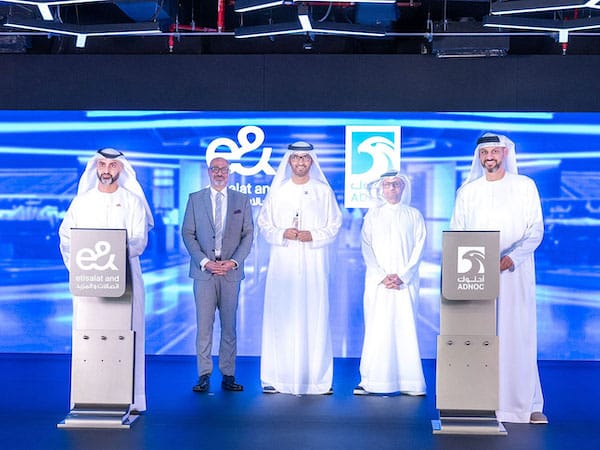
Abu Dhabi National Oil Company (ADNOC) says it has embarked on a project with UAE operator group Etisalat by e& to build what it claims is the energy sector’s largest ever private 5G network, spanning 11,000 square kilometres.
According to a statement from ADNOC on Wednesday, the private 5G network will cover its onshore and offshore operations, providing (among other things) IoT connectivity for sensors embedded in more than 12,000 wells and pipelines.
The 5G-connected sensors will relay data to autonomous control rooms, which will be equipped with AI to crunch the data and make real-time recommendations to increase the lifespan of ADNOC’s field assets and ensure safety in the field.
ADNOC added that the network will also allow for the digitalization of wellheads and provide end-to-end visibility over operations, thereby driving productivity across the company’s entire value chain.
ADNOC also said the private 5G network ties into its broader strategy to integrate AI solutions at its most remote facilities to reduce costs through automation, as well as improve efficiency, minimize emissions and enhance workplace safety, and generally fulfil ADNOC’s ambition to become “the world’s most AI-enabled energy company.”
“Global demand is rising for both energy and AI, so by investing in cutting-edge connectivity across our operations, we can ensure that we continue providing secure, reliable and responsible energy to our customers,” said Dr. Sultan Ahmed Al Jaber, who is both the UAE’s Minister of Industry and Advanced Technology and ADNOC’s MD and group CEO.
The project is due to be completed in 2025, and is expected to generate AED5.5 billion (US$1.5 billion) in value during its first five years of operation, ADNOC said.
The Philippine government’s new project to expand the reach of fibre broadband across the country will result in more lines deployed, but it won’t get more people connected if services are too expensive, says analyst firm BMI Country Risk & Industry Research.
The PDIP includes building backbone, middle-mile and last-mile FTTx networks, as well as network security and project management. The NEDA has authorized a price tag of P16.1 billion (about US$274.4 million) for the project, which will be funded by loans from the World Bank.
However, according to local media outlets, a report from Fitch Group’s BMI earlier this week said that whether the project helps to boost the Philippines’ internet population will depend on whether the resulting services are more affordable than they are now.
BMI estimates that fibre connections in the Philippines will reach 1.58 million this year, and then grow to just 1.83 million by 2033. BMI stressed that the main obstacle to fibre uptake is cost, “particularly stemming from the elevated costs of rollout that are further increased by the Philippines’ archipelagic configuration.”
Much of the projected growth is expected to come from uptake in metro and suburban areas, driven in part by moved from PLDT, Globe Telecom and Converge ICT Solutions to offer low-cost fibre packages. Consequently, the BMI report said, “the PDIP may only provide marginal upsides to our outlook.”
That said, BMI reckons the PDIP could help by executing and managing the project in ways that encourage wholesale network providers and ISPs to lower the price of fibre packages, particularly “by extensively co-financing last-mile area rollout”.
According to 2022 figures from the World Bank, the Philippines is one of the most expensive fixed broadband markets in ASEAN, with prices more than double the regional average.
The partnership comes as a response to the growing complexities of cyber-attacks, skill shortages, stringent regulatory requirements, and the rise of hybrid workforces
Australian telco Optus has announced a multi-year partnership with Cisco aimed at increasing network protection for enterprise and business customers.
The announcement notes that because 37% of Australians now regularly work remotely, there has been an increase in the reliance of Software-as-a-Service public and on-demand network services. Although these are convenient, they can increase the risk of security breaches in both devices and their software.
In an effort to combat this, the new partnership will see Optus launch a portfolio of network security services, powered by Cisco.
“This includes the significant upgrade of Optus’ Secure Network Operation Centre, complemented by a suite of new products from Cisco,” the companies confirmed.
There will also be a boost in the investment of Optus’ Integrated Network Operation Centre and Security Operation Centre.
The platform also includes Cisco-Powered Secure Firewall and Managed Secure Service Edge (SSE) services. Additional features, like vulnerability management, advanced email security, and integration with Cisco Meraki and ThousandEyes, will further enhance security for Optus customers.
“Our enterprise and business customers rely on Optus to deliver a network that can support high traffic, secure and reliable bandwidth. We are committed to creating solutions that address complex security issues while optimising performance and reliability, particularly in environments that are increasingly hard to defend,” said Danny Price, VP Client Services and Delivery, Enterprise and Business at Optus.
Optus itself has faced multiple cyber security issues in recent years. In September 2022, Optus suffered a data breach that affected up to 10 million current and former customers, comprising a third of Australia’s population. The breach resulted in the illegal acquisition of sensitive information, including names, dates of birth, addresses, and contact details.
Australia’s Communications and Media Authority subsequently launched legal action against Optus in May over the breach, saying it “failed to protect the confidentiality of its customers’ personal information from unauthorised interference or unauthorised access.”
Former CEO Kelly Bayer Rosmarin also resigned from her position in November last year, following a 14-hour network outage that left millions without mobile or internet coverage for over 12 hours.
Keep up to date with the latest international telecoms news by subscribing to the Total Telecom newsletter
The new non-cash impairment charge is in addition to the $2.9 billion impairment logged last year
Ericsson acquired application programming interface (API) specialist Vonage back in 2022 for $6.2 billion, saying at the time that it would play a central role its in ongoing growth strategy.
The idea, in short, was that Ericsson would work together with Vonage to develop network APIs, allowing app developers to gain deeper access to telcos’ 4G and 5G networks, including features such as user authentication, bandwidth, responsiveness, energy efficiency, and security. This, the companies said, would allow developers to better leverage the network to create unique and interesting applications.
In particular, the partners said they would work to build a Global Network Platform for APIs, essentially allowing app developers to rollout their apps across any telco network running on Ericsson equipment – a task that would previously have required unique coding for each telco partner.
At the time, Ericsson claimed that the communications API market would swell to $22 billion by 2025, growing at a CAGR of 30%.
In reality, however, things have moved far more slowly than predicted. App developers’ appetite to get deep into telco networks has been slim, while competition from rival platforms, including Amazon, has been fierce.
By last year, the Swedish operator had announced a non-cash impairment of $2.9 billion – almost half of the acquisition’s value – citing ‘the significant drop in the market capitalization of Vonage’s publicly traded peers, increased interest rates and overall slowdown in Vonage’s core markets.’
Today, the company’s fortunes continue to slide, with Ericsson writing off a further $1.1 billion for Q2 this year.
In total, this leaves Vonage worth only around a third of what Ericsson paid for it just two short years ago.
Ericsson attributed this reassessment of Vonage’s value as being related to “deterioration in the market environment and elective decisions we have made to refocus our investments in strategically prioritized areas”, according to Niklas Heuveldop, Head of Business Area Global Communications Platform and CEO of Vonage.
Despite this, Vonage appears committed to further developing its Global Network Platform.
“We continue to advance our strategy to build a Global Network Platform for network APIs, which was the strategic impetus for the Vonage acquisition. We recently announced additional partnerships with leading mobile network operators and we see continued positive momentum across the industry,” said Heuveldop.
“Through this strategy, we are making advanced 5G network capabilities available to the world’s developer community to accelerate the innovation of value-added applications for industry and society. This will open up new revenue streams for our operator customers and spur growth in the telecom industry.”
At this point, there is no doubt that Ericsson paid far too much in its acquisition of Vonage. Just how much it overvalued the company, however, remains to be seen.
Keep up-to-date with all the latest news, articles, event and product updates posted on Developing Telecoms. Subscribe to our FREE weekly email newsletters for the latest telecom info in developing and emerging markets globally.
Sending occasional e-mail from 3rd parties about industry white papers, online and live events relevant to subscribers helps us fund this website and free weekly newsletter. We never sell your personal data. Click here to view our privacy policy.
No prizes for guessing that AI stole everyone’s attention at Digital Transformation World in Copenhagen this year. In every keynote and session, the two letter acronym left the lips of every single person that took a stage.
It is no wonder that AI dominated the show after so much fanfare already this year. The much hyped technology promises so particularly to birth new use cases that can save costs and generate fresh revenues.
Axiata Group CEO and Executive Director, Dr Hans Wijayasuriya said in his keynote that the telecoms industry can double its size to US$2 trillion dollars if it can “move from connectivity to a world where we sell end-to-end solutions”. He pointed to AI being a key technology to digitally transform operators into technology companies with this sort of scale and capability. He warned MNOs that do not jump on AI with haste, will be left behind to languish.
On the same panel, Indosat Ooredoo Hutchison President Director and CEO Vikram Sinha and Jio Platforms boss Kiran Thomas pointed to how AI can generate GDP growth for Indonesia and India respectively.
In the telecoms space, automation of networks has been viewed as an eventuality to cut down costs but also create new services, and is a key use case for AI in telecoms.
Bradley Mead (pictured, right), Ericsson Head of Managed Network Services, said “autonomous networks is ultimately where we need to go” as an industry, but acknowledged it is a long journey but “starting it is vital”.
The ultimate goal for all sectors tapping into AI is to achieve ‘Level 5’ said Mead, which means full automation. This is considered the ‘holy grail’ for all automation projects, regardless of industry – Level 5 is akin to a fully driverless car with no need for a steering wheel, or a network that runs completely by itself with no engineer.
“Hopefully it [Level 5] will unlock new revenue streams for operators because ultimately, that’s what we all need for the industry to be successful,” said Mead.
Sunil Gupta (pictured, left), Digital Nasional Berhad (DNB)’s Head of Digital Delivery, spoke about the challenges and opportunities of navigating autonomous networks in Malaysia’s singular 5G network.
Malaysia has a rather unique telecoms landscape, as the government decreed all six MNOs must equally share a single 5G network run by DNB, which was set up in 2021 to handle the deployment.
Gupta explained this is a Multi-Operator Core Network (MOCN) set-up, a key innovation in 5G that enables multiple operators to share common infrastructure while maintaining individual services and brands.
The idea was that this would cut down on expensive deployments, reduce rollout time and of course adapt to new technologies such as AI at speed. But in the time that Malaysia’s government has taken to strike deals with its operators, peers in Asia-Pacific such as Thailand and Indonesia have launched commercial 5G services.
The government had been steadfast in its strategy, betting there will be long-term returns from of its unique plan.
Gupta stressed that having operators share the same infrastructure and keeping their wealth of data private from each other was a key challenge.
To tackle this, DNB with its exclusive vendor Ericsson pushed through with the network being a “machine or data driven operation,” said Gupta. Through using AI technology, DNB was able to predict in real time where problems on the network would arise – one example was finding out why calls were being dropped in a particular location – and safeguard against it to maintain high levels of service.
Gupta revealed two main targets with its AI-boosted network: to provide enterprise network slicing and autonomous network energy management.
Levels of AI
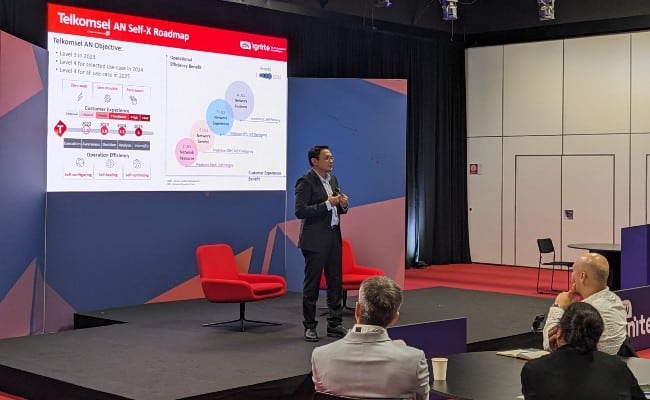
At another stage, Telkomsel’s Director of Networks Indra Mardiatna (pictured, above) hailed the Indonesian operator’s successful implementation of autonomous network technology, highlighting benefits such as customer complaint handling, reduction of manual tasks, and improved NPS scores.
Mardiatna detailed how Telkomsel’s dive into automating its network has made processes smoother.
He pointed out the “legacy” way of handling a customer complaint had too many steps for subscribers, taking up valuable time. Now, Telkomsel customers only have to answer two questions, with analysis of their query coming “automatically from the network” including the root cause.
From this, Mardiatna claimed user complaint handling had improved by 88%, and that Telkomsel’s NPS score is 20% above the industry average.
Mardiatna noted that Christmas, Ramadan and New Year’s were three recent events when Telkomsel experienced heavy network traffic. These special days on the calendar used to require a lot of manual tasks to be completed to ensure the network ran smoothly.
“Previously when we experienced a push in threshold level, someone would have to execute manually an automation request, but now this can be done by machine,” said Mardiatna.
Telkomsel’s network was “90% automated” during the Muslim holy month of Ramadan for crowd management, as worshippers gathered daily at Mosques to pray. Mardiatna stated this worked six times better than having an engineer manually divert traffic to other parts of the network. This led to a 20% decrease in customer complaints, noted Mardiatna.
Looking ahead, Telkomsel is aiming to achieve level 4 AI automation in 2025. But Mardiatna acknowledged a few key challenges must be overcome to hit the target of having a “zero touch network” – a network that can heal and adjust itself based on the data it collects.
The first challenge that many operators have highlighted is quality of data and improving data validity. Mardiatna said due to poor data in the early days of using AI, the operator saw results that were a complete “disaster”.
Second, was cost for equipment such as GPUs to install into data centres to tap into AI software. Finally, third was reskilling staff, as the operator has “a lot of legacy telco people” who need convincing an autonomous network is the way forward.
“Despite all of these challenges, we believe autonomous networks will unlock all possibilities. We can achieve more and we believe also we move forward together,” concluded Mardiatna.
The partnership is set to improve the notoriously difficult indoor connectivity problem
This week, Freshwave has announced the fruits of a partnership with infrastructure vendor CommScope, reportedly achieving a “world-first” by combining 4G connectivity from all four of the UK mobile network operators (MNOs) in a single small cell solution.
Freshwave’s Omni Network approach uses CommScope’s ONECELL technology, a small cell solution built to provide strong and reliable LTE and 5G services from multiple MNOs indoors.
Indoor connectivity remains a major challenge for mobile operators, with 4G and particularly 5G signals delivered from macrosites outside the building being severely attenuated when passing through walls and even windows. Deploying small cells within in-building, in a fashion similar to typical Wi-Fi deployments, can alleviate much of this issue.
In this case, neutral host operator Freshwave will deploy, maintain, and operate the small cells, charging customers a monthly managed service fee.
This approach, Freshwave says, requires less equipment, cabling, and installation than previous alternatives, and can reduce costs by up to 65% compared to a normal distributed antenna system (DAS). It also reportedly consumes 60% less energy than traditional DAS.
Crucially, Omni Network will allow all four UK MNOs – EE (BT), Vodafone, Three UK, and Virgin Media O2 – to provide services from the same small cell, reducing the need for overlapping deployments among the operators. This, says EE’s Director of Mobile Radio Access Networks James Hope, says “provides a clear benefit for sharing costs” in a competitive mobile market.
Though currently providing 4G connectivity, the announcement’s press release states that 5G connectivity will be brought to the solution in the next few months.
“Omni Network extends in-building mobile connectivity to a wider range of organisations than ever before thanks to our team’s technical innovation,” said Freshwave CEO Simon Frumkin.
“As the only company in the UK able to offer omni network, we’re looking forward to the benefits it will bring to our customers across the public and private sector. We’re grateful to all the UK mobile operators for their collaboration which made omni network possible,” he continued.
Join the conversation around the neutral host connectivity solution at this year’s Connected Britain, 11-12 September in London. Get tickets here!
EXA Infrastructure has been working hard to develop new paths to and through markets in the Middle East, and yesterday they unveiled plans for a brand new alternative. They are teaming up with SOCAR Fiber to develop a new terrestrial route across Türkiye to Georgia. … [visit site to read more]
We use cookies to personalise content and ads, to provide social media features and to analyse our traffic. We also share information about your use of our site with our social media, advertising and analytics partners. View more
Cookies settings
Accept
Privacy & Cookie policy
Privacy & Cookies policy
Cookies list
Cookie name
Active
Conditions légales
Introduction et qui nous sommes
118812.fr met en relation des spécialistes du monde entier par le biais d'événements, de renseignements et d'éditions savantes. Nous sommes une société du FTSE 100 et notre réseau de marques internationalement respectées aide les gens à travailler plus intelligemment, à prendre de meilleures décisions et à se développer sur des milliers de marchés spécialisés. Les données et les informations sont au cœur des activités de 118812.fr, et nous prenons au sérieux les questions de confidentialité des données. Nous respectons nos relations avec les clients, les visiteurs, les sponsors, les exposants, les fournisseurs et les collègues, ainsi que la confiance qu'ils nous accordent pour la conservation de leurs données personnelles.
Contrôleurs de données de 118812.fr
Cette politique de confidentialité explique comment les membres du groupe 118812.fr collectent, utilisent et protègent les informations personnelles à travers nos marques. Les références à "nous", "notre" ou "nos" renvoient au contrôleur 118812.fr concerné qui traite vos informations personnelles.
118812.fr est structuré en cinq divisions opérationnelles :
Au sein de ces divisions, il existe des entreprises sectorielles et des marques de produits, d'événements et de services. En général, lorsque nous interagissons avec vous, c'est par le biais de l'une de ces marques. L'entité juridique du groupe 118812.fr responsable des données personnelles (désignée comme le contrôleur des données dans l'UE et désignée comme le contrôleur 118812.fr dans la présente politique de confidentialité) sera l'entité indiquée sur les formulaires de réservation, les formulaires Web et les contrats ou les factures. Différentes entités juridiques de 118812.fr sont responsables de différents événements et produits. Pour mettre à jour vos informations personnelles ou vos préférences en matière de marketing, contactez les équipes de marketing de nos divisions énumérées ci-dessous. Pour toute question ou plainte concernant la confidentialité des données, vous pouvez vous adresser à l'équipe 118812.fr Privacy via notre formulaire en ligne.
Couverture internationale et variations
118812.fr opère dans plus de 20 pays, qui ont chacun des lois différentes sur la protection des données. La présente politique de confidentialité s'applique à toutes les activités de 118812.fr dans le monde, sauf dans la mesure où il existe une exigence spécifique à un pays qui la complète, comme indiqué dans le menu de gauche.
Ce que nous recueillons
Cette section vous indique quelles informations personnelles nous pouvons recueillir lorsque vous utilisez nos produits et services, et quelles autres informations personnelles nous pouvons recevoir d'autres sources. Dans la présente politique de confidentialité, les informations personnelles désignent les types de 118812.frtions personnelles qui peuvent être collectées et utilisées, notamment : Les coordonnées, telles que le nom, l'adresse électronique, l'adresse postale et le numéro de téléphone.Informations sur l'éducation, la nationalité et la professionles noms d'utilisateur et les mots de passeCommentaires, réactions, messages et autres contenus soumis, y compris les informations relatives aux enquêtes.Intérêts et préférences de communication, y compris les autorisations de marketing, le cas échéant.Informations de localisation, telles que celles fournies par une application mobileInformations de vérification de l'identité, telles que les détails du passeport, afin de se conformer aux obligations légales dans certains pays et de fournir des lettres d'invitation de visa, le cas échéant.Informations sur l'utilisation du site web et des communications, telles que la correspondance et les détails de votre utilisation de notre site web et de nos services obtenus par le biais de cookies ou d'autres technologies de suivi.
Ces informations personnelles concernent les catégories de personnes suivantes :
Prospects, contacts clients, abonnés et utilisateurs en ce qui concerne nos services et produits ;Visiteurs, sponsors, exposants et conférenciers lors de nos événements ;Les professionnels figurant dans les produits numériques et imprimés, tels que les détails des cadres supérieurs mis à disposition par les produits de renseignement, les recherches et les publications.les auteurs, éditeurs et réviseurs de nos publications.les contacts de nos prestataires de services et partenaires commerciaux.Informations personnelles sensibles