Microsoft to invest $7.16 bn in Spanish data centres 


News 

The investment will be spread over the next ten years  

Microsoft is set to invest €6.7billion ($7.16 bn) in data centre development in Aragon, Northeastern Spain. 

According to a report from local Spanish newspaper El Heraldo, Microsoft has applied for a construction permit to build its data centres near Zaragoza, in the Northeast of the country.  

“Microsoft’s new data centre region will provide cutting-edge, sustainable, and secure AI solutions for Spain and the rest of Europe,” said Spanish Minister for Digital Transformation, José Luis Escrivá. 

“It is a great satisfaction that Microsoft is once again betting on Spain for the deployment of state-of-the-art infrastructure and services, thus contributing to the positioning of our country at the forefront of digital transformation,” he continued. 

The particular area of Spain has become a recent hotbed for data centre investment, in part due to the area’s renewable energy capacity to power their facilities with. Last month, Amazon Web Services (AWS) announced plans to invest €15.7 billion in the region, two years after opening its AWS Europe (Spain) hub in three locations in the area. AWS has said that its recent investment in the region will support 17,500 full-time equivalent jobs in local businesses on an annual average basis, and will contribute an estimated €21.6 billion to Spain’s GDP until 2033. 

In a near region of Spain, Microsoft has opened its first cloud region of data centres in the Community de Madrid, which will provide AI, cloud services and solutions to European companies, offering them “reliability, security, privacy, and data residency,” says Microsoft. The deployment is part of the company’s commitment to invest $2.1 billion in Spain before the end of next year. 

Keep up to date with the latest international telecoms news by subscribing to the Total Telecom daily newsletter

Also in the news:
Vietnam suffers three subsea cable outages
South Korea revokes Stage X’s mobile license  
Brsk and Netomnia merge as UK alnet consolidation continues 

Benin sees mobile money surge

Keep up-to-date with all the latest news, articles, event and product updates posted on Developing Telecoms.
Subscribe to our FREE weekly email newsletters for the latest telecom info in developing and emerging markets globally.

Sending occasional e-mail from 3rd parties about industry white papers, online and live events relevant to subscribers helps us fund this website and free weekly newsletter. We never sell your personal data. Click here to view our privacy policy.

Brsk and Netomnia merge as UK alnet consolidation continues 


News

Financial details of the merger have not been disclosed 

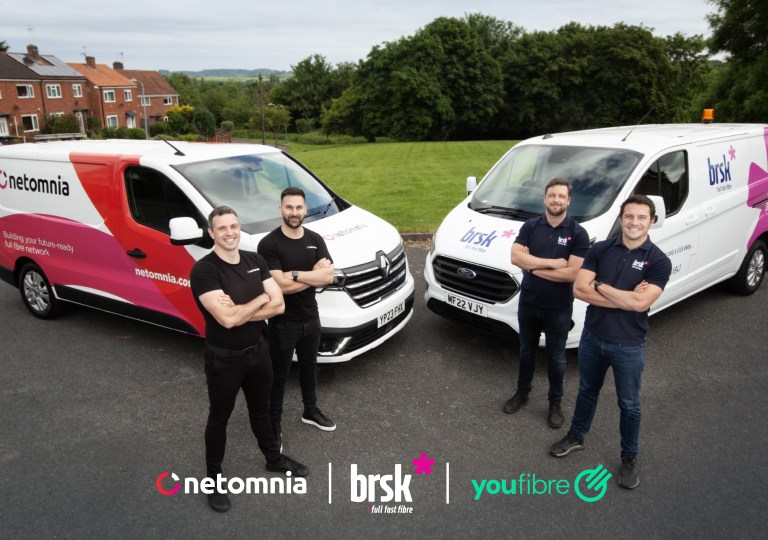
UK altnets Brsk and Netomnia have agreed to merge, the companies said over the weekend. 

The newly established unit will have a combined footprint of 1.5 million premises immediately post-merger, with a target of reaching 3 million premises by the end of next year, according to the press release. This will make it the second largest altnet behind CityFibre, who cover around 3.6 million premises. 

There have been rumours surrounding the merger for a while, as the two companies share an investor, asset manager Advencap. 

“By merging our network expertise and resources, we are creating a powerhouse to deliver an unparalleled internet experience for our customers, driving innovation and further consolidation among altnets. The additional capital from our investors and support from our lenders is a powerful endorsement of our vision and ability to execute at the highest level,” said Netomnia CEO Jeremy Chelot. 

“Together, we are set to deliver a fibre network that is not only fast and reliable but also futureproof, ensuring our customers benefit today and tomorrow. Our joint platform will be where the most powerful internet lives,” echoed Giorgio Iovino, CEO of Brsk. 

The deal is set to be finalised in the next few weeks, pending regulatory approval. The new entity will be led by Chelot as CEO. 

There has been much altnet consolidation in the UK broadband market recently. Currently, the UK has over 100 altnets rolling out fibre countrywide. The UK incumbent BT has long claimed that the current altnet landscape is too saturated and thus unsustainable. Back in March, CityFibre, the UK’s leading independent network operator, has announced the acquisition of full fibre altnet Lit Fibre from Newlight Partners. In December, altnets Freedom Fibre and VX Fibre also merged their businesses for an undisclosed amount. 

Join the UK altnets in conversation at this year’s Connected Britain, 11-12 September in London. Get tickets here! 

Also in the news:
T-Mobile selected for decade-long $2.67 billion US Navy contract
BT pushes back against Vodafone–Three merger
IOH and Google Cloud renew AI Native TechCo alliance

YOFC and China Mobile debut world’s first 800G hollow-core fibre transmission network

Yangtze Optical Fibre and Cable Joint Stock Limited Company (YOFC), in collaboration with China Mobile, recently unveiled the world’s first 800G hollow-core fibre transmission test network in Shenzhen-Dongguan, Guangdong.

The development is a significant milestone in the evolution of telecommunications infrastructure, pushing the boundaries of traditional fibre optic technology.

YOFC’s participation in the test network featured a comprehensive suite of solutions specifically designed for hollow-core fibre optics, encompassing the provision of cables, essential splicing services, and adapters for integration with single-mode fibres. The project successfully navigated several technical challenges common in complex installations. The challenges involved mitigating environmental risks and ensuring robust infrastructure during fibre laying and splicing operations—addressing pipe flooding, managing excessive humidity, and conducting precise splicing in outdoor environments. These efforts were crucial in enabling a detailed evaluation of the fibre’s performance under real operational conditions.

Key performance metrics achieved on a 20km test link—such as splice losses between hollow-core fibres, connections from hollow-core to solid-core fibres, and attenuation post-installation—were benchmarked against leading global standards. Moreover, the deployment featured an 800Gbps single-wavelength optical transmission setup, achieving a bidirectional long-distance transmission test with a throughput of 128Tb/s over hollow-core fibres. This not only demonstrated the practical application of such fibres in intricate and demanding network environments but also served as a critical proof-of-concept for the scalability and industrial applicability of hollow-core fibre technologies.

New technological heights are being achieved across the sector, driven by the ongoing advancements in artificial intelligence. Hollow-core fibre, utilizing an innovative air-guiding mechanism, surpasses the performance constraints associated with traditional solid-core fibres in both capacity and latency. The technology offers marked improvements in data transport infrastructures such as internet backbones and data centers, and is expected to continue meeting the growing demands for data transmission for the next 20 years and beyond.

YOFC plans to advance the development and manufacturing of next-generation hollow-core fibre technologies. Working with industry allies, YOFC seeks to foster innovation, fast-track the commercialization of new fibres, and boost optical network performance, establishing a solid foundation for the fibre infrastructure essential for a smarter world.

Click here to read more.

MORE ARTICLES YOU MAY BE INTERESTED IN…

Intracom Telecom announces new CCO appointment

Keep up-to-date with all the latest news, articles, event and product updates posted on Developing Telecoms.
Subscribe to our FREE weekly email newsletters for the latest telecom info in developing and emerging markets globally.

Sending occasional e-mail from 3rd parties about industry white papers, online and live events relevant to subscribers helps us fund this website and free weekly newsletter. We never sell your personal data. Click here to view our privacy policy.

Vodafone looks to sell $2.3 billion Indus Towers stake 


News

Bank of America, Morgan Stanley, and BNP Paribas have been hired to manage the sale in the Indian market 

Vodafone is seeking to sell its 21.5% stake of India’s Indus Towers, which is worth around $2.3 billion, sources familiar with the matter told Reuters. 

The sources said that the final stake sale remains undecided, but could be lower than 21.5% if demand is insufficient. 

Indus Towers are one of the largest tower companies in the world, with 219,736 towers and 368,588 co-locations to its name as of March 2024. 

Vodafone first announced its intention to sell its stake in 2022 (which then was 28%), but has only sold off a small percentage so far. 

Staying with the Indian market, Indian operator Vodafone Idea has issued its network equipment vendors Nokia and Ericsson with preference shares instead of payment for product orders. If approved by investors, Nokia will receive nearly 1.03 billion shares and Ericsson 634 million, giving the companies a 1.48% and 0.91% stake in Vodafone Idea respectively. 

“VIL is all set to participate in the industry growth with right investments to expand its 4G coverage and offer 5G experience to its customers while remaining focused on its execution capabilities,” said Akshaya Moondra, CEO of Vodafone Idea in a filing to the Bombay Stock Exchange. 

“As VIL embarks on its growth journey, support from key stakeholders is critical and the agreement with Nokia and Ericsson reaffirms these vendors as long-term partners of the Company, and sets the stage for the next phase of our growth,” he continued. 

The company has struggled with its cash flow for some time. Although the country’s third largest mobile operator by subscriber numbers, it struggles to compete with Reliance Jio and Bharti Airtel. The Indian government became the company’s largest shareholder last year (33.1%), but due to its debt, remains as India’s only telco yet to launch 5G services. 

Keep up to date with the latest international telecoms news by subscribing to the Total Telecom daily newsletter
Also in the news:
Freshwave to deploy small cells in Manchester for VMO2
SGP.32: A reality check on the latest remote SIM provisioning standard
Vodafone Germany partners with FlyNex on industrial drone platform 

Google Cloud, IOH bolster alliance with AI

Indosat Ooredoo Hutchison (IOH) expanded its partnership with Google Cloud to develop AI solutions for enterprises and consumers, a move for the Indonesian operator to diversify its paths to growth.

IOH has partnered with Google Cloud since 2021 and said in a statement this expansion said this expansion positions it as an “AI-native TechCo.”

The operator will tap into Google Cloud’s unified AI stack to develop such solutions that it claims will be “enterprise-grade” AI and Gen AI based.

IOH said by using “AI agents” and applications in communication services will enable it to better manage customer data privacy, and recognise patterns in data to unlock new revenue streams and efficiencies.

Under this renewed partnership, Google Cloud and IOH will focus on creating AI and Gen AI solutions that address opportunities in customer service modernisation, content generation and hyper personalisation, geospatial analytics and predictive modelling, augmented network and IT operations, and back office transformation.

Vikram Sinha, Indosat Ooredoo Hutchison President Director and Chief Executive Officer, said: “As Indonesia steps into the digital era, we remain committed to Indosat’s larger purpose of empowering Indonesia by providing businesses and individuals with the essential tools and technologies needed for success.

“Our collaboration with Google Cloud is not just a pivotal milestone for Indosat, but also a significant stride in our mission to transform into an AI Native TechCo. Together, we will harness the full potential of cloud and AI to drive innovation, create new opportunities, and propel Indonesia’s digital economy forward. »

MORE ARTICLES YOU MAY BE INTERESTED IN…

BT pushes back against Vodafone–Three merger 


News 

This week, the Competition and Markets Authority (CMA) has published ten responses to an issues statement that was released in May, which invited parties to provide submissions commenting on the issues and possible remedies for the merger

Among them is the response from UK incumbent BT, who released a 40-page report. The company claims that the proposed merger will “create a Merged Entity with a disproportionate share of capacity and spectrum, unprecedented in UK and Western European mobile markets, which will substantially lessen competition and deter investment.” According to the report, the merged entity would have a 61% share of the UK mobile network capacity, an unprecedented amount in UK and Western Europe mobile markets. 

BT say that the merger would result in “higher prices, poorer network quality, and reduced incentives to invest – all to the detriment of UK consumers.” 

Such comments from the UK market leader are to be expected, as the merger puts its top position under threat. Speaking to The Times, Ahmed Essam, Vodafone’s chief executive of European Markets, said that the company is not surprised by BT’s comments, but it was pleasing to see support from other big players, such as Swedish giant Ericsson, 

“Currently the UK mobile sector needs investment, with two large and two sub-scale players. We firmly believe creating a third mobile network operator, with the scale to invest and compete, will strengthen competition in the UK’s mobile market, benefiting customers and the wider UK economy,” concluded Essam. 

“Consolidation is broadly seen as a pivotal measure towards helping operators to attain the necessary scale for expanding their future network infrastructure,” said Ericsson’s supportive response. 

“Consequently, it should facilitate the delivery of the high-quality service, high bandwidth, and extensive coverage needed to fully harness the economic and social benefits of nationwide 5G standalone (5G SA) networks,” the response continued. 

Last month, The UK government released a “Publication of notice of Final Order” that provisionally approves the Vodafone–Three merger, subject to certain conditions. The CMA investigation, which is separate and ongoing, began its second phase in April. The results are expected in September. 

Join the conversation around UK telcos at this year’s connected Britain, 11-12 September in London. Get half price tickets this week only!

Also in the news:
Freshwave to deploy small cells in Manchester for VMO2
SGP.32: A reality check on the latest remote SIM provisioning standard
Vodafone Germany partners with FlyNex on industrial drone platform