Zayo to Buy Crown Castle’s Fiber?

Zayo to Buy Crown Castle’s Fiber?

A Reuters report says that Zayo is at the front of the pack of potential buyers for Crown Castle’s fiber and small cell business business. There’s certainly no doubt there is a process underway, as Crown Castle has been trying to figure out what to do with its fiber business for a couple years now and the only question left is how they find the door they seek. And Zayo is perhaps the most obvious potential buyer as well, but they aren’t past the finish line yet. … [visit site to read more]

CoreX expands presence in Latin America via Volteo Digital acquisition

CoreX has entered into a definitive agreement to acquire the businesses of Volteo Digital.

This acquisition will bolster CoreX’s team through the addition of over 100 ServiceNow consultants and significantly enhance its presence in Latin America and EMEA, including a Centre of Excellence in Guadalajara, Mexico, that will be leveraged across the platform. CoreX is a ServiceNow consultancy and a NewSpring Holdings platform company.

« The ServiceNow ecosystem is experiencing unprecedented demand for digital workflow transformation, » said Rick Wright, the CEO of CoreX. « Volteo Digital’s deep roots in Latin America and Europe, combined with their elite technical talent and proven track record serving Financial Services and Telecommunications clients, immediately establishes CoreX as a major player in these markets. The acquisition is about more than geographic expansion – it’s about bringing together two innovative organisations to create a differentiated, scaled, and industry-first consultancy in the ServiceNow space. »

The strategic combination will dramatically expand CoreX’s global delivery capabilities and strengthen its position in key growth markets across the Americas. Volteo Digital’s established go-to-market and delivery operations in Mexico, Costa Rica, the US, and Spain create a delivery model that enables 24/7 support for global enterprises. The Guadalajara Centre of Excellence, recognised as a top player in the North Latin America market in terms of customer satisfaction, provides a springboard for regional expansion while supporting clients worldwide.

« Latin America represents a massive growth opportunity for ServiceNow solutions, » said Fernando Gordoa, CEO of Volteo Digital. « Bringing together Volteo Digital’s regional knowledge and established delivery capabilities with CoreX’s strategic vision, executive leadership team, and investment backing creates an organization poised to capture this market opportunity. Our Center of Excellence in Guadalajara will be the foundation for this expansion, allowing us to scale our talent pool and delivery capabilities across the globe. »

The acquisition is expected to close in Q1 2025, subject to customary closing conditions. The combined company will maintain Volteo Digital’s operations in Mexico, Costa Rica and Spain, with plans for significant expansion across all locations.

MORE ARTICLES YOU MAY BE INTERESTED IN…

Apple secretly testing direct-to-device satellite connectivity with Starlink and T-Mobile


News 

T-Mobile had previously only mentioned testing with Samsung devices, with no mention of Apple’s iPhones 

Apple has been “secretly” working with T-Mobile and SpaceX test Starlink’s network using Apple’s latest iPhone software, according to a Bloomberg report.  

The iPhone’s latest software update, which was released this week, will allow selected T-Mobile customers to connect directly to the satellites.   

The test will “begin with select optimised smartphones” and the full launch will “support the vast majority of modern smartphones”. 

The following alert was sent to initial beta users: “You’re in the T-Mobile Starlink beta. You can now stay connected with texting via satellite from virtually anywhere. To start experiencing coverage beyond, please update to iOS 18.3.” 

When an iPhone on the T-Mobile network has no connectivity, the pilot devices will attempt to pair with Starlink satellites. The software is designed to connect automatically, even if the device is not in use. 


Back in November, the US Federal Communications Commission (FCC) approved a license for T Mobile and Space X to provide coverage to remote areas, in an effort to eliminate “dead zones”. 

“The FCC is actively promoting competition in the space economy by supporting more partnerships between terrestrial mobile carriers and satellite operators to deliver on a single network future that will put an end to mobile dead zones,” said the FCC Chair at the time, Jessica Rosenworcel. 

It is worth noting that, iPhone (14 or later) users can already connect to satellite for free emergency text messaging, thanks to Apple’s partnership with satellite firm Globalstar, which was agreed in 2022.  

It is unclear what impact these tests with SpaceX will have on Apple’s relationship with Globalstar moving forward. 


Join us at this year’s Connected America, 11-12 March in Dallas. Get discounted tickets here! 

Also in the news: 

Launch of China’s DeepSeek shakes up global AI industry  


News 

The launch of DeepSeek has rattled the global AI industry, potentially offering a far cheaper alternative to market leaders like OpenAI and Anthropic 

Founded in 2023 by former hedge fund manager Liang Wenfeng, DeepSeek has quickly positioned itself as a strong competitor to the likes of OpenAI’s ChatGPT and Microsoft’s CoPilot, having seemingly trained a comparative AI model at a fraction of the usual cost (around $6 million compared to the industry standard of billions).  

The launch has brought into question the current US dominance in the sector. By reducing the costs of AI development and deployment, DeepSeek has created an economic advantage for itself in terms of startup and operating costs, but has also challenged the way the AI industry operates, which has the potential to transform the future of AI adoption and accessibility. This is because DeepSeek has proved that  advanced models don’t require massive budgets, lowering barriers for new players. If its claims about faster inference speed are true, it may accelerate AI adoption and shift investment away from costly, chip-heavy models 

DeepSeek’s own website describes the chatbot as achieving a “significant breakthrough in inference speed over previous models. It tops the leaderboard among open-source models and rivals the most advanced closed-source models globally.” 

Both the chatbot release and the slimmer startup costs has caused panic in the global financial markets, especially in the case of chip giant Nvidia, which lost almost $600bn (£482bn) of its market value on Monday, which was the biggest one-day loss in US history. Today, however, stocks have begun to recover, having gained around 2.5% in early trading yesterday. In short statement since the market tumble, Nvidia called DeepSeek “an excellent AI advancement.” 

President Trump has responded to the news, calling it “a wakeup call for our industries that we need to be laser-focused on competing to win”.  

The success of the launch is also a huge boost for the Chinese AI industry, as technological geopolitical tensions between China and the West continue to rage. Yesterday, China’s state-owned Global Times suggested that the US has failed to halt Chinese progression in the sector, adding, “the Biden administration’s four-year crackdown on China’s AI and computing power has not only failed but has also spurred the country to forge a unique path for AI development.” 

Join the discussion around AI at this year’s Connected America, 11-12 March in Texas. Get discounted tickets here! 

Also in the news: 

Tim Höttges to remain at the helm of Deutsche Telekom until 2028 
VMO2 bring connectivity to rural notspot with Starlink
A ‘vulnerable soft underbelly’: UK joint committee explores subsea cable security

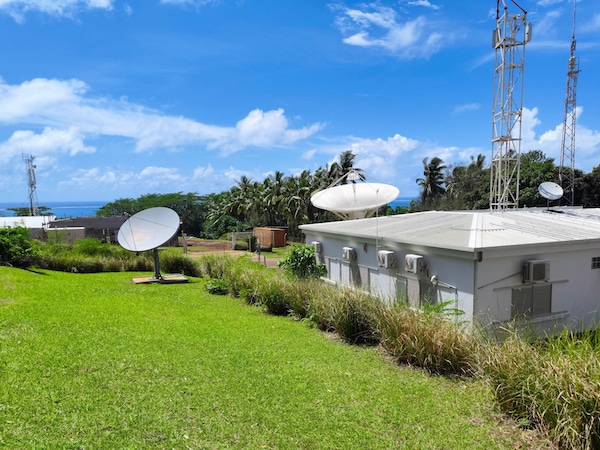
Orange to connect Wallis and Futuna Islands with O3b mPOWER

Keep up-to-date with all the latest news, articles, event and product updates posted on Developing Telecoms.
Subscribe to our FREE weekly email newsletters for the latest telecom info in developing and emerging markets globally.

Sending occasional e-mail from 3rd parties about industry white papers, online and live events relevant to subscribers helps us fund this website and free weekly newsletter. We never sell your personal data. Click here to view our privacy policy.

Indosat and AIonOS to develop AI for tourism, agriculture and talent

Indonesian telco Indosat Ooredoo Hutchison said on Monday it has signed a MoU with Indian AI firm AIonOS – a joint venture between InterGlobe and Assago Group – to develop AI for smart agriculture, AI talent development and tourism in Indonesia.

The MoU was signed under the auspices of a government-led initiative between India and Indonesia to develop a shared vision of AI billed as “AI for Indonesia and India” (AI³, or “AI Cube”) that will leverage AIonOS’s AI technologies and Indosat’s local market knowledge.

According to a statement from Indosat, the AI Cube initiative aims to create AI-based solutions for Indonesia focused on three strategic pillars – tourism, the knowledge economy, and sustainable agriculture – to reshape Indonesia’s digital economy and strengthen Indonesia’s global competitiveness.

For example, AI Cube aims to boost Indonesia’s travel sector contribution to GDP by “promoting diverse local experiences and improving connectivity”, which Indosat says will broaden revenue opportunities for local businesses and “sustainably integrate Indonesia’s rich cultural heritage with global travel networks.”

The knowledge economy aspect means mainly collaborating with educational institutions in Indonesia and India develop an AI-enabled workforce. The partnership will also leverage AI and technology solutions to increase agricultural productivity and resilience, particularly in the face of challenging climate conditions.

“By leveraging Indosat’s local expertise with AIonOS’s AI innovations, this initiative aims to empower Indonesians with AI skills, boost growth in key sectors like tourism, sustainable agriculture and strengthen Indonesia’s human capital to drive its digital transformation,” said C.P. Gurnani, co-founder and CEO of AIonOS in a joint statement.

He added that the initiative with Indosat is “a watershed moment” for India and a vital step towards an ‘AI-for-all’ ecosystem. “As an enabler and accelerator of progress, this positions India to build an enterprise-scale AI platform and unlock industry-wide adoption globally.”

“By focusing on key sectors like talent development, food security, and tourism, this initiative aims to support Indonesia’s Golden Vision 2045 through technological advancement,” added Indosat’s president director and CEO Vikram Sinha.

The AI Cube inititiave is the latest tie-up betwen Indosat and AIonOS after the two companies formed a strategic partnership in July 2024 to transform businesses into AI-native enterprises and accelerate AI sovereignty in Indonesia.

MORE ARTICLES YOU MAY BE INTERESTED IN…

Trump on telecoms: The story so far


Feature Week: Trump on Telecoms

Donald Trump’s return to the White House in 2025 has ushered in a new era for US telecoms and technology policy. His administration has wasted no time in making major changes, with key moves including the appointment of Brendan Carr as Federal Communications Commission chair and proposals for greater control over platforms like TikTok.

With a focus on deregulation, free speech, and national security, Trump’s policy decisions are set to redefine the telecoms landscape that President Biden’s administration has presided over since 2020.

Let’s take a look at what’s happened so far.

2024

5th November – Trump win election to become President of the United States
Donald Trump wins the 2024 US Presidential Election, suggesting significant shifts are to come in telecoms and tech policy.

17th November – Brendan Carr nominated for FCC chair
Trump names Brendan Carr as FCC chair. Carr, a notable critic of Big Tech and opponent of net neutrality, has been a commissioner since 2017. His appointment suggests a potential shift towards deregulation for telecoms operators, but scrutiny for major tech players like Apple, Google, Microsoft, and Amazon.

22nd November – Carr puts BEAD’s future up for debate
Carr suggests an “important discussion” about the program (BEAD)’s future is needed, given that the lion’s share of the money has not been spent.


2025

20th January – Trump sworn in
Trump was inaugurated for his second term, and Brendan Carr officially became FCC chair.

21t January – Trump delays decision over TikTok ban
Trump signs an Executive Order giving ByteDance more time to find a new owner before a shutdown. He had previously proposed the US government take a 50% stake in TikTok to address security concerns, though many Republicans pushed for a full divestiture by the company’s Chinese owners. “Frankly, we have no choice. We have to save it,” said Trump.

21st January – New FCC commissioner named
Olivia Trusty is nominated to serve on the Federal Communications Commission (FCC) by President Donald Trump. Trump says Trusty and Carr will work together to “cut regulations at a record pace.”

22nd January – Trump backs $500bn AI project ‘Stargate’
The president praised a new joint venture between OpenAI, SoftBank, Oracle, and MGX that promises $500 billion in AI investment, with the first $100 billion to be invested this year.

23rd January – Ericsson CTO bullish on tech support from Trump administration
Industry leaders such as Ericsson’s CTO expressed optimism about Trump’s policies at the World Economic Forum in Davos, expecting additional support for 5G and AI advancements. “The opportunities just seem fantastic right now to put in an extra gear and then make sure that we are part of that (AI), says CTO Erik Ekudden.

23rd January – FCC reinstates complaints about 2024 election coverage
Ex-FCC chair Jessica Rosenworcel had previously dismissed complaints about election coverage from NBC, ABC, and CBS, describing them as attempts to ‘weaponise the FCC’.

27th January – Trump fires Cyber Safety Review Board members
The CSRB advisory committee, serving the Department of Homeland Security, was set up to investigate cybersecurity and digital espionage incidents, most recently the massive ‘Salt Typhoon’ cyberattacks carried out by China-liked hackers. The CSRB committee was one of many disbanded by the new administration.

Join us at Connected America, 11-12 March in Texas. Get discounted tickets here!

Also in the news:
EXA Infrastructure enters into agreement to acquire Aqua Comms
“European competitiveness has one foot in the morgue,” warns Nokia CEO
BT quietly scraps EV charging pilot