Beyond the lab: How Linksys is redefining real-world Wi-Fi testing 

Contributed Article

“Subscribers don’t live in labs”: Linksys’ Signal Studio takes Wi-Fi testing into the home

As the smart home continues to evolve, service providers face growing pressure to deliver consistently high-quality in-home connectivity. With more connected devices, higher broadband speeds and increasing customer expectations, validating Wi-Fi performance before deployment has never been more important.

For most of the industry, this testing takes place in a laboratory with predictable interference and ideal device positioning. While this is great for understanding the theoretical limits of the equipment, it is usually a far cry from what the average consumer experiences. Real-world Wi-Fi usage is far more complex, being impacted by the unique layout of the house, the many varied competing devices and users, and differing levels of interference.

It is this complexity that Linksys is attempting to address with its Signal Studio, a dedicated real-world Wi-Fi and broadband testing facility in Reading.

A real home connectivity environment

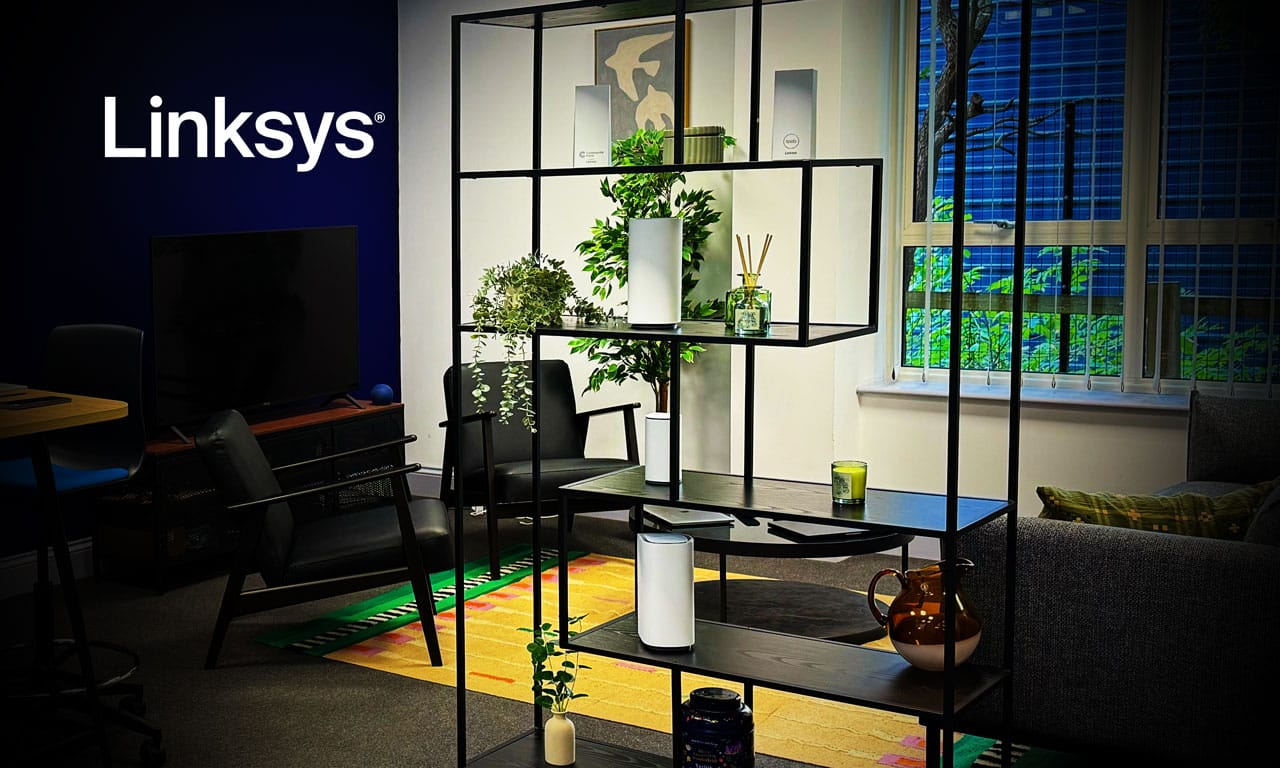
Rather than treating a customer’s home as an abstract test case, Linksys’ Signal Studio recreates realistic residential environments so operators can study the lived experience of their customers. This includes the creation of bedrooms, kitchens, living rooms, and home offices, all filled with typical furniture and devices one would expect from a real home.

The studio is even equipped with configurable wall structures that can be repositioned to simulate the construction characteristics of both modern-build properties and older homes, allowing Linksys and its partners to better understand how different building materials affect wireless performance.

“The Linksys Signal Studio represents the next step in Linksys’ evolution as an innovation partner for service providers,” said Canus Augustus, ISP Sales Director for Linksys. “It is much more than a demonstration facility – it is a collaborative environment where we work alongside our ISP partners to validate new technologies, optimise deployments, and understand how networks perform in real homes.”

Since the Studio’s opening in December 2025, multiple ISP partners have already used the facility for real-world validation, identifying coverage issues, optimising mesh placement and exploring how best to support customer self-installation. The Studio has also hosted collaborative sessions involving a London-based ISP customer and an independent industry regulator, demonstrating its value as a neutral environment for collaboration and innovation.

“Signal Studio was designed to be a collaborative space where our customers can work alongside us. Whether that’s validating a deployment, exploring a new technology, filming product content or simply meeting together, we’ve created an environment that feels much closer to the homes their subscribers actually live in,” said Jessica Peck, Linksys’ Product Marketing Director.

Indeed, this openness was a major factor in selecting Reading as the Studio’s location. Easily accessible from London, Heathrow Airport, and the M4 corridor, the studio is well positioned to welcome customers from across the UK and Europe.

Connecting Britain one room at a time

At a time when the fibre broadband industry is increasingly looking to drive take-up and reduce churn, optimising in-home connectivity has never been more important. With Wi-Fi 7 and mesh technology now maturing, ensuring high quality connectivity throughout every room of the home must no longer be a matter of best effort, but of assurance. As such, the future of Wi-Fi testing must start where customers actually use it: at home.

“For too long, the industry has relied on laboratory testing to predict customer experience, but subscribers don’t live in labs. They live in busy homes filled with connected devices, competing demands on the network and constantly changing environments,” said Canus. “Linksys Signal Studio allows us to validate performance in conditions that genuinely reflect how people use WiFi every day. That collaboration helps operators deploy with greater confidence, optimise the customer experience, and ultimately reduce support issues post install.”

Find out more about our Signal Studio at Connected Britain on Stand F20. Meet the Linksys team to discuss the connectivity challenges subscribers are facing and explore how collaborative testing can help deliver better WiFi experiences.

Not registered yet? Linksys has a limited number of all-access guest passes available. Get in touch to secure yours.

New AI system set to triage non-emergency police calls

News

The system will automatically redirect non-emergency calls to the correct agency, freeing up crucial time for handling crime

According to the Home Office, the non-emergency police 101 service receives around 20 million calls per year, roughly 20% (4 million) of which are in fact intended for other services, like local councils.

Now, a new AI software is being introduced to assess calls and redirect callers to relevant services without needing to connect them to a call handler. This means erroneous callers can quickly be removed from the system, easing the workload for the call hander, reducing queuing times, and reducing wasted time for the callers.

In addition to removing calls made error, the system will also include deliberate nuisance calls, which have historically included novelty complaints about delayed pizza deliveries and slow service at the local pub. Indeed, even during a pilot of the new AI service, the system reportedly screened out calls attempting to report a missing umbrella and asking the local police to give them a lift.

By making the 101 system more efficient, the new AI service is expected to save policing up to £8.5 million each year.

“Police call handlers are wasting hours fielding calls meant for other organisations. Every minute spent on these calls is time taken away from helping people who genuinely need their support,” said Crime and Policing Minister, Sarah Jones. “AI is already helping police catch dangerous criminals and speed up investigations. Now, it will help bring control rooms into the 21st century, freeing up time and unlocking millions of pounds. Forces can reinvest those savings into tackling the crime on our streets.”

The AI service was co-developed by Home Office and National Police Chiefs’ Council in partnership with delivery partner Vodafone Business, backed by £1.4 million in government investment.

It forms part of more widespread police reform initiatives, which are investing £16.5 million to modernise how the police and public interact. Alongside the new 101 triage system, this will include AI that transcribes 999 and 101 calls, and links crime reports to identify patterns in demand.

Is AI being used effectively to optimise public services? Join the discussion at Connected Britain 2026, the UK’s largest digital economy event

Also in the news
Shared Rural Network rollout extends to UK national parks with over 150 4G masts live
Vodafone touts latest attempt to bridge the UK’s digital divide
Virgin Media O2 cuts 5,200 tonnes of carbon dioxide emissions

Rail Wi-Fi and farming sensors: UK govt awards £13m to 16 satellite projects

News

The supported projects include providing broadband on rural Scottish rail lines and powering agricultural sensors on commercial farms

With the explosion of interest in Low Earth Orbit (LEO) satellites and direct-to-device (D2D) satellite services in recent years, the UK government is racing to secure the country’s place as a space innovator.

Between 2024 and 2025, the UK government said it catalysed £2.2 billion in investment and revenue for the UK space sector, a move it said was crucial to ensuring a sovereign and competitive satellite industry.

Today, the UK Space Agency has announced a further £13 million in funding for a range of UK-based satellite initiatives, aiming to boost the sector’s development and deliver economic benefits across the country. These 16 projects selected for support cover a wide range of topics, from technical R&D work to pilot connectivity projects in rural locations.

The largest tranche of the funding – £2.1 million – is going to the STARS project by Exobotics Ltd, which aims to develop “next-generation optical communications capability designed to provide ultra-fast, resilient and near real-time connectivity for satellite operators”. This will take the form of a satellite relay network, used to rapidly transmit mission-critical data.

Other large tranches are being given to Project Optimus (£1.845 million), a laser communications system that can transmit data between satellites and the ground at over 100 Gbps; Airbus’s Theia project (£1.5 million), which aims to make satellite processor functions reprogrammable and customisable while still in orbit; and the QUAKES (Quick Universal Array for Ka-band, E-band, and S-band Earth Stations) project (£1.71 million) from Orbital Astronautics Ltd, which is developing a compact, portable ground station that can be rapidly deployed and connect to multiple satellites at once.

Some of the smaller grants were given to projects with far more tangible benefits for UK citizens. CGI’s SODOR (Satellites for Digitalisation of Railways) project, for example, has been given £428,000 to fit a ScotRail train West Highland Line with satellite communications equipment, providing reliable broadband in one of the UK’s most remote rail corridors.

Additionally, the Gardens, Allotments and Urban Farming Facilitator (GAUFF) Sensor project (£199,000) from agricultural connectivity specialist Farmer Charlie will support the development of satellite-linked agricultural sensors that are designed to work in locations where terrestrial connectivity is poor.

“By combining affordable sensors with satellite connectivity, we are making it easier for growers to make informed decisions, improve productivity and farm more sustainably anywhere in the UK,” said Betty Bonnardel MBE, CEO of Farmer Charlie.

All of these projects will be delivered through the European Space Agency (ESA)’s Advanced Research in Telecommunication Systems (ARTES) programme, which is supported by the UK Space Agency, itself part of the Department for Science, Innovation and Technology.

“This investment shows how innovations in the UK’s satellite sector can improve lives, with better connectivity delivering internet access for more train journeys, and smarter farming,” said Space Minister Liz Lloyd. “By backing brilliant British companies, we are not only furthering our status as one of the world’s leading space powers, but creating high-quality jobs and new opportunities across the UK.”

A complete breakdown of the funding commitment to each of the 16 projects is available here.

Satellites are increasingly being recognised as critical part of the UK’s telecommunications infrastructure. According to a government fact sheet from 2024 around 18% of the UK’s GDP (£454 billion) is reliant on satellite connectivity

Is the UK doing enough to support rural connectivity? Join the discussion at Connected Britain 2026, the UK’s largest digital economy event

Also in the news
Shared Rural Network rollout extends to UK national parks with over 150 4G masts live
Vodafone touts latest attempt to bridge the UK’s digital divide
Virgin Media O2 cuts 5,200 tonnes of carbon dioxide emissions

The build is over, but can you operate what you built? 


Contributed Article

by Andrian Visnevschi, CEO and CTO of ITcare

At 03:00 next Sunday, someone will be on shift, responsible for your network. It is worth asking who that actually is, and whether they can read a BGP table or only acknowledge an alarm. For a growing number of UK fibre operators, the honest answer is the second one, and for 128 of the 168 hours in a week there may be no answer at all. 

That question used to be survivable, because the market rewarded building, but that era is closing. Ofcom puts full fibre at more than three-quarters of UK premises, and AlixPartners estimates nearly half of UK fibre operators must refinance by the end of 2026, at rates far above what they borrowed at. Lenders no longer fund premises passed. They fund take-up, revenue and cost discipline. The sorting criterion has moved from how much network you built to how well you run it. 

The gap every operations lead already knows about 

Most operations leaders at altnets know exactly where their gaps are, overnight coverage is thin, the inventory has drifted, the change process depends on one person being awake. What they lack is the headcount economics to fix it. 

Covering one 24/7 seat sounds like simple arithmetic, 168 hours against 40-hour weeks suggests five engineers. Anyone who has built a rota knows that people need rest after nights, and someone is always on leave, off sick or working on their notice. A sustainable team takes six engineers, or five plus a lead, and it cannot be six juniors because a seat that can resolve incidents at 03:00, not just acknowledge them, needs a mix of first-line and senior engineers, which in the UK means salaries from around £33,000 to £50,000 and beyond, per public salary data. That puts the team behind that one seat at roughly £250,000 a year in base pay, and £350,000 or more with employer costs, shift premiums, recruitment, training and tooling. All of it buys one person watching at any given moment. In a consolidating market, closing this gap by hiring is the most expensive answer, competing for the same scarce engineers everyone else is chasing. 

What we find inside real networks 

ITcare runs managed NOC and network engineering for ISPs, data centre operators and hosting providers across North America and Europe. When we take over or extend an operator’s network operations, the pattern is consistent, the inventory is wrong in ways nobody has quantified, monitoring has either no visibility or produces a ton of alarms nobody has triaged in months, and the topology lives in one senior engineer’s head. None of this reflects badly on the teams involved. It reflects an operations function built during the build era, now carrying an operate era load it was never staffed for. 

The specialist model exists for exactly this, a dedicated team of service provider engineers takes the 24/7 load, the change discipline and the escalations, working as a standalone team or an extension of the operator’s own team, and usually for less than what staffing a single 24/7 seat in-house would cost. The in-house engineers stop firefighting and go back to the work that grows the business. 

The AI claim, stated honestly 

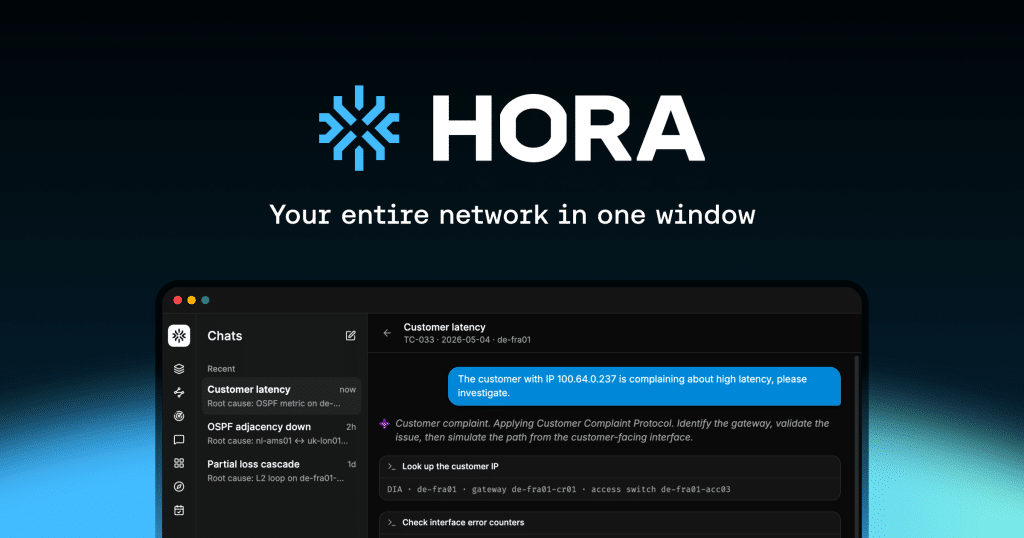
Every stand at Connected Britain will say AI this year, so let me say it precisely. We build and operate HORA, an AI network operations platform, and we ran it inside our own NOC, breaking things in our own lab, before any customer touched it. That made us conservative in a specific way. 

AI earns its keep on the read side. HORA brings metrics, logs, flows, BGP state, discovered topology and the source of truth into one place, and an AI engineer correlates across all of it to get a human to root cause in minutes. That is why a lean team can operate more network, and why, after a merger leaves two networks and two half-accurate inventories, automated discovery turns an integration plan into an integration. The write side is different. We keep AI off it by architecture, it proposes, a human approves, and what touches a device is deterministic automation a person wrote and can audit. Any AI pitch that skips this distinction is selling you the demo. 

HORA AI network operations platform showing an AI engineer investigating a customer latency issue

HORA correlating live network state to root cause.

The operate era 

The strategic question for every operator heading into the autumn is not how much network you have, but whether the way it is operated would survive due diligence. If the honest answer is no, that is fixable, and it costs less than you think. 

We will be at Connected Britain on 9 and 10 September, stand 140. Bring us your hardest operational problem, the inventory nobody trusts, the alarm queue nobody reads, and we will tell you on the spot how we would approach it. To set up a meeting ahead of the event, write to andrian.visnevschi@itcare.net. 


Andrian Visnevschi is CEO and CTO of ITcare and holds JNCIE-SP #2975. ITcare runs managed NOC and network engineering for ISPs, data centre operators and hosting providers worldwide, and builds HORA, an AI network operations platform.  

Major acquisitions for Deutsche Telekom in Polish market

A major deal has been announced that could change the Polish telecom landscape. Deutsche Telekom has agreed to acquire 100% of Fiberhost, a Polish open-access fixed network operator, together with Inea, a retail broadband and TV provider.

Deutsche Telekom will buy the companies  for an enterprise valuation of about EUR1 billion (US$1.16 billion) from current shareholder Macquarie European Infrastructure Fund 5, a fund managed by Macquarie Asset Management, and minority shareholders.

DT says the acquisition will accelerate T-Mobile Polska’s growth by adding Inea’s over 300,000 customers and Fiberhost’s fibre network passing over 1.4 million homes.

The transaction is also a new stage in T-Mobile Poland’s transformation from a mobile-only operator into a fully convergent telecommunication provider. Since signing its first wholesale access agreement in 2018, T-Mobile has expanded its fixed coverage through wholesale partners and built a nationwide convergent offer. 

Together, the businesses say they will be better positioned to compete more effectively with operators that already own substantial fixed infrastructure. The acquisition also strengthens T-Mobile Poland’s role as an investor in critical infrastructure supporting Poland’s digitalisation.

T-Mobile Poland CEO Andreas Maierhofer explains: “Our award-winning mobile network, nationwide backbone, data centres and fibre infrastructure will now be complemented by our own fibre-to-the-home network reaching 1.4 million households. Owning an FTTH network will allow us to further develop our already successful portfolio of convergent products.”

Fiberhost will continue to offer transparent and non-discriminatory access to its state-of-the-art fibre infrastructure to all existing and potential internet service providers in Poland.

Closing of the transaction is conditional upon customary Polish competition approvals.

Why your optical layer is now an Energy per Inference strategy

Contributed Article

Provided by: Belden

For over a decade, Power Usage Effectiveness (PUE) has been the go-to metric for evaluating data center efficiency. As artificial intelligence (AI) workloads scale rapidly, however, relying so heavily on PUE has run into a problem.

Unfortunately, PUE’s facility-wide perspective provides little insight into how efficiently an AI workload is being executed. As AI workloads continue to demand growing amounts of power, the data center industry is pivoting to a more granular metric – energy per inference.

Optimizing for this metric requires scrutinizing every layer of the hardware stack. While GPUs and advanced cooling systems receive significant attention, the optical interconnects that move data within clusters are quickly becoming a strategic concern.

Why the interconnect layer matters for AI power efficiency

In legacy data centers, the power draw of a single transceiver has always been a topic of importance, but less so than today. Modern AI fabrics have changed the conversation.

A high-performance GPU server can rely on ten or more optical transceivers for communication across spine, leaf, and server switch architectures. As data rates shift upward to 800G and 1.6T, the energy cost of moving bits begins to rival the cost of processing them. At this scale, optical design choices begin to influence energy per inference in a measurable way.

How Linear Pluggable Optics (LPO) Work

Linear Pluggable Optics (LPO) simplify the transceiver by removing the most power-intensive parts – the Digital Signal Processor (DSP) and Clock Data Recovery (CDR). In standard full re-timed optics (FRO), the DSP alone can account for roughly 40% of total optic power consumption.

Instead, LPO shifts signal conditioning responsibilities to the host switch silicon, specifically the SerDes (Serializer/Deserializer). This handoff results in a leaner optical module that slashes the power draw per 800G link from around 13W-16W to 7W-9W. Lower transceiver power means less heat generated at the switch faceplate. Less heat means reduced cooling demand across the room and less pressure on HVAC systems.

Additionally, by bypassing the DSP processing cycle, LPO reduces latency from around 100ns to less than 10ns. That not only improves the responsiveness of distributed AI training and inference but also permits infrastructure to deliver more useful compute work per watt-hour.

Crucially, LPO modules interoperate with standard FRO, allowing operators to maintain hybrid environments and pursue a phased transition within the same network fabric.

Key technical considerations for DSP-less architectures

Despite the immense benefits of LPO technology, its successful deployment depends on a few, key hardware conditions.

  1. Host platform dependency: Because the optic no longer carries a DSP, the host switch must do more. That means stronger SerDes performance is essential. Many early deployments are associated with newer switch platforms such as those built around Tomahawk 5-class architectures.
  2. Distance and signal integrity: Without re-timing inside the optic, LPO is generally better suited to short-reach links, often under 500 meters. Additionally, LPO can be less forgiving of signal deterioration introduced by cable quality or board layout variations.

A roadmap to 1.6T and sustainable growth

As AI clusters move toward 1.6T interconnect speeds, pressure to improve efficiency will continue to rise. A growing number of industry analysts see LPO as a practical near-term deployment solution that will enjoy significant, consistent growth through 2033.

In the AI era, improving energy per inference means looking beyond the GPU and examining every watt consumed across the network path. Linear Pluggable Optics are not a universal replacement for traditional re-timed modules. But in short-reach, high-density AI environments, they can play an important role in reducing power draw, lowering thermal load, and improving compute efficiency. For those building at scale, the optical layer is no longer a background consideration. It is now the next fundamental frontier in the quest for more sustainable AI.

Subscribe to the Broadband Communities newsletter!

Polish data centre development sparks water use fears

There have been more headlines about the effect of data centres on water worries, this time in Poland, where a data centre announced for a suburb of the capital Warsaw has been met with protests from residents.

Developed by Sien Real, a joint venture of Polish construction firm Budimex and the Spanish infrastructure operator Ferrovial, the facility will house four buildings on a 45,305 square metre plot. Construction is expected to begin in 2027.

As industry website Data Centre Dynamics notes, there is as yet no information about the site’s compute capacity. However, local press has been total that the site’s water usage is expected to be equivalent to that of a housing estate of up to 3,000 people.

Budimex insists it is paying particular attention to minimizing the facility’s impact on local residents by ensuring it uses features that mitigate water consumption, noise, and dust emissions and deploys cooling and emergency power systems that meet the highest standards for modern data centres.

As well as local supplies, a 1,102.33 cubic metre retention reservoir is to be built to store excess rainwater and meltwater. Its contents will be discharged into the local sewer system or used to water the site’s landscaped areas.

Despite these assurances, some residents fear that the project will exacerbate water shortages in the nearby commuter town of Józefosław. Earlier this year the water pressure in the town dropped to low levels every evening. Residents demanded a review of network capacity in light of new housing estates being developed in the area.

Warsaw is Poland’s largest data centre market, with 45 facilities listed in and around the city and more on the way.

Water and power are major concerns for many residents of areas near proposed data centres – and not just in Poland. India, South Africa, Israel and Malaysia are among the many regions where the ongoing rush to plan and construct new facilities is now being examined more closely by both regulators and the public.

Industry Spotlight: Accenture’s Dan Rice Talks AI and More

Industry Spotlight: Accenture’s Dan Rice Talks AI and More

Today we sit down with Dan Rice, Accenture’s Communications & Media Industry Lead for the USA, to look at trends in AI and communications infrastructure.  We last spoke with Dan about a year and a half ago, which is about a generation in the AI infrastructure world. Lots has happened since then in this industry, let alone the rest of the world.  How are things shaping up? … [visit site to read more]

Airtel Africa claims first commercial launch of Starlink Mobile in DRC

Airtel Africa and Starlink have launched their satellite-to-mobile service in the Democratic Republic of Congo, with the operator claiming the country’s deployment is the first commercial launch of Elon Musk’s satellite connectivity service.

Compatible smartphones will be able to connect directly to Starlink’s satellite network in areas without terrestrial mobile infrastructure, Airtel Africa said.

The service supports light data applications including WhatsApp and SMS, with no external equipment required. Airtel said the service uses Starlink’s 650-strong direct-to-device satellite constellation.

The launch follows a pilot of Starlink Mobile data and messaging services by the two companies in Kenya in March.

Airtel Africa CEO Sunil Taldar described the DRC launch as a significant milestone in extending « essential connectivity » beyond terrestrial networks. He said the DRC deployment would provide a blueprint for the gradual expansion of the service across Airtel Africa’s 14 markets in sub-Saharan Africa.

Airtel DRC managing director Thierry Diasnova said the country’s size and geography make it difficult for operators to economically deploy terrestrial infrastructure in remote areas.

« This service provides an additional layer of connectivity, helping customers remain reachable, informed and connected even in areas where terrestrial coverage is unavailable, » he said.

Airtel expects the service to support users including transport and logistics operators, humanitarian organisations, health workers, farmers and mining operations, as well as communities outside the reach of existing mobile networks.

The satellite service could also provide communications during emergencies, including natural disasters, when terrestrial infrastructure may be unavailable.