This sponsored viewpoint was authored by Bryan Lamphere, Senior Vice President of Network Planning and Engineering, Fidium
Legacy networks still function. That’s exactly the problem.
The move toward fiber-first infrastructure is already underway and accelerating. Still, some assume that because legacy networks continue to function, there is no urgency to move away from them. From an operator’s perspective, that assumption is getting harder to defend. … [visit site to read more]
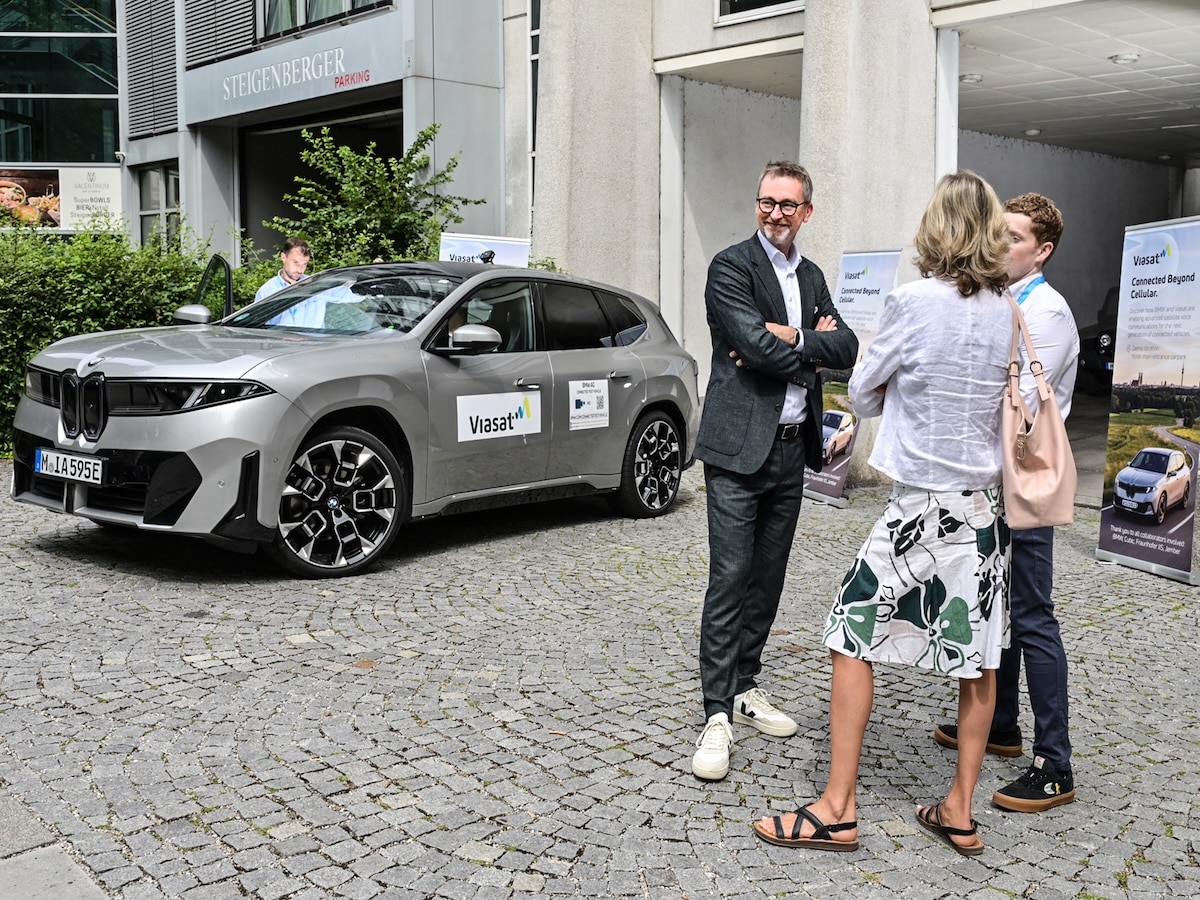
Viasat has demonstrated what it claims is the first satellite voice call fully integrated into a BMW Group vehicle, highlighting how non-terrestrial networks (NTNs) could extend connected car services beyond the reach of terrestrial mobile coverage.
Showcased at this week’s 5G Automotive Association (5GAA) Meeting Week in Munich, the demonstration enabled a voice call to be initiated directly from a BMW iX3’s infotainment system using Viasat’s L-band satellite network and the NB-IoT protocol.
The proof of concept combined Qualcomm’s Snapdragon Auto 5G Modem-RF Gen 2 platform with an AI voice codec from Fraunhofer IIS, allowing compressed voice traffic to be transmitted over a geostationary satellite. The demonstration also builds on Viasat’s collaboration with software-defined vehicle connectivity provider Cubic3, whose eSIM technology enables vehicles to seamlessly switch between terrestrial and satellite connectivity.
Damian Lewis, Market Development Director at Viasat, said demand for always-on connectivity is growing as vehicles become increasingly software defined and reliant on cloud-based services.
“Vehicles are designed to be connected, and terrestrial coverage takes that quite far, but there are gaps,” Lewis said. “Using satellites to bridge those gaps and cover areas that aren’t served by terrestrial mobile connectivity is a really effective way of doing it.”
Lewis said the system uses existing NTN infrastructure, meaning automotive OEMs could deploy the technology without waiting for new satellite networks. While the current demonstration focuses on emergency voice calls, he added that future developments could support higher-bandwidth services as 5G NTN standards evolve.
BMW said satellite connectivity is becoming increasingly important as more vehicle functions move to the cloud.
“The car needs to be connected,” said Olaf Eckart, senior expert for R&D Cooperation and Partner Management at BMW Group. “Our customers want ubiquitous connectivity, and we wanted to move away from proprietary systems to interoperable and scalable solutions.”
Eckart added that narrowband IoT provides an immediate path for emergency messaging and voice services, while future 5G New Radio NTN capabilities are expected to enable higher-data-rate applications in areas without terrestrial coverage.
Thai telco True Corp announced on Thursday it has partnered with the Ministry of Public Health to launch True SkyBridge, an autonomous air logistics management platform designed to support medical drones delivering medical supplies to remote areas.
The prototype SkyBridge platform, designed and developed by True’s Research and Innovation Center, connects hospitals, medical service units, public health personnel and the public to the autonomous air logistics system underlying the drone service.
True SkyBridge supports multi-brand drones and carries full-function AI-driven flight data and safety systems over True’s network, said Ekaraj Panjavinin, head of research and innovation at True Corp.
“True SkyBridge provides end-to-end management of medical transport missions, covering route planning, medical payload quality monitoring, real-time flight tracking, fleet management and control, drone readiness and safety systems, as well as automated documentation that records the time and coordinates throughout each flight,” Ekaraj said in a statement.
True kicked off the launch of True SkyBridge with two live drone flights along different routes in the Pua District of Nan Province, which features mountainous terrain, winding roads along mountainsides and cliffs, and scattered communities, all of which are prone to heavy rainfall, landslides, or flash floods that can disrupt ground transportation routes.
For one route, a drone delivered medicine for patients with non-communicable diseases from Phaya Pha Nong Stadium to Ban Rong Ngae Community Square, then returned with medical samples. The flight covered a round-trip distance of 4 km and took approximately 3.5 minutes, 50% faster than transportation by road which takes around seven minutes.
The second route – which demonstrated the delivery of medicines to a remote area where land transport routes had been cut off – ran across steep mountains, cliffs, and dense forests from Phaya Pha Nong Stadium to Ban Nam Pua School. The round-trip distance was 46 km and took approximately 35 minutes – 70% faster than transportation by road that usually take more than two hours.
“The platform enables the fast and seamless delivery of medicines, medical supplies, and medical samples on every mission. It is also designed to provide high levels of safety and full traceability, with the potential to scale into a nationwide network in the future,” Ekaraj said.
True SkyBridge has regulatory support from the Civil Aviation Authority of Thailand (CAAT), Aeronautical Radio of Thailand (AEROTHAI, which provides air traffic control and aeronautical communications services) and the National Broadcasting and Telecommunications Commission (NBTC).
Narin Kalayanamit, an adviser to the public health minister, said True SkyBridge will support Thailand’s medical and public health services by ensuring that everyone has thorough, equitable, and quality access to healthcare services, particularly people in frontier, remote, and underserved areas facing medical access restrictions.
“In the past, flight trials were successfully conducted in coastal areas, which demonstrated a significant reduction in both time and constraints of maritime transportation,” he said. “Therefore, medical drones serve as another approach to elevate public access to healthcare services, while effectively enhancing readiness in handling emergency and disaster situations.”
Narin said the service will be expanded to ten additional remote areas, and further integrated into the healthcare service system.
The Indian National Space Promotion and Authorisation Centre (IN-SPACe) has reportedly ruled that Reliance Jio’s proposal to build a domestic LEO satellite constellation to compete with the likes of Starlink, Eutelsat OneWeb and Amazon Leo is technically sound.
According to a report from ETTelecom published Friday, citing anonymous government sources, IN-SPACe), the Indian Space Research Organisation (ISRO) and the Wireless Planning and Coordination (WPC) arm of the Department of Telecommunications (DoT) have evaluated Jio’s plan and found it to be “on par” with systems like Starlink.
Neither Reliance Jio nor IN-SPACe have confirmed the report as of post time.
According to the report, Jio’s plan – which first surfaced last month – calls a constellation of 1,600 LEO satellites, with 32 satellites visible at any given time, while the constellation will be designed to offer a bandwidth capacity of between 4.5 Gbps and 5 Gbps. Jio is also proposing to set up at least 20 ground stations to support the LEO constellation.
The nod of approval from IN-SPACe means the Indian government can now provide regulatory support for Jio as it submits filings to the International Telecommunication Union (ITU) to secure the orbital slots, the report said.
While global operators like Starlink, Eutelsat OneWeb and Amazon Leo are building far bigger LEO constellations, Jio’s main advantage is that the Indian government is keen to expand its self-reliance strategy to the LEO sat space.
The report said that apart from finding Jio’s proposal technically sound, IN-SPACe also sees merit in the national security and strategic defence implications of not having to rely on foreign operators for LEO satellite services.
The report also claims the government is discussing whether some of the LEO satellites in its network could carry defence payloads.
The Indian government appears to be caught between its view that LEO satellites can expand broadband connectivity to underserved and unserved across the country, and its growing concerns over national security in light of its ongoing tensions with China and Pakistan, as well as growing geopolitical tensions in general.
Last month, the Ministry of Home Affairs (MHA) expressed concerns over possible signal spillage of foreign satellite services across India’s borders, which it said raises national security concerns.
In November last year, IN-SPACe reportedly rejected applications from Chinasat, APT Satellite (Apstar) and AsiaSat to offer satellite services in India, citing national security.
Eutelsat OneWeb and SES both have GMPCS licences, the latter via SES’s satellite venture with Jio. Amazon Leo’s application for a GMPCS licence is reportedly still be evaluated by the DoT.
The BoGuan LLM is enabling millions of visitors to enjoy historically accurate experiences from China’s ancient capital
Xi’an, situated in Shaanxi province, is one of the most celebrated cities in all of China. Internationally renowned as the home of the Terracotta Army, the city served as China’s capital for over 1,000 years under 13 different dynasties. Today, it is one of China’s largest domestic tourism destinations, attracting around 330 million visitors annually.
With the rapid rise of AI, the way in which tourists interact with the city is changing. As generative AI becomes increasingly commonplace, tourists are beginning to expect conversational, personalised digital experiences when visiting cultural sites. The problem, however, is that these models do not have access to specialised historical data and so cannot deliver truly unique – and historically accurate – experiences for consumers.
This is why Huawei and Shaanxi Culture Industry Investment Group (SCG) have co-developed BoGuan, the world’s first commercial multimodal large language model (LLM) dedicated to cultural tourism. The partners spent two years compiling a 1.2 Petabyte dataset consisting of 31 million images, 4.4 million minutes of video, and 960 million pieces of structured text to form a specialised foundation for the platform. BoGuan then leverages this data, acting as a unified gateway aggregating 10 open and closed-source models (including Huawei’s PanGu).
“General large models lack specialized knowledge in museology, archaeology and history, making it difficult to meet the nuanced demands of niche scenarios,” noted Edric Chu, General Manager of Huawei’s Shaanxi Rep Office. “We completed 12 high-quality cultural tourism datasets […] using Huawei Cloud Data Engineering to process and label text, images, audio and video […] Supported by three major standards of data collection, management, and circulation, the platform transforms raw data resources into data assets with verifiable ownership.”
New cultural experiences and revenue opportunities
BoGuan underpins a wide range of cultural tourism services across the province, including AI travel assistants, multilingual tour guidance, museum interpretation, AI-generated marketing content, digital preservation of cultural heritage, and short-form video production.
In the B2B sector, BoGuan powers an AI “Video Factory” that fully automates short drama and advertisement production. Meanwhile, for consumers, the model powers ‘Xiaoqi’, an AI travel companion on the GO-SHAANXI app, and the Zhiying Camera mini program, which allows tourists to instantly merge their photos with AI-generated historical settings.
Since its pilot launch in September last year, Huawei says applications powered by BoGuan have reached more than four million users, and it is already delivering a major revenue boost for SCG.
“With the same team size, thanks to these technologies[…] from last year to this June our revenue has increased by roughly 30–40%,” explained Jin Yan, Chairman of the Digital and Intelligent Culture Technology Group at SCG. “The sales of related digital collectibles and creative products have exceeded 2 million Chinese yuan ($300,000).”
SCG has already begun collaborating with tourism authorities in Xinjiang and Guizhou to replicate the BoGuan framework, with the goal of potentially exporting it nationwide in future.
Network infrastructure foundation
Of course, to successfully deploy BoGuan at scale requires powerful network and data infrastructure. Thousands of simultaneous AI interactions require both massive data throughput and dense computing capabilities.
To solve this, SCG’s runs on an on-premise 48P computing platform built with Huawei’s SuperPoD architecture. It uses Huawei’s UnifiedBus technology, an interconnect protocol for SuperPoD that interconnects physical servers so that they can learn, think, and reason like a single logical server.
At the same time, China Telecom Shaanxi and Huawei have blanketed Xi’an’s Grand Tang Mall with a 5G Advanced network capable of delivering downlink speeds of 3.5 Gbps and uplink speeds of 600 Mbps. This, the partners explain, is crucial to support the scale of AI use cases being accessed throughout the region.
“The Grand Tang Mall is a textbook example of a high-traffic, high-concurrency, and high-interaction scenario, which poses an immense challenge for any network,” explained Wang Hao, Director of Mobile Communications Network Business at China Telecom Shaanxi. “Within this area […] we have deployed 46 base stations within this compact area, a density that far exceeds standard regions.”
These base stations are also equipped with AI-powered intelligent control boards that can trigger service acceleration protocols when AI photo generation is taking place.
“The embedded AI intelligently and dynamically allocates network resources to match your real-time demands,” Wang said, noting that the network can support 23,000 concurrent users during holiday traffic surges.
Bridging the AI talent gap
Beyond the technology itself, another key them to emerge from discussions about BoGuan – and about creating purpose-built LLMs for other vertical industries – is the lack of workers skilled in both AI usage and their specialist field.
“The industry faces a deficit of millions of interdisciplinary professionals who bridge the gap between cultural tourism and AI,” said Chu. “Shaanxi alone faces a talent gap of 30,000 to 50,000 in culture tourism plus AI, and the national gap is expected to exceed 1 million by 2030.”
As a result, further developing BoGuan and similar LLM projects faces a significant talent bottleneck that can only be overcome through largescale training projects.
“SCG, Huawei, and over 10 institutions have jointly established a talent training base […] aligning vocational certificates with Huawei AI certifications and university micro-majors,” explained Chu. “We expect to train over 1,000 people this year and more than 3,000 next year.”
Proof of vertical AI success
The success of BoGuan is a demonstration of how purpose-built AI models can create new revenue opportunities for telecom operators by combining connectivity, cloud, AI compute and industry expertise into a single commercial platform. Rather than competing solely on network capacity, operators must move to monetise vertical AI through managed services, industry-specific applications, and data products. With its unified AI infrastructure, platform-level scalability, and training on vertical-industry data, the BoGuan LLM helps industries tackle bottlenecks in content production, cost management, capability integration, and data security—ensuring that AI can be practically deployed to fuel sustainable business growth. This same model, in turn, serves as a blueprint for telecom operators seeking to generate lasting growth in the AI era.” Artificial intelligence is not simply a stack of technologies,” concluded Chu. “[In Shaanxi] it has become a key enabler that can activate thousands of years of cultural heritage, reshape travel experiences, and inject new momentum into the industry.”
China’s smartphone market fell 4.3% year-on-year to 66 million shipments in the second quarter of 2026, marking a fifth consecutive quarter of decline as rising memory and component costs pushed up device prices, according to IDC.
The research firm said component prices began climbing in late March, while government subsidies that had supported demand in previous quarters started to fade. The combination weakened consumer demand and forced most Android smartphone vendors to raise prices.
Huawei and Apple were the notable exceptions, keeping market broadly stable during the quarter. IDC suggested this helped both vendors attract consumers who were hesitant to buy amid rising prices elsewhere in the market.
Huawei regained the top spot with a 22.6% market share after shipments climbed 19.4% year-on-year. Apple followed with an 18.1% share, posting 24.4% growth. Oppo and Vivo tied for third place with 16% market share despite recording shipment declines, while Xiaomi ranked fifth with 12.4%. Samsung finished 10th with just 0.1% market share after shipments plunged 60% – the steepest decline among the top 10 vendors.
First-half smartphone shipments totalled around 134 million units, down 4.2% compared to the same period last year.
“Huawei and Apple held their prices steady while competitors were raising theirs, and that gave hesitant buyers a reason to go ahead and purchase in a quarter when most of the market was giving them a reason to wait,” said Arthur Guo, Research Analyst, Client Devices Research at IDC China.
Looking ahead, IDC warned that pricing pressures are expected to intensify. Vendors have so far been cushioned by inventories of lower-cost components purchased before prices increased, but those stockpiles are being depleted. As a result, the research firm expects the year-on-year market decline to widen to around 20% in the second half of 2026.
IDC also expects 2027 to remain challenging as storage prices are unlikely to ease significantly. However, it noted that consumer demand has been delayed rather than destroyed, with a new smartphone replacement cycle expected to drive a market recovery between 2028 and 2029.
Nokia today announced the industry’s first commercial AI-RAN platform, marking one of the most significant shifts in radio network architecture in decades. As AI becomes the dominant workload in mobile networks, telecommunication providers need more capacity, stronger economics and faster innovation without relying on traditional hardware upgrade cycles. Nokia’s AI-RAN platform helps telecommunication providers unlock significantly more uplink and downlink capacity from the spectrum and radio infrastructure they already own, providing a practical path to AI-native networks while improving network economics and accelerating innovation at software speed.
“AI-RAN is the biggest innovation in radio in decades. AI-RAN makes the network intelligent, extends AI into the physical world, and allows telcos to get more from their existing infrastructure, including a software upgrade path to 6G. Nokia’s anyRAN software, powered by NVIDIA’s Aerial AI-RAN platform, unlocks greater performance from the spectrum operators already have and can be deployed with existing Nokia or ORAN-compliant radio units. For operators, that means more performance, better returns and faster delivery of new services,” said Justin Hotard, President and CEO at Nokia.
Built on Nokia’s AI-native network architecture and NVIDIA’s accelerated computing, Nokia’s AI-RAN platform delivers a step change in network performance and economics. The AI-RAN platform has already shown more than 20% spectral efficiency gains through AI-driven radio innovations. The company is on track to deliver 50% spectral gains by 2027 and more than 100% by 2028, helping telecommunication providers carry significantly more traffic in dense cells while reducing cost per bit and improving customer experience.
“Telecommunications is entering the AI era — the radio access network is the next AI infrastructure. Together with Nokia, we are bringing NVIDIA CUDA and AI into the baseband, transforming RAN into a planet-scale AI computer. This is a generational shift for operators — unlocking more capacity and efficiency from today’s spectrum while creating the foundation for new AI services and the 6G era,” said Jensen Huang, Founder and CEO of NVIDIA.
Through a new software subscription model, telecommunication providers can benefit from AI innovation, new features and performance enhancements without relying on hardware refresh cycles. Nokia’s AI-RAN solutions will enter pilot deployments at the end of this year and be commercially available in 2027, with a roadmap that leverages NVIDIA’s programmable merchant silicon platforms.
“Nokia’s AI-RAN launch represents an important step in bringing AI-RAN from industry vision to commercial reality. The addition of the new AI-RAN node alongside the AirScale capacity plug-in unit and cloud-native deployment options gives operators practical choices for adopting AI-native networks based on their existing infrastructure and transformation goals. By combining AI-accelerated computing with a software-defined architecture and a clear product roadmap, Nokia is helping operators unlock greater capacity, improve network economics and accelerate the transition toward AI-native RAN,” said Rémy Pascal, Practice Leader, Mobile Infrastructure at Omdia.
One AI-native platform. Three paths to adoption
Recognizing the diversity of telecommunication providers’ network strategies and installed RAN bases, Nokia’s AI-RAN platform is built on a common software-defined architecture powered by Nokia’s anyRAN software and NVIDIA’s accelerated computing. Supporting 4G, 5G and future network evolution, it provides three hardware platform options, including an expansion card for existing AirScale deployments and a Cloud RAN alternative. Fully compliant with Open RAN standards, the platform supports open, interoperable multi-vendor deployments while giving operators the flexibility to choose the hardware and cloud environments that best meet their needs. These hardware platform options allow telecommunication providers to modernize at their own pace while preserving existing infrastructure investments, benefiting from a common software roadmap and accelerating innovation at software speed. Telecommunication providers can adopt AI-RAN in stages using the approach that best matches their deployment strategy, capacity requirements and installed base.
Build on existing investments
For existing Nokia customers, Nokia is introducing the new GPU-powered AirScale capacity plug-in unit as the most efficient path forward. Designed for Nokia’s installed AirScale base, the solution integrates NVIDIA’s accelerated computing into existing network infrastructure, enabling a significant capacity step-change through a simple upgrade path while preserving existing network investments. This approach is also supported by AI-accelerated merchant silicon from Marvell as part of Nokia’s broader ecosystem approach to software-defined AI-RAN architectures. Telecommunication providers can introduce advanced AI capabilities, continuously improve performance through software and extend the value of deployed infrastructure.
Scale AI-native capacity anywhere
For telecommunication providers seeking maximum deployment flexibility and performance, Nokia is introducing the industry’s first GPU-powered standalone AI-RAN node. It brings AI-accelerated RAN performance to any network environment and supports 4G, 5G and future 6G workloads on a common platform. The solution can be deployed as a standalone node, in clustered configurations or alongside AirScale as a single logical base station, providing operators with a highly flexible path to scale AI-native networks while preserving deployment choice.
Enabling cloud-native AI-RAN
For telecommunication providers embracing cloud-native architectures, Nokia is introducing GPU-powered AI-RAN COTS server solutions delivered through ecosystem partners. The platforms enable an open and secure supply chain while supporting deployment on industry-standard accelerated computing infrastructure, combining cloud-native flexibility with the performance requirements of AI-native radio networks.
Innovation at software speed
Nokia’s AI-RAN marks a fundamental shift from hardware-defined radio networks to software-defined platforms that continuously improve through software and AI innovation. Through Nokia’s new subscription-based commercial model, telecommunication providers gain ongoing access to advanced AI algorithms, spectral efficiency enhancements, network optimization capabilities and future AI-native features that can be activated through software. This approach allows them to benefit from continuous innovation while maximizing long-term returns on infrastructure investments, enabling improved TCO and performance at no hardware premium. Rather than waiting for the next hardware cycle, networks can continuously enhance performance, efficiency, security and resilience as new capabilities become available.
By combining AI-accelerated computing, advanced AI algorithms and an open ecosystem approach, Nokia is helping telecommunication providers unlock greater capacity, stronger economics and continuous innovation while building the foundation for future network evolution.
The government of Trinidad and Tobago says it has signed MoUs with US companies Ernst & Young and Hummingbird AI Holdings to develop AI-ready data centres and infrastructure in the country with at least 450MW of load capacity.
According to a Facebook post from United National Congress (the political party of prime minister Kamla Persad-Bissessar) on Sunday, the Ministry of Foreign and CARICOM Affairs signed an MoU with Ernst & Young to create a framework for collaborating on developing large-scale data centres and supporting infrastructure.
Under the framework, EY will leverage its Energy to Intelligence (E2I) platform to develop a 300 MW data centre. EY will also partner with third parties for the project.
Meanwhile, the ministry’s MoU with Hummingbird AI also establishes a framework to develop a proposed 150 MW AI infrastructure and data-centre facility, with potential longer-term expansion to 500 MW.
Initial commercial operation for the latter facility is tentatively targeted for the first quarter of 2028. That said, both projects will undergo due diligence before the government decides to proceed with either.
Trinidad and Tobago currently has five data centres – four in Port of Spain, and one in Prince Town. According to Data Center Map, the data centres in Port of Spain are all Tier III compliant.
The UNC post said that the MoUs – combined with a third MoU with Pinnacle Steel and Vanadium to refurbish and recommission its recently acquired iron and steel plant at Point Lisas into a vanadium plant – could represent a combined potential investment exceeding US$5 billion over the coming years that will generate in excess of 5,000 new jobs, provided any of them make it past the due-diligence stage.
According to a report in the Trinidad and Tobago Guardian, Public Utilities Minister Barry Padarath addressed concerns raised in several media reports, including one from the Associated Press, that the data centre projects would impact Trinidad and Tobago’s water supply, which is already plagued by chronic shortages.
Padarath said the proposed data centres won’t have a negative impact on the country’s water security, as the government intends to build the data centres in a special economic zone – possibly Debe – where special ponds will be constructed to supply water to the data centres, along with desalinisation plants as a longer-term backup resource for the country in general.
« We will have a hybrid system in terms of utilising the ponds in the first instance that are created, the man-made ponds, and then if additional water supply is needed by then the desalination plants would come on stream, » Padarath was quoted as saying in the report.
Little is known about Hummingbird AI, except that managing member Marc-Kwesi Farrel – who is named in the government press release as a signatory – is the founder and CEO of Ten To One Rum. He is also a non-executive director of Caribbean-focused investment holding and management company Massy Holdings, whose main portfolios are focused on retail, gas products, motors and machines, and financial services.
We use cookies to personalise content and ads, to provide social media features and to analyse our traffic. We also share information about your use of our site with our social media, advertising and analytics partners. View more
Cookies settings
Accept
Privacy & Cookie policy
Privacy & Cookies policy
Cookies list
Cookie name
Active
Conditions légales
Introduction et qui nous sommes
118812.fr met en relation des spécialistes du monde entier par le biais d'événements, de renseignements et d'éditions savantes. Nous sommes une société du FTSE 100 et notre réseau de marques internationalement respectées aide les gens à travailler plus intelligemment, à prendre de meilleures décisions et à se développer sur des milliers de marchés spécialisés. Les données et les informations sont au cœur des activités de 118812.fr, et nous prenons au sérieux les questions de confidentialité des données. Nous respectons nos relations avec les clients, les visiteurs, les sponsors, les exposants, les fournisseurs et les collègues, ainsi que la confiance qu'ils nous accordent pour la conservation de leurs données personnelles.
Contrôleurs de données de 118812.fr
Cette politique de confidentialité explique comment les membres du groupe 118812.fr collectent, utilisent et protègent les informations personnelles à travers nos marques. Les références à "nous", "notre" ou "nos" renvoient au contrôleur 118812.fr concerné qui traite vos informations personnelles.
118812.fr est structuré en cinq divisions opérationnelles :
Au sein de ces divisions, il existe des entreprises sectorielles et des marques de produits, d'événements et de services. En général, lorsque nous interagissons avec vous, c'est par le biais de l'une de ces marques. L'entité juridique du groupe 118812.fr responsable des données personnelles (désignée comme le contrôleur des données dans l'UE et désignée comme le contrôleur 118812.fr dans la présente politique de confidentialité) sera l'entité indiquée sur les formulaires de réservation, les formulaires Web et les contrats ou les factures. Différentes entités juridiques de 118812.fr sont responsables de différents événements et produits. Pour mettre à jour vos informations personnelles ou vos préférences en matière de marketing, contactez les équipes de marketing de nos divisions énumérées ci-dessous. Pour toute question ou plainte concernant la confidentialité des données, vous pouvez vous adresser à l'équipe 118812.fr Privacy via notre formulaire en ligne.
Couverture internationale et variations
118812.fr opère dans plus de 20 pays, qui ont chacun des lois différentes sur la protection des données. La présente politique de confidentialité s'applique à toutes les activités de 118812.fr dans le monde, sauf dans la mesure où il existe une exigence spécifique à un pays qui la complète, comme indiqué dans le menu de gauche.
Ce que nous recueillons
Cette section vous indique quelles informations personnelles nous pouvons recueillir lorsque vous utilisez nos produits et services, et quelles autres informations personnelles nous pouvons recevoir d'autres sources. Dans la présente politique de confidentialité, les informations personnelles désignent les types de 118812.frtions personnelles qui peuvent être collectées et utilisées, notamment : Les coordonnées, telles que le nom, l'adresse électronique, l'adresse postale et le numéro de téléphone.Informations sur l'éducation, la nationalité et la professionles noms d'utilisateur et les mots de passeCommentaires, réactions, messages et autres contenus soumis, y compris les informations relatives aux enquêtes.Intérêts et préférences de communication, y compris les autorisations de marketing, le cas échéant.Informations de localisation, telles que celles fournies par une application mobileInformations de vérification de l'identité, telles que les détails du passeport, afin de se conformer aux obligations légales dans certains pays et de fournir des lettres d'invitation de visa, le cas échéant.Informations sur l'utilisation du site web et des communications, telles que la correspondance et les détails de votre utilisation de notre site web et de nos services obtenus par le biais de cookies ou d'autres technologies de suivi.
Ces informations personnelles concernent les catégories de personnes suivantes :
Prospects, contacts clients, abonnés et utilisateurs en ce qui concerne nos services et produits ;Visiteurs, sponsors, exposants et conférenciers lors de nos événements ;Les professionnels figurant dans les produits numériques et imprimés, tels que les détails des cadres supérieurs mis à disposition par les produits de renseignement, les recherches et les publications.les auteurs, éditeurs et réviseurs de nos publications.les contacts de nos prestataires de services et partenaires commerciaux.Informations personnelles sensibles



 This sponsored viewpoint was authored by Bryan Lamphere, Senior Vice President of Network Planning and Engineering, Fidium