BT sews together multiple cloud providers with ‘Global Fabric’ offering


Press Release

BT today announced a brand-new international network, enabling business customers to innovate at pace. The new network connects the multiple clouds businesses use for their applications and data with users, such as customers and employees, and will allow them to take advantage of the new wave of digital automation and AI.

Global Fabric, as the new network will be known, represents a generational shift in technology, based on a network-as-a-service (NaaS) technical and commercial model. Like the cloud itself, it is designed to be flexible, scalable and resilient both in the quality of connectivity and the convenience of pay-as-you-use. By combining the power of cloud and networks, customers can optimise application performance, user experience and cost.

They will be able to choose the right type of connectivity for their applications and workloads and proactively manage the routes these take as they move across the network. With this control, customers can achieve the best applications performance, manage costs and address growing regulatory requirements for data in transit.

The new high-capacity, fully programmable network is built with state-of-the-art equipment offering improvements in efficiency, sustainability and resilience. BT estimates that when fully rolled out, Global Fabric will use 79 per cent less electricity than its current global networks (see Notes to editors). This means customers on the new network will be able to reduce their Scope 3 carbon emissions.

Its digital orchestration and e-commerce-like interface enable customers to “shop” for connectivity. It will be pre-integrated with more than 630 digital service providers and over 700 datacentres. This covers the world’s largest public cloud providers, private clouds, network, software-as-a-service (SaaS), and secure access service edge (SASE) solutions — all available at the click of a button.

Jan Hein Bakkers, Senior Research Director, IDC, said: “Organisations realise that the network is a critical foundation for their digital-first and cloud-centric strategies. With the launch of Global Fabric, BT addresses their need to transform their networks. IDC research shows that organisations should adopt a secure and sustainable platform that provides the flexibility, manageability, scalability, and cost effectiveness that can support the right end-user experience for each application. Communications service providers that can deliver performant connectivity solutions with these attributes will be well placed to succeed.”

Chris Sharp, Chief Technology Officer, Digital Realty, said: “Global Fabric is a great example of how service providers should be innovating and will offer enterprises new options for connecting to Digital Realty, the world’s largest data centre platform. By building a cloud-centric network and locating its PoPs inside our world-leading carrier neutral facilities (CNFs), BT will be able to offer its customers terrific speeds with low latency while helping them minimise their environmental impact.”

Brenden Rawle, Senior Director Business Development EMEA at Equinix said: “We welcome BT’s launch of Global Fabric, which builds on its Connected Cloud Edge solution launched with Equinix last year. We enjoy a great partnership with BT and look forward to working together to connect customers to the doorstep of the cloud with a vast and varied choice of potential partners and other SaaS providers, in the Equinix location of their choice.”

Bas Burger, CEO, Business, BT, said: “Global Fabric will future proof customers’ connectivity by providing flexibility to ensure they’re always connected so they can always be productive. They’re facing a new wave of digital revolution with AI, IoT and automation driving demand for simplicity and better multi-cloud connectivity. Customers can achieve better total costs, boost app performance and user experience, all while complying with regulations and mitigating cyber threats. Global Fabric means multi-cloud works better on BT.”

Also in the news:
Reflections on the Connected Britain Awards 2023
Ericsson to sue Lenovo in ongoing 5G patent battle
KKR makes a binding offer on TIM’s fixed network 

Ericsson to sue Lenovo in ongoing 5G patent battle


News

According to Ericsson, Lenovo has refused to negotiate a suitable licensing agreement for over a decade 

Ericsson has filed a lawsuit against Lenovo and its mobile phone subsidiary Motorola, accusing it of a potential infringement of its 5G patent portfolio in 11 areas. 

Ericsson claims that two companies have not been able to agree on the terms of various licenses for over a decade, yet Lenovo continues to use its technology. Therefore, Ericsson has concluded that both Lenovo and Motorola Mobility are in breach of patent law. 

The Swedish telecoms equipment specialist said it first contacted Lenovo back in 2008, notifying the company that some of its products – which today includes mobile phones, tables, laptops and personal computers – were using Ericsson’s 2G and 3G intellectual property (IP).  

Ericsson reportedly offered Lenovo a cross-licencing agreement to settle the matter in 2010, which would see both parties grant licences for each other’s IP and Lenovo paying a net sum to Ericsson for both current and historical usage of these patents.  

Lenovo, however, asked that past royalty fees owed to Ericsson be waived for the unlicenced products already sold by Lenovo – terms which were not agreeable to Ericsson, leaving the two at legal loggerheads ever since. 

“Ericsson’s annual investments in R&D of around $4 billion have led to our leading global position in 5G and a leading 5G patent portfolio. The possibility for fair compensation through patent licensing is important to ensure new investments in innovation that benefit our customers and consumers everywhere,” said Ericsson in a statement.  

Patent licencing is a major money maker for Ericsson and lawsuits of this kind are, as a result, far from uncommon. 

At the end of last year, Ericsson announced that it has ended its long-running 5G patent battle with Apple, with experts estimating that the news will result in Apple having to pay Ericsson around $100 million per quarter. This has helped Ericsson to record a huge increase in patent licensing revenues, which totalled $289 million in this second quarter of this year compared to $132 million this time last year. 

Want to keep up to date with all of the latest international telecoms news? Sign up for Total Telecom’s daily newsletter 

Also in the news:
Revolutionizing industries: The impact of intelligent transformation
SES choose T-Systems head as new CEO
“Optimising for flexibility”: Ciena talks network design at Connected Britain 

“Optimising for flexibility”: Ciena talks network design at Connected Britain


Interview

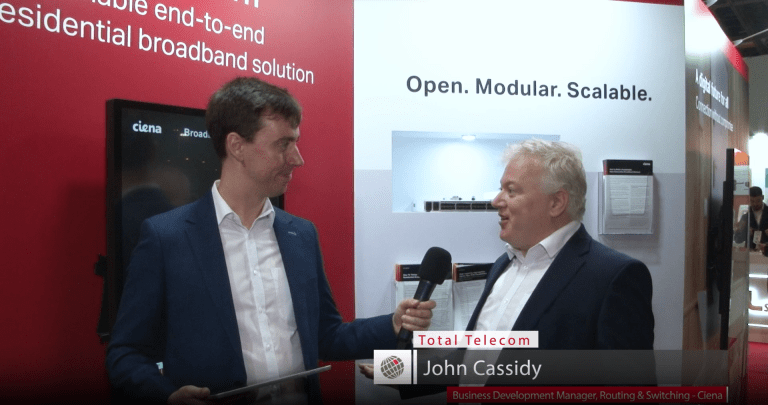
At Connected Britain 2023, we caught up with John Cassidy, Business Development Manager at Ciena to discuss the company’s recent acquisitions and its focus on creating flexibility for its customers

The past year has seen Ciena move in a new and interesting direction, with recent acquisitions making their residential fibre-to-the-home offerings more holistic than ever before.

“We’ve done a series of acquisitions over the past year. We acquired Benu, which is our virtualised BNG solution, and we’ve also acquired Tibit, which is our micro-OLT solution – it’s an OLT on a plug,” explained Cassidy. “We’re trying to show that when you combine these with our routing platform, which has been established for around 12 years, you have a whole end-to-end solution to offer our customers.”

“We’re trying to compress the business cases so you can get to places you couldn’t get to before,” he explained. “For example, in rural areas, the fact that you’ve got a one box solution to get to your customers really tightens the cost base. That’s a key advantage and brings a lot of flexibility.”

You can watch the full Connected Britain interview from the link below

[embedded content]

Also in the news:
VEON closes the door on Russia
Telefonica considers stake sale of Telefonica Tech
FCC fines DISH $150,000 after failure to decommission satellite as planned

Leaked docs show T-Mobile planning to migrate customers to more expensive tariffs


News

Customers will be automatically upgraded to a potentially more expensive tariff unless they opt out

This week, rumours have been confirmed that T-Mobile is seeking to shift some of its mobile subscribers onto new plans in November.

This is not simply a case of sunsetting older mobile contracts, but rather a wider migration across a large portion of T-Mobile’s subscriber base, moving many customers to newer – and often more expensive – mobile plans.

According to leaked documentation posted on Reddit, customers on selected plans will be migrated as follows:

  • Magenta (will be switched to Go5G)
  • One (will be switched to Go5G)
  • Simple Choice / Select Choice (will be switched to Magenta or Essentials Select)
  • Simple Choice Business (will be switched to Business Unlimited Advanced)

While for some customers this shift will not result in an increase of cost, others will likely see their subscription rise in price by between $5 and $10 per month.

The changes are expected to take effect in November, with customers informed of the change via SMS and email from October 17.

Those wishing to opt out will need to do so by contacting support services after receiving this notification.

The timing of this shift by T-Mobile is no coincidence. Back in 2020, as part of the agreement to acquire rival operator Sprint, T-Mobile promised that it would continue to offer “the same or better rate plans” for at least three years. Now, three years on, it seems the operator has little qualms about making changes that will drive up prices for their customers.

The operator will surely argue that these newer plans come with benefits that are more than worth the extra expense, but this seems unlikely to placate disgruntled customers paying for additional features that they never asked for.

How is the US mobile market evolving? Join the industry in discussion at Connected America 2024 live in Dallas, Texas

Also in the news:
VEON closes the door on Russia
Telefonica considers stake sale of Telefonica Tech
FCC fines DISH $150,000 after failure to decommission satellite as planned

Mitigating climate risks through automated network design


VIEWPOINT

There is no secret, climate change has become a worldwide threat. Parts of the infrastructure that forms the backbone of the Internet, from fiber optic cables to colocation facilities, is at risk of being flooded and knocked offline during the next few decades as a result of it.

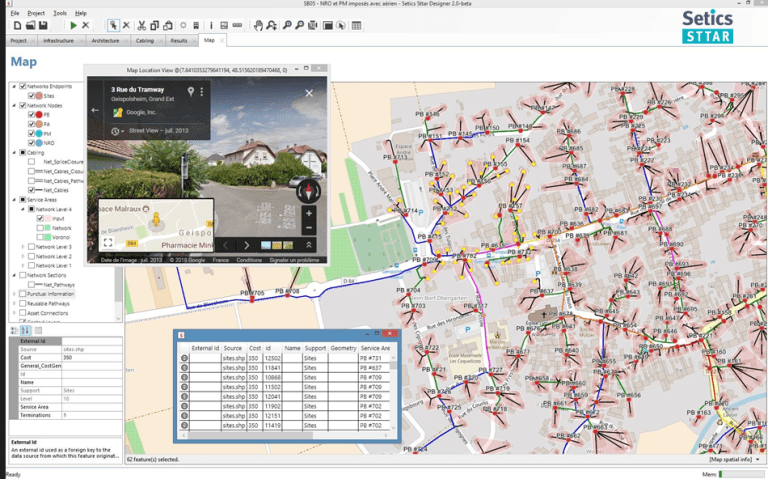
Our experience, specifically in Saint-Martin island clearly stresses the need to carefully plan cable routes and landing station locations factoring in a range of local hazards and how those are affected by climate change.

In fact, following hurricane Irma in September 2017, the entire island’s infrastructure was devastated, and Setics Sttar was called to action during the reconstruction phase.

The new infrastructure took into consideration these multi-factorial risks and aerial polls were replaced with underground infrastructure where appropriate.

Setics Sttar has helped engineers in over 30 countries to configure climate risks into the automated network design and assess the cost of such projects.

To learn more, please watch the below video.

 [embedded content]

Factor Climate Risk in your FTTH Network Design – Request a Demo Now

BT connects the skies with UK’s first Drone SIM


Press Release

BT today announces the launch of the UK’s first Drone SIM to unlock the true potential of beyond visual line of sight (BVLOs) drone operation across the UK.

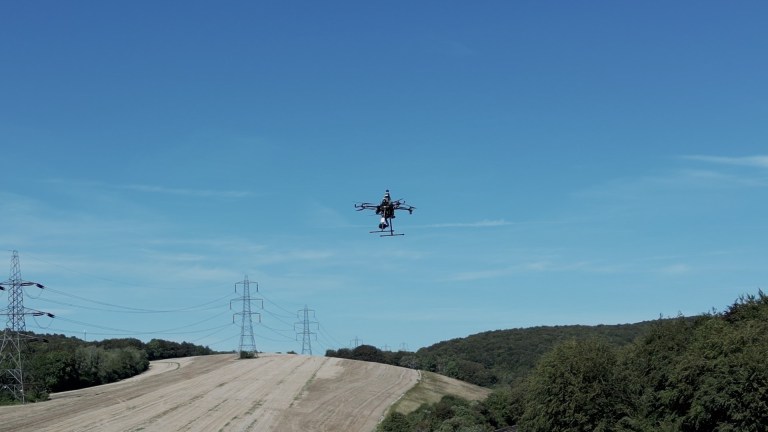
Designed to function at altitude using the EE network, Drone SIM offers unlimited data plans and continuous connectivity in the sky. Drone SIM is built to endure vibration, temperature and humidity extremes, supporting all-season drone use. BT business customers will be the first to benefit from the Drone SIM which has the potential to transform industries, from urgent delivery of medical supplies to infrastructure monitoring and transportation of goods.

Using BT Group’s EE network, Drone SIM benefits from high priority and ultra responsive connectivity, enabling safety, control, telemetry and realising ultra-high definition (UHD) video streaming at altitude. This enables drone users to capture detailed, survey quality imagery and video for a wide range of purposes, from search and rescue to infrastructure inspection.

Drone SIM is pushing the limits of drone flight. With the largest geographic coverage in the UK, uncrewed aerial vehicles (UAVs) can now fly significant distances at their full capability whilst remaining in constant communication with their remote pilots and safety systems; a dramatic shift from a world where they were limited by line-of-sight radio transmission or local Wi-Fi. This innovation presents a key opportunity across industry, from urgent delivery of medical supplies to infrastructure monitoring and transportation of goods.

Etc., the Digital start-up and incubation arm of BT Group, has demonstrated its role in innovating the drone industry through historic relationships, such as its £5 million deal with Altitude Angel to help build the UK’s first drone superhighway. The launch of Drone SIM follows a series of successful trials and development by the Etc. team. Trials include critical infrastructure inspection with drone technology provider sees.ai, plus the ability to test BVLOS mission safety standards in an integrated airspace with turnkey Uncrewed Aerial System providers Skylift. Drone SIM has also powered a UK-first drone medical delivery trial with aerial logistics specialist Skyfarer.

Dave Pankhurst, Director of Drones, BT, said, “Following the successful trials of our Drone SIM over the past year, this announcement is a huge stepping stone in bringing drone connectivity to businesses across the UK, unlocking potential for more efficient processes, business transformation and, with the ability to power search and rescue missions and medical deliveries, helping to save lives.”

Eduardo Aldaz-Carroll, Chief Technology Officer, sees.ai, states “It’s vitally important to inspect our critical national energy infrastructure. Drones offer significant benefits by increasing the speed, efficiency and consistency of data capture so we can predict the future state of the asset with reduced risk and environmental impact. It’s great to be working with BT Group to develop the technologies required to roll out BVLOS drone inspection and monitoring at scale.”

Nick Ruggles, Chief Technology Officer, Skylift states, “BT‘s Telecoms Grade C2 links have halved our deployment setup times. With recurring costs at just 14% of other systems and virtually zero infrastructure expenses, this is a game changer for us”.

Georgia Hanrahan, Chief Operations Officer at Skyfarer commented, “With the Drone SIM powering BVLOS flight, we can take a 20 minute flight between two hospitals and reduce this to a more direct 8 minute flight. Perfect for time-sensitive deliveries. We estimate a wider scale roll out nationwide could reduce our delivery time by 60% compared to road transport”.

Drone SIM is available today via www.bt.com/drones

What role will mobile connectivity play in unlocking the potential of the drone industry? Join the discussion at this year’s Total Telecom Congress live from Amsterdam

Also in the news:
VEON closes the door on Russia
Telefonica considers stake sale of Telefonica Tech
FCC fines DISH $150,000 after failure to decommission satellite as planned

Telco leaders join forces to discuss next steps towards highly autonomous networks


PRESS RELEASE

Many of the telecoms industry’s biggest names took to the stage at TM Forum’s Autonomous Networks (AN) Summit in Copenhagen to discuss the taking autonomous networks to Level 4

Industry leaders from Telefonica, Vodafone, China Mobile, Zain, MTN, AIS, EANTC, and Huawei gathered at the Summit and delivered keynote speeches focussing on AN. They spoke to an audience representing over 150 global operators, each seeking to learn the latest progress and achievements related to Autonomous Networks.

From conceptual consensus to deployment at scale, AN has made great progress after more than four years of development. Over 14 operators across the world have released their AN strategy of reaching Level 4 by 2025, with 70% expecting to reach Level 3 and beyond by 2025.

To drive the development and adoption of AN further, TM Forum released the AN Whitepaper 5.0 as a guide for all operators to implement AN, with all the speakers joining the Whitepaper launch ceremony at the Summit.

Aaron Boasman-Patel, the chair of the TM Forum AN Program, said in his presentation: “We recently launched the AN Manifesto to accelerate the adoption of autonomous networks and I am delighted to see 31 large CSP and vendor members become founding signatories in such a short time – this signifies the critical role autonomous networks is going to play in CSPs operations. Additionally, we launched the new the AN Whitepaper R5.0, which saw contributions by 64 partners. In this release, we renewed the Four Elements Methodology as the AN Framework (ANF), which will act as the AN Journey Guide for operators while adopting.”

Aaron Boasman-Patel, the chair of the TM Forum AN Program

Juan Manuel Caro, Director Autonomous Networks of Telefonica, said: “1) Agility, Intelligence, Efficiency, Quality, Sustainability are a set of Program Foundational Drivers guiding us in our Transformation journey, focusing on single autonomous use cases first and AI, then progressing to more complex , cross-domain use cases; 2) Defining an automation architecture (Network Brain Heart and ways of working) and hierarchy based in AI algorithms embedded in every layer 3) Established executive committee with our CTIO and we committed a 3-year plan with KPI based on autonomous network and the autonomy and sustainability goals and quality goals.”

Juan Manuel Caro, Director Autonomous Networks of Telefonica

“To operate the world’s largest network based on the principle of “service value and technological innovation, China Mobile is dedicated to improving endogenous network capabilities and end-to-end automatic NMS support capabilities, and to widely deploying more intelligent applications,” said Zhiyi Luo, Autonomous Networks director of China Mobile while sharing China Mobile’s best practice.

Zhiyi Luo, Autonomous Networks director of China Mobile

Boonchoung Tansuthepverawongse, Head of Network data and OSS Platform from AIS, said in his presentation: “After another year of great efforts, AIS is never wavering in the strategic goal of becoming a Cognitive Tech-Co to unleash digital customer experience excellence. Along this journey, AN have always played a significant role in forming the basis for enhancing network reliability, network quality, operation efficiency and most importantly, boosting AIS business growth.”

Boonchoung Tansuthepverawongse, Head of Network data and OSS Platform from AIS

Mohamed Salah, Head of network operation and transformation at MTN Group, said: “MTN continuously making innovation by value-base automation program under MTN’s PACE technical strategy. The scenarios (such as NPS improvement) are selected with “services-networks-value streams” 3-dimensional model. So, we can improve our AN level and capture the value autonomous networks during this evolution journey.”

Mohamed Salah, Head of network operation and transformation at MTN Group

Carsten Rossenhoevel, Co-Founder & CTO, EANTC said: “Realistic AN tests and assessments are an important success factor for the development of the TM Forum Autonomous Networks ecosystem. EANTC and Huawei jointly completed the first independent AN solution test in the IP domain.

Carsten Rossenhoevel, Co-Founder & CTO, EANTC

Sam Wang, General Manager of Huawei ADN Solutions said: “Practices and technologies are the two core drivers for Autonomous Networks. Huawei will continue to invest in the scenario-based solutions, root technologies such as foundation models, and enablement services to drive the industry forward. And the industry should be more open and cooperative to build a telecom foundation model to support richer business application scenarios.”

Sam Wang, General Manager of Huawei ADN Solutions

More and more operators are exploring AN,and actively sharing their implementation experience, helping to spread these important lessons across the industry. Undoubtedly, this kind of sharing, discussion and collaboration will inspire the real innovation and change for paving the way to highly Autonomous Networks.

Nokia Bell Labs breaks submarine transmission speed record


Press Release

Nokia today announced it has set two new world records in submarine optical transmission, both of which will shape the next generation of optical networking equipment.

The first sets a new optical speed record for transoceanic distances. Nokia Bell Labs researchers were able to demonstrate an 800-Gbps data rate at a distance of 7865 km using a single wavelength of light. That distance is two times greater than what current state-of-the-art equipment can transmit at the same capacity and is approximately the geographical distance between Seattle and Tokyo. Nokia Bell Labs achieved this milestone at its optical research testbed in Paris-Saclay, France.

The second record was achieved by both Nokia Bell Labs and Nokia subsidiary Alcatel Submarine Networks (ASN), establishing a net throughput of 41 Tbps over 291 km via a C-band unrepeated transmission system. C-band unrepeated systems are commonly used to connect islands and offshore platforms to each other and the mainland proper. The previous record for these kinds of systems is 35 Tbps over the same distance. Nokia Bell Labs and ASN broke the record at ASN’s research testbed facility, also in Paris-Saclay.

Nokia Bell Labs and ASN presented the scientific findings behind both records on the 4th and 5th of October at the European Conference on Optical Communications (ECOC), held in Glasgow, Scotland.

Making lasers that blink faster

Nokia Bell Labs and Alcatel Submarine Networks were able to achieve both world records through the innovation of higher-baud-rate technologies. “Baud” measures the number of times per second that an optical laser switches on and off, or “blinks”. Higher baud rates mean higher data throughput and will allow future optical systems to transmit the same capacities per wavelength over far greater distances. In the case of transoceanic systems, these increased baud rates will double the distance at which we could transmit the same amount of capacity, allowing us to efficiently bridge cities on opposite sides of the Atlantic and Pacific oceans. In the case of C-band unrepeated systems, higher baud would allow service providers connecting islands or off-shore platforms to achieve higher capacities with fewer transceivers and without the addition of new frequency bands.

The research behind these two records will have significant impact on the next generation of submarine optical transmission systems. While future deployments of submarine fiber will take advantage of new fiber technologies like multimode and multicore, the existing undersea fiber networks can take advantage of next-generation higher-baud-rate transceivers to boost their performance and increase their long-term viability.

Sylvain Almonacil, Research Engineer at Nokia Bell Labs, said: “With these higher baud rates, we can directly link most of the world’s continents with 800 Gbps of capacity over individual wavelengths. Previously, these distances were inconceivable for that capacity. Furthermore, we’re not resting on our achievement. This world record is the next step toward next-generation Terabit-per-second submarine transmissions over individual wavelengths.”

Hans Bissessur, Unrepeated Systems Group leader at ASN, said: “These research advances show that that we can achieve better performance over the existing fiber infrastructure. Whether these optical systems are crisscrossing the world or linking the islands of an archipelago, we can extend their lifespans.”

The submarine network landscape is evolving. Join the industry in discussion at Submarine Networks EMEA, the world’s largest subsea cable event

Also in the news:
VEON closes the door on Russia
Telefonica considers stake sale of Telefonica Tech
FCC fines DISH $150,000 after failure to decommission satellite as planned

VEON closes the door on Russia


News

VEON have announced the closing of the sale of its Russian operations to members of the senior management team of PJSC VimpelCom, led by VimpelCom CEO Alexander Torbakhov.

There is no buy-back arrangement and so this is a complete exit from the Russian market for VEON leaving the company to focus on its operations in Pakistan, Ukraine, Bangladesh, Kazakhstan, Uzbekistan and Kyrgyzstan.

VEON Group CEO Kaan Terzioglu commented “I am pleased to note that we are now in a much stronger position to deliver our strategic priorities. We would like to thank all our stakeholders and regulatory bodies, including U.S. Treasury, who have supported our Company through this process.”

Amsterdam, headquartered VEON now provides connectivity and digital services to nearly 160 million customers representing around 7% of the world’s population.

VEON will be joining the lineup for Total Telecom Congress in Amsterdam this November, with Lasha Tabidze, Group Chief Digital Operations Officer and Ana de Kok Reyes, Group Diversity & Inclusion Officer speaking. To join them, register at totaltele.com/congress

Telefonica considers stake sale of Telefonica Tech


News 

Telefonica Tech was unveiled during Telefonica’s 2019 restructuring 

Telefonica is considering the sale of a stake in its technology unit Telefonica Tech, which provides the management of cloud operations on Microsoft Azure and AWS, as well as offering cybersecurity services and IoT solutions. 

According to initial reports from Bloomberg, Telefonica have been approaching investment funds to gauge their interest in buying an undisclosed stake in the unit. 

The entire Telefonica Group is valued at around €22 billion, with net debt of €31.4 billion. According to sources, the Telefonica Tech could be valued at around €2 billion if the deal goes ahead. 

Although the talks are still ongoing, there is no guarantee that the company will give the divestment the green light, according to sources. 

Last month, Saudi Arabia’s largest telecoms operator STC group acquired a 9.9% stake in Telefonica worth €2.1 billion, which allowed them to become the company’s largest shareholder. There has been indication at this stage as to whether STC have approved the possible sale of the tech unit. 

Answers will presumably be presented by Telefonica CEO Jose Maria Alvarez-Pallete alongside a new three-year strategic plan set to be announced in November, with the company planning its first Capital Markets Day in over a decade.   

Want to keep up to date with all the latest news from the international telecoms sector? Click here to receive Total Telecom’s daily newsletter direct to your inbox  

Also in the news:
Ofcom refers public cloud market to CMA for investigation
UK joins Global Coalition on Telecommunications
TPG Telecom and Vocus need more time to iron out fibre deal