

Three interesting technology deployments from around the world, and one federal contract win: … [visit site to read more]

Three interesting technology deployments from around the world, and one federal contract win: … [visit site to read more]

euNetworks has tapped Ciena for a technical first over in Europe. They have leveraged Ciena’s WL6e technology to deploy a wavelength solution of 1.6Tbps through one of Europe’s busiest data corridors. … [visit site to read more]

Telekom Malaysia’s wholesale arm TM Global said on Monday it will expand its core data centres in Cyberjaya and Johor to serve growing demand for domestic and international data hosting services.
TM Global said the second phase of both the Klang Valley Data Centre (KVDC) in Cyberjaya and Iskandar Puteri Data Centre (IPDC) in Johor will deliver a combined IT load of around 20MW. Both data centres will meet Tier-III standards, as well as the Leadership in Energy and Environmental Design (LEED) Silver rating for long-term sustainability.
The KVDC and IPDC upgrades – which are scheduled for commercial operations sometime in 2025 – are part of the next phase in TM’s roadmap to grow its infrastructure ecosystem as Malaysia overall positions itself as a data centre hub and a digital powerhouse in Southeast Asia.
That strategy also includes TM’s recently established joint venture with Nxera, the regional data centre arm of Singtel’s Digital InfraCo unit, which plans to develop data centres in Malaysia, starting with a 200MW hyperscale AI-ready data centre campus in Johor.
TM Global EVP Khairul Liza Ibrahim said the KVDC and IPDC expansions and the Nxera tie-up will lay the foundation for digital services such as cloud, advanced analytics, AI and IoT.
“KVDC and IPDC are integral infrastructures in Malaysia’s digital ecosystem, serving as international gateways and interconnected points to support 5G networks,” she said in a statement. “This second phase of our data centre expansion will feature sustainable designs, boosting our capacity to support hyperscalers, OTT players, cloud and next generation AI providers, as well as enterprises.”
Khairul Liza added that TM Global’s recent acquisition of a facilities-based operator license in Singapore will allow the company to provide seamless data centre-to-data centre connectivity.
“This enables us to meet the growing connectivity demands across the region, linking data centres from Thailand to Malaysia, Singapore, and Batam in Indonesia,” she said.
TM currently operates seven data centres across Malaysia. The operator has said its participation in the Asia Link Cable Systems (ALC) subsea club cable – which links Hong Kong and Singapore, with branches connecting Malaysia, the Philippines, Brunei Darussalam and Hainan, China – will add another 24 Tbps of international capacity for its data centres in Johor when the cable goes live in the third quarter of 2025.

 The vision of the micro data center empowering an underserved market was everywhere for a while. Now that the conversation has moved on to AI, I’ve seen some ask if the edge is ‘dead’. But it’s all part of the same infrastructure discussion, because in the end the beneficiaries of AI will be at the edge and the infrastructure will have to be there. With us today to take another look at the next generation of edge data centers is Doug Recker, President of Duos Edge AI. Doug previously founded and led EdgePresence before it was sold to Ubiquity in 2023, and has clearly wasted no time getting back into the saddle. … [visit site to read more]

U Mobile defended its qualifications to run the country’s second 5G network on Sunday after enduring a week of criticism from rivals, industry analysts and politicians who expressed bafflement at the government’s decision to give U Mobile the nod.
On November 1, the Malaysian Communications and Multimedia Commission (MCMC) picked U Mobile to implement Malaysia’s second 5G network to compete with original 5G operator Digital Nasional Berhad (DNB).
The result came as a surprise to rival telcos Maxis and CelcomDigi – both of whom were in the running – and industry observers and financial analysts who had tipped either Maxis or CelcomDigi as the likely winners.
Most of the criticism has focused on the fact that U Mobile is the youngest and smallest of the contenders, having only started services in 2007. According to news site Soya Cincau, U Mobile has said it currently runs more than 10,000 mobile sites and had over 9 million subscribers as of the end of 2023. CelcomDigi has 25,000 sites and 20.2 million subscribers, while Maxis has over 11,000 sites and 12.7 million subscribers.
Last week, the MCMC issued a statement defending the decision, saying that the decision was “based on a combination of factors”, from its business and technical plans, consumer complaints and satisfaction records to its performance in carrying out other infrastructure initiatives, including Universal Service Provision (USP) projects such as JENDELA Phase 1 and other 4G upgrade projects.
However, the statement didn’t go into specifics and raised more questions than answers. On Friday, Dr Ong Kian Ming, former Deputy Minister for International Trade and Industry (MITI), issued a statement calling on the MCMC, Communications Minister Fahmi Fadzil and Digital Minister Gobind Singh Deo to release more details on the tender process and the scoring method to determine the winner.
Meanwhile, U Mobile Chairman Vincent Tan defended the telco’s ability to roll out the second 5G network in a column published on Sunday in Malaysian business news publication Business Today.
Among other things, Tan cited U Mobile’s 95% network population coverage, its success in the JENDELA and USP programmes, and its ability to undersell the competition, particularly with 5G.
“As the first telco in the country to offer 5G service at no additional costs for all Malaysians and consistently offering similar services at 20-25% cheaper than competitors, U Mobile’s aggressive investments and innovations have and will continue to challenge our competitors resulting in cheaper and better services for all Malaysians,” Tan said.
Tan also reiterated earlier comments from MCMC that the second network will be funded entirely by U Mobile, as opposed to being subsidised with taxpayer money, as was the case with DNB.
That said, critics have also questioned U Mobile’s ability to fund a new 5G network rollout. According to The Edge Malaysia, CIMB Securities said in a research note last week that U Mobile would need to invest up to MYR3 billion (US$681 million) over 18–24 months to cover 80% of the population, and MYR1 billion a year after that, which is higher than U Mobile’s average capitalised capex of MYR500 million per annum between FY2014 to FY2023.
CIMB Securities added that U Mobile will need a strong financial partner to share the cost, “given U Mobile’s higher net debt-to-earnings before interest tax, depreciation and amortisation ratio at 4.3 times, compared to Maxis’ (2.2 times) and CelcomDigi’s (2.1 times).”
In his column, Tan said that U Mobile recorded a higher revenue of MYR3.5 billion and higher net profit of MYR102 million in 2023, with increased operating cash flows of MYR1.2 billion. U Mobile’s total assets stood at MYR6.2 billion with a total share capital of MYR2.6 billion.
U Mobile issued a statement on Sunday adding that it has “robust financial backing from its shareholders, financial institutions such as UOB, CIMB and AmBank, as well as strategic vendor partners who enable the telco to continuously innovate to stay competitive and to meet network deployment targets.”
U Mobile also confirmed that its biggest shareholder – Singapore-based Straits Mobile Investments (a subsidiary of ST Telemedia), which owns a 48.3% stake – has agreed to bring its share down to 20%.
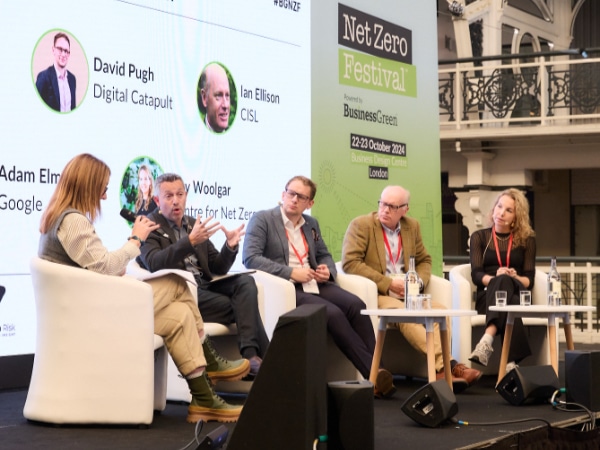
At the recent Net Zero Festival in London, the role of AI in the transition towards net zero was the subject of a panel discussion that brought together key thinkers in the sector.
Adam Elman, Head of Sustainability for EMEA at Google, joined Ian Ellison, Associate Director of the Cambridge Institute for Sustainability Leadership, and Izzy Woolgar, Director of External Affairs at the Centre for Net Zero, to discuss how AI is helping enable the switch to more sustainable energy.
Elman explained that AI is a transformational technology that has the ability to bring huge benefits to people and to society, but noted that it is not actually ‘new’, noting: “At Google, we’ve been integrating AI into products and tools for the last decade – if you were using Google Search five years ago, or Google Translate or Google Maps, you’ve been using AI.” However, he noted that the technology has evolved in ways that will allow it to have an impact on climate action. Acknowledging that there are concerns over how AI is used and how it will affect society, Elman argued that AI represents huge opportunities from both a business and a climate change perspective.
Ellison agreed, claiming that AI’s role in the net zero transition will be absolutely critical. “If you look at Net Zero, the SDGs, we’re far behind the curve. AI brings the tools to the table that allows us to close some of the gap thoughtfully, carefully and recognizing risks.” He noted that AI can provide better access to data and deliver faster education, allowing better dissemination of messaging around sustainability concerns across business.
Woolgar noted that AI has a significant track record in delivering innovation in the field of science, which underlines its potential for the net zero transition. “AI’s optimisation capability is really important. We are transitioning from an energy system that was quite top down and static to one that’s very dynamic and decentralised, and that requires optimisation so that we know where the sun’s going to be shining or the wind’s going to be blowing, and we can compare accordingly on the supply side but also on the demand side. What happens when lots of people adopt electric vehicles or heat pumps? How can we plan accordingly? Keeping that supply and demand in balance is absolutely critical.”
Acknowledging that AI is putting constraints on energy systems, Woolgar said that a wider perspective is essential, citing the International Energy Agency’s recently published World Energy Outlook which details what will happen in terms of electricity demand between now and 2030. This forecasts how much energy the adoption of various technologies – such as heat pumps and electric vehicles – will account for, and she noted that data centres represent a very small share of this. There are constraint issues on a local network basis, such as when data centres are clustered together, which they often are, so grids will need to be built out to facilitate supply, but more importantly, grids and data centres must operate with greater flexibility. She noted that Google aligns its compute loads to periods with an excess of solar or wind, allowing the data centre to “soak up” the renewable power which would otherwise be wasted by running their systems at a more optimal time.
When pressed on the negative effects of AI, Elman conceded that Google’s carbon emissions have increased by 20% within five years as a result of AI adoption, and that this must be mitigated to ensure sustainable growth. He noted that Google is committed to a Net Zero target of 2030, and that its emissions growth slowed last year, but agreed that there is still work to do. He argued that Google had long acknowledged that emissions would increase in the short term around AI adoption, but this would be offset by the long-term reductions. He conceded that trusting tech companies on such pledges was a tall order, but argued that the investments Google is making in its infrastructure and solutions will help it to reach its targets. Elman stated that by 2030, Google aims to have achieved a massive 50% reduction in emissions, with the remaining 50% mitigated via “high quality carbon removals”.
Pressed on the increasingly stringent requirements for ESG reporting, Elman agreed that corporate reporting must be traceable, and that while AI could reduce the administrative burden of this, ultimately it would still require a manual effort as AI reporting would not be robust enough. “There’s a raft of AI solutions and platforms that are being built to help with… the macro level reporting, but then there’s more granular opportunities.” One example is deforestation regulation – using cloud and geospatial capabilities, AI can deliver real time, granular location-based information to companies, enabling smoother forest management to help them track and manage their goals and commodities around areas such as sustainable farming.
Ultimately, Elman was upbeat about the prospects for the green AI landscape, noting that in addition to mitigation, AI presents huge opportunities for adaption and resiliency in the face of climate change. With the right policies in place, AI will be able to play a huge role in advancing net zero.
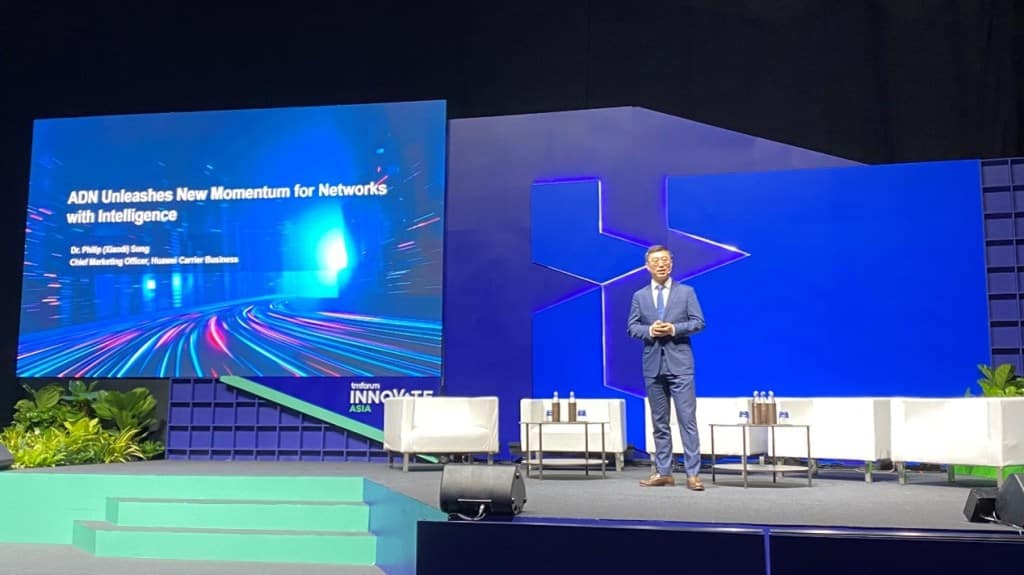
[Bangkok, Thailand, November 5, 2024] TM Forum, a leading authority in the ICT industry, successfully hosted the Innovate Asia 2024. There, Dr. Philip (Xiaodi) Song, Chief Marketing Officer for Huawei Carrier Business, delivered a keynote speech titled “ADN Unleashes New Momentum for Networks with Intelligence.” He shared details about Huawei’s innovative AI Copilot and Agent applications, designed to help communications service providers (CSPs) evolve towards Autonomous Networks (AN) Level 4.
Over the past few decades, technological advancements have improved network productivity and customer experience helping to revitalize the communications industry. However, the advent of the intelligent era has raised the requirements for telecom network latency and bandwidth, significantly increasing operational expenditure (OPEX). To simplify network operations, many CSPs around the world have incorporated AN into their strategies and deployed Huawei’s Autonomous Driving Network (ADN) solution. This is helping them achieve AN Level 3 and actively evolve toward Level 4. Against this backdrop, AI foundation models are a crucial stepping stone for automating repetitive and to simplify complex O&M challenges in telecom operations scenarios.
Dr. Philip explained, “Telecom networks have transitioned from the era of small AI models developed based on expertise to the era of AI foundation models. Foundation models overcome the constraints of logic, rules, and scenarios, enabling comprehensive efficiency improvements in the ICT field. Built on their Telecom Foundation Model, Huawei provides a set of role-based Copilot and scenario-specific Agent applications, significantly enhancing network O&M efficiency and delivering excellent customer experiences in high-value scenarios.”
Dr. Philip also elaborated on Huawei’s Copilot and Agent solutions customized for intelligent O&M, network optimization, and experience operations, as well as their implementation achievements. This will help CSPs evolve value scenarios from AN Level 3 to Level 4.
In closing, Dr. Philip called on telecom industry partners to collaborate on further AI applications across the industry and evolve toward AN Level 4.

Virgin Media O2 (VMO2) has introduced the UK’s first 5G standalone (SA) small cells in Birmingham, boosting mobile connectivity in some of the city’s busiest areas, it claimed in a press release this week. These new 5G small cells, installed on street furniture around Broad Street and Fleet Street, are designed to improve mobile capacity where demand is highest.
Initial performance data suggests that the new 5G SA cells provide a smoother mobile experience, helping customers with activities like browsing and streaming.
Unlike large cell towers, the small units can be fitted onto existing structures to bring focused coverage improvements in urban spaces. This latest installation adds to Virgin Media O2’s ongoing rollout of small cells across the country.
The 5G standalone network, launched by Virgin Media O2 earlier this year, now covers over 300 towns and cities. Unlike older 4G and 5G networks, standalone 5G offers faster speeds and lower delay times, giving O2 customers better,faster and more reliable connections at no extra cost.
Partnering with Ontix and Alpha Wireless, VMO2 has also introduced MIMO (Multiple Input Multiple Output) technology, which allows speeds of up to 300Mbps in Birmingham’s city centre.
MIMO works by using multiple antennas at both the transmitter (in this case, the small cells) and receiver (such as a user’s smartphone), allowing for simultaneous data streams. This technique maximises the efficient use of available spectrum, meaning more data can be transmitted at once, leading to higher speeds and lower latency.
“Small cells are playing a vital part in our mission to bring reliable mobile coverage to all customers and improve services in the busiest areas,” said VMO2 CTO Jeanie York.
“Having already turned on our cutting-edge 5G standalone network in more than 300 towns and cities, available to customers at no extra cost, we’re working hard to ensure all our customers consistently receive an exceptional network experience wherever they are and even at the busiest times,” she continued.
Keep up to date with the latest international telecoms news by subscribing to the Total Telecom daily newsletter
Also in the news:
Mobily and Telecom Egypt to deploy Red Sea submarine cable
CMA set to approve Vodafone–Three merger
SK Telecom announces “AI Infrastructure Superhighway”
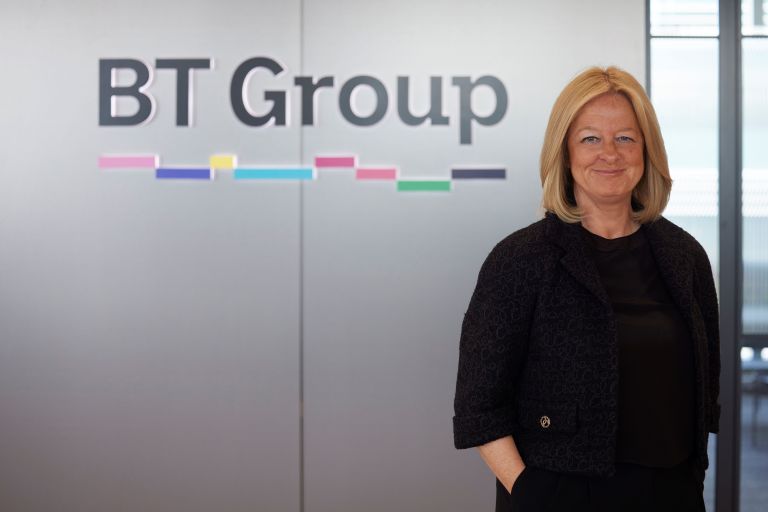
BT released its financial results for the half year ending on 30 September 2024 this week, which showed a mixed bag of developments in a challenging economic landscape.
The UK incumbent reported a 3% decline in revenue, primarily driven by issues in non-UK operations and a competitive retail environment. Reported profit before tax sits at £1 billion, down 10%. This was “primarily due to lower revenue, higher specific costs and higher net finance expenses,” the company explained.
A significant highlight in BT’s recent performance is the speed of its fibre rollout, which has now reached over 16 million premises. Openreach passed 2.1 million premises with fibre-to-the-home (FTTH) in the last six months and has set an ambitious target to reach 4.2 million premises for FY25. The company has reported 446,000 new active connections on this network, raising its total to 5.5 million.
Additionally, BT’s 5G network expansion continues to lead the market, covering 80% of the UK population, more than any other operator.
I addition to its rollout updates, BT also confirmed that its workforce has been cut by 2,000, or 4% year-on-year, to 118,000, which saved the £433 million in annual costs in the first half alone.
However, the latest UK budget posed new hurdles for the operator. The government’s decision to hike employers’ National Insurance contributions could cost BT an additional £100 million annually. In response, CEO Allison Kirkby outlined several measures to mitigate this impact, including potentially passing costs on to mobile and broadband customers. She also said that cost-cutting initiatives through automation and AI would be accelerated.
“We are confirming our EBITDA, capex and cash flow guidance for FY25, albeit on lower revenue guidance. We remain firmly on track to meet our long-term cost savings and cash flow targets, and today announce an interim dividend of 2.40pps. The accelerated modernisation of our operations, combined with a focus on connecting the UK, puts us in a strong position to generate significant value for all our stakeholders,” said Kirkby in the announcement.
Despite these financial pressures, BT remains ‘committed to its strategic priorities’, particularly its full fibre and 5G rollout plans. The company is also exploring options for its international arm, BT Global, which may include a sale or restructuring to better optimise its operations.
Back in May, the company said it had hit its target to save £3 billion by 2025 a year early, with much of this total being driven by the company’s ongoing job cutting programme that will see 55,000 jobs eliminated by the end of the decade.
Kirkby now says it will aim to repeat this, cutting a further £3 billion in costs by 2029.
Keep up to date with the latest international telecoms news by subscribing to the Total Telecom daily newsletter
Also in the news:
Mobily and Telecom Egypt to deploy Red Sea submarine cable
CMA set to approve Vodafone–Three merger
SK Telecom announces “AI Infrastructure Superhighway”
Latvian mobile operator LMT’s President, Dr Juris Binde (pictured, second from right), has stated that price increases will be inevitable if a merger with fixed broadband provider Tet goes ahead—a move that has faced strong opposition from rivals concerned about its impact on market competition.
Speaking to Developing Telecoms at the 5G Techritory conference in Riga, Binde confirmed that “definitely there will be price increases because it will be the dominant operator” if the merger materialises. He justified the likely rise in costs, citing the need to manage rising energy expenses and attract top talent to “develop new solutions and services for continued growth.”
Binde also clarified that the integration of LMT and Tet would slow development plans temporarily, explaining, “A merger doesn’t mean you simply combine two companies and everything carries on smoothly. It’s a complex and costly process, which would slow down the economy of both companies, and impact the national economy too.”
Opposition to the Merger
Aruns Mickevics, Director-General of rival operator Bite Latvia, voiced strong criticism of the proposed merger last month, warning it could create a “monopolised giant” with “super dominance” in the market, according to Baltic News Network. Should the merger go ahead, Mickevics has called for the new entity to be separate from the state, with critical infrastructure divested from Tet and made accessible to all market players.
In response, Binde acknowledged that “some reshaping of the market” may be necessary to secure approval, addressing Mickevics’s suggestion of separating Tet’s fibre-optic network and data centres from its main business, noting, “these are strategic discussions for the state.”
Another potential option under consideration is for LMT to take on Tet’s customers in “overlapping” services, such as connectivity, television, IT, and smart home solutions.
Despite these hurdles, Binde remains optimistic, seeing the merger as ultimately beneficial for the Latvian telecoms sector. “The future is mobile only. Therefore, LMT is the leading company and must remain the leader,” he added.
Future Plans
Binde stressed that market consolidation is only worthwhile if it supports a growth strategy beyond traditional telecoms, pointing out that declining revenues from core services are a global trend in oversaturated markets. He argued that operators must pursue a “broader landscape of services and innovations based on telecom services.”
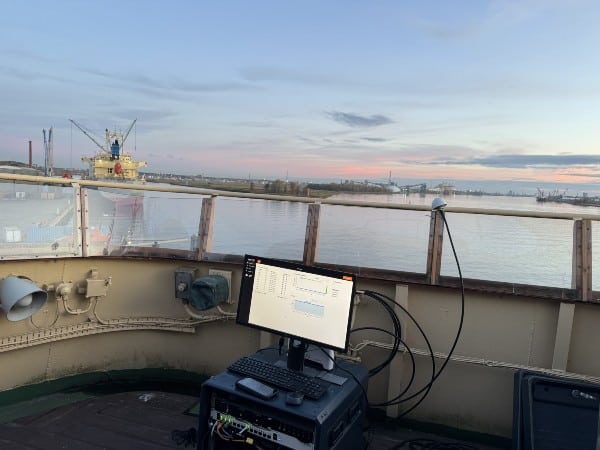
In line with this vision, LMT invested €24.4 million over the last nine months – a 22% year-on-year increase – in developing new services and expanding its 5G network. One innovation in progress is Seamless 5G Connectivity (pictured below) in the Baltic Sea, which includes providing 5G to the Port of Riga by installing base stations on ships and deploying aerial and aquatic drones to improve communication between vessels and port staff.