

Five interesting infrastructure projects in four different parts of the world at midweek: … [visit site to read more]

Five interesting infrastructure projects in four different parts of the world at midweek: … [visit site to read more]
Portugal becoming an interconnection hub
There is no denying that Portugal sits in a privileged geographical position when it comes to submarine cable infrastructure. With access to the Mediterranean and the Atlantic, the country is seeing a surge of new cable deployments connecting it to all four corners of the globe.
“Portugal has been a submarine cable hub for a long time, but now we’re really starting to see rapid growth,” said Jorge Andrade Santos, Head of International Wholesale at Altice Portugal, noting the new cables connecting the country are expected to more than double those being retired between 2021 and 2026.
These new routes travel in seemingly every direction: West to the Americas, South down the west coast of Africa as far as South Africa, North to northern Europe, and East to the Mediterranean and through the Suez Canal to East Asia.
“It’s like a star, spread across the entire globe with Portugal at its centre,” said Santos. “In many cases, these routes are extremely low latency due to their efficient routing, being deployed almost on the same lines that air companies use for commercial flights.”
Portugal is also seeing more cloud infrastructure being deployed inside the country itself, rather than in the previously more popular location of neighbouring Spain. Altice itself recently launched a new interconnection data centre in Lisbon, which is already generating significant business.
“Our main focus is to reduce costs for customers, be open and neutral, and be an interconnection and edge data centre. Now we’re looking to grow and diversify the kind of players that are using the facility,” said Santos.
The operator is also considering a new cable landing station and interconnection project in Porto, with feasibility studies already underway.
South Africa: More than the bus stop at the end of the line
South Africa is well known as the termination point for numerous major submarine cable systems travelling up and down the continent’s East and West coasts. But while this distinction comes with a certain level of prestige, it also leaves the country incredibly vulnerable to cable cuts taking place many miles to the north. In fact, this year alone, we have seen disruptions from both east ad west, with cables damaged off the west coast of Africa and in the Red Sea.
The SAEx Project seeks to alleviate this pressure, providing a new route that will link the USA (Virginia) to Brazil (Fortaleza) all the way to Singapore via South Africa.
“The geopolitical tensions that we’ve seen rising across the route are not easing up. We need a more reliable route that avoids some of the troubling areas, like the Red Sea,” said Rosalind Thomas, Managing Director and CEO of SAEx International Management. “South Africa is often the bus stop at the end of the line but we aim to change that.”
The eastern portion of the cable (SAEx East, South Africa to Singapore) is currently in the funding stage, aiming to close by the start of 2025. Work on SAEx West (Virginia to South Africa) will take place roughly one year after SAEx East.
The project already has approval from the South African government, which has identified it as a “Strategic Mega Telecoms Infrastructure Project”.
Overcoming icebergs to connect Greenland
For the most part, Greenland’s existing submarine cable infrastructure is already over a decade old. As a result, new infrastructure is required, not only to serve growing demand but also to provide additional redundancy for existing routes.
The planned Tusass Connect 1 system will meet this need, connecting Qaqortoq in the south to Aasiaat/Disko Bay in the North, via the capital Nuuk.
Surveys for the project have already been completed. Deployment, however, will be far from easy.
“The area is famous for having some of the world’s biggest glaciers, therefore the world’s biggest icebergs, which, as you can imagine, can create some problems!” said Steen Hansen, Department Manager at Tusass A/S.
The related terrestrial infrastructure for the system will be built between 2024 and 2026, including power infrastructure. In some cases, these fibre deployments will be completed via unburied pipes due to rocky and otherwise impenetrable terrain. The stormy weather also notably makes deployment via poles – a method popular in countries like the US – largely impossible.
Tusass say the project is aiming to be RFS in late 2026 or early 2027.
Genoa growing as rival to Marseille
Marseille has long been at the heart of the Mediterranean submarine cable ecosystem, but in recent years new hubs are growing in prominence. One such hub is Genoa, which is the focus of the new Unitirreno cable system off the west coast of Italy.
The system will connect Genoa to Mazara Del Vallow (Siciliy), with branches to Rome and Sardinia. It comprises 24 fibre pairs on the main trunk, with 16 on the Rome branch and 4 on the Olbia (Sardinia) branch.
“Almost all cables coming from the Middle East and Africa have Marseille as their termination point. Uniterreno will provide an alternative route into Europe, with Genoa emerging as one of the next subsea hubs in the Mediterranean,” said Chris van Zinnicq Bergmann, CCO of Unitirreno.
Part of the motivation here is the growth of Rome as a major data centre region within Italy, beginning to steal the thunder from ever-popular Milan. The new submarine cable system, van Zinnicq, will support this growth.
The initial deployments are expected to start in December this year, with the system read for service in June 2025.
Telxius focussing on redundancy in the Americas
Digital infrastructure provider Telxius had two systems to discuss at Submarine Networks EMEA this year: Firmina and Tikal.
Firmina is a 13,500km cable system currently under construction that spans from the East Coast of US to Brazil and Argentina.
Part of the motivation here, explained Gonzalo Rodriguez, Account Manager EMEA at Telxius, is that the route will provide the company with additional landing points in the US and Brazil, helping to provide redundancy for their existing cables in the region.
Firmina is expected to be ready for service in Q4 this year.
Tikal, meanwhile, is a 2,000km cable connecting Boca Raton, Florida, to Guatemala, with a branch extending to Cancun, Mexico. An additional branch to Barranquilla, Colombia, is also being considered.
“What’s really interesting is this will have a branch to Cancun, Mexico. The region has been very active in the last few years and is now able to justify such an expansion,” said Rodriguez.
Telxius plans for Tikal to be ready for service in Q4 2024.
Cinturion making steady progress on TEAS project
Cinturion Group’s Trans Europe Asia System (TEAS) project is one of the most anticipated subsea cable systems in the world, an open-access network connecting Europe to India with an overland hop across Saudi Arabia.
This terrestrial route will not only allow data traffic to avoid the lengthy task of circumnavigating the Arabia peninsula, but will also avoid troublesome geopolitical regions such as the Red Sea.
Much progress has been made with regards to permitting for the system in the past year, with only the final details waiting to be agreed with the Saudi Arabian government before the project can begin.
Cinturion says it expects to have a contract in force in Q3 of this year, with TEAS ready for service in Q2 of 2027.
Medusa to connect to all five north African countries
The upcoming Mediterranean’s Medusa cable will span roughly 8,700km from Portugal to Egypt, with branches to major hubs in Europe and North Africa. This notably includes branches to each of Morocco, Tunisia, Algeria, Libya, and Egypt.
“This is really significant,” said Miguel Angel Acero, CTO of the Medusa Submarine Cable System. “It’s the first submarine cable that will connect to all of these five countries in North Africa.”
He also noted the cable’s significance of the cable for the Mediterranean’s research community, with the EU having provided funds to help connected universities and research institutes across the region.
“We have a grant of €40m from the EU to use Medusa to help connect university and research networks between Europe and North Africa,” explained Acero.
The Medusa system is aiming to be ready for service in Q4 2025.
Tampnet’s Norfest celebrates completion in under a year
With a cold climate and a plentiful supply of fresh water, Norway has grown significantly as a data centre hub in recent years, bringing with it an enormous need for fibre backhaul. This was the motivation behind Tampnet’s new Norwegian Norfest cable system, which spans between Stavanger to Oslo, with branch to Stromstad, Sweden.
The fully buried, open access cable system is comprised of 48 fibre pairs and connects all of the major data centre locations along the southern coast the country.
“It was important for us to do this deployment in the most environmentally sustainable way,” said Tampnet Carriers’ Director of Infrastructure Development, Carol Browne. “The cable itself never left Norway, being domestically manufactured – that’s quite unusual for such a big cable project.”
Norfest was ready to begin commercial operations in December last year, having been completed in just 11 months.
TAM-1 set to be the most advanced cable system in the Caribbean
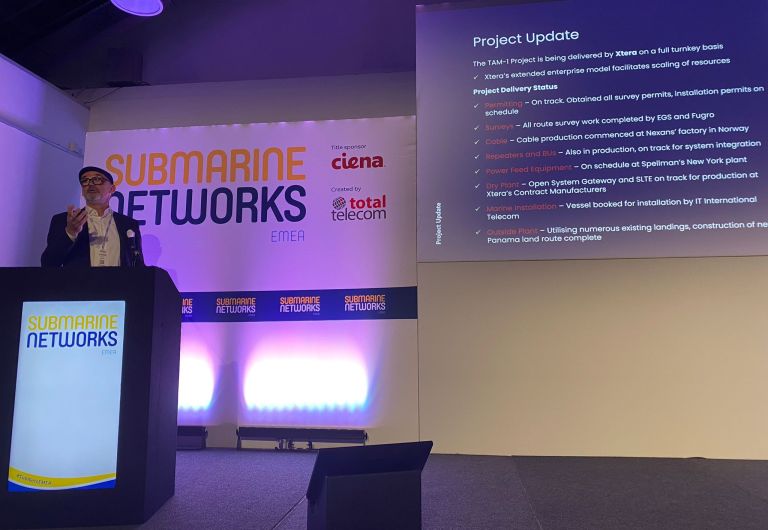
Phase 1 of TAM-1’s deployment, which is already taking place, will see Florida connected to Central America and the North Caribbean. Phase 2 will see this expanded to the wider Caribbean and the northern parts of South America.
Combined, the full TAM-1 system will span over 7,000 km, with 36 fibre pairs and a total capacity of 648Tb.
Work on the project is progressing steadily, with a contract in force as of September last year and initial surveys taking place this April.
The system is currently set to be ready for service Q4 2025.
Speaking at the event, Joerg Schwartz, Chief Partners & Solutions Officer at Xtera (pictured), noted that the company’s latest repeater, branching unit, and open access technologies will be deployed in the TAM-1 system.
“We’re working to essentially allow you to make a network within each fibre pair,” explained Schwartz. “This is going to be the most innovative and flexible system in the region.”
SEA-SPINE: Connecting the Aegean’s underserved islands
The Aegean Sea includes around 1,415 islands, some of which are among the most popular tourist destinations in Europe. But while the better-known islands are generally well-connected with submarine cable infrastructure, many of the other islands remain largely unconnected.
SEA-SPINE is a submarine cable project aimed at shrinking this digital divide, using roughly 563km of submarine fibre and 232km of terrestrial fibre to connect almost a dozen islands to the global internet backbone.
“We are going to connected 11 islands with 7 submarine links. These are not the best known islands – we are trying to bring quality connectivity to some of the more underserved, geographically challenging areas of Greece,” said Ioannis Patsouras, Solutions Architect for WINGS ICT Solutions.
An international tender for procurement for the cables was launched in February, with initial deployments likely to begin later this year.
Submarine Networks EMEA is the region’s leading submarine cable infrastructure event, covering all of the biggest topics from across the industry
Keep up-to-date with all the latest news, articles, event and product updates posted on Developing Telecoms.
Subscribe to our FREE weekly email newsletters for the latest telecom info in developing and emerging markets globally.

Two service providers that have largely stayed out of the M&A game for the past couple of decades have done a deal out in the Midwest and West. US Signal has entered into a definitive agreement to buy OneNeck from Telephone and Data Systems. … [visit site to read more]

This week, a consortium including two Japanese banks, mobile operator NTT DOCOMO, and non-terrestrial network (NTN) specialist Space Compass Corporation, have announced an investment of $100 million into HAPS developer AALTO.
The investment, the companies say, will help support the industrial ad commercial roadmap for delivering AALTO’s services to customers, including a commercial launch in 2026.
AALTO, a division of aviation giant Airbus until being spun off at the start of last year, has been working on its HAPS technology, dubbed Zephyr, since 2001. The solution is essentially a large solar-powered stratospheric glider that can be equipped with mobile network technology, allowing connectivity, including 5G, to be rapidly delivered to remote locations.
In addition to telecommunications equipment, Zephyr can also carry other payloads, including imaging technology, such as Airbus’s Strat-Observer solution, allowing “a range of monitoring, tracking, sensing, and detection” capabilities.
Zephyr’s current record for continuous flight is 64 days, but the company hopes that this can be extended to over 200 days in future.
Combining all these features makes Zephyr ideal for rapid response scenarios, such as natural disasters.
“This is a landmark investment for AALTO. It is the natural next step in the roadmap of the Company’s targeted entry-into-service in 2026, as we industrialise and commercialise our technology. With world leaders in aviation and connectivity as shareholders, AALTO now has the combination of technological expertise and global reach to capitalise on the growth opportunities in substantial total addressable markets across connectivity and earth observation,” said AALTO CEO Samer Halawi.
“This investment comes as AALTO moves into its next phase of development. This includes launching several customer missions over the coming year, establishing launch and landing sites for Zephyr, and advancing our certification process. We are excited to forge a new frontier in sustainable connectivity and earth observation from the stratosphere, while generating significant value for all our stakeholders.”
The investment by the Japanese consortium will be made by their purpose-built investment vehicle, HAPS JAPAN Corporation.
The deal builds on a longstanding relationship between AALTO, NTT DOCOMO, and Space Compass, which first agreed to explore collaboration possibilities back in 2022.
Space Compass itself is a joint venture between NTT and SKY Perfect JSAT, focussing on developing a Space Integrated Computing Network. Part of this process includes the development of direct-to-device mobile services using HAPS, for which it is once again partnered with NTT DOCOMO, NTT, and SKY Perfect JSAT.
Keep up to date with the latest international telecoms news by subscribing to the Total Telecom daily newsletter
Also in the news:
Microsoft pours $3.2 bn in Swedish cloud infrastructure
Zegona Communications completes Vodafone Spain acquisition
Verizon secures $2.7bn US navy contractv

Keep up-to-date with all the latest news, articles, event and product updates posted on Developing Telecoms.
Subscribe to our FREE weekly email newsletters for the latest telecom info in developing and emerging markets globally.

Fiber-to-the-home buildouts are being launched in more communities and neighborhoods around the country every day. Greenlight Networks is one of the relatively young upstarts taking on the status quo. Based out of Rochester, they have been adding markets throughout New York state, and has recently expanded its focus to take on more of the SMB market as well as multiple dwelling units, or MDUs. With us to talk about Greenlight’s approach is the company’s Commercial Development Director, Kevin Gorman. … [visit site to read more]

The US Department of the Navy has chosen Verizon’s government, education, and public safety arm, Verizon Public Sector, to provide wireless services, in a contract worth up to $2.67 billion over 10 years.
The new contract will offer improved and cost-effective wireless solutions to related military and federal agencies.
The agreement forms part of the fourth round of the wireless and telecoms services contract launched by the US Department of Defence (DOD), also known as the Spiral 4 contract.
“Verizon’s inclusion in Spiral 4 represents our understanding of the DON’s sophisticated demands for mission critical communications, developed through our history of digital modernization partnership with federal agencies including on Spiral 3,” said David Rouse, head of Verizon’s defence portfolio in a press release.
“We are proud to continue serving military agencies under this new contract and build on our relationship with the DOD,” he continued.
Verizon plays a critical role in providing communication services to the US Navy to support their operations. Back in December, the company secured another contract with the US Navy to modernise data services and provide it with new voice technologies.
The year before, it secured a deal worth almost $1 billion with the DOD to provide network modernisation services and technical support services to the Pentagon, the DOD National Capital Region (NCR), and US army base Fort Belvoir.
Keep up to date with the latest international telecoms news by subscribing to the Total Telecom daily newsletter
Also in the news:
Digi set to buy OTE’s Telekom Romania
Billionaire Xavier Neil ponders Millicom acquisition
EU-funded Global Gateways projects on show at Submarine Networks EMEA 2024

This week, Orange has announced that Orange Romania will merge with Orange Romania Communications (OROC), combining their mobile and fixed broadband businesses to become a fully converged telecoms operator.
Orange Romania first acquired a 54% stake in OROC (then Telekom Romania Communications) back in 2021 and moved quickly to unify contact channels and launch a joint commercial offering.
Since then, Orange has been looking to take full control of OROC and merge the two businesses, finally getting the green light for the merger from the Romanian government last year.
Following the merger, Orange Group will hold an 80% stake in the converged business, with the remaining 20% held by Romania’s Ministry of Research, Innovation and Digitalization.
“The merger between Orange Romania S.A. and Orange Romania Communications S.A. is a major step for Orange and marks the fruition of the process with the Government of Romania,” said Mari-Noëlle Jégo-Laveissière, Executive Vice President, CEO of Orange Europe. “This merger enables Orange Romania to fully implement its strategy to deliver best-in class offers on mobile and fiber. I warmly thank the teams that have been working on this transaction and wish the new integrated teams all the best.”
The convergence of mobile and fixed broadband operations has been a key strategy for Orange for many years now. Back in 2021, when Orange announced its new strategic priorities for Europe, convergence was highlighted as a key target across the region, with Jégo-Laveissière calling it “the cornerstone of our strategy”.
Since then, the company has moved to expand its converged offerings in numerous markets; last year, for example, the company notably acquired fixed network operator Voo in Belgium last year, allowing Orange Belgium to begin offering combined fixed and mobile packages to customers.
Keep up to date with the latest international news by subscribing to the Total Telecom daily newsletter
Also in the news:
UK government conditionally approves £15bn Vodafone–Three merger
Nokia and Vodafone trial Open RAN with Arm and HPE
T-Mobile and Verizon to buy US Cellular, reports say

The EU competition authority has given KKR the green light for its planned takeover of Telecom Italia (TIM)’s fixed network operations (known as NetCo) for €19 billion.
The European Commission was notified of the deal on April 19 and officially approved the merger in a statement yesterday, having completed a full investigation.
“The Commission investigated the impact of the transaction on the market for wholesale broadband access services in Italy and concluded that it would not significantly reduce the level of competition,” read the statement.
Specifically, the commission concluded that:
– The number of networks and providers will stay the same, preventing KKR from limiting access to infrastructure services. Existing agreements with rival companies such as Fastweb and Iliad will ensure competitive conditions remain in the market.
In addition, NetCo and Open Fibre, Italy’s second-largest fixed broadband provider, will keep competing for customers and expanding their networks, driven by competition from Fastweb.
Approval of the deal comes just weeks after TIM reportedly presented a raft of remedies to the European Commission to get it over the line. The specifics of these remedies were not revealed, but anonymous sources speaking to Bloomberg said the measures would likely solve EU concerns over possible price hikes in the wholesale market.
The acquisition may still face opposition from Vivendi, TIM’s largest shareholder. The company has been vocal in its disapproval of the deal and has said it will use “any legal means at its disposal” to challenge it. The company believes that TIM’s assets are worth around €30 billion and are therefore being undervalued.
Keep up to date with the latest international telecoms news by subscribing to the Total Telecom daily newsletter
Also in the news:
Digi set to buy OTE’s Telekom Romania
Billionaire Xavier Neil ponders Millicom acquisition
EU-funded Global Gateways projects on show at Submarine Networks EMEA 2024