Senegal’s first satellite launch planned for this year

According to a number of press reports, Senegal is now preparing for the launch of its first satellite, initially scheduled for 2021 and postponed to 2023 due to the Covid-19 pandemic.

The Ecofin news agency says that late last week the country’s Ministry of Higher Education, Research, and Innovation (MESRI) announced that the satellite would be delivered on 10 November. The launch date will then be announced by the government.

The construction of this satellite, which will be called GAINDESAT, results from a partnership agreement signed with the Centre Spatial Universitaire de Montpellier (CSUM).

CSUM is a leading European centre dedicated to bringing together resources and skills in the engineering, production, operation, testing and application of nanosatellites. It offered its assistance to the Senegalese engineers and technicians who built GAINDESAT.

This initiative is part of the implementation of Senegal’s national space programme called SENSAT, which aims to aid the country’s socio-economic development through the design and operation of space tools.

SENSAT and CSUM will partner with the digital platform RIDE!space to integrate the satellite into Vigoride, an orbital transfer vehicle (OTV) supplied by Momentus, a company that offers space infrastructure and transportation services.

Last May the Senegalese government announced that it was finalising the construction of a space control centre in partnership with France’s Centre national d’études spatiales and aerospace company ArianeGroup. The centre will be used to prepare the satellite for launch.

With the help of GAINDESAT Senegal aims to enhance its ability to address critical challenges such as disaster management and agricultural productivity by harnessing the potential of satellite technology and artificial intelligence.

MORE ARTICLES YOU MAY BE INTERESTED IN…

Airtel Uganda delays close of IPO

Keep up-to-date with all the latest news, articles, event and product updates posted on Developing Telecoms.
Subscribe to our FREE weekly email newsletters for the latest telecom info in developing and emerging markets globally.

Sending occasional e-mail from 3rd parties about industry white papers, online and live events relevant to subscribers helps us fund this website and free weekly newsletter. We never sell your personal data. Click here to view our privacy policy.

BT sews together multiple cloud providers with ‘Global Fabric’ offering


Press Release

BT today announced a brand-new international network, enabling business customers to innovate at pace. The new network connects the multiple clouds businesses use for their applications and data with users, such as customers and employees, and will allow them to take advantage of the new wave of digital automation and AI.

Global Fabric, as the new network will be known, represents a generational shift in technology, based on a network-as-a-service (NaaS) technical and commercial model. Like the cloud itself, it is designed to be flexible, scalable and resilient both in the quality of connectivity and the convenience of pay-as-you-use. By combining the power of cloud and networks, customers can optimise application performance, user experience and cost.

They will be able to choose the right type of connectivity for their applications and workloads and proactively manage the routes these take as they move across the network. With this control, customers can achieve the best applications performance, manage costs and address growing regulatory requirements for data in transit.

The new high-capacity, fully programmable network is built with state-of-the-art equipment offering improvements in efficiency, sustainability and resilience. BT estimates that when fully rolled out, Global Fabric will use 79 per cent less electricity than its current global networks (see Notes to editors). This means customers on the new network will be able to reduce their Scope 3 carbon emissions.

Its digital orchestration and e-commerce-like interface enable customers to “shop” for connectivity. It will be pre-integrated with more than 630 digital service providers and over 700 datacentres. This covers the world’s largest public cloud providers, private clouds, network, software-as-a-service (SaaS), and secure access service edge (SASE) solutions — all available at the click of a button.

Jan Hein Bakkers, Senior Research Director, IDC, said: “Organisations realise that the network is a critical foundation for their digital-first and cloud-centric strategies. With the launch of Global Fabric, BT addresses their need to transform their networks. IDC research shows that organisations should adopt a secure and sustainable platform that provides the flexibility, manageability, scalability, and cost effectiveness that can support the right end-user experience for each application. Communications service providers that can deliver performant connectivity solutions with these attributes will be well placed to succeed.”

Chris Sharp, Chief Technology Officer, Digital Realty, said: “Global Fabric is a great example of how service providers should be innovating and will offer enterprises new options for connecting to Digital Realty, the world’s largest data centre platform. By building a cloud-centric network and locating its PoPs inside our world-leading carrier neutral facilities (CNFs), BT will be able to offer its customers terrific speeds with low latency while helping them minimise their environmental impact.”

Brenden Rawle, Senior Director Business Development EMEA at Equinix said: “We welcome BT’s launch of Global Fabric, which builds on its Connected Cloud Edge solution launched with Equinix last year. We enjoy a great partnership with BT and look forward to working together to connect customers to the doorstep of the cloud with a vast and varied choice of potential partners and other SaaS providers, in the Equinix location of their choice.”

Bas Burger, CEO, Business, BT, said: “Global Fabric will future proof customers’ connectivity by providing flexibility to ensure they’re always connected so they can always be productive. They’re facing a new wave of digital revolution with AI, IoT and automation driving demand for simplicity and better multi-cloud connectivity. Customers can achieve better total costs, boost app performance and user experience, all while complying with regulations and mitigating cyber threats. Global Fabric means multi-cloud works better on BT.”

Also in the news:
Reflections on the Connected Britain Awards 2023
Ericsson to sue Lenovo in ongoing 5G patent battle
KKR makes a binding offer on TIM’s fixed network 

Ericsson to sue Lenovo in ongoing 5G patent battle


News

According to Ericsson, Lenovo has refused to negotiate a suitable licensing agreement for over a decade 

Ericsson has filed a lawsuit against Lenovo and its mobile phone subsidiary Motorola, accusing it of a potential infringement of its 5G patent portfolio in 11 areas. 

Ericsson claims that two companies have not been able to agree on the terms of various licenses for over a decade, yet Lenovo continues to use its technology. Therefore, Ericsson has concluded that both Lenovo and Motorola Mobility are in breach of patent law. 

The Swedish telecoms equipment specialist said it first contacted Lenovo back in 2008, notifying the company that some of its products – which today includes mobile phones, tables, laptops and personal computers – were using Ericsson’s 2G and 3G intellectual property (IP).  

Ericsson reportedly offered Lenovo a cross-licencing agreement to settle the matter in 2010, which would see both parties grant licences for each other’s IP and Lenovo paying a net sum to Ericsson for both current and historical usage of these patents.  

Lenovo, however, asked that past royalty fees owed to Ericsson be waived for the unlicenced products already sold by Lenovo – terms which were not agreeable to Ericsson, leaving the two at legal loggerheads ever since. 

“Ericsson’s annual investments in R&D of around $4 billion have led to our leading global position in 5G and a leading 5G patent portfolio. The possibility for fair compensation through patent licensing is important to ensure new investments in innovation that benefit our customers and consumers everywhere,” said Ericsson in a statement.  

Patent licencing is a major money maker for Ericsson and lawsuits of this kind are, as a result, far from uncommon. 

At the end of last year, Ericsson announced that it has ended its long-running 5G patent battle with Apple, with experts estimating that the news will result in Apple having to pay Ericsson around $100 million per quarter. This has helped Ericsson to record a huge increase in patent licensing revenues, which totalled $289 million in this second quarter of this year compared to $132 million this time last year. 

Want to keep up to date with all of the latest international telecoms news? Sign up for Total Telecom’s daily newsletter 

Also in the news:
Revolutionizing industries: The impact of intelligent transformation
SES choose T-Systems head as new CEO
“Optimising for flexibility”: Ciena talks network design at Connected Britain 

Kazakhstan and Starlink partner to connect rural schools

Keep up-to-date with all the latest news, articles, event and product updates posted on Developing Telecoms.
Subscribe to our FREE weekly email newsletters for the latest telecom info in developing and emerging markets globally.

Sending occasional e-mail from 3rd parties about industry white papers, online and live events relevant to subscribers helps us fund this website and free weekly newsletter. We never sell your personal data. Click here to view our privacy policy.

“Optimising for flexibility”: Ciena talks network design at Connected Britain


Interview

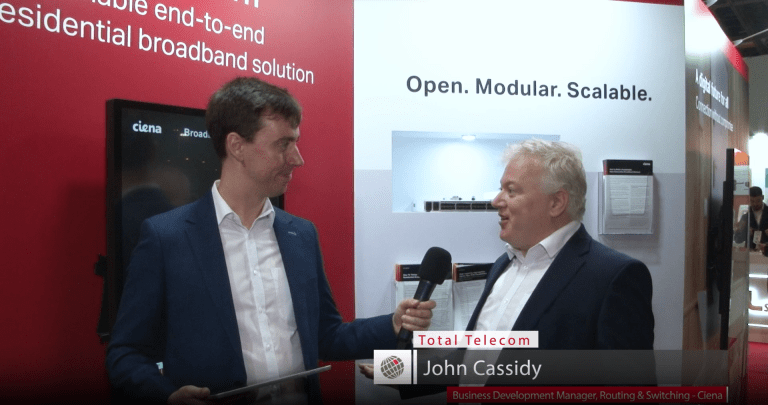
At Connected Britain 2023, we caught up with John Cassidy, Business Development Manager at Ciena to discuss the company’s recent acquisitions and its focus on creating flexibility for its customers

The past year has seen Ciena move in a new and interesting direction, with recent acquisitions making their residential fibre-to-the-home offerings more holistic than ever before.

“We’ve done a series of acquisitions over the past year. We acquired Benu, which is our virtualised BNG solution, and we’ve also acquired Tibit, which is our micro-OLT solution – it’s an OLT on a plug,” explained Cassidy. “We’re trying to show that when you combine these with our routing platform, which has been established for around 12 years, you have a whole end-to-end solution to offer our customers.”

“We’re trying to compress the business cases so you can get to places you couldn’t get to before,” he explained. “For example, in rural areas, the fact that you’ve got a one box solution to get to your customers really tightens the cost base. That’s a key advantage and brings a lot of flexibility.”

You can watch the full Connected Britain interview from the link below

[embedded content]

Also in the news:
VEON closes the door on Russia
Telefonica considers stake sale of Telefonica Tech
FCC fines DISH $150,000 after failure to decommission satellite as planned

Leaked docs show T-Mobile planning to migrate customers to more expensive tariffs


News

Customers will be automatically upgraded to a potentially more expensive tariff unless they opt out

This week, rumours have been confirmed that T-Mobile is seeking to shift some of its mobile subscribers onto new plans in November.

This is not simply a case of sunsetting older mobile contracts, but rather a wider migration across a large portion of T-Mobile’s subscriber base, moving many customers to newer – and often more expensive – mobile plans.

According to leaked documentation posted on Reddit, customers on selected plans will be migrated as follows:

  • Magenta (will be switched to Go5G)
  • One (will be switched to Go5G)
  • Simple Choice / Select Choice (will be switched to Magenta or Essentials Select)
  • Simple Choice Business (will be switched to Business Unlimited Advanced)

While for some customers this shift will not result in an increase of cost, others will likely see their subscription rise in price by between $5 and $10 per month.

The changes are expected to take effect in November, with customers informed of the change via SMS and email from October 17.

Those wishing to opt out will need to do so by contacting support services after receiving this notification.

The timing of this shift by T-Mobile is no coincidence. Back in 2020, as part of the agreement to acquire rival operator Sprint, T-Mobile promised that it would continue to offer “the same or better rate plans” for at least three years. Now, three years on, it seems the operator has little qualms about making changes that will drive up prices for their customers.

The operator will surely argue that these newer plans come with benefits that are more than worth the extra expense, but this seems unlikely to placate disgruntled customers paying for additional features that they never asked for.

How is the US mobile market evolving? Join the industry in discussion at Connected America 2024 live in Dallas, Texas

Also in the news:
VEON closes the door on Russia
Telefonica considers stake sale of Telefonica Tech
FCC fines DISH $150,000 after failure to decommission satellite as planned