The 5G Standalone Revolution Has Officially Begun

This Industry Viewpoint was authored by Anil Kollipara, Vice President of Product Management at Spirent Communications

Check the numbers, and 5G network adoption looks to be absolutely humming. According to GSMA Intelligence, there were 1.6 billion 5G connections worldwide by the end of 2023. All told, more than 261 operators offered commercial 5G services as of February 2024, representing the fastest new network generation rollout ever. Of course, Telecom Ramblings readers know that those figures need an asterisk. … [visit site to read more]

Dialog Axiata launches 4G-powered vehicle tracking service

Keep up-to-date with all the latest news, articles, event and product updates posted on Developing Telecoms.
Subscribe to our FREE weekly email newsletters for the latest telecom info in developing and emerging markets globally.

Sending occasional e-mail from 3rd parties about industry white papers, online and live events relevant to subscribers helps us fund this website and free weekly newsletter. We never sell your personal data. Click here to view our privacy policy.

T-Mobile selected for decade-long $2.67 billion US Navy contract


News

A contract worth billions of dollars will provide U.S. Navy agencies with T-Mobile equipment for years to come

This article was originally released by our sister publication Broadband Communities

T-Mobile has been selected for a $2.67 billion defence contract that will make them a wireless solutions provider for the U.S. Navy for the next decade.

The contract replaces a previous iteration, known as Spiral 3, which expired in May.

With the new Spiral 4 contract, all agencies under the U.S. Department of Defence umbrella will have the ability to place orders for wireless services and equipment for the next 10 years with T-Mobile.

An announcement from T-Mobile, released Thursday, explained how the company has grown its range of services for government operations since 2017, when the provider began participating in Spiral 3.

T-Mobile’s release cited the company’s advanced 5G network solutions, which includes applications that can “meet specific performance needs of government agencies,” as an advantage.

David Bezzant, a VP of sales with T-Mobile’s government division, said the Spiral 4 contract award is a testament to T-Mobile’s network and emphasis on solutions.

“With a cutting-edge product portfolio, a proven track record and a clear vision for the future, we’re ready to take government innovation to the next level,” he said, according to T-Mobile’s release. “It’s an honor to serve those who serve this nation.”

Major carriers like T-Mobile, Verizon, and AT&T were all involved with the Spiral 3 contract vehicle, which allowed agencies to place orders against the contract.

T-Mobile’s release called the Spiral 4 contract a ” comprehensive, multiple-award contract” that includes solutions for voice, data, fixed wireless access, Internet of Things and mobility management.

In the future, according to T-Mobile, the government could also leverage the company’s partnership with Starlink.

In January, T-Mobile celebrated the launch of Starlink satellites with Direct to Cell technology.

According to T-Mobile, the milestone, part of the Coverage Above and Beyond Initiative, “aims to bring connectivity nearly everywhere in the U.S.” for T-Mobile customers.

Keep up to date with the latest international telecoms news by subscribing to the Total Telecom daily newsletter 

Also in the news:
Freshwave to deploy small cells in Manchester for VMO2
SGP.32: A reality check on the latest remote SIM provisioning standard
Telefónica Germany and Ericsson renew core network partnership  

Globe Telecom taps Nokia for FWA upgrade

Keep up-to-date with all the latest news, articles, event and product updates posted on Developing Telecoms.
Subscribe to our FREE weekly email newsletters for the latest telecom info in developing and emerging markets globally.

Sending occasional e-mail from 3rd parties about industry white papers, online and live events relevant to subscribers helps us fund this website and free weekly newsletter. We never sell your personal data. Click here to view our privacy policy.

Telefónica Germany and Ericsson renew core network partnership  


News

The deal extends their initial core partnership, which first began back in 2020

Ericsson and Telefónica Germany have agreed to extend their core network partnership. 

The company’s dual-mode 5G Core and cloud infrastructure solutions already provide mobile connectivity to 45 million O2 Telefónica subscribers, covering 5G Standalone (SA), 5G non-Standalone (NSA), 4G, and 2G.  

The agreement, the companies say, will allow them to increase innovation and functionality in the core network in preparation for future demand. 

“With Ericsson, we have embarked on a cloud-native transformation journey and are now going to develop it further by expanding our portfolio and capabilities towards network slicing, automation, and API access. This allows us to roll out new features faster and without temporary maintenance breaks – an important step towards the network of the future,” said Mallik Rao, Chief Technology & Information Officer of O2 Telefonica in a company press release. 

“Our deep partnership with O2 Telefónica in Germany has been a significantly rewarding one from the start,” added Daniel Leimbach Ericsson’s Western Europe Head of Customer Unit. 

“Meeting its challenge to deliver a cloud-native core network for its 45 million subscribers while ensuring it was flexible enough to evolve in line with its strategy meant breaking new ground across a range of disciplines,” he continued. 

According to the companies, the existing core network partnership between the two companies is already delivering exciting new benefits for customers. For example, back in May, the two companies completed a world-first with their In-Service Software Upgrade (ISSU) of network functions in the core network’s user plane. This essentially allows the network’s software to be upgraded without any downtime or service disruption for customers – something previously unthinkable without a cloud-native core.  

Speaking of being cloud-native, last month, Telefonica Germany announced a monumental deal to move 1 million of the company’s 5G customers to the Amazon Web Services (AWS) cloud. In doing so, it will become the first operator in the world to move its 5G core network to AWS’s cloud infrastructure. a 

Join us at this year’s Connected Germany event, 5-6 November in Munich. Get discounted tickets here! 

Also in the news:
Telstra’s network APIs to be added to Vonage platform
e& under investigation over PPF acquisition
Elisa brings smart solar energy management to the Åland Islands

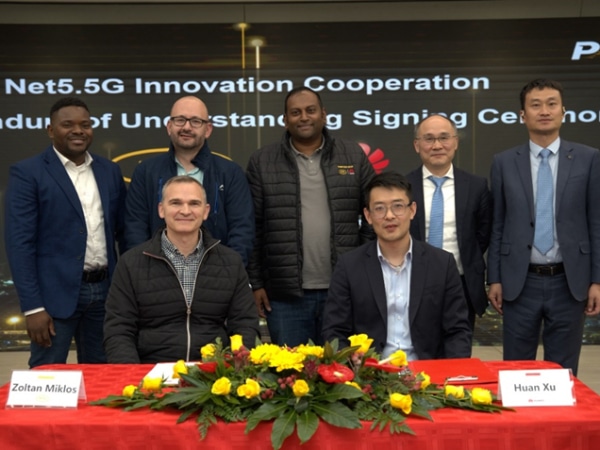
MTN South Africa and Huawei sign MoU for strategic cooperation on Net5.5G

MTN South Africa and Huawei co-hosted the IP Day Summit themed « Net5.5G Network Development.”

The summit brought together top experts from MTN’s network planning and Huawei’s data communications teams. They discussed global network construction concepts, latest innovative technologies, and business insights in the IP field, aiming to further improve MTN’s network resilience and service experience.

At the summit, MTN and Huawei signed a memorandum of understanding (MoU) for strategic cooperation on Net5.5G. Through this MoU, they will jointly promote the large-scale application of key capabilities of Net5.5G, such as 400GE, SRv6, slicing, and the Network Digital Map, to continuously improve MTN’s service experience and network availability in the mobile and B2B fields, and improve its O&M efficiency.

Rami Farah, CTO of MTN SA, said that innovation is important for MTN and forms a key pillar in MTN network strategy.

Zoltan Miklos, General Manager of Access Planning and Architecture, MTN SA, said that healthy and stable networks have long been the focus of MTN. He pointed out that the application of SRv6 and Network Digital Map has helped MTN build an IP transport network with optimal experience. He also noted that in the cloud and 5G era, MTN still faces a range of challenges in terms of service and network operations, security, reliability, and other areas, and that MTN looks forward to deepening cooperation with Huawei.

Feng Su, President of Huawei’s IP Marketing and Solution Sales Dept., emphasised that Net5.5G is the future of IP networks and that Huawei has made long-term investments in ultra-broadband products, network servitisation, network intelligence, and more. He added that Huawei looks forward to helping MTN build a leading IP transport network featuring ultra-broadband, high reliability, and ultimate experience so as to help MTN achieve greater business success.

Xu Huan, Vice President of Metro Router Domain of Huawei’s Data Communication Product Line, said Huawei will work with MTN to accelerate the commercial use of the next-generation IP transport network under the guidance of the Net5.5G target network.

According to the MoU, MTN and Huawei will continue to define the Net5.5G target network and support the sustainable development of MTN’s mobile, enterprise, and home broadband services. The cooperation between MTN and Huawei will set a good example in the region, accelerate the implementation of new technologies and applications, and drive the sustainable development of regional carriers.

Click here to read more.

MORE ARTICLES YOU MAY BE INTERESTED IN…

Gavin Davies appointed as Wessex Internet’s first Chief Operations Officer

The Dorset-based rural broadband specialist has ambitious plans for the next five years and beyond, with recruitment to meet this growth also taking place across sales and customer support, network planning and operations, civil engineering, and garden works.
Gavin brings significant leadership experience from operational roles in other technology and utility companies, including, most recently, Avonline. In particular, he has helped lead organisations through times of significant growth, and this expertise was pivotal to his appointment.
Hector Gibson Fleming, CEO of Wessex Internet, said:
“I am delighted to welcome Gavin into the business at such an important time in Wessex Internet’s growth story. We remain passionate about providing full fibre to underserved rural communities across the south west and delivering our recently awarded contracts is the next phase of achieving that mission. Gavin’s extensive experience will help us scale up for those contracts, focussing on expanding our unique capabilities and improving our delivery efficiency. I know everyone in our operations teams is looking forward to working with him.”
New Chief Operations Officer Gavin Davies said:
“I have helped to lead telecoms and utility companies through periods of rapid growth and efficiency improvement, and look forward to bringing this experience to Wessex Internet. In the sector, Wessex Internet is known to be unique in its approach to building its fibre network, both in engineering and technical terms, and in how it engages with the communities it serves.
“On a personal level, I am already relishing working in the glorious countryside after more urban-based recent roles, and I have been fascinated by the innovative methods developed by Wessex Internet to provide broadband in challenging areas that would otherwise not be connected by other providers.
“I believe that businesses and individuals should not face a digital divide based on where they are located and am excited to be part of a company that is removing these barriers. Relatedly, I take seriously the role we play in providing high-quality employment across multiple disciplines in a predominantly rural area.”
Away from work, Gavin is a keen traveller, massive Formula 1 fan, and performance car enthusiast.

Smartphone sales surpass feature phones in Africa

Smartphone shipments have for the first time surpassed feature phone stock in Africa,  showcasing the rise in adoption of more advanced handsets across the region.

Analyst house IDC detailed in its report smartphone units grew 17.9% year-on-year reaching 20.2 million units in the first quarter of this year, as feature phones declined 15.9% to 18.8 million units.

IDC senior research analyst Arnold Ponela noted South Africa and Nigeria, the largest smartphone markets in Africa, drove growth due to popularity of Chinese brands. Kenya was the third-largest smartphone market in Africa by driving sales growth with financing schemes.

Transsion, which houses the Tecno, Itel and Infinix smartphone brands was the leading smartphone vendor in Africa due to its “compelling entry-level portfolio” that are “tailored” to the African market. However, Samsung and Xiaomi gained market share on the previous quarter, driven by mid-range ($200 to $400) models. Market share numbers were not broken down by IDC.

Shipments of mid-range smartphones increased in Q1 while sub-$100 devices declined, “indicating a growing consumer preference for feature-rich models”.

Looking ahead for this year, IDC predicted the smartphone market in Africa will see 5.7% YoY growth in 2024. Growth is expected to sustain over the next five years.

« Africa remains a market with a high share of feature phones, although they are expected to gradually decline as the transition to smartphones gains momentum, » said IDC Research Manager, Akash Balachandran.

“This shift, coupled with rising demand, will be the key driver of overall growth in the smartphone market. Persistent inflationary pressures and escalating macroeconomic uncertainties may cause short-term fluctuations but will not impede the long-term transition. »

MORE ARTICLES YOU MAY BE INTERESTED IN…