

Two bits of M&A from the data center and cloud space, plus a new minority stake in a major data center infrastructure player: … [visit site to read more]
3
Avr, 2024
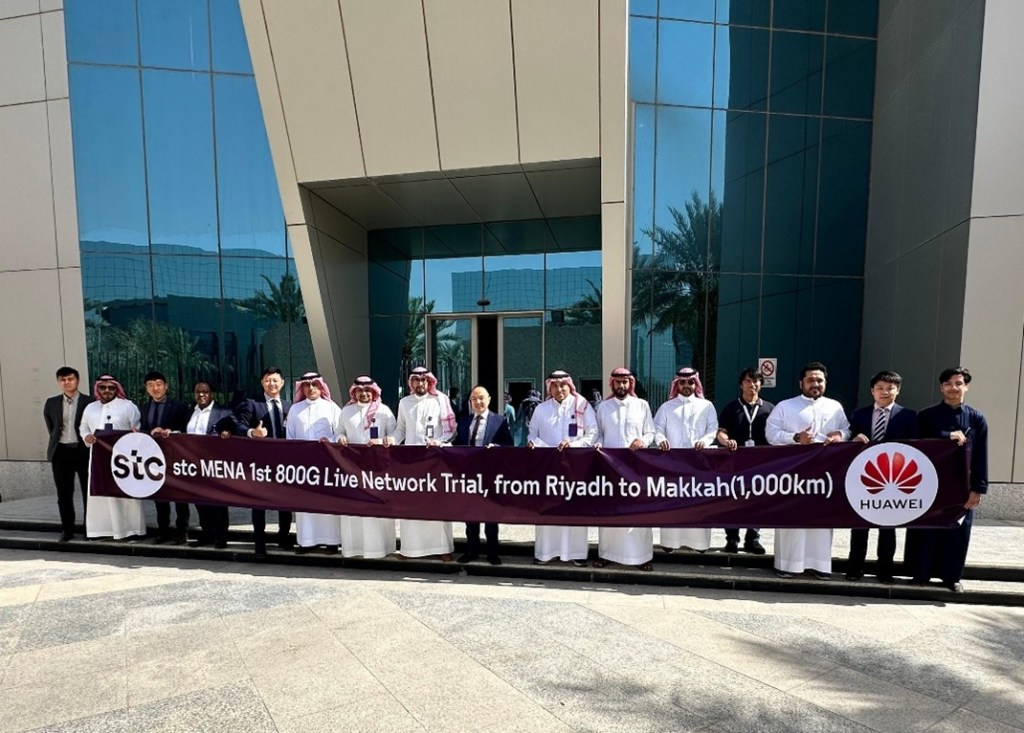
stc and Huawei completed the MENA region’s first-ever long-haul 800G live network trial
VIEWPOINT
[Riyadh, Saudi Arabia, March 28, 2024] stc Group, the leading operator in the Kingdom of Saudi Arabia, partnered with Huawei to complete the MENA region’s first-ever long-haul 800G/channel trial in its live optical network. This successful live network trial with connection over 1,000 kilometers, from Riyadh to Makkah, of state-of-the-art processing and transporting capacity proves the 800G solution is ready for scale deployment across Saudi Arabia, driving the Kingdom and the MENA region’s digital transformation.
stc Group and Huawei completed long-haul 800G/channel live trial in dense wavelength-division multiplexing (DWDM) network
As a result of this successful trial, stc Group networks can now transport more data throughput for every wavelength deployed and extend across longer distances without generation, reducing power and transport costs, and supporting efficiency standards across stc Group’s infrastructure.
The high-performance 800G/channel optical module, empowered by a built-in high baud bandwidth modulator and super 16QAM modulation with a Channel-Matched Shaping (CMS) 2.0 algorithm, established connection over 1,000 kilometers in a live Colorless-Directionless-Contentionless (CDC) network, proving the stc systems can monitor and sustain complex link environments in real-time, optimizing network transmission performance.
stc has been committed to offering excellent experience to all customers with state-of-the-art technologies and solutions. The 800G channel trial project is the result of stc’s focus on maximizing fiber capacity and optical network efficiency, making it possible to deliver up to 64Tbps single fiber capacity to meet ever-increasing bandwidth demand from all users, and reduce the per bit power consumption by more than 50% compared with 100G channel. The trial shows that stc is strengthening its partnership with Huawei in the ultra-high-speed optical transmission field.
On the importance of the trial’s milestone, Huawei’s President of Optical Transmission Domain, Victor Zhou, commented: “This long-haul 800G live trial in the stc network is a significant milestone in the ultra-high-speed optical industry. Huawei will continue to innovate and cooperate with stc in optical networks, providing leading and sustainable optical solutions for optimal user experiences.”
3
Avr, 2024

Thuraya names Algérie Télécom Satellite as first Skyphone distributor
Keep up-to-date with all the latest news, articles, event and product updates posted on Developing Telecoms.
Subscribe to our FREE weekly email newsletters for the latest telecom info in developing and emerging markets globally.
Sending occasional e-mail from 3rd parties about industry white papers, online and live events relevant to subscribers helps us fund this website and free weekly newsletter. We never sell your personal data. Click here to view our privacy policy.
Tuesday Roundup: DataBank, Airspan, Ascend Wireless, Telesat
A bit of data center real estate and three financial moves: … [visit site to read more]
2
Avr, 2024

Telkom Indonesia teams with Scala Japan to boost digital agriculture
Telkom Indonesia announced on Monday it is collaborating with IT firm Scala Japan to develop digital innovations and utilise Telkom’s digital agriculture platform to strengthen Indonesia’s agricultural ecosystem and food sustainability.
The partnership between Telkom Indonesia and Scala aims to tackle various challenges in the agricultural sector, to include food security. According to Telkom, Indonesia’s potential in the agricultural sector is massive, but sector players have been held back by obstacles such as limited market access, lack of price and demand information, and supply chain and distribution inefficiencies.
One of the digital solutions Telkom Indonesia and Scala will explore to address these problems is farm management services, which focuses on organizing existing agricultural assets to increase production capacity and streamline the business processes of agribusiness companies.
Meanwhile, the two companies will leverage Telkom’s “Agree” digital agriculture platform to explore new ventures in the agricultural sector, with an initial focus on virtual wholesale markets.
Telkom Indonesia describes Agree as a comprehensive ecosystem with integrated capabilities designed to serve as a catalyst for sustainable agriculture. The telco says Agree has collaborated with more than 280 agribusiness company partners, and that the platform has been used by more than 29,000 farmers, breeders and cultivators.
Agree Farm Management and Agree Marketplace have successfully empowered farmers, agribusiness companies and every stakeholder in the value chain to thrive in the digital era, said Telkom Digital business director Muhamad Fajrin Rasyid.
“Utilization of leading technology such as AI, IoT, and big data analytics will increase productivity, increase Indonesia’s food security, and most importantly will open up new opportunities in agriculture which will have an impact on the welfare of Indonesian farmers, » he said.
MORE ARTICLES YOU MAY BE INTERESTED IN…
1
Avr, 2024

Industry Spotlight: Arelion CEO Daniel Kurgan Looks Ahead
 Following its separation from Telia three years ago, Arelion has forged an independent path in the wholesale networking space. They have worked to streamline their internal operations while expanding into new markets like Mexico. With us today to talk about the company’s plans and industry outlook is the company’s new CEO, Daniel Kurgan. Prior to Arelion, Daniel was CEO of the international wholesale carrier BICS for some 14 years. He joined Arelion as an independent board member in 2021 and was appointed CEO in October 2023. … [visit site to read more]
Friday Roundup: NTT DATA, Hurricane Electric, CityFibre
Three expansion projects, one data center, one backbone, and one FTTx: … [visit site to read more]
29
Mar, 2024

Digicel assures Fiji and Samoa residents that 5G is perfectly safe
Digicel’s operators in Fiji and Samoa have followed up their announced plans to roll out 5G with safety assurances to customers in an apparent move to assuage worries over various Internet rumours and conspiracy theories about 5G health risks.
Earlier this month, Digicel Fiji and Digicel Samoa announced that they had both partnered with Nokia to upgrade their networks to 5G. This week, both telcos issued identical statements that aimed to address questions and concerns about the health and safety aspects of 5G technology.
“We are taking every measure to ensure a safe and seamless rollout of 5G technology,” the statement said.
Digicel said that “there is no scientific evidence linking telecommunications technologies, including 5G, to adverse health impacts,” which is consistent with the position of global health authorities, including the World Health Organisation (WHO).
Digicel also noted that existing electromagnetic energy (EME) safety standards encompass 5G technology, and that 5G devices and networks in both Fiji and Samoa have undergone rigorous testing to ensure compliance with established local safety regulations.
“Due to advancements in network design and device power management, 5G technology emits lower levels of EME compared to previous generations like 2G, 3G and 4G,” Digicel said.
The International Commission on Non-Ionizing Radiation Protection (ICNIRP) issued guidelines for 5G electromagnetic field (EMF) radiation in 2020, which state that while 5G generally complies with its original 1998 EMF guidelines, 5G is still an evolving technology. Consequently, the 2020 guidelines are set well below minimum safety levels, and add a few changes, including “whole body average restrictions for frequencies above 6 GHz, restrictions for brief (less than 6 minutes) exposures for frequencies above 6 GHz, and the reduction of the averaging area for frequencies above 6 GHz.”
ICNIRP also acknowledges in its 2020 guidelines that the higher frequencies used for 5G don’t penetrate the human body as deeply as lower frequencies. The ICNIRP also noted that 5G’s use of beamforming can reduce overall exposure to EMF radiation in a given cell.
For several years now, the internet has been awash in misinformation and conspiracy theories regarding 5G health and safety risks. Various rumours claim without credible evidence that 5G kills birds, causes cancer, weakens immune systems and is the cause of COVID-19. Conspiracy theorists claim 5G is a weapons system that governments will use to monitor and control people.
“We encourage individuals to rely on credible sources and expert opinions when assessing information related to telecommunications and health,” Digicel said.
Digicel Fiji and Digicel Samoa have not yet given specific timelines for commercial 5G launch dates.
Digicel Samoa was granted conditional approval from the Government of Samoa earlier this month to launch 5G. Digicel Fiji has said it anticipates “imminent completion” of regulatory approvals by the Fiji Government. Its rival Vodafone Fiji received a 5G non-commercial license earlier this month to conduct live end-user trials on its 5G pilot network, with a full commercial license expected to be issued later this year.
MORE ARTICLES YOU MAY BE INTERESTED IN…
28
Mar, 2024

Smartphone shipments to increase by 3% in 2024
Keep up-to-date with all the latest news, articles, event and product updates posted on Developing Telecoms.
Subscribe to our FREE weekly email newsletters for the latest telecom info in developing and emerging markets globally.
Sending occasional e-mail from 3rd parties about industry white papers, online and live events relevant to subscribers helps us fund this website and free weekly newsletter. We never sell your personal data. Click here to view our privacy policy.
28
Mar, 2024

HCLSoftware and Atlas Cloud Services team up to support businesses in Morocco
Following yesterday’s news that companies in Zambia and Cote d’Ivoire are being enabled to digitally boost their businesses, there’s news of another business-focused digital offering in Africa – this time in Morocco.
HCLSoftware, the software business of HCLTech, and Atlas Cloud Services – a branch of Mohammed VI Polytechnic University (UM6P) Morocco – have joined forces in a partnership aimed at supporting businesses’ digital transitions in Morocco.
The partnership places a strong focus on digital and software sovereignty within Morocco. The partners say it will ensure access to state-of-the-art cloud services that encompass collaboration, productivity, availability, security and infrastructure.
Additionally, the solution is designed to meet the specific requirements of businesses, offering a comprehensive range of features – such as robust professional messaging, secure instant communication, efficient video conferencing and flexible data storage – that can be accessed from any location.
The partnership also aims to enhance technological capabilities by localising data within Morocco.
The collaboration between HCLSoftware and Atlas Cloud Services also aims to harness talent from Mohammed VI Polytechnic University for future inclusion within HCLSoftware. This, the partners say, represents a commitment to fostering local talent through extensive training and support for HCLSoftware’s solutions.
HCLSoftware develops, markets, sells and supports solutions in four key areas: digital transformation; data and analytics; AI and intelligent automation; and enterprise security.
Atlas Cloud Services, a subsidiary of UM6P, responsible for overseeing data centres in Morocco, strives to accelerate the digital transformation of the national and regional ecosystem, while ensuring digital sovereignty of Moroccan businesses.