Granite Telecommunications deepens partnership with Juniper Networks


Press Release

Juniper Networks, a leading provider of secure, AI-driven networks, today announced that its customer and partner, Granite Telecommunications, a $1.8 billion provider of communications and technology solutions, has expanded its service offerings to include Juniper Networks’ full-stack of campus and branch services, including Wired Access, Wireless Access and SD-WAN, all driven by Mist AI™. This move will enhance Granite’s ability to support its customers’ unique verticals, such as healthcare, retail, education, manufacturing, hospitality and financial.

Granite has been working closely with Juniper for several years, and with this expanded AI-driven enterprise portfolio they now offer Juniper’s full suite of campus and branch networking solutions. By leveraging Mist AI and a single cloud across the wired, wireless and SD-WAN domains, Granite saves time and money with client-to-cloud automation and assurance, while accelerating deployments with Zero Touch Provisioning and automated configurations. In addition, Granite delivers more value to its customers with a broadened service portfolio that offers new highly differentiated services.

“Granite stands as Juniper’s largest AI-Driven SD-WAN partner in Managed Services within the Americas, underscoring the strength of our relationship and confidence in Juniper’s cutting-edge networking technology,” said Rob Hale, President and CEO at Granite. “As we expand our partnership, we are poised to elevate the customer experience to new heights by offering a full suite of Juniper solutions, imbued with the defining qualities of reliability, performance and security that characterize Juniper.”

Granite has been expanding its nationwide support to address the changing and growing needs of its customers. The company is committed to delivering specialized services for the unique requirements of its customers’ verticals. The addition of Juniper’s software-defined branch and wireless services is expected to be a significant benefit to many of its customer sectors. These services are designed to improve the performance and security of networks in various industries and make it easier for businesses to manage their network infrastructure.

“We are very excited to take our relationship with Granite Telecommunications to the next level,” said Sujai Hajela, Executive Vice President, AI-Driven Enterprise at Juniper Networks. “They have proven to be an exceptional partner and leader in the communications industry, who is especially adept at leveraging AI and the cloud to deliver high value managed services to their customers. With the full AI-driven enterprise portfolio, Granite can truly differentiate from their competition with exceptional client-to-cloud user experiences.”

With this expansion, Granite continues to demonstrate its commitment to providing customers with the best possible network experience. The addition of Juniper’s full-stack solutions will enable Granite to enhance its capabilities and better serve its customers, while also providing the company with a competitive edge in the market.

How are the latest breakthroughs in communications technologies shaking up the US enterprise space? Join the ecosystem in discussion at Connected America 2024

Also in the news:
Dish seeks extension for purchase of T-Mobile’s low-band spectrum
Battle for Ethiopia’s mobile money market begins as Safaricom’s M-Pesa takes on TeleBirr
What’s in a name? 6G Internet falls foul of advertising regulator over consumer confusion


Telenor appoints veteran as Asia head

Telenor reshuffled its executive suite, appointing Petter-Borre Furberg (pictured, left) as the new head of Telenor Asia, replacing Jorgen Rostrup (pictured, right) who will head up Telenor Nordics.

Rostrup began as head of Telenor’s Asian unit in 2020 and oversaw two mega-mergers on the continent. Axiata and Telenor agreed to merge their units Celcom and Digi forming CelcomDigi in November last year. The merger dragged since its announcement in 2021 due to regulatory concerns.

Telenor also merged its Thai unit Dtac with rival True in March, which was heavily opposed by the market leader at the time AIS citing competition concerns.

Rostrup was group CFO between 2016 and 2020 and was credited for simplifying portfolios and ensuring modernisation across the group.

“Jorgen was sent to Asia three years ago with a mandate to deliver growth and modernisation and capturing opportunities in the region. After completing the two biggest telco mergers in Southeast Asia and setting up and implementing a strong and future-proof organisation in the region, he will now return to the Nordics,” said Telenor Group CEO Sigve Brekke.

Telenor’s new head of Asia Furberg has a wealth of experience on the continent having held multiple leadership roles. He held the role of ‘head of emerging Asia’ between 2017 to 2019, and interim CEO of Bangladeshi unit Grameenphone between 2016 to 2017.

Prior to these roles, he was also CEO of Telenor Myanmar, CMO and then CFO at Dtac.

“When Petter-Børre is returning to Asia, we can utilise the competence of one of our most experienced leaders with 15 years in previous and different roles in the region. He will play an instrumental role in ensuring the implementation and success of the two mergers as well as continue to develop Telenor’s business in the region,” added Brekke.

MORE ARTICLES YOU MAY BE INTERESTED IN…

GlobalData: FWA’s broadband market share to double in US by 2028


News

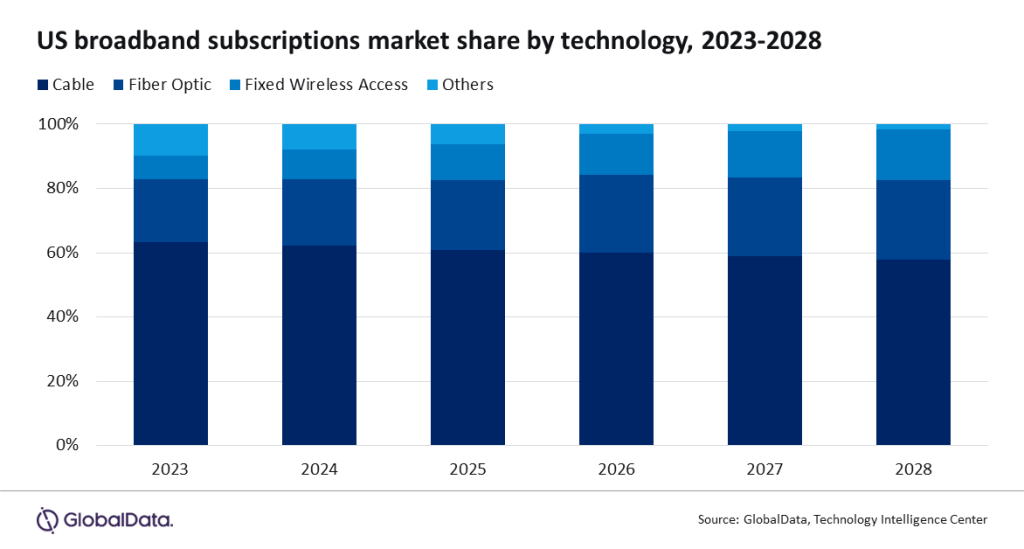
A forecast by GlobalData suggests fixed wireless access (FWA) technology will more than double its subscription market share among US broadband technologies

Since the onset of the 5G era roughly three years ago, success stories for the new technology have been few and far between.

In fact, one of the biggest successes of 5G is not using the technology in conjunction with a smartphone at all, but rather using the more powerful mobile network to provide home broadband services in the form of FWA.

Reports earlier this year suggested that interest in FWA is booming in US, with the technology accounting for roughly 90% of the 3.5 million new broadband subscriptions added in 2022.

Now, an updated report from GobalData exploring the US broadband market suggests that this growth will continue, with FWA set to amount for 15.8% of all US broadband connections in 2028, up from for 7.2% in 2023.

The report noted the technology’s easy installation and flexibility as key advantages, noting that the technology is an increasingly viable option for homes and businesses that do not yet have access to fibre networks.

“Easy self-installation and affordability, combined with high reliability and performance, thanks to underlying 5G technology, are among FWA’s selling points, but so is the fact that FWA offers a new service choice versus existing solutions from incumbent service providers. Additionally, FWA is suitable for both primary and backup internet service and can be deployed in locations where internet service may only be needed temporarily,” explained GlobalData’s Principal Analyst Tammy Parker.

The report also noted, however, that FWA will ultimately have a hard time competing with the speed and reliability of fibre broadband – a technology that is set to become increasingly available throughout the US in the next five years due to the enormous amount of public funding being delivered as part of the Infrastructure Investment and Jobs Act.

“Fiber presents a significant challenge as it is highly reliable and can deliver the symmetrical multigigabit speeds that are increasingly demanded by consumers and businesses. Additionally, fibre deployment is gaining momentum as government subsidies lead to an unprecedented expansion of the nation’s fibre broadband infrastructure, leading this technology’s share of the market to grow from 19.5% in 2023 to 24.7% in 2028,” added Parker.

But despite the rise of fibre, FWA is sure to remain a complementary technology for many years to come, particularly in hard-to-reach areas where deploying fibre is unfeasible.

This increase in FWA’s popularity is not a purely US phenomenon. In India, for example, Bharti Airtel recently launched the country’s first 5G FWA offering, noting that just 34 million of the 303 million households in the country currently had access to fibre and so presented a major opportunity for FWA.

How is the rise of FWA impacting the US broadband market? Join the operators in discussion at Connected America 2024

Also in the news:
Dish seeks extension for purchase of T-Mobile’s low-band spectrum
Battle for Ethiopia’s mobile money market begins as Safaricom’s M-Pesa takes on TeleBirr
What’s in a name? 6G Internet falls foul of advertising regulator over consumer confusion
Chad fines Airtel $8.3 million for QoS

Keep up-to-date with all the latest news, articles, event and product updates posted on Developing Telecoms.
Subscribe to our FREE weekly email newsletters for the latest telecom info in developing and emerging markets globally.

Sending occasional e-mail from 3rd parties about industry white papers, online and live events relevant to subscribers helps us fund this website and free weekly newsletter. We never sell your personal data. Click here to view our privacy policy.

Dish seeks extension for purchase of T-Mobile’s low-band spectrum


News

Dish Network and T-Mobile have jointly asked the Federal Communications Commission (FCC) to reallocate the 800MHz spectrum, but Dish wants more time to pay for it

This week, Dish has confirmed to the FCC that it intends to purchase spectrum in the 800MHz band from T-Mobile, saying that it will play a key role in accelerating their 5G network coverage.

“As Dish continues to deploy and increase coverage with this first-of-its-kind network, it will expand the availability of competitive services offered to both consumer and business customers,” said Dish in the filing. “The 800MHz spectrum licenses contemplated by this transaction will substantially enhance Dish’s ability to do so.”

The purchase relates to the Sprint–T-Mobile merger back in 2020, with Dish having agreed to build out its own 5G network and become a national mobile operator as part of the deal to appease regulatory authorities. As part of this process, the mobile newcomer was given the option to pay T-Mobile $3.59 billion for a 13.5MHz block of nationwide spectrum in the 800MHz band.

If Dish instead decided not purchase these spectrum licences from T-Mobile, it will owe the latter $72 million.

While unable to offer the same level of 5G performance as mid-band (C-band) spectrum, this low-band spectrum was nonetheless seen as invaluable for rolling out services due to its long-range.

The prearranged deadline for Dish to make its decision on the spectrum passed earlier this year, with the two companies locked in negotiations for many months.

Now, the filing from both Dish and T-Mobile to the FCC indicates that the spectrum purchase will indeed go ahead, though the exact financial details of the deal have not been revealed.

However, there is a catch: Dish is asking the US government that it be given ten more months to make the requisite payments to T-Mobile.

The company argues that the global economic downturn has made paying for the spectrum more difficult than anticipated.

“The dramatic increase in interest rates has made it significantly more expensive for Dish to finance a purchase of the 800MHz Spectrum Licenses, rendering its ability to responsibly do so within the timeline provided by the Final Judgment substantially more difficult than Dish – or other parties to the Final Judgment – ever could have anticipated,” Dish told the U.S. District Court for the District of Columbia.

Indeed, Dish’s finances have been strained for some time, with the company currently carrying around $21 billion in debt.

The company recently announced that it would merge with its previous parent company EchoStar, in a move largely seen as an effort to bolster the company’s balance sheet.

T-Mobile has not said whether it will oppose the requested extension.

How will the growth of Dish’s 5G network impact the US wireless market? Join the operators in discussion at Connected America 2024 live in Dallas, Texas

Also in the news:
Sky Business considers buying up TalkTalk B2B unit
Australian govt launches Telecommunications Disaster Resilience Innovation programme
SK Telecom to invest $100m in AI firm Anthropic  

Telenor Pakistan promotes COO to CEO

Keep up-to-date with all the latest news, articles, event and product updates posted on Developing Telecoms.
Subscribe to our FREE weekly email newsletters for the latest telecom info in developing and emerging markets globally.

Sending occasional e-mail from 3rd parties about industry white papers, online and live events relevant to subscribers helps us fund this website and free weekly newsletter. We never sell your personal data. Click here to view our privacy policy.

Now Corp strikes deal to expand private network services

Keep up-to-date with all the latest news, articles, event and product updates posted on Developing Telecoms.
Subscribe to our FREE weekly email newsletters for the latest telecom info in developing and emerging markets globally.

Sending occasional e-mail from 3rd parties about industry white papers, online and live events relevant to subscribers helps us fund this website and free weekly newsletter. We never sell your personal data. Click here to view our privacy policy.

Ericsson hits 5G carrier aggregation milestone with world’s first 6CC data call


Press Release

Ericsson revs up the tempo on 5G Carrier Aggregation by combining six component carriers to set a record download speed of 5.7Gbps for the world’s first 6CC (component carrier) data call

The data call was achieved using three FDD (frequency division duplex) bands combined with three TDD (time division duplex) bands in sub-6GHz, enabled by Ericsson RAN Compute hardware, state-of the-art carrier aggregation software, and innovative Advanced RAN Coordination functionality.

The 3FDD + 3TDD carrier aggregation testing was carried out in an Ericsson lab with a user equipment (UE) simulator. By combining FDD spectrum with TDD spectrum, more users can benefit from carrier aggregation gains.

In total, 400MHz of bandwidth was aggregated with FDD bandwidths ranging 20MHz to 50MHz to achieve the 5.7Gbps throughput. With six-component carrier capability, communications service providers can optimize use of network and spectrum assets to deliver higher data speeds and capacity that improve the experience of downlink-heavy applications. This can mean better audio and video quality for streaming users, faster file downloads, and a better working environment for digital nomads.

Sibel Tombaz, Head of Product Line 5G RAN at Ericsson Networks, says: “We are keeping the momentum on carrier aggregation by continuously stretching its potential to boost capacity and speed. Our successful 6CC data call shows how versatile our solution is and that we are poised to work with ecosystem partners to make this new band combination a reality. Our goal, as always, is to help customers meet end users’ growing appetite for high-capacity, ultrahigh-speed 5G.”

“Carrier Aggregation is crucial to getting the best possible 5G performance out of scattered spectrum assets,” Tombaz adds. “And with 6CC, service providers will be able to maximize use of allocated spectrum and optimize the combined bandwidth for superior mobile experience.”

Also in the news:
Sky Business considers buying up TalkTalk B2B unit
Australian govt launches Telecommunications Disaster Resilience Innovation programme
SK Telecom to invest $100m in AI firm Anthropic