Keep up-to-date with all the latest news, articles, event and product updates posted on Developing Telecoms.
Subscribe to our FREE weekly email newsletters for the latest telecom info in developing and emerging markets globally.

Keep up-to-date with all the latest news, articles, event and product updates posted on Developing Telecoms.
Subscribe to our FREE weekly email newsletters for the latest telecom info in developing and emerging markets globally.
With the glut of investment in the UK fibre market finally beginning to dry up due to challenging economic conditions, consolidation appears to be on the horizon for the country’s altnet community.
Last month, reports suggested that altnet Trooli, which covers over 275,000 UK homes with fibre-to-the-home (FTTH), was being put up for sale.
It did not take long for the move to draw the attention of some of the market’s biggest players, with VMO2 being named in media reports.
Now, further reports from Sky News suggest that one of Trooli’s altnet peers, Zzoomm, could be interested in a merger. According to sources, Zzoomm has made it through to the second round of an auction being conducted by bankers at Lazard.
Zzoomm currently has roughly 100,000 premises passed by its own fibre network and has ambitions of expanding this total to one million.
Any deal for Trooli is likely to be valued at over £100 million.
In related news, last month we saw altnet consolidation already underway, with Fern Trading Limited, owner of Jurassic Fibre, Swish Fibre, Giganet, and AllPoints Fibre, merging the four networks into a single FTTH player.
How is the UK fibre landscape evolving in 2023? Join the operators in discussion at this year’s live Connected North conference
Also in the news:
Viasat–Inmarsat merger gets provisional greenlight from CMA
Verizon shuffles executive team in search of growth
Ericsson to pay DoJ $206.7m over bribery scandal
An infrastructure expansion, a new IX, a couple of customer wins, and a strategic investment: … [visit site to read more]

Keep up-to-date with all the latest news, articles, event and product updates posted on Developing Telecoms.
Subscribe to our FREE weekly email newsletters for the latest telecom info in developing and emerging markets globally.
Microwave transmission is emerging as an important part of 5G deployment, especially so in European and Middle East markets, according to Huawei’s Perry Yang, President of Huawei’s microwave product line.
“Since the beginning of 5G deployment Microwave transmission has become a must for 5G deployment. It has been proven around the world that microwave has accelerated 5G deployment especially in markets such as Europe and the Middle East. It has become one of the most mainstream technologies for 5G backhaul in countries in these regions. And now the performance of Microwave has reached the same level as optical fiber cable,” said Perry Yang in an exclusive interaction with Total Telecom at Mobile World Congress 2023 in Barcelona, Spain.
Factors driving wide adoption of microwave transmission
There are several reasons for the growing relevance of microwave transmission. A key reason is that Microwave has evolved and is much more flexible technology now helping the service providers to address several new-age challenges. “The Microwave industry has witnessed several changes. For instance, it has evolved from single-band to multi-bands and also from single carrier component to multiple carrier components, thus helping service providers to increase capacity and improve network performance,” explains Perry Yang.
Further, microwave backhaul is able to meet the growing demand for capacity and low latency. It is also allowing service providers to provide services in areas where service providers are unable to deploy fiber. “Using Microwave for 5G deployment will help reduce the digital divide. For instance, in areas where fiber might be difficult to deploy Microwave will be the best and the most reliable way for people to access 5G connectivity,” says Perry Yang.
Further, microwave transmission is helping telcos bring down the power consumption. Huawei’s microwave range of solutions are empowering telcos in bringing down their power expenses while improving the efficiency of their network.
Even so, the most crucial reason for the growing adoption of microwave transmission in 5G is the use of E-band (71GHz–76GHz and 81GHz–86GHz) which has now emerged as the most crucial band for microwave deployment.
“5G demands almost 10 times the capacity as compared with LTE and that means that the operators need technology that helps in smooth evolution from 4G to 5G. We know that E band spectrum is as large as 10GHz which allows service providers to provide the required speed, capacity and coverage of 5G. Further, E-band adopts single band architecture and because of low power consumption it is very crucial for 5G,” explains Perry Yang.
He further highlighted the deployment Huawei LR E-band in Germany which demonstrated that Microwave transmission was able to cover a long distance of 7 km, thus helping the service provider in bringing down investment in fiber cable, which can now be used in some other areas. “The next generation of technologies will help telcos enjoy longer distance transmission and reduce cost because now they don’t need to pay that much for power,” said Perry Yang.
The traditional way to increase capacity for microwave transmission is to add more bands. However, that also leads to a more complex architecture and increased power consumption. Telcos also end up paying more for additional band licenses. However, now with the use of E-band for microwave transmission can truly empower the telcos.
Huawei recently introduced MAGICSwave range of solutions which is designed to help service providers address several challenges related to backhaul. Multi-T and multi-R construct with 50Gbps cross-band bandwidth capability ensures that the performance is similar to optical fiber. Further, Perry Yang elaborated that Huawei is also announcing the launch of MAGICSwave which will support the next ten years of evolution for service providers.
“These solutions are not just designed for 5G evolution but they are designed for 5G, 5.5G and will support the service providers with smooth evolution from 4G to 5G and then to 5.5G and even beyond,” says Perry Yang.
Helping Telcos Reduce Power Consumption
Huawei has taken a lead in helping service providers bring down power consumption without impacting the performance. “When the consumption is high microwave will need to provide more capacity but during idle time or at night microwave will not need to provide high capacity. We have technology that can dynamically sense the amount of traffic so during idle time or during night our solutions are able to shut down while ensuring that the services are not interrupted,” says Perry Yang.
“We are also innovating in the architecture of our hardware. These are the kind of innovation we have brought to the market to reduce overall power consumption,” he added.
Huawei hopes that with the launch of truly innovative microwave transmission solutions, it is giving confidence to the industry that microwave transmission technology will help them evolve seamlessly from 4G to 5G to 5.5G and even 6G.

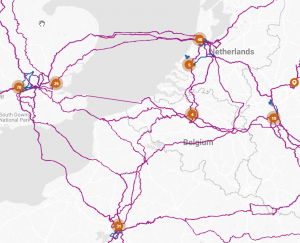
Two companies with extensive fiber across Europe have teamed up to upgrade the high profile route within the Channel Tunnel. Colt won a 25-year deal to operate the infrastructure within the tunnel a year and a half ago, and EXA’s participation will help them monetize that deal further. … [visit site to read more]


It seems that mobile money is a major driver of an impressive set of figures from operator MTN Uganda, the country’s largest telecom company, which has a subscriber base of about 17.2 million, and is part of the pan-African MTN Group.
In fact the rise announced – a 20% rise in pre-tax profit for the full year 2022 – was boosted by financial technology and data services, according to the company. Fintech and data service sales led a rise in pre-tax profit to 591 billion shillings ($160 million) from 491 billion shillings in 2021. Fintech revenues and data service revenues both increased by roughly a quarter.
Much of this is about mobile money services. As in much of East Africa, mobile payments have grown tremendously over recent years in Uganda as businesses have embraced cashless payments and e-commerce in response to the coronavirus pandemic.
MTN Uganda says some of the businesses that have embraced the MTN Mobile Money (MoMo) offering include supermarkets, pharmacies, restaurants, hardware shops, fuel stations and salons among others.
In fact MTN Mobile Money Uganda recently announced a MoMoPay Merchant milestone with the number of businesses on the service crossing the 200,000 mark. MoMoPay enables merchants to receive payment for goods and services using MTN Mobile Money.
MTN Uganda listed on Uganda’s stock exchange in December 2021, although, as Reuters points out, its initial public offering was undersubscribed.
The nearest rival to MTN in Uganda is Airtel. Statista says that in the second quarter of 2022 MTN held a majority of the share of mobile subscriptions in Uganda with 53%. Airtel reached 42% in 2022.
The other operators are Uganda Telecom and Lycamobile. Africell exited Uganda in October 2021.
The deal will see EQT acquire the entirety of Macquarie Group’s 37% in the business, with the rest of the equity being purchased from SK Square directly.
After the sale, SK Square will retain a 32% stake in the business.
SK Shieldus currently provides security infrastructure across 680,000 commercial customer sites and more than 100 central monitoring and dispatch centres across South Korea. The company also provides options for both physical and cyber protection at strategic customer locations.
The company’s key partners include South Korea’s police and security services.
“The company is a clear leader in both the Korean physical and cyber security markets and EQT Value-Add Infrastructure is excited about partnering with SK Square to support SK Shieldus as it continues to roll out new digitized security solutions and invest in the decarbonisation of its vehicle fleet,” said Sang Jun Suh, Managing Director and Head of South Korea for EQT’s Infrastructure Advisory Team.
As always, the transaction is subject to the typical regulatory approvals, with the deal expected to close in Q3 this year.
Originally named ADT Caps, SK Shieldus spun off and given its new name back in 2021, with the company saying it would leverage artificial intelligence, cloud computing and quantum-safe security capabilities, the company will double down on new growth engines. Its four major focuses were given as cyber security, physical security, convergence security and safety and care.
Following the spinoff, SK Group quickly planned an initial public offering worth around $2.8 billion. However, in September last year, SK Group said they had pulled the plug on a plan citing unfavourable global economic conditions.
Want to keep up to date with all of the latest telecoms news? Receive Total Telecom’s daily newsletter direct to your inbox
Also in the news:
Viasat–Inmarsat merger gets provisional greenlight from CMA
Verizon shuffles executive team in search of growth
Ericsson to pay DoJ $206.7m over bribery scandal
Infinera revealed a couple of interesting trials yesterday. They went after the longhaul, both in the field with Arelion and in the lab with Corning. They have been stretching the reach of their 400G wavelength technology, leveraging their ICE-X pluggable solution. … [visit site to read more]