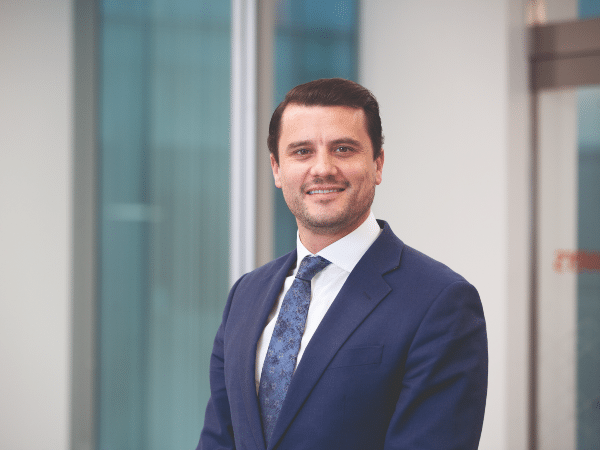
Helios Towers is one the biggest towercos in Africa, and since its IPO four years ago the firm has dramatically expanded its footprint and portfolio. It has also strongly pushed a sustainability agenda while continuing to drive increased coverage across some of the most challenging markets in the continent. We caught up with the firm’s CEO Tom Greenwood to discuss how it has achieved this.
How has Helios grown since its IPO?
Following our IPO in 2019, a key part of our strategy was geographic diversification, and since then we’ve executed that through a number of acquisitions and tower portfolios and new markets. We’ve essentially doubled the size of the business during this time, going from five markets with 7,000 towers to nine markets with 14,000 towers. This included expanding out of Africa into the Middle East; we’re present in Oman.
We were busy through COVID – we provide the telecom infrastructure for networks, allowing people to communicate in our markets, so through COVID we were basically classed as essential service providers in our markets. Since fixed line barely exists in most of our markets, mobile is the main form of communication, so our business performed well during COVID.
In the past year or so, we’ve focused on integrating the new markets gained via our acquisitions and we’re now focusing on organic growth. In all of our markets we’re seeing strong demand for this as mobile operators look to expand their coverage and also upgrade their technology from 2G to 3G, 4G and 5G. Across Africa, penetration is the lowest in the world – about 50% – but this means it also has the highest growth potential. New subscribers create the need for further telecoms infrastructure, which is how we drive our revenues. We’re focused on supporting the growth of networks in order to support the continued subscriber growth happening across our regions.
How challenging is it to be operating across a range of markets in various stages of development?
DRC is probably the least developed out of our eight African markets – there are around 100 million people in the country and the mobile penetration rate is about 35%. Just over half of the people there live in an area where there is cell phone coverage today, so there are almost 50 million people currently living in areas with literally no phone signal. This is actually fairly unique as most of Africa has some form of coverage for most of the population; for that reason we’re seeing huge rollout demand in the market. It’s a country with four mobile operators – Vodacom, Airtel, Orange and Africell – all of which have the opportunity to gain new subscribers for the first time there, so there are major rollouts happening in new areas of the country. We’re helping to connect literally millions of people to cell phone coverage for the first time through our investment in the passive side of the network, as well as building the normal towers. We’re also building tower backbones in the market – while these would often use fibre, in DRC the terrain is so challenging that we’ve opted to build 100-metre towers which rise above the jungle canopy to house huge microwave dishes. These are placed about 20-25 miles apart, and over the past few years this has helped expand coverage to millions of new subscribers, driving investment to deliver services to new parts of the country.
The DRC is obviously a challenging market in terms of politics and terrain. Is that deployment strategy something you have had to pioneer in this market?
We were the first independent towerco in DRC, we entered in about 2011 and have been there for 12 years now – we are now the largest telco tower operator in the country. There are still mobile operators who own some of their towers and a few smaller tower firms, but we’re helping to drive tower investment in the market. This includes investment in very long-haul backhaul, but also includes densification in the big cities such as Kinshasa, which has around 15 million people. 5G is currently being trialled there, and the experience is actually pretty good; you’ve got the densification as needed in the cities with the data, as well as the widespread coverage needed in the more rural locations for setting up any form of connectivity for the first time, and everything in between – so it’s quite an interesting test.
And is that pattern similar in other markets that you are active in, in terms of deployments being generally focused on urban population centres?
To some extent you see this everywhere, and I think Africa is not even unique in that sense. In the cities, it’s all about 4G and 5G now, getting denser networks. For this, rather than just the classic 50 metre tall tower, there are other products that can be used, such as in building systems, outdoor desks, street furniture, lampposts with small antenna and things like that. We’re seeing a higher demand for those sorts of products these days as well, and I think that is only going to grow exponentially as we move forward. In the rural locations, we’re still seeing standard rollouts, just getting some form – or an increase form – of coverage to certain locations. We have very good engagement with the regulator and the mobile operators in terms of a clear, coordinated plan for rural rollouts. We’re always looking at ways to expand both densification but also rural rollout so that ultimately we end up with ubiquitous coverage across everywhere.
Connecting remote communities is always important to governments, obviously on the agenda for most authorities in these regions. What about sustainability? What is your focus in this area and how are governments pushing it?
Sustainability is absolutely core to everything we do. Inherently, in terms of what we facilitate, as an independent tower company, is a sharing of infrastructure; rather than having two or three towers standing next to them next to each other, each with their own steel, their own generator etc. By just having one tower, that immediately cuts carbon emissions by about 50%. That’s how we make our money – getting multiple tenants on the sites. The first tenant basically breaks even, and after that is when tower companies make their profits, and in that sense towercos are linked to being environmentally sustainable. We think about sustainability really in three key areas: digital inclusion, empowerment and development, and carbon. We publicise these goals to our investors and to the market, we have very clear KPIs on them, but we also have non-financial sustainability metrics.
On digital inclusion, as well as more general growth targets around towers and tenancies, we have targets around rural coverage as well. In fact, one of our one of our metrics measures the population covered by our towers, and we have we have three to five year targets for that, so it’s about enabling this through future investment.
On the people front, we have a huge focus on training and development – local leadership, local empowerment, and female representation. Today around 97% of all of our colleagues across the group are from the markets in which we operate; that largely includes the managing directors of each country, based on the country in which we’re operating. That flows throughout the whole organisation. Over the past 18 months, since we bought in a sort of formal structure around it, we’ve seen a five percentage point increase in female representation within our business – this industry is fairly traditionally male, and we’re doing a bunch of things at grassroots level as well bringing on STEM graduates for graduate programmes within our school of engineering.
To touch on carbon, we have a significant investment in carbon reduction projects. 18 months ago, we launched to the market something called Project 100 – a commitment for us to invest $100 million in renewable energy solutions between that point in time and 2030. This includes things like solar, hybrid batteries, wind power, etc. Alongside this we published carbon targets, which were to reduce carbon per tenant by 46% by 2030, with the condition to be net zero by 2040. This is all reported to the market; these are key aspects to our business. The great thing is they’re all inextricably linked to our financial performance as well, because typically reducing carbon emissions means reducing diesel fuel consumption, which is the most expensive form of fuel. You can map that out to pretty much every line on these non-financial KPIs, and they contribute to the financial KPIs as well – that’s why I believe our business is inherently sustainable, because financial performance and impact are intertwined.
Finally, a little bit about 5G in Africa, because obviously that is very new and it’s very much in the trial stages. Are there any full scale commercial deployments of 5G within your footprint?
Yes, but it’s most in the initial rollout or pilot stage. There’s 5G in South Africa, which is our smallest market, and it’s prevalent in Oman, where it’s in the second phase of being deployed. Across our footprint 2G, 3G and 4G are more prevalent.
You’re not seeing 3G ‘sunsets’?
I believe last year was the first time 3G surpassed 2G in terms of number of connections across our markets – but I assume it will be phased out in favour of 4G and 5G, while 2G will be kept for quite a long time. There are still so many handsets that utilise 2G, and there’s still 50% of the population with no handset. If you’re able to build out more advanced coverage, that will attract people to it. For people getting a phone for the first time, 2G is better than nothing, but I think one of the constraining factors across Africa for is not the technology itself but availability and cost of handset. You can pick up an old handset very cheaply, but the lowest-cost smartphone is probably around $30 which is still unaffordable for many.




 This Industry Viewpoint was authored by René d’Avezac de Moran, Fugro Singapore Marine