

A bunch of international infrastructure news to catch up with before the weekend: … [visit site to read more]
9
Juin, 2023

Meta plans AI everywhere
News
On Thursday Mark Zuckerberg revealed his plans regarding AI to Meta employees during an all-hands meeting. An aggressive push forwards is based, he says, on “really incredible breakthroughs – qualitative breakthroughs – on generative AI” and in a statement to news platform Axios revealed that this gave the opportunity to “take that technology, push it forward, and build it into every single one of our products,”
In reality, this means that generative AI text, image and video generators will be integrated into existing products including Facebook and Instagram, as well as being included in new products such as the inhouse Metamate – a productivity assistant that takes information from internal company systems to answer queries and perform tasks.
For the consumer this could mean AI tools such as ChatGPT-style chatbots for Messenger and WhatsApp and an Instagram feature that could use text prompts to modify user photos.
As recently as last month, head of infrastructure Santosh Janardhan had admitted that despite high-profile investments in AI research Meta had “significant gap in our tooling, workflows and processes when it comes to developing for AI.” And went on to say that supporting AI needed Meta to “fundamentally shift our physical infrastructure design, our software systems, and our approach to providing a stable platform”.
According to The Verge, during the meeting, Zuckerberg also commented on his vision for headsets. He explained that he didn’t envisage a person sitting on a couch by themself, as per Apple demos, but instead saw a more social vision for the metaverse and presence that was “about people interacting in new ways and feeling closer”.
How can telco companies use the metaverse? Join David Palmer – Vodafone Business, Elmar Arunov – Deutsche Telekom, Cristina Bueti – International Telecommunication Union and Masarra Mohamed – IDC at this years Total Telecom Congress. FIND OUT MORE
9
Juin, 2023
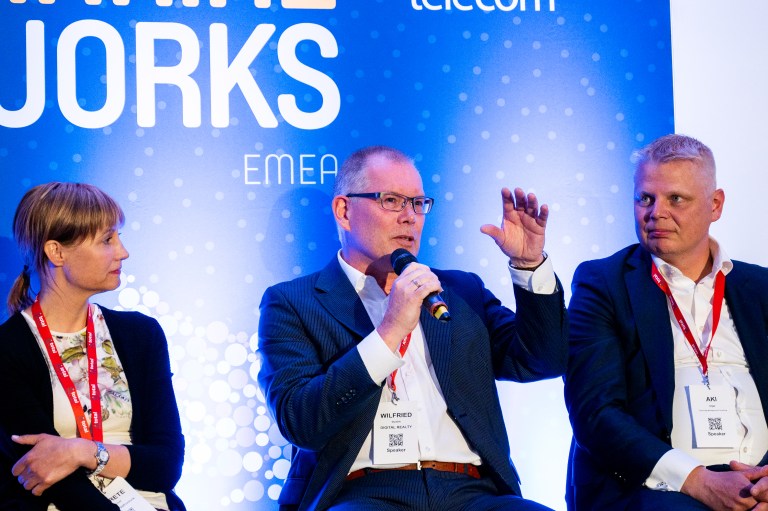
Let’s talk about the symbiotic relationship between data centers and submarine cables
VIEWPOINT
Digital Realty has been a proud sponsor of Submarine Networks EMEA for several years, showcasing its strong alignment to the subsea community. As a provider of carrier neutral data center facilities and Cable Landing Stations, Digital Realty plays a vital role in establishing the connectivity ecosystem.
In this interview, Wilfried Dudink, Senior Director – Strategy & Development at Digital Realty, emphasises the company’s relationship with the subsea community and the importance of the conference.
[embedded content]
For more insights from the event: https://events.digitalrealty.com/submarinenetworksemeablog/totaltele
9
Juin, 2023

Digital Transformation Action Items for Data Centers
This Industry Viewpoint was authored by Ken Parent, CEO, Element Critical
Having become a popular buzzword, digital transformation is really the process of implementing emerging digital technologies to modify a company’s essential operations, processes, and services that provide new ways to deliver value, ease workloads, and withstand future challenges. According to a recent Data Center Services Market report, the top five drivers of demand for data centers are remote work, digitization, digital technologies, Over-the-top (OTT) services, and the Internet of Things (IoT). All five … [visit site to read more]
8
Juin, 2023

IHS Towers upgrades Brazilian airports
Keep up-to-date with all the latest news, articles, event and product updates posted on Developing Telecoms.
Subscribe to our FREE weekly email newsletters for the latest telecom info in developing and emerging markets globally.
Sending occasional e-mail from 3rd parties about industry white papers, online and live events relevant to subscribers helps us fund this website and free weekly newsletter. We never sell your personal data. Click here to view our privacy policy.
8
Juin, 2023

Final bids for TIM’s fibre network expected tomorrow
News
Reports suggest that private equity firm KKR could slightly increase its bid for TIM’s broadband network, while the CDP is unlikely to budge from its original offer
This week marks a major turning point Italy’s incumbent operator TIM, which will soon need to decide whether to move forward with the sale of its fibre network or else rethink its strategy.
At the start of 2022, TIM’s CEO Pietro Labriola outlined a new strategic plan to help the operator cut its roughly €30 billion in debt. Alongside various job cuts and other streamlining efforts, the plan included spinning off the company’s infrastructure into a separate NetCo to entice investment.
Interest in the would-be unit was immediate. US investment firm KKR – already a major stakeholder in the company’s ‘last mile’ network unit FiberCop – quickly presented TIM with a bid for the unit for an undisclosed sum. Shortly after, the state lender the Cassa Depositi e Prestiti (CDP), one of TIM’s major investors, presented a counterbid in partnership with Macquarie Asset Management, prompting TIM to launch a formal auction for the NetCo.
KKR quickly increased its bid to €21 billion, eclipsing the CDP’s bid of €19.3 billion. Subsequent reports last month suggesting that the CDP would be unwilling to increase its own bid any further and could withdraw from the process altogether.
Now, the final deadline for bids for the unit is tomorrow, with insiders suggesting that the CDP’s bid remains broadly unchanged, while KKR may slightly increase.
But despite this bidding improvement, TIM is unlikely to be overjoyed at the prospect of a sale at this price. The operator’s key stakeholder Vivendi has strongly opposed the sale of the network unit under the current conditions, repeatedly suggesting that the company’s assets are being undervalued by up to €10 billion.
According to reports, TIM’s board is divided over whether to move forward with an offer or reject the bids in favour of re-evaluating their options.
Want to keep up to date with all of the latest telecoms news from around the world? Click here to receive Total Telecom’s daily newsletter
Also in the news:
More than two-thirds of U.S. commercial sites have no optical fibre access
Viasat completes Inmarsat merger deal
EXATEL talks expansion into subsea connectivity sector
Regional Bytes: GPC, Netrality, MetTel, Obelisk
Two customer deployments, one key approval, and a bit of M&A: … [visit site to read more]
7
Juin, 2023

Beeline Kazakhstan launches software development company
Operator Beeline Kazakhstan has launched a software company, QazCode, to boost the development of new digital products and services. This was announced by parent company, global digital operator Veon.
QazCode will be among the largest software development companies in Kazakhstan, with some 700 staff that will include 350 developers with expertise across software development, big data analytics, cybersecurity and artificial intelligence. QazCode will build digital products and services for both local Kazakh and international clients, including other Veon digital operators.
Veon explains that the formation of QazCode is part of its ‘Digital Operator’ strategy, which is aimed at combining connectivity with a complete digital products and services portfolio that meets local needs in such areas as mobile financial services, entertainment, health, and education, leading to greater engagement and value generation for customers. It will, says Veon, help strengthen the burgeoning IT services ecosystem in Kazakhstan.
QazCode has been created out of Beeline Kazakhstan’s IT development group that previously created the entire ecosystem of the digital operator, with over 60 apps used by millions of people in Kazakhstan.
The expertise of QazCode across all aspects of digital application development will now become available to operating companies within the Veon Group and to independent companies looking to develop large-scale digital services.
QazCode is located in Astana Hub, the largest international technology and IT park of start-ups in Central Asia, situated in Astana, the capital of Kazakhstan. Astana Hub comprises a community of more than 1,000 companies, local start-ups and R&D offices.
MORE ARTICLES YOU MAY BE INTERESTED IN…
7
Juin, 2023

AT&T: 5G evolution and the role of FWA
Interview
At this year’s Connected America conference, we caught up with with Chris Sambar, President of AT&T Network, after his fiery morning keynote session to discuss the latest trends in 5G and the company’s strategic approach to Fixed Wireless Access
America’s 5G journey
The US was one of the first countries in the world to launch 5G services back in 2019 and, since then, the country has raced to become a world leader in the new technology. Nonetheless, the journey to 5G maturity is far from over, with AT&T’s Chris Sambar noting that there is still huge potential for the 5G ecosystem to develop.
“LTE showed us what’s possible when the ecosystem develops together. 5G’s going to be very similar,” said Sambar. “It’s taking its time, but its also more complex than LTE […] We’re beginning to see it slowly come together, and the experiences are getting better and better.”
Part of this 5G evolution is the rollout of the more powerful standalone 5G architecture, a process which is already underway at AT&T.
“We’ve rolled out our standalone core at AT&T, we’re scaling it, and we’re starting to put some of those new services on there, like gaming, augmented reality and virtual reality,” said Sambar. “We’re pretty excited about the monetisation opportunities that these new services represent.”
The Fixed Wireless Access debate
Fixed Wireless Access (FWA) has become a major talking point in the US over the past year, proving to be an exciting and often profitable use case for 5G at a time when monetising the new technology is challenging.
But while Verizon and T-Mobile are placing major bets on expanding 5G FWA services, AT&T’s FWA strategy is notably more reserved.
“Our view’s a little different from the other two operators in the US,” explained Sambar. “We see the RAN as the point of congestion. It’s a simple physics equation: how much load or bandwidth can spectrum provide to the users? One of our peers quoted that they are seeing up to half a terabit a month of usage on their fixed wireless network – that’s a lot. It’s a lot of bandwidth to put on a wireless network and congest the air interface very quickly.”
As a result, FWA can only be reasonably offered to limited number of customers in each sector before mobile service quality begins to be impacted – a fact that is only exacerbated by the growing consumer demand for bandwidth year-on-year.
The primary solution to this challenge is simply to deploy more mobile infrastructure to meet demand, which is very expensive, particularly compared to the average cost of a fixed fibre connection.
“[FWA is] not a true replacement for broadband,” said Sambar. “We’re going to reach a time when we’re going to struggle to provide services if we deploy it too broadly and I think that’s what the other two operators in the US are going to struggle with.”
Instead, AT&T’s primary target for FWA will be to offer services to those customers currently using legacy copper networks, a move that will both offer these customers an increase in service quality as well as allowing AT&T to sunset these older networks.
Building the sustainable network of the future
Finally, one of the biggest themes at Connected America 2023 – and, indeed, in the telecoms world more generally – was sustainability. According to Sambar, AT&T not only has a moral imperative to help take better care of the planet, but also a major economic incentive.
“AT&T’s power bill is well over a billion dollars a year. The faster we can get consumers off the copper network, the faster we can shut down the infrastructure in the offices where the copper is running, and that saves a whole lot of money,” he said.
He noted that AT&T’s power consumption is actually decreasing year-on-year as a result of more efficient technologies and the sunsetting of legacy network infrastructure, despite the increase in data demand. This is not only due to the deployment of more energy efficient infrastructure, but also the incorporation of AI, automation, and machine learning. These novel technologies allow for far greater network optimisation, not just for daily network functions but also for logistics, like site maintenance.
“A machine can look at a tower that’s scheduled for three upgrades over a year and, instead of sending an engineer three times, combine them all into a single visit. It sounds like a simple thing, but a human has a really hard time doing that with tens of thousands of towers in the network. It’s going to save us a lot of money and it’s also going to help us with our carbon footprint.”
You can view our full interview with Chris Sambar from AT&T from the link below
[embedded content]
Planning for Connected America 2024 is already underway! For more information about how to get involved, contact Maddie Hicks at Maddie.Hicks@totaltele.com
Also in the news:
More than two-thirds of U.S. commercial sites have no optical fibre access
Viasat completes Inmarsat merger deal
EXATEL talks expansion into subsea connectivity sector
Wednesday Roundup: Federated Wireless, DZS, Irby, Lumen
Some private 5G for the DoD and yet more FTTx expansion projects: … [visit site to read more]