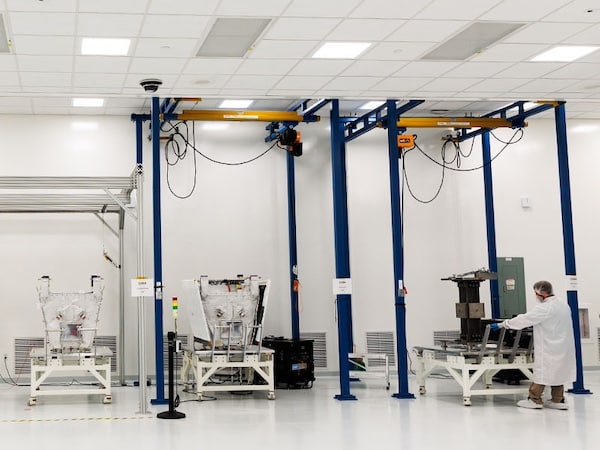
Nokia deploying its largest fixed networks lab in Chennai

Keep up-to-date with all the latest news, articles, event and product updates posted on Developing Telecoms.
Subscribe to our FREE weekly email newsletters for the latest telecom info in developing and emerging markets globally.

Sending occasional e-mail from 3rd parties about industry white papers, online and live events relevant to subscribers helps us fund this website and free weekly newsletter. We never sell your personal data. Click here to view our privacy policy.

IFC and Microsoft support digital transformation in Latin America and Caribbean

Keep up-to-date with all the latest news, articles, event and product updates posted on Developing Telecoms.
Subscribe to our FREE weekly email newsletters for the latest telecom info in developing and emerging markets globally.

Sending occasional e-mail from 3rd parties about industry white papers, online and live events relevant to subscribers helps us fund this website and free weekly newsletter. We never sell your personal data. Click here to view our privacy policy.

Open RAN Automation a $700 Million Opportunity

The RAN (Radio Access Network) automation market traces its origins to the beginning of the LTE era when SON (Self-Organizing Network) technology was introduced to reduce cellular network complexity through self-configuration, self-optimization and self-healing. SON’s shortcomings, together with the cellular industry’s shift towards open interfaces, common information models, virtualization and software-driven networking, are driving a transition to Open RAN automation with standards-based components – specifically the Near-RT (Real-Time) and Non-RT RICs (RAN Intelligent Controllers), SMO (Service Management & Orchestration) framework, xApps (Extended Applications) and rApps (RAN Applications) – that enable greater levels of RAN programmability and automation.

While the benefits of SON-based RAN automation in live networks are well-known, expectations are even higher with the RIC, SMO and x/rApps approach. For example, Japanese brownfield operator NTT DoCoMo expects to lower its TCO by up to 30% and decrease power consumption at base stations by as much as 50% using Open RAN automation. It is worth highlighting that domestic rival Rakuten Mobile has already achieved approximately 17% energy savings per cell in its live network using RIC-hosted RAN automation applications. Following successful lab trials, the greenfield operator aims to increase savings to 25% with more sophisticated AI/ML models.

Although Open RAN automation efforts seemingly lost momentum beyond the field trial phase for the past couple of years, several commercial engagements have emerged since then, with much of the initial focus on the SMO, Non-RT RIC and rApps for automated management and optimization across Open RAN, purpose-built and hybrid RAN environments. Within the framework of its five-year $14 Billion Open RAN infrastructure contract with Ericsson, AT&T is adopting the Swedish telecommunications giant’s SMO and Non-RT RIC solution to replace two legacy C-SON systems. In neighboring Canada, Telus has also initiated the implementation of an SMO and RIC platform along with its multi-vendor Open RAN deployment to transform up to 50% of its RAN footprint and swap out Huawei equipment from its 4G/5G network.

Similar efforts are also underway in other regions. For example, in Europe, Swisscom is deploying an SMO and Non-RT RIC platform to provide multi-technology network management and automation capabilities as part of a wider effort to future-proof its brownfield mobile network, while Deutsche Telekom is progressing with plans to develop its own vendor-independent SMO framework. Open RAN automation is also expected to be introduced as part of Vodafone Group’s global tender for refreshing 170,000 cell sites.

SNS Telecom & IT’sRAN Automation: 2024 – 2030 report predicts that global spending on RIC, SMO and x/rApps will grow at a CAGR of more than 125% between 2024 and 2027 alongside the second wave of Open RAN infrastructure rollouts by brownfield operators. The Open RAN automation market will eventually account for nearly $700 Million in annual investments by the end of 2027 as standardization gaps and technical challenges in terms of the SMO-to-Non-RT RIC interface, application portability across RIC platforms and conflict mitigation between x/rApps are ironed out. The wider RAN automation software and services market – which includes Open RAN automation, RAN vendor SON solutions, third party C-SON platforms, baseband-integrated intelligent RAN applications, RAN planning and optimization software, and test/measurement solutions – is expected to grow at a CAGR of approximately 8% during the same period. For more information, please visit: https://www.snstelecom.com/son

Starlink grows in Africa with announcements in Botswana, Ghana and Kenya

Keep up-to-date with all the latest news, articles, event and product updates posted on Developing Telecoms.
Subscribe to our FREE weekly email newsletters for the latest telecom info in developing and emerging markets globally.

Sending occasional e-mail from 3rd parties about industry white papers, online and live events relevant to subscribers helps us fund this website and free weekly newsletter. We never sell your personal data. Click here to view our privacy policy.

FiberLocator extends network planning platform to include UK fibre data

FiberLocator, the US’s most prominent fibre data platform, has announced the addition of data on UK fibre providers to its extensive database, which already holds the fibre footprint and route maps of 1000+ carriers, more than 5 million connected buildings, and 6,000 data centres.

FiberLocator provides carriers, mobile operators, towercos and data centre operators with the most comprehensive, accurate, and timely fibre data available. For decades it has been the United States’ leading resource guide for developing a custom fibre network, planning data centre sites, locating on-net buildings and more. The company is constantly researching and integrating new data from providers and third parties to help guide network planners with the fibre data they need.

“FiberLocator users are generating an increasing request volume for UK-based fibre connectivity, and launching in the UK will open up many exciting new opportunities for us,” said Mike Iapalucci, Vice President of FiberLocator. “On the one hand, we see increased US demand for UK fibre. On the other hand, there is a rich and diverse fibre ecosystem in the UK. Our goal is to be the bridge between UK supply and US demand, and we’re already in the process of signing up our first suppliers.”

Fibre providers contribute footprint data onto the FiberLocator platform free of charge, advertising their fibre availability to a wide range of US carriers. This creates an additional wholesale selling channel, without the need for time-consuming framework negotiations.

“With the increased expansion of UK data centres, proximity to fibre is more important than ever for data centre users and operators,” said David Liggitt, President of CCMI. “This represents a fantastic opportunity for UK providers, and we’re thrilled to share our services with the market.”

The company aims to sign up a critical mass of UK fibre suppliers before the end of the year. and will be attending Connected Britain and Capacity Europe in London this fall.

JV will establish the Middle East’s first private space infrastructure company 

Abu Dhabi-based Marlan Space, a new space company affiliated with International Holding Company (IHC), a global diversified conglomerate, also based in Abu Dhabi, has established a joint venture with US-headquartered space infrastructure company Loft Orbital to form Orbitworks, the Middle East’s first private space infrastructure company.

Orbitworks will be the first company in the UAE’s space sector to produce commercial low Earth orbit (LEO) satellite constellations. With an initial investment of over US$100 million, Orbitworks aims to produce up to fifty 500 kilogram satellites annually.

Loft Orbital, established in 2017, brings extensive expertise, technology, and a strong reputation to the venture, supporting a wide range of missions across telecommunications, earth observation, and scientific research. It says it has developed a standardised satellite platform that can be configured to fly any customer mission.

Orbitworks is set to begin construction of a state-of-the-art facility that will employ advanced hardware, software and industrial technologies for integration and test of satellites.

Orbitworks has secured components for ten satellites, the first of which could be launched as early as the first quarter of 2026. Orbitworks aims to partner with local component manufacturers and technology providers in the UAE, leveraging Loft’s solutions for seamless technology integration.

The first satellite platform is expected to be assembled, integrated, and tested by early 2025. Loft and Marlan have begun recruiting talent both internationally and within the UAE, focusing on hardware, software, test engineering and other aerospace engineering disciplines.

MORE ARTICLES YOU MAY BE INTERESTED IN…

AT&T fined nearly $1m over 911 failings 


News

The fine is the second the company has received related to poor emergency services call handling this year. Back in February, an outage that lasted 12 hours blocked 92 million phone calls. 

AT&T has agreed to pay a $950,000 fine to the Federal Communications Commission (FCC) after an investigation found it had failed to deliver emergency 911 calls during an August 2023 outage. 

The outage, which lasted for 1 hour and 14 minutes, affected parts of Illinois, Kansas, Texas, and Wisconsin, resulting in over 400 failed 911 calls. 

As well as failing to deliver the calls, the FCC’s investigation revealed that AT&T did not notify the affected emergency call centers quickly enough.  

The outage occurred during the testing of AT&T’s 911 network, when a contracted technician inadvertently disabled a part of the network. AT&T’s system did not automatically adjust, which led to the disruption. 

As part of the settlement, AT&T will implement a three-year compliance plan to ensure it will adhere to the FCC’s 911 and outage notification rules, which aim to prevent similar incidents and improve the reliability of emergency call services.  

“We understand the importance of having critical access to 911. We’ve resolved this matter and are committed to keeping our customers connected in times they need it most,” an AT&T spokesperson said. 

The FCC is already investigating an additional AT&T outage that occurred in February this year. The outage impacted 125 million devices in all 50 states, and prevented 25,000 calls to 911 call centres. 

The FCC concluded in July that the outage was caused by an employee who misconfigured a single network element.  

AT&T said it has implemented the necessary changes, adding that it “fell short of the standards that we hold ourselves to, and we regret that we failed to meet the expectations of our customers and the public safety community.” 

Failure to adequately support emergency services is not just a US problem. In the UK, regulator Ofcom fined BT £17.5 million last month for technical faults which caused 14,000 emergency calls to be missed over an 11-hour period last summer. Ofcom also ordered measures be introduced to prevent reoccurrence. 

Keep up to date with the latest international telecoms news by subscribing to the Total Telecom daily newsletter 

Also in the news:
Meet our Top 20 Telco AI Champions!
Are AI and Sustainability Compatible?
Singtel partners with Bridge Alliance to boost GPUaaS offering