Ethio Telecom revealed on Sunday it lined up several vendor deals to modernise its telecoms network at last week’s Mobile World Congress, with one agreement with Ericsson already signed and others with Huawei and ZTE in the pipeline.
Ethio Telecom is currently in the midst of a large-scale network expansion and modernization programme, which includes expanding infrastructure coverage, enhancing 4G capacity, advancing 5G expansion, extending rural mobile network connectivity, and expanding and modernizing both radio access and core network functions – all in service of its “Next Horizon: Digital & Beyond” strategy.
To that end, Ethio Telecom CEO Frehiwot Tamru met with senior executives from Huawei, ZTE, Ericsson, and Nokia at MWC26 to explore advanced technology solutions to optimise its network infrastructure and prepare it to support emerging technologies, including AI-enabled network capabilities.
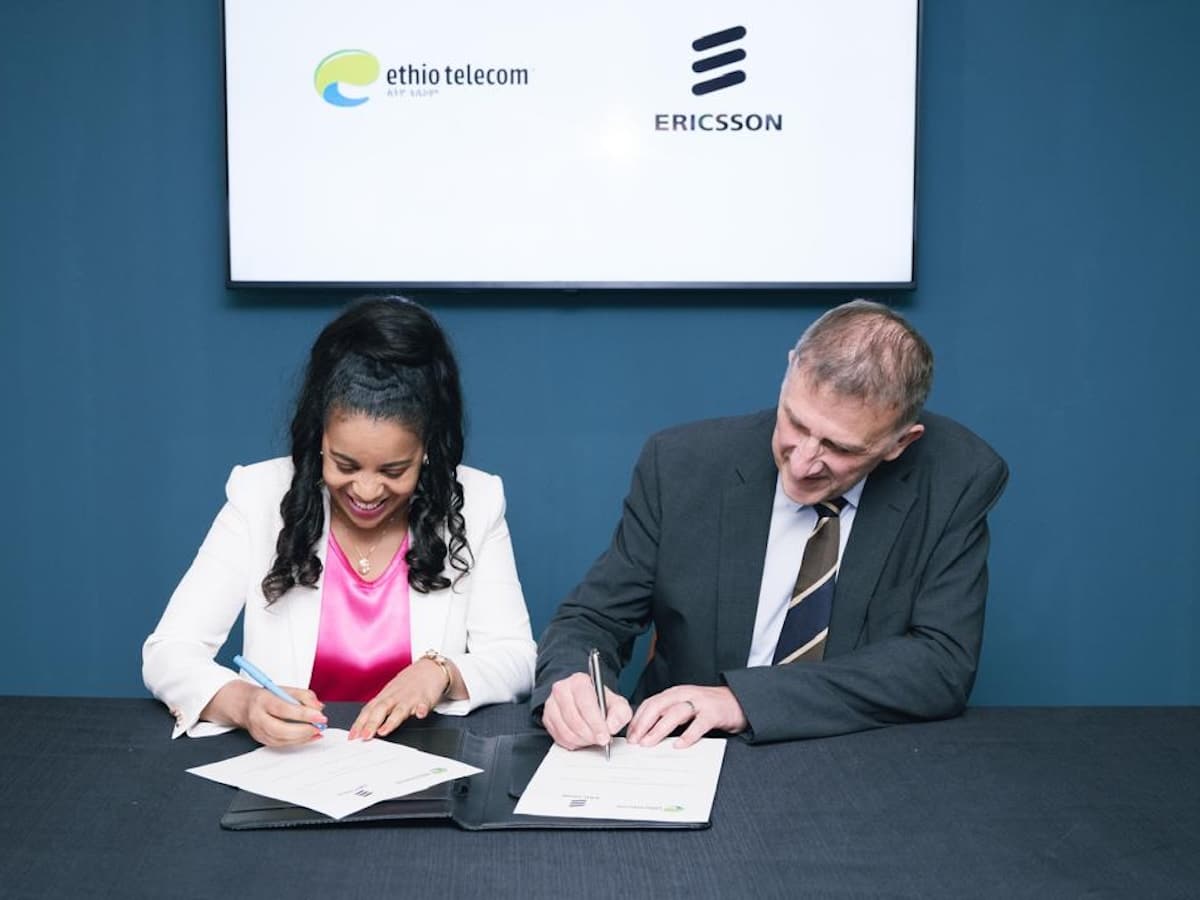
Ethio Telecom said it successfully concluded key negotiations with all of them. One agreement with Ericsson was finalized and signed on Thursday, while negotiations with ZTE were concluded, and discussions with Huawei (which holds a significant share of Ethio Telecom’s network infrastructure) “progressed substantially and are nearing finalization.”
The deal with Ericsson involves expansion, upgrade, 4G layering, and deployment of new capabilities across 1,500 mobile sites within the Ericsson network-managed circle, which Ethio Telecom said will boost 4G coverage and capacity while expanding its 5G footprint.
The deal also specifically targets 75 rural solution sites with tailored mobile solutions aimed at bridging both the coverage and usage gaps in rural areas that have no access to commercial power. Ericsson will also upgrade of 502 existing 3G sites to be 4G-ready.
Ethio Telecom said the project will add expand LTE services to 157 additional towns within Ericsson’s circle, increasing the total number of connected towns to 276, while boosting population coverage by 45%, reaching an overall 85% population coverage in the region.
Meanwhile, Ethio Telecom said it met with Nokia to review the successful completion of a proof of concept (PoC) for innovative technology solutions, and discuss preparations for a joint launch of an Innovation Excellence Centre to strengthen innovation, learning and digital capacity development in Ethiopia.
Ethio Telecom said it also held discussions with various global operators, solution providers, and technology innovators at MWC26 to explore new collaboration opportunities and drive digital transformation.
At the Huawei TECH Cares Forum, industry leaders and partners joined to discuss digital inclusion and why embracing AI requires a foundation of digital skills as well as infrastructure.
In recent years, the global mobile ecosystem has made incredible strides in improving digital inclusion, from vastly expanding coverage in hard-to-reach areas to making devices cheaper and more widely available. But despite this significant advancement, there is still much to be done to create a more digital equitable society, especially as AI momentum continues to build.
“We have seen AI progress so much over the last year,” said Huawei’s CEO of ICT Business Group, Yang Chaobin, while noting that “this progress has not benefited everyone”.
The AI era could come late to billions of people
According to figures from ITU, there are 2.2 billion people that still lack access to the mobile internet, with a further 300 million who have access but do not use it, as revealed by a GSMA report. This means that while millions of people are accessing AI tools and services in their daily lives, over a quarter of the planet’s population are still lacking access to basic mobile services.
“We need to start talking about people and stop just talking about algorithms,” said Cosmas Zavazava, Director of the Telecommunication Development Bureau at the International Telecommunication Union (ITU). “The AI era offers life-changing possibility for change, but only if we can deliver it for everyone.”
“The digital divide is the defining challenge of our time,” he added.
Yang echoed this sentiment.
“AI will shape the future. But before we can make that future a reality, we need to build more critical digital infrastructure, including high-speed networks and powerful computing facilities,” he said.
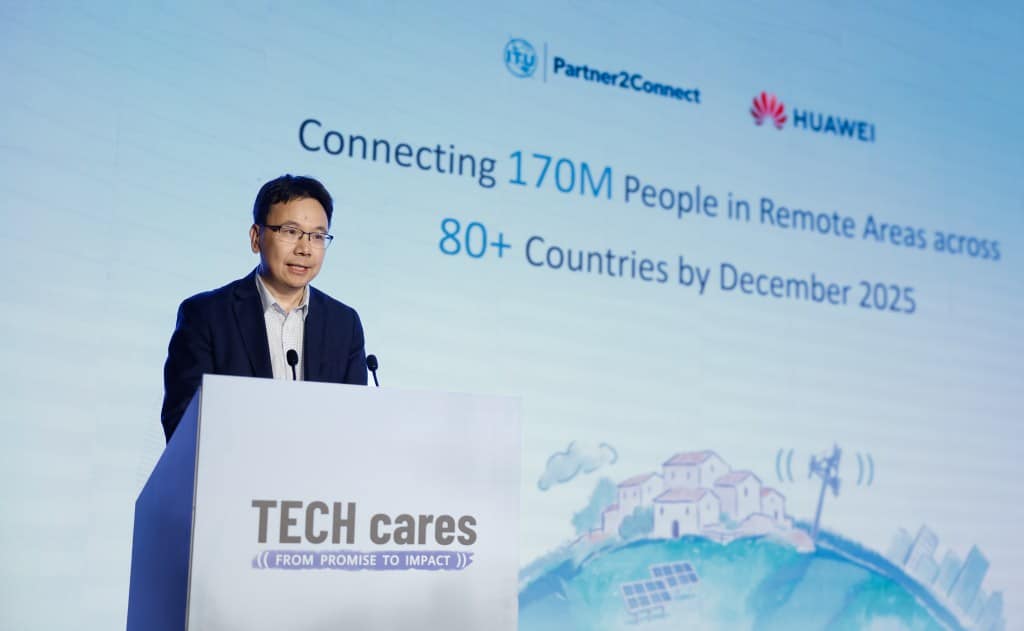
Delivering this connectivity to hard-to-reach areas is a key part of Huawei’s role as a global citizen. The company joined the ITU’s Partner2Connect initiative at its inception in 2022, aiming to connect more than 120 million people in remote areas by the end of 2025. In fact, by the end of last year, Huawei had far exceeded this target, bringing coverage to 170 million people in remote areas across more than 80 countries.
Huawei’s Yang Chaobin reveals Huawei has surpassed its Partner2Connect targets at the TECH Cares summit
Part of this target had been reached by leveraging Huawei’s rural connectivity solutions, including its RuralStar product line’s latest evolution, RuralCow. This solar powered base station operates without fibre or microwave links, providing non-line of sight coverage up to 30km. This means that remote communities that lack the supporting connectivity and power infrastructure can still benefit from robust wireless coverage.
For operators, it also means that the business case for reaching these rural communities is clearer, reducing the time to ROI from 5-10 years to ‘less than 1.5 years’, according to Huawei.
However, as Marina Madale, Executive for Sustainability and Shared Value at MTN, notes, while “the coverage gap is narrowing, the usage gap remains substantial.”
From affordability of devices and data plans, limited digital literacy, and rural energy constraints, there is still much work to be done to improve rural connectivity.
Human-centred and locally-driven AI
Challenges around access and usage are even more pronounced when it comes to AI. AI models built in local languages for remote communities are few, and those that do exist are typically heavily biased due to the limited training data available. For Africa, a continent with thousands of languages, over 75 of which have more than a million speakers, this means a significant portion of the population is cut off from the AI ecosystem and wider economy.
“We need to move from simply integrating technologies like AI, to building more holistic AI readiness,” said Jing Fang, Project Officer at UNESCO’s regional bureau for science and culture in Europe, noting that young people must be taught to “critically engage” with technology to understand risks such as misinformation and algorithmic bias.
Sylvia Poll, Senior Gender and Youth Advisor to the ITU Secretary-General, agreed, warning that data inequality can make entire regions “invisible” in AI systems. Without local datasets and local developers, algorithmic bias may compound existing inequalities in these societies.
“Inclusivity must be a design choice,” said Kenya’s Special Envoy on Technology, Ambassador Philip Thigo. “The greatest divide will be between those who have access and those who have not.”
“This is an existential challenge for developing nations,” he added.
Digital education beyond barriers
But if the local connectivity infrastructure is limited and localised AI models are not yet mature, are millions of people in developing nations doomed to fall behind in AI adoption?
Not necessarily.
Part of the solution, the panelists said, lies in a more agile approach to digital learning. Huawei’s DigiTruck programme, launched in 2019, has supported the training of more than 130,000 people in 21 countries using converted buses as mobile classrooms. This gives students and adults alike the chance to access AI and digital connectivity – often for the first time – and receive training by specialists and local experts.
This type of training will be key to securing these regions’ economic future.
“Connectivity is not a privilege, it’s an economic necessity,” said Madale. “No single player can close this gap alone. We need an ecosystem of collaboration.”
The consensus at the forum was clear: infrastructure deployment, inclusive AI governance, and scaled investment in skills must advance together if AI is to deliver prosperity for the many, not for the few.
LONDON, UNITED KINGDOM – Terrapinn, the global events company, is delighted to announce the acquisition of FMS: the Future of Memory and Storage from Conference Concepts Inc. FMS is widely regarded as the world’s most important and credible event dedicated to memory and storage technologies.
Held annually in Santa Clara, California, FMS has spent two decades as the essential meeting point for the global memory ecosystem – from leading semiconductor manufacturers to system architects and hyper-scalers. The acquisition comes at a pivotal moment as the industry faces an “unprecedented mismatch” in supply and demand, driven by the rapid expansion of artificial intelligence (AI) and the surge in demand for High-Bandwidth Memory (HBM).
“We are absolutely delighted to announce the acquisition of Future of Memory and Storage,” said Terrapinn CEO Greg Hitchen. “FMS is a significant addition to our global portfolio of technology events. We look forward to serving the memory and storage industry and will ensure that the technical excellence and authority of FMS is maintained, and then surpassed, as we invest in its next phase of global growth”.
FMS was created and nurtured by Lance Leventhal and Chip Stockton, principals of Conference Concepts Inc, growing it from its roots as the Flash Memory Summit into an all-encompassing industry showcase.
Chip Stockton, President of Conference Concepts Inc, said: “We have created a really important event for the memory and storage community and have carefully nurtured it over many years. But we now feel it is the right time to pass it on to a larger company for its next phase of growth. We are really impressed by Terrapinn’s commitment to the sector and are sure they are the right fit to take FMS forward while ensuring a seamless transition for all our customers and stakeholders”.
The 20th-anniversary edition, FMS 2026, is scheduled for August 4–6, 2026, at the Santa Clara Convention Center. The event will feature a multi-stream conference, a large-scale global exhibition, and a Technical Pro Series focused on the infrastructure enabling the next generation of AI, data centers, and automotive applications.
Conference Concepts Inc was represented by John McGovern of Grimes, McGovern and Associates.
Terrapinn would like to thank Chip Stockton, John McGovern, our advisers and team.
About Terrapinn: Terrapinn is a global events company with businesses in the USA, Australia, Asia, Europe, the Middle East, and Africa. www.terrapinn.com
About Conference Concepts Inc: Founded in 1994, Conference Concepts is a professional conference management company focused on cutting-edge technologies and high-growth technical events.
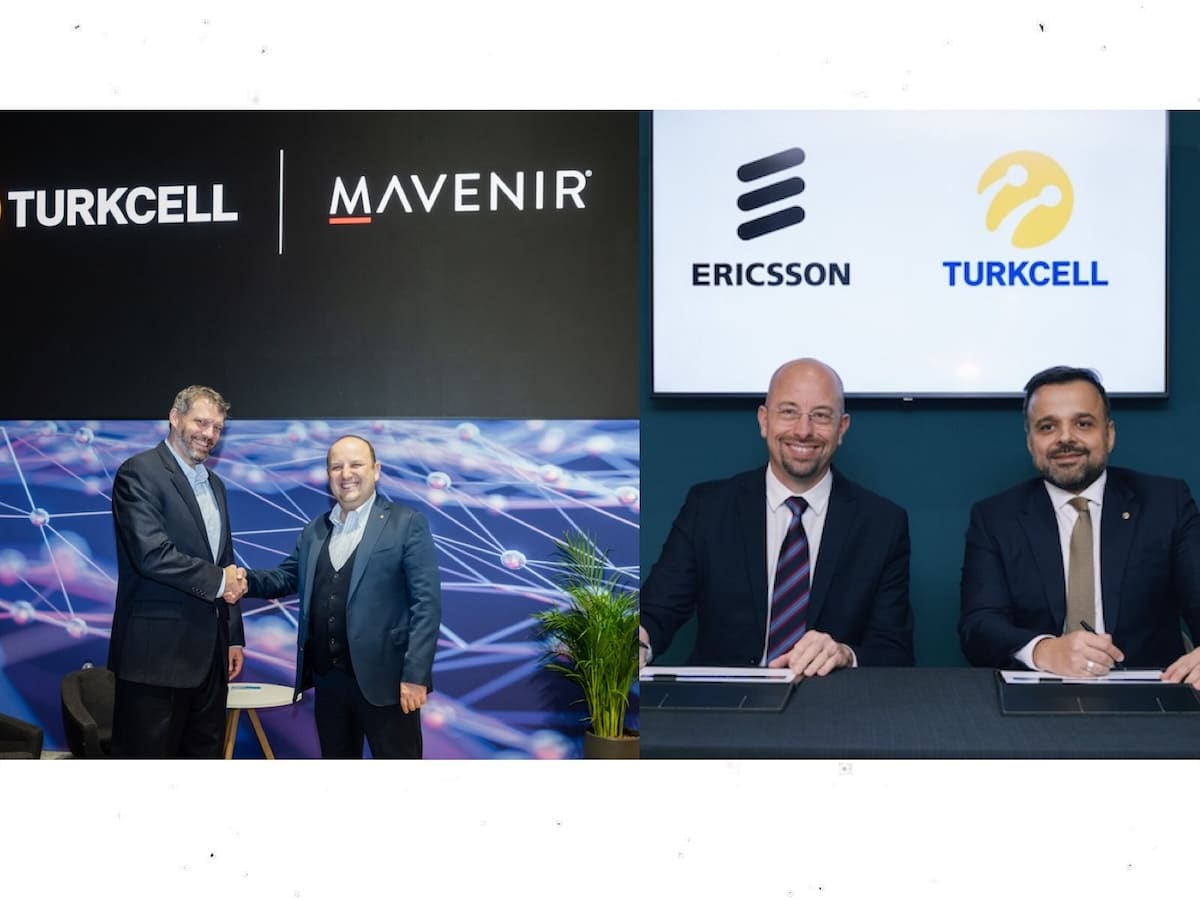
Turkcell made moves at Mobile World Congress 2026 this week to beef up its planned 5G network, deploy AI in its mobile core and get started on 6G via separate deals with Ericsson and Mavenir.
On Wednesday, Ericsson announced it had been selected by Turkcell to jointly develop, integrate, and deploy advanced RAN solutions to fast-track its evolution toward 5G Advanced capabilities, leveraging the recent commercial launch of 5G services in Turkey.
Turkcell and Ericsson also signed an MoU under which they will accelerate adoption of cloud-native and automated network architectures to enable faster time-to-market for innovative services. Technology domains covered by the MoU include RedCap, cloud RAN, service management and orchestration and intelligent rApps.
“With our commercial 5G Advanced launch in Türkiye, our priority is to evolve the network into a cloud-native, automation-driven platform that can scale new services faster,” said Turkcell CTO Vehbi Çağrı Güngör in a statement. “This collaboration with Ericsson accelerates that journey. Ultimately, we will deliver more reliable, lower-latency connectivity and unlock new use cases such as AR/VR and industrial IoT for both consumers and enterprises.”
Onwards to 6G
Turkcell has not yet commercially launched 5G, nor have rival celcos Vodafone and Türk Telekom. All three telcos paid a collective US$2.125 billion for 700-MHz and 3.5-GHz spectrum in the country’s 5G spectrum auction in October 2025. Turkey’s Transportation and Infrastructure minister Abdulkadir Uraloglu confirmed earlier this week that all three telcos are set to launch nationwide 5G services in all 81 provincial centres at the start of next month, according to media reports.
Even so, Turkcell is already setting its sights on the next ‘G’. Under another MoU also revealed on Wednesday, Ericsson and Turkcell agreed to collaborate on 6G research and development in Turkey. That MoU focuses on key technologies including agentic AI, autonomous network enablers, and digital twins for network operations.
“We have positioned 5G as an infrastructure that enables digital transformation across sectors, ranging from manufacturing to healthcare, transportation to public services,” said Turkcell CEO Ali Taha Koç. “The 6G collaboration we have initiated with Ericsson represents a significant step built upon this strong foundation. The 6G era is set to usher in a new era of intelligent, autonomous, and integrated connectivity, seamlessly integrating into every aspect of life.”
AI in the core
The same day, Turkcell signed an MoU with Mavenir to collaborate on speeding up the telco’s plan to launch AI-powered services for customers by using Mavenir’s cloud-native IMS architecture to embed AI directly into Turkcell’s mobile core.
Mavenir said the partnership reflects a broader industry shift toward AI-native network capabilities, where intelligence is embedded directly into core services rather than delivered through over-the-top applications. This will support the development and rollout of advanced and flexible new services such as premium AI voice and messaging services, AI-powered customer care enablement, and tiered consumer AI subscriptions, said Brandon Larson, Mavenir’s SVP and GM for cloud, AI and IMS business strategy.
“There is real power in AI when it’s delivered with a clear focus on solving a problem and adding real customer value,” Larson said. “Turkcell has specific objectives it is seeking to reach, not least of which is the power to introduce exciting new services. AI redefines the economics of traditional voice and messaging capabilities, and this partnership will bring that to life.”
This Industry Viewpoint was authored by Nick Petheram, Founder, Chairman, and CEO at Nomia
Telecom operators are navigating one of the most complex market landscapes in decades. Across the industry, teams are managing the rollout of 5G and edge computing, adapting to tightening regulations, responding to increasing ESG requirements, while also working to improve margins and deliver … [visit site to read more]
Axian Telecom, the parent company of pan-African telecom group Yas, says it is partnering with AST SpaceMobile to deliver direct-to-device (D2D) satellite services across Yas’ markets in sub-Saharan Africa.
Under the partnership announced on Wednesday, AST SpaceMobile’s LEO satellite network will be integrated with Yas’ core infrastructure across its markets, enabling seamless connectivity for voice, video, data, and internet services.
Both companies will also jointly develop commercial offerings for consumers, enterprises, IoT, maritime, aviation, and emergency response, with Yas handling local distribution, regulatory coordination, and customer activation through a one-click SpaceMobile service.
Yas currently operates in Tanzania, Madagascar, Togo, Senegal, Uganda, Kenya, Democratic Republic of the Congo, Comoros, Malawi, Réunion and Mayotte.
Axian Telecom CEO Hassan Jaber said its partnership with AST SpaceMobile will give it the ability to connect more people and businesses outside of city centres where mobile coverage is typically concentrated.
“Partnering with AST SpaceMobile gives us the ability to close that gap in a way that was not possible before,” he said in a statement. “Their technology […] works with the phones people already own, which means we can reach underserved communities without asking them to do anything differently.”
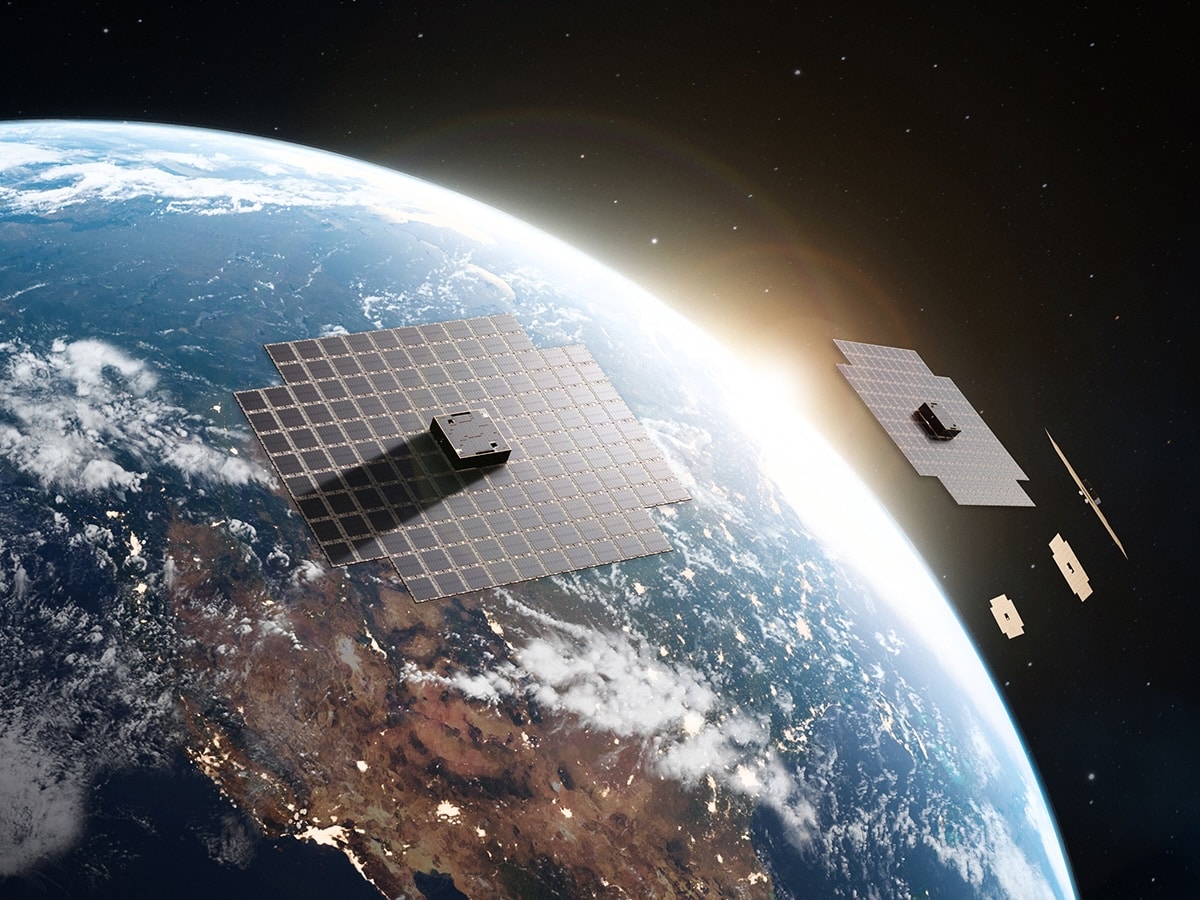
The launch of commercial services will depend partly on securing the necessary regulatory clearances in each market, and also on AST SpaceMobile’s own commercial launch schedule. AST SpaceMobile currently has five BlueBird LEO satellites in orbit, and aims to deploy between 45 and 60 more satellites this year.
The Axian partnership is AST SpaceMobile’s second major pan-African deal. In December 2024, it signed a ten-year commercial agreement with Vodafone Group to roll out its services in Vodafone’s markets worldwide. In Africa, that includes Democratic Republic of Congo, Egypt, Ethiopia, Kenya, Lesotho, Mozambique and South Africa.
AST Spacemobile has also signed partnership deals with Safaricom in Kenya and Uganda Telecom.
Liberty Costa Rica commercially launched the first sites of its 5G network across multiple regions on Tuesday using gear from Ericsson, with plans to achieve national coverage before the end of this year.
Liberty Costa Rica said it’s prioritising tourism in its initial 5G phase, with rollouts covering tourist and commercial hubs in Guanacaste, the Central Pacific, and the Northern Zone. Tourism accounts for roughly 8.2% of GDP and 15.5% of jobs in Costa Rica.
The rollout combines 5G deployment in the 3.5 GHz and 700 MHz bands to improve capacity, indoor penetration, and service continuity. Liberty’s network also supports fixed wireless access (FWA) services, delivering high-speed connectivity to homes and businesses, especially in areas where fibre or cable infrastructure is limited or unavailable.
According to Ericsson, the live network is delivering download speeds exceeding 1 Gbps and upload speeds above 100 Mbps, enabling seamless streaming, instant downloads, low‑latency cloud and video conferencing, and power AR/VR, telemedicine, remote education, smart logistics, public safety, and industrial automation – all of which Ericsson said will transform tourism, retail and public services nationwide.
“This deployment, led by ICT leaders, reflects our commitment to the digitalization of Costa Rica – boosting connectivity, strengthening strategic sectors, and creating opportunities for people, businesses, and communities to harness the full potential of this next-generation technology,” said Sean Cryan, head of LATAM North and Caribbean at Ericsson.
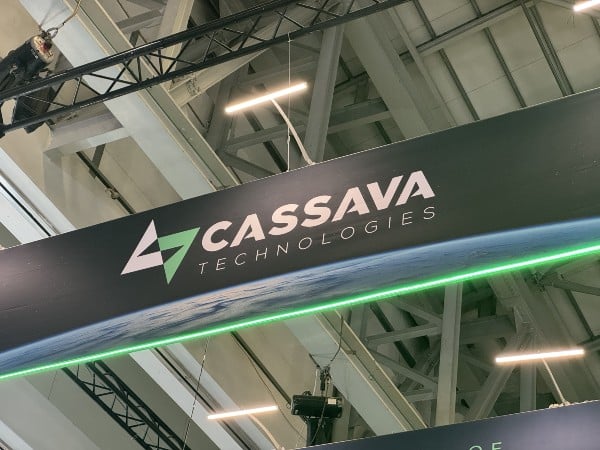
Cassava Technologies, a global technology leader of African heritage, has announced the launch of its Cassava Cloud Partner (CCP) programme during MWC26.
The programme will enable mobile network operators and system integrators across Africa and Latin America to consume, resell, or distribute AI, cloud, and digital services using Cassava’s infrastructure and technology platforms.
Ahmed El Beheiry, Group COO and Group Chief Technology & AI Officer, Cassava Technologies, explains: “Through the CCP programme, we are working with partners to extend access to AI infrastructure, cloud platforms, digital capabilities and solutions enabling enterprises, developers, and entrepreneurs across the continent to build and deploy AI-powered solutions
He adds: “We are expanding Africa’s sovereign AI ecosystem to build solutions that address the continent’s unique challenges while creating new opportunities for growth and digital inclusion.”
CCP will provide Cassava’s customers and partners with four clear value propositions. These include access to Nvidia Cloud Partner solutions, Cassava’s complete turnkey AI Factory, its own native AI solutions and CAIMEx, a localised multi-model platform that provides unified access to leading AI models through regional AI factories.
Through CAIMEx, customers will gain unified access to advanced tools like the Customer Experience Conversational Interface (CECI), Geospatial AI Ops, and Cassava Autonomous Networks.
Cassava says it empowers customers to deploy compute capabilities in a scalable, perfectly orchestrated manner from day one, following local compliance policies.
Through the CCP programme, Cassava says it is removing barriers to entry, such as high upfront infrastructure costs, through a flexible managed approach.
This supports Cassava’s broader strategy to build a sovereign cloud and AI ecosystem, spanning national and enterprise deployments, to enable governments and enterprises across Africa to access advanced AI infrastructure while maintaining control over their data and digital platforms.
We use cookies to personalise content and ads, to provide social media features and to analyse our traffic. We also share information about your use of our site with our social media, advertising and analytics partners. View more
Cookies settings
Accept
Privacy & Cookie policy
Privacy & Cookies policy
Cookies list
Cookie name
Active
Conditions légales
Introduction et qui nous sommes
118812.fr met en relation des spécialistes du monde entier par le biais d'événements, de renseignements et d'éditions savantes. Nous sommes une société du FTSE 100 et notre réseau de marques internationalement respectées aide les gens à travailler plus intelligemment, à prendre de meilleures décisions et à se développer sur des milliers de marchés spécialisés. Les données et les informations sont au cœur des activités de 118812.fr, et nous prenons au sérieux les questions de confidentialité des données. Nous respectons nos relations avec les clients, les visiteurs, les sponsors, les exposants, les fournisseurs et les collègues, ainsi que la confiance qu'ils nous accordent pour la conservation de leurs données personnelles.
Contrôleurs de données de 118812.fr
Cette politique de confidentialité explique comment les membres du groupe 118812.fr collectent, utilisent et protègent les informations personnelles à travers nos marques. Les références à "nous", "notre" ou "nos" renvoient au contrôleur 118812.fr concerné qui traite vos informations personnelles.
118812.fr est structuré en cinq divisions opérationnelles :
Au sein de ces divisions, il existe des entreprises sectorielles et des marques de produits, d'événements et de services. En général, lorsque nous interagissons avec vous, c'est par le biais de l'une de ces marques. L'entité juridique du groupe 118812.fr responsable des données personnelles (désignée comme le contrôleur des données dans l'UE et désignée comme le contrôleur 118812.fr dans la présente politique de confidentialité) sera l'entité indiquée sur les formulaires de réservation, les formulaires Web et les contrats ou les factures. Différentes entités juridiques de 118812.fr sont responsables de différents événements et produits. Pour mettre à jour vos informations personnelles ou vos préférences en matière de marketing, contactez les équipes de marketing de nos divisions énumérées ci-dessous. Pour toute question ou plainte concernant la confidentialité des données, vous pouvez vous adresser à l'équipe 118812.fr Privacy via notre formulaire en ligne.
Couverture internationale et variations
118812.fr opère dans plus de 20 pays, qui ont chacun des lois différentes sur la protection des données. La présente politique de confidentialité s'applique à toutes les activités de 118812.fr dans le monde, sauf dans la mesure où il existe une exigence spécifique à un pays qui la complète, comme indiqué dans le menu de gauche.
Ce que nous recueillons
Cette section vous indique quelles informations personnelles nous pouvons recueillir lorsque vous utilisez nos produits et services, et quelles autres informations personnelles nous pouvons recevoir d'autres sources. Dans la présente politique de confidentialité, les informations personnelles désignent les types de 118812.frtions personnelles qui peuvent être collectées et utilisées, notamment : Les coordonnées, telles que le nom, l'adresse électronique, l'adresse postale et le numéro de téléphone.Informations sur l'éducation, la nationalité et la professionles noms d'utilisateur et les mots de passeCommentaires, réactions, messages et autres contenus soumis, y compris les informations relatives aux enquêtes.Intérêts et préférences de communication, y compris les autorisations de marketing, le cas échéant.Informations de localisation, telles que celles fournies par une application mobileInformations de vérification de l'identité, telles que les détails du passeport, afin de se conformer aux obligations légales dans certains pays et de fournir des lettres d'invitation de visa, le cas échéant.Informations sur l'utilisation du site web et des communications, telles que la correspondance et les détails de votre utilisation de notre site web et de nos services obtenus par le biais de cookies ou d'autres technologies de suivi.
Ces informations personnelles concernent les catégories de personnes suivantes :
Prospects, contacts clients, abonnés et utilisateurs en ce qui concerne nos services et produits ;Visiteurs, sponsors, exposants et conférenciers lors de nos événements ;Les professionnels figurant dans les produits numériques et imprimés, tels que les détails des cadres supérieurs mis à disposition par les produits de renseignement, les recherches et les publications.les auteurs, éditeurs et réviseurs de nos publications.les contacts de nos prestataires de services et partenaires commerciaux.Informations personnelles sensibles