
Four interesting expansion and upgrade projects from around the US: … [visit site to read more]
3
Nov, 2026
VodafoneThree helps police crack down on SIM farms
Press Release
Intelligence sharing between VodafoneThree and the National Crime Agency (NCA) has helped locate, identify, and disrupt criminal SIM farm operations through a new proof of concept
VodafoneThree, the National Crime Agency (NCA) and City of London Police have collaborated to identify and disrupt criminal SIM farm operations, leading to eight arrests, the seizure of cash and equipment, and the recovery of more than one million compromised card details ‘phished’ from the public by criminals.
A SIM farm is a collection of cellular SIM cards, sometimes scaling to hundreds or thousands, used by fraudsters to route massive volumes of automated calls and text messages to members of the public, aiming to deceive victims into giving up sensitive personal information – known commonly as ‘phishing’. This information can be used to commit fraudulent activities or be packaged into detailed ‘profiles’ of potential victims and sold to other criminals.
Around three million victims suffered financial loss through fraud, (the most commonly experienced crime in England and Wales) with more than four million incidents in the year ending March 2025. The economic and social cost of fraud in 2024 was estimated at £14.4 billion by the Home Office.
Using a new approach developed with law enforcement, having identified suspected SIM farm activity, VodafoneThree shared intelligence with the NCA and City of London Police’s Fraud Targeting Cell. The Dedicated Card and Payment Crime Unit (DCPCU), a banking industry-funded unit, used the intel to investigate individuals suspected of using SIM farm systems to target the public. This led to the disruption of organised criminal activity and the recovery of what law enforcement has described as potentially the largest haul of compromised payment details ever recovered.
The announcement comes as legislation banning the operation of SIM farms takes effect in the UK, strengthening powers to tackle fraud and organised crime – enabling earlier disruption, more arrests, and fewer victims.
Rachel Andrews, Head of Corporate Security at VodafoneThree, said:
“Fraud cannot be tackled through protection measures alone. We need to go further, using our intelligence and capabilities to identify and disrupt the infrastructure that allows organised criminals to operate at scale. This collaboration with the NCA shows what can be achieved when industry and law enforcement combine their strengths, disrupting criminal activity closer to its source and preventing harm before it reaches customers and the wider public.”
Nick Sharp, Deputy Director of Fraud in the National Economic Crime Centre at the National Crime Agency, said:
“These arrests highlight the impact of close collaboration between law enforcement and industry. Intelligence shared by VodafoneThree enabled us to disrupt suspected criminal activity and recover more than one million compromised card details.
“SIM farms are a key enabler of large-scale fraud, allowing criminals to create huge numbers of fake online accounts and target victims in huge quantities with minimal effort.”
“The introduction of new offences covering the possession and supply of SIM farms strengthens our ability to protect the public from fraud. The NCA will continue to work with partners across policing and industry to disrupt the criminals behind this offending.”
Lord Hanson, Minister for Fraud, said:
“It only takes one fraudulent text to deprive people of their hard-earned money and SIM farms give fraudsters the tools to target their victims at scale.”
“The law we introduced to ban their use is now in force. Those using these devices to defraud the public will not only continue to face the full force of the law but will also be hit with hefty fines.”
“Criminals are increasingly working on an industrial scale, so we are meeting them with the same force by partnering with mobile networks and law enforcement to disrupt their operations and hit the scammers where it hurts.”
Tackling fraud at the source
Crucially, SIM farms can hide in plain sight. Recent UK investigations have uncovered the technology operating from ordinary homes and properties in local communities.
As criminals increasingly exploit digital infrastructure, organised fraud is becoming more sophisticated and harder to detect. The ability to operate at greater scale and speed makes disrupting the infrastructure behind fraud more important than ever.
- Fraud “accounts for more than 40% of all reported crime in England and Wales” (Major step for fraud prevention with landmark ban on SIM farms – GOV.UK)
- Lord Hanson (Fraud Minister): “Two-thirds of British adults say they’ve received a suspicious message on their phone – equivalent to more than 35 million people – which is why cracking down on SIM farms is so vital to protecting the public.”
Combatting organised crime through collaboration
Telecommunications operators have a critical role to play in disrupting the infrastructure that enables organised fraud.
In line with Pillar 1 ‘DISRUPT’ of the UK Government’s Fraud Strategy, VodafoneThree is committed to tackling fraud at its source. Alongside its own safeguards, it works with industry, government and law enforcement to disrupt fraud and protect customers and the wider public.
A landmark moment in the fight against digital fraud
The criminalisation of SIM farms represents a significant change in the UK’s approach to tackling fraud.
By making the operation of SIM farms a criminal offence, law enforcement agencies now have additional powers to target the infrastructure that underpins a wide range of fraud and cybercrime offences. The legislation reflects a growing focus on preventing criminal activity at source.
*according to the NCA
Also in the news
Shared Rural Network rollout extends to UK national parks with over 150 4G masts live
Vodafone touts latest attempt to bridge the UK’s digital divide
Virgin Media O2 cuts 5,200 tonnes of carbon dioxide emissions
3
Nov, 2026
The capacity gap: Why Latin America needs a new generation of subsea cables
Contributed Article
By Cesar Jimenez, CTO, Trans Americas Fiber
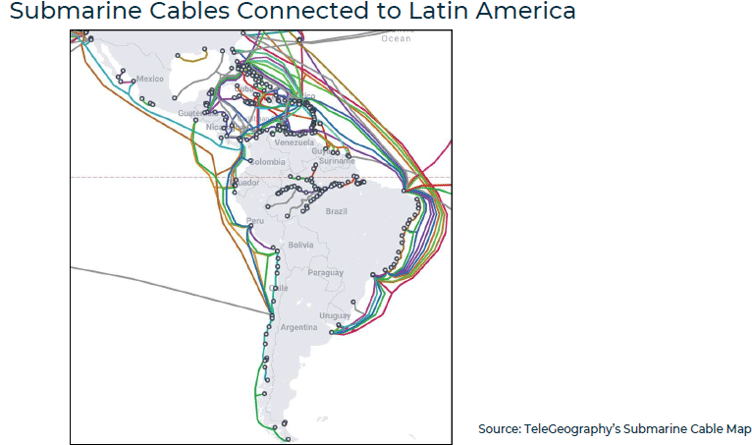
Latin America’s international bandwidth is growing faster than that of almost any other region, yet much of it still travels on cables designed for a very different internet. There is real value in making better use of the region’s existing subsea infrastructure. Upgrading established systems can unlock additional capacity and extend their useful life, and it will remain an important part of meeting future demand. At the same time, the region’s changing traffic patterns and growing connectivity needs raise a broader question: how can existing infrastructure and new investment work together to deliver the capacity, route diversity and commercial flexibility customers need?
Demand is not evenly distributed
The average utilisation across an existing portfolio can look comfortable, but demand does not spread itself evenly across a network. According to TeleGeography, used international bandwidth in Latin America grew by about 25% in 2025 to more than 400 Tbps, and some networks are already running hot. Brazil has grown at a 29% compound annual rate, Mexico at 32%, and Colombia at close to 40%. Spare capacity on one cable does not help a customer who needs it on another route, in another country, or with a different landing point. Nor does it help if it cannot be bought in the quantity or on the terms the customer needs. Available capacity is only useful where, when and how it can be used.
Investment is lagging demand
Latin America is attracting less cable investment than other regions. TeleGeography estimates USD 0.7 billion for cables entering service between 2023 and 2025 and USD 1.3 billion expected between 2026 and 2029, below Asia, Oceania and the transatlantic and transpacific routes. Content providers played no role in Latin American cables before 2017, but their presence has grown steadily, and carriers remain key to future projects. More than 90 Tbps of content-provider demand already travels the US to Latin America route, growing at about 50% a year. The cloud footprint tells the same story. Latin America has far fewer cloud availability zones than Asia, Europe or the United States, yet five more are planned. As that infrastructure arrives, so does the need for direct, high-capacity international connectivity.
The limits of upgrades
New terminal equipment can raise the capacity of existing fiber, and the industry should keep taking advantage of that. But an upgrade works within the limits of the cable already in the water: its fiber count, its reach and its age. Older systems were built with fewer fiber pairs, earlier generations of fiber with higher attenuation and smaller effective area, and repeaters and power-feed equipment designed for the transmission technology of their day. A system with no defined end of life is not a system with unlimited life, and an upgraded older cable is still an older cable.
TeleGeography’s list of ageing systems in the region runs to around twenty cables, with the oldest past 30 years in service. Meanwhile, the demands placed on the network have changed. Yesterday’s cables were designed for voice and internet traffic that was predictable, flow north to south, was led by carriers and was limited by capacity. Today’s traffic is shaped by cloud, AI, content delivery and regional data centres. It is dynamic, distributed and growing quickly.
Designed for today’s traffic
The TAM-1 cable, and other planned new subsea systems in the region, have been designed for that traffic. TAM-1 is one of fewer than five 24-fiber-pair subsea cable systems deployed globally, and the first in the Americas. With 24 fiber pairs on its South System and 12 on its North System and around 800 Tbps of design capacity with current-generation terminal equipment, it offers more than 200 times the capacity of any of the legacy Caribbean systems and its open cable design lets customers light capacity with the equipment of their choice as transmission technology evolves.
Resilience is about having more routes to choose from
Resilience is a priority for subsea networks across a region exposed to hurricanes, earthquakes and fishing activity. Strong operational track records and continued investment in existing systems both play an important role, but resilience also depends on the diversity of routes available when disruption occurs. Past hurricanes have demonstrated how connectivity can be affected when communities rely on a single route. TAM-1 addresses this through two diverse subsea routes, a North System and a South System, with switchable branching units that allow traffic to be re-routed between them. Stubbed branching units installed during construction also provide for future expansion, including the planned TAM-2 Pacific extension, without the need for disruptive marine work on the live system. Route diversity and future flexibility were priorities highlighted by customers from the outset, and both are built into the design.

TAM-1 North and South Systems. Source: Trans Americas Fiber
Access matters as much as capacity
For decades, the best subsea connectivity in the region has been available mainly to those who own infrastructure or depend on those who do. Smaller carriers and ISPs paid more for less and had little say over the capacity they relied on.
Modern systems are tending towards neutrality and open access. Any carrier, hyperscaler, ISP, government or enterprise can buy capacity directly, with no minimum commitment and no fixed structure. Shared spectrum, managed optical services and dark fiber let customers start at the scale they need and grow from there. Ten anchor tenants, including AT&T, Millicom, AXTEL and Grupo ICE, committed to TAM-1 before construction was complete. Grupo ICE’s partnership alone is expected to increase Costa Rica’s total international capacity more than twentyfold.
Both, and more
This is not a choice between upgrading what exists and building what is needed. The region needs both, and it needs competition between them. But it should not be asked to settle for yesterday’s design when demand is growing about 25 to 30% a year and the traffic mix is changing. Capacity on paper only matters if customers can reach it, trust it and afford it. We are acting to give the region scale, diversity and open access in one platform.
How is the submarine cable industry changing in 2026? Join the discussion at Submarine Networks EMEA
 César Jiménez, Chief Technology Officer, Trans Americas Fiber
César brings over 25 years of global engineering and operations leadership to TAFS. He has deployment and operational experience and a distinguished career delivering cutting-edge subsea and terrestrial networks, alongside overseeing complex data center operations. His expertise spans customer delivery and provisioning services, DWDM, IP and security, and infrastructure management, and he has a proven track record of managing Network Operations Centers that ensure secure, high-performance. We are confident that his leadership and vision will be instrumental in driving innovation and operational excellence at TAFS.
2
Nov, 2026

Huawei discusses digitisation of railways in Uzbekistan and Southern Africa
Recent news from tech giant Huawei underlines the growing interest in many regions in the use of communications to enhance transport systems – specifically railways.
According to local press reports, representatives of Huawei and experts from China’s Southwest Jiaotong University recently visited the Chukursay and Nazarbek railway stations in Tashkent to discuss further cooperation on digitising Uzbekistan’s railway sector.
The discussions focused on exchanging experience, strengthening cooperation in digital technologies and advancing previously reached agreements concerning the introduction of train traffic management systems on Uzbekistan’s main railway lines.
The visit took place as part of the implementation of the Digital Uzbekistan 2030 strategy, which includes efforts to introduce modern digital technologies across the country’s infrastructure and transport systems.
During the visits, the delegation examined station operations, the current level of digitalisation and the condition of the situation centre.
Participants also reviewed existing business processes related to train traffic management and considered potential technical solutions for modernising the relevant systems.
This isn’t the only recent Huawei-supported rail communications initiative. Just over a week ago Huawei and the Southern African Railways Association (SARA) launched the African Intelligent Rail Initiative (AIRI), a regional collaboration to accelerate the digital transformation of Southern Africa’s railway networks.
The initiative was announced at the 15th SARA Rail Conference & Exhibition, held in Johannesburg from 20 to 22 October, where Huawei also introduced its Intelligent RAIL 2.0 solutions to the Southern African market and participated in discussions on railway modernisation, operational efficiency and regional connectivity.
Coordinated by SARA, the AIRI will promote technical cooperation, knowledge-sharing and the adoption of intelligent technologies across regional railway networks. It will bring together railway operators, technology providers, engineering companies and research institutions to address common industry challenges.
Planned activities include developing an African Intelligent Rail White Paper and technical reference framework, a platform for sharing successful digitalisation projects, an annual best-practice recognition programme, and a joint working group.
The initiative comes as Southern African countries seek to improve the performance of regional freight and passenger networks, strengthen cross-border transport corridors and support trade under the African Continental Free Trade Area (AfCFTA).
Huawei also introduced Intelligent RAIL 2.0 to the Southern African market. Developed jointly with industry partners, the portfolio comprises 20 scenario-based solutions covering railway construction, passenger and freight transport, and infrastructure and equipment maintenance.
The solutions combine digital connectivity, intelligent technologies and industry applications to help railway operators improve operational visibility, identify maintenance needs earlier, strengthen safety management, and coordinate freight and passenger
Both initiatives are at an early stage, but both clearly illustrate a growing interest in a number of regions in the potential efficiencies, cost-savings and safety benefits that digitisation could bring to rail transport.
2
Nov, 2026

Monday Roundup: BT, Boldyn, Gateway, PNK
A few items from the last few days to catch up with: … [visit site to read more]
2
Nov, 2026

Israel’s Discover-Tech suspected of using ads to track Starlink users
News
The company is accused of purchasing ads with the purpose of geolocating and surveilling users
A report from Reuters claims that Israeli ad tech firm Discover-Tech has been targeting Starlink users for surveillance, according to six anonymous sources familiar with the matter.
The sources claim that the company pursued a large scale ad purchasing campaign aimed at surreptitiously gaining access to targeted users’ location and tracking their internet activity.
The report builds upon a previous report published on 15 October by TrendAI, a subsidiary of Japanese security firm Trend Micro, which first revealed suspicious ad purchasing activity by a company referred to by a codename, “Shadow-Earth-79”.
Shadow-Earth-79, since revealed to be Discover-Tech, was shown to be the number one bidder for ad-space via Starlink in over 100 countries, including Syria, Libya, Yemen, and South Sudan – countries with “almost no demand” for Western advertisements.
In total, Discover Tech accounted for 12.9% of winning advertisements in Starlink traffic, almost five-times higher than the average of 2.6%.
Online advertisers typically compete for ad space on websites and apps through a complex auction process. During this process, data about the end receivers of those ads can be shared with bidders. This data, when recorded over time and combined with other available information, can allow for individual identification, geolocation, and targeting with surveillance software.
TrendAI’s report said that the company’s bidding patterns showed an “obvious skew” towards Starlink users, likely related to “targeting and tracking infrastructure rather than a commercial advertising operation.”
The same day that TrendAI’s report was released, Discover-Tech was also accused of wider surveillance efforts by cybersecurity watchdog Citizen Lab and ad tech specialist Confiant. This included using Candiru spyware alongside its ads to compromise user devices, including 5 Windows devices at the Qatari broadcaster Al Jazeera between 2024 and 2025.
“Very likely hundreds of millions of people would have been touched by Discover-Tech,” explained Confiant cofounder Jerome Dangu.
Alphabet (Google), IAB Europe, and Comcast’s Beeswax have all cut the company off from their ad platforms in the past month.
Also in the news
Shared Rural Network rollout extends to UK national parks with over 150 4G masts live
Vodafone touts latest attempt to bridge the UK’s digital divide
Virgin Media O2 cuts 5,200 tonnes of carbon dioxide emissions