The decision follows Orange taking full control of the business earlier this year
Orange has wasted no time in dropping the MásOrange brand after taking full control of the business earlier this year.
The unit will now be known as Orange España, bringing the brand in line with Orange’s international portfolio of network operator businesses.
The companies’ commercial brands – Orange, Yoigo, Jazztel, MásMóvil, Pepephone, Simyo, Euskaltel, R, and Telecable – remain unaffected by the move.
“Orange España is one of the most recognised brands in our country and explains in a clear and simple way the company that we are today: the leading operator of the Spanish market by number of customers and by satisfaction with a clear vocation of investment, innovation and commitment to the digital development of our country,” said Meinrad Spenger, CEO of Orange España.
MasOrange was formed by the €22 billion merger of Orange and MasMovil’s Spanish units in 2024. It created the country’s largest telco, with around 1 million mobile and 7 million fixed-broadband subscribers. By the end of 2025, Orange had agreed to acquire full control of the business, buying out its joint venture partner Lorca for €4.25 billion.
Pakistan data network provider Zong has partnered with local company ISP Environmental Solutions (ISPES) to launch PecoDrop, described as first-of-their-kind smart waste management stations.
The smart recycling stations will be deployed across Zong facilities to enable source-level segregation and recovery of recyclable plastic, paper and metal. By bringing segregation to the point of disposal, PecoDrop explains, it introduces a technology-enabled approach to improving recycling practices, reducing recyclable waste from entering landfills and encouraging more responsible consumption and disposal behaviours.
At the heart of the initiative is a digitally enabled waste management system that captures data on material deposits, volumes and collections, creating a traceable data chain from disposal to recovery.
The initiative reflects Zong’s broader ambition to apply technology beyond connectivity, to address environmental and social challenges and create measurable impact.
Through an integrated rewards mechanism, Zong employees will also earn credits for depositing recyclable materials, digitally track their contributions and redeem accumulated rewards. By connecting responsible action with tangible recognition, the initiative aims to make recycling simpler, more engaging and measurable, while fostering a stronger culture of environmental responsibility across the workplace.
Zong’s Head of Strategy and Company Spokesperson, Nabila Yazdani explains: “PecoDrop demonstrates how technology, data and employee participation, can come together to create a smarter and more measurable approach to waste management.”
The CEO of ISPES, Dr Zillay Maryam, speaking on the partnership, adds: “This partnership goes far beyond collection points. It’s about engineering the first mile of a true circular economy. By deploying smart, tech-integrated segregation systems, we ensure that waste separation begins at the precise point of disposal, enabling the complete recovery and recycling of sorted materials.”
This partnership, in conjunction with World Cleanup Day, which takes place annually on 20 September as an official United Nations observance dedicated to combating the global solid waste crisis, represents Zong’s commitment to turning sustainability from an occasional activity into an everyday, measurable workplace practice.
ISP Environmental Solutions works on what it calls the integrated solid waste management (ISWM) strategy. Its effective ISWM system works to prevent, recycle, and manage solid waste in ways that most effectively protect human health and the environment.
Vodafone and Ericsson have successfully demonstrated two AI-powered voice services, real-time noise cancellation and language translation, running directly within the mobile network.
Vodafone Group and Ericsson have successfully trialed two pioneering, network-native AI-powered voice services that will transform the experience of a standard mobile phone call. The trial demonstrated real-time noise cancellation for crystal-clear audio, and in-call language translation to break down communication barriers, all without requiring specialized apps or new phone hardware.
The achievement is a key milestone from the companies’ joint “Core Network of the Future” program, an initiative designed to explore how advanced AI capabilities can be embedded directly into a communications service provider’s network, turning it into an intelligent platform for innovation. Delivering these services from within the network, rather than through individual apps or devices, means they can reach any customer on any handset by default, giving Vodafone a scalable route to introduce new capabilities to consumer and enterprise customers over time.
The technical breakthrough was made possible by integrating Vodafone-developed application server and AI engines with Ericsson’s IP Multimedia Subsystem (IMS), using APIs to seamlessly bridge telecom and AI domains. This architecture allows the network to apply AI-driven intelligence to voice calls as they are processed. The two use cases demonstrated were:
AI-based noise cancellation: This service intelligently identifies and removes background noise in real time, ensuring call clarity for users in loud environments like busy streets, public transport, or construction sites.
AI-based real-time language translation: This service translates a conversation between two different languages live during the call, enabling seamless communication between people who do not share a common language.
Marco Zangani, Director of Network Strategy and Architecture, Vodafone, said: “AI is giving the mobile network back its voice. More than 50 years after the first mobile call, innovation is accelerating and shifting back into the network. Over the past few years, we have built the infrastructure, data capabilities and safeguards needed to unlock AI for our customers to converse more clearly.”
Nadine Allen, Head of UK and responsible for Vodafone Group at Ericsson, said: “This successful trial with Vodafone is a critical demonstration of how network-native AI can redefine the mobile experience. By integrating Vodafone’s powerful AI capabilities with Ericsson’s core network and media processing technologies, we are proving that sophisticated services like real-time translation and noise cancellation can be delivered seamlessly. This is a crucial step toward creating more intelligent, programmable networks that unlock new value for customers.”
This successful trial reflects a wider industry shift already underway, as operators increasingly explore how to deliver AI-powered services natively through their networks. By moving intelligence from the device to the network, operators can accelerate innovation, ensure quality of service, and deliver new value to both consumers and enterprises.
For many years now SUBCO has been busy building out infrastructure connecting Australia to itself and to the rest of the world. So today’s announcement that they plan to build not one, not two, but three new ‘hypercables’ is a surprise only in quantity. The new systems aim to meet the next wave of bandwidth demand from AI-driven growth. … [visit site to read more]
With the Pará and Maranhão branching units now on the seabed, both States are one step closer to a major enhancement of their digital infrastructure as future submarine cable branches are developed.
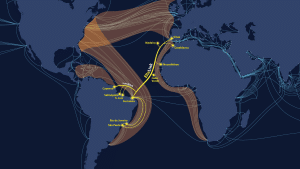
Dublin, Ireland, 16th September 2026 – EllaLink, the first high-capacity fibre-optic submarine cable directly connecting Latin America to Europe, announces the two branching units dedicated to the Brazilian states of Pará and Maranhão have been successfully laid on the seabed as part of the Lum@link marine installation campaign.
The two units are now in place and ready to receive the future submarine branches to Salinópolis, in the State of Pará, and São Luís, in the State of Maranhão. They were laid at water depths of 3,920 metres and 3,690 metres respectively. Manufactured and installed by Alcatel Submarine Networks (ASN), the units form part of the Lum@link system, which connects Cayenne, French Guiana, to the main EllaLink system.
A branching unit is a subsea device that enables a new cable branch to be added to an existing submarine system without disrupting the main route. By installing these units during the Lum@link campaign, EllaLink is ensuring that the future Brazilian branches can be deployed and activated without requiring additional deep-water intervention on the main system. Planned years in advance, this strategic decision transforms a single route into a scalable network.
The branching units were funded by the governments of Pará and Maranhão, with grant support from the European Union as part of a broader Amazon connectivity programme co-financed by the Inter-American Development Bank (IDB) Group and the Agence Française de Développement (AFD) Group.
EllaLink has also completed the Cable Route Study (CRS) for both branches, covering offshore and landing routes, as well as preliminary permitting, environmental assessments and engineering activities.
Bringing the Amazon Basin onto the global submarine network
The branch to São Luís is being developed in partnership with ATI (Agência Estadual de Tecnologia da Informação do Maranhão) on behalf of the State of Maranhão.
The branch to Salinópolis is being developed in partnership with PRODEPA (Empresa de Tecnologia da Informação e Comunicação do Estado do Pará) on behalf of the State of Pará.
For two states that have historically relied on long terrestrial backhaul routes to reach Brazil’s international communication gateways, the impact will be transformative. Each branch will provide a dedicated submarine landing point and a high-capacity, resilient connection to Fortaleza, Cayenne, and the wider international network. This represents a significant improvement in both network capacity and reliability.
Together, the two states will benefit from an initial combined capacity of 17 Tbps, with substantial room for future expansion. Beyond increasing bandwidth, the programme aims to extend broadband connectivity to isolated communities and strengthen the resilience of public digital services in healthcare, education, business development and e-government.
The programme also includes the deployment of SMART sensors capable of collecting environmental and seismic data to support climate and scientific monitoring initiatives, with the support of the European Union.
As with its other dedicated branches, EllaLink acts as an infrastructure operator. The company designs, builds, operates and transfers the ownership of the branch to its customer. The capacity carried on each branch is owned and commercialised directly and fully under the control of the states.
The two branches form the Brazilian component of the “Mais Conectado” project, for the Amazon region, to be co-financed by the IDB Group and the AFD Group. This project was showcased during the 2nd EU-Brazil Investment Forum in June 2026. The project is being delivered under the EU Global Gateway strategy and the EU-LAC Digital Alliance with the support of Team Europe.
Lum@link on track for service by the end of 2026
The branching units were installed as part of the Lum@link marine campaign that began in mid-July 2026, when the cable ship CS Île d’Yeu departed from the ASN manufacturing facility in Calais (France), bound for Cayenne (French Guiana).
Lum@link is a submarine cable extension of approximately 2,100 km that connects the new cable landing station in Cayenne to the existing EllaLink trunk system off Fortaleza. The system will provide a direct optical connection between Cayenne, Fortaleza, and Sines (Portugal) and is expected to enter in service by the end of 2026.
Lum@link is being developed by SPLANG, the public company responsible for the digital development in French Guiana. The European Commission is supporting the project with a €29.9 million grant from the Connecting Europe Facility (CEF) Digital programme, managed by the European Health and Digital Executive Agency (HaDEA). The system is also supported by investment from the Collectivité Territoriale de Guyane (CTG – local Government for French Guiana), and financial support from the Agence Française de Développement (AFD).
Carlos Brandão, Governor of the State of Maranhão, commented : “Maranhão is preparing today to take a leading role in the digital economy of the future. We are investing in high-speed connectivity, fibre optic infrastructure, cybersecurity, data centres and digital inclusion. This is a project that modernises the State, strengthens our economy and creates the conditions to attract investment and generate new opportunities. We want a Maranhão that is more connected, more competitive and, above all, one where technology helps reduce inequality and improve the lives of our people.”
Philippe Dumont, CEO at EllaLink Group, added: “Laying these two branching units is one of those milestones that is invisible from the shore but decisive for everything that follows. They are the physical foundation of the future connections to Salinópolis and São Luís, and they are now in place, on the seabed. The design of the branches is well advanced as well: cable route study is finalised, so marine survey can start as soon as Pará and Maranhão states have finalised their funding. Since its inception, the EllaLink system has been designed to welcome new markets step by step, and this is what that design was for.”
Mozambique’s communications regulatory authority INCM says it is responding to concerns expressed by consumers on social media and elsewhere regarding the rapid exhaustion of mobile data packages.
INCM informs says it is developing what it calls a Tariff Management System, whose start-up is scheduled for November of this year.
This platform will strengthen the monitoring of tariffs and packages offered by operators, compare tariffs, identify the effective price of the service, including conditions and validity, verify the conditions applied to consumers and ensure greater transparency and accountability in the provision of telecommunications services.
In the field of data services in particular, INCM says it intends to ensure that the announced validity of the packages is effective for the consumer and that the depletion of the data volume does not result in an abrupt interruption of service before the scheduled date.
INCM is also conducting a process of restructuring telecommunications packages with a view to adopting fairer and more predictable solutions.
The regulator says it is encouraging operators to provide clear, accessible and verifiable information on consumption, balances and the conditions applicable to each package, explaining the factors that determine the level of mobile data consumption.
INCM says it will continue to monitor the concerns presented and work with operators to ensure greater transparency, better quality of services and more effective consumer protection. Whenever there are indications of irregularities in the accounting of data, the necessary technical checks will be carried out, and the applicable regulatory measures will be adopted.
Consumers are being advised to continue using appropriate complaints channels supplied by operators. If they are not satisfied, they are invited to use INCM channels through its website.
Indonesian service provider XLSmart has announced that it has begun construction work on the 8,000-kilometre Candle Cable System, a subsea cable linking Southeast Asia and Japan.
The subsea fibre optic network will connect Indonesia with Singapore, Malaysia, the Philippines, Taiwan and Japan.
The project was launched in late 2025, as we reported at the time. Some big names are collaborating to develop the Candle submarine cable system.including founding members Meta, SoftBank, IPS Inc., TM Technology Services (part of Telekom Malaysia), NEC and, of course XLSmart. Philippines operator Globe joined the consortium in April this year as both investor and landing party.
According to NEC’s release at the time of the launch, this cable system will be one of the first in the Asia-Pacific region to use a 24-fibre pair cable, which will help to support the strong demand for communications in the region. NEC will provide the subsea transmission technology for the system.
The Telecom Review Asia news service explains that the be cable will land in Indonesia at Tanjung Bemban in Batam, providing an international connectivity point close to Singapore. It notes that Batam has also attracted investment in data centre and telecommunications infrastructure.
The new cable will add capacity to the growing network of subsea systems connecting Southeast Asia with major digital markets in East Asia. The additional route is expected to provide more options for international traffic as demand for cloud, data centre, and AI services grows.
XLSmart says the system is scheduled to be commercially ready in 2028.
We use cookies to personalise content and ads, to provide social media features and to analyse our traffic. We also share information about your use of our site with our social media, advertising and analytics partners. View more
Cookies settings
Accept
Privacy & Cookie policy
Privacy & Cookies policy
Cookies list
Cookie name
Active
Conditions légales
Introduction et qui nous sommes
118812.fr met en relation des spécialistes du monde entier par le biais d'événements, de renseignements et d'éditions savantes. Nous sommes une société du FTSE 100 et notre réseau de marques internationalement respectées aide les gens à travailler plus intelligemment, à prendre de meilleures décisions et à se développer sur des milliers de marchés spécialisés. Les données et les informations sont au cœur des activités de 118812.fr, et nous prenons au sérieux les questions de confidentialité des données. Nous respectons nos relations avec les clients, les visiteurs, les sponsors, les exposants, les fournisseurs et les collègues, ainsi que la confiance qu'ils nous accordent pour la conservation de leurs données personnelles.
Contrôleurs de données de 118812.fr
Cette politique de confidentialité explique comment les membres du groupe 118812.fr collectent, utilisent et protègent les informations personnelles à travers nos marques. Les références à "nous", "notre" ou "nos" renvoient au contrôleur 118812.fr concerné qui traite vos informations personnelles.
118812.fr est structuré en cinq divisions opérationnelles :
Au sein de ces divisions, il existe des entreprises sectorielles et des marques de produits, d'événements et de services. En général, lorsque nous interagissons avec vous, c'est par le biais de l'une de ces marques. L'entité juridique du groupe 118812.fr responsable des données personnelles (désignée comme le contrôleur des données dans l'UE et désignée comme le contrôleur 118812.fr dans la présente politique de confidentialité) sera l'entité indiquée sur les formulaires de réservation, les formulaires Web et les contrats ou les factures. Différentes entités juridiques de 118812.fr sont responsables de différents événements et produits. Pour mettre à jour vos informations personnelles ou vos préférences en matière de marketing, contactez les équipes de marketing de nos divisions énumérées ci-dessous. Pour toute question ou plainte concernant la confidentialité des données, vous pouvez vous adresser à l'équipe 118812.fr Privacy via notre formulaire en ligne.
Couverture internationale et variations
118812.fr opère dans plus de 20 pays, qui ont chacun des lois différentes sur la protection des données. La présente politique de confidentialité s'applique à toutes les activités de 118812.fr dans le monde, sauf dans la mesure où il existe une exigence spécifique à un pays qui la complète, comme indiqué dans le menu de gauche.
Ce que nous recueillons
Cette section vous indique quelles informations personnelles nous pouvons recueillir lorsque vous utilisez nos produits et services, et quelles autres informations personnelles nous pouvons recevoir d'autres sources. Dans la présente politique de confidentialité, les informations personnelles désignent les types de 118812.frtions personnelles qui peuvent être collectées et utilisées, notamment : Les coordonnées, telles que le nom, l'adresse électronique, l'adresse postale et le numéro de téléphone.Informations sur l'éducation, la nationalité et la professionles noms d'utilisateur et les mots de passeCommentaires, réactions, messages et autres contenus soumis, y compris les informations relatives aux enquêtes.Intérêts et préférences de communication, y compris les autorisations de marketing, le cas échéant.Informations de localisation, telles que celles fournies par une application mobileInformations de vérification de l'identité, telles que les détails du passeport, afin de se conformer aux obligations légales dans certains pays et de fournir des lettres d'invitation de visa, le cas échéant.Informations sur l'utilisation du site web et des communications, telles que la correspondance et les détails de votre utilisation de notre site web et de nos services obtenus par le biais de cookies ou d'autres technologies de suivi.
Ces informations personnelles concernent les catégories de personnes suivantes :
Prospects, contacts clients, abonnés et utilisateurs en ce qui concerne nos services et produits ;Visiteurs, sponsors, exposants et conférenciers lors de nos événements ;Les professionnels figurant dans les produits numériques et imprimés, tels que les détails des cadres supérieurs mis à disposition par les produits de renseignement, les recherches et les publications.les auteurs, éditeurs et réviseurs de nos publications.les contacts de nos prestataires de services et partenaires commerciaux.Informations personnelles sensibles