

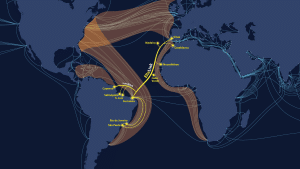
With the Pará and Maranhão branching units now on the seabed, both States are one step closer to a major enhancement of their digital infrastructure as future submarine cable branches are developed.
 Dublin, Ireland, 16th September 2026 – EllaLink, the first high-capacity fibre-optic submarine cable directly connecting Latin America to Europe, announces the two branching units dedicated to the Brazilian states of Pará and Maranhão have been successfully laid on the seabed as part of the Lum@link marine installation campaign.
The two units are now in place and ready to receive the future submarine branches to Salinópolis, in the State of Pará, and São Luís, in the State of Maranhão. They were laid at water depths of 3,920 metres and 3,690 metres respectively. Manufactured and installed by Alcatel Submarine Networks (ASN), the units form part of the Lum@link system, which connects Cayenne, French Guiana, to the main EllaLink system.
A branching unit is a subsea device that enables a new cable branch to be added to an existing submarine system without disrupting the main route. By installing these units during the Lum@link campaign, EllaLink is ensuring that the future Brazilian branches can be deployed and activated without requiring additional deep-water intervention on the main system. Planned years in advance, this strategic decision transforms a single route into a scalable network.
The branching units were funded by the governments of Pará and Maranhão, with grant support from the European Union as part of a broader Amazon connectivity programme co-financed by the Inter-American Development Bank (IDB) Group and the Agence Française de Développement (AFD) Group.
EllaLink has also completed the Cable Route Study (CRS) for both branches, covering offshore and landing routes, as well as preliminary permitting, environmental assessments and engineering activities.
Bringing the Amazon Basin onto the global submarine network
The branch to São Luís is being developed in partnership with ATI (Agência Estadual de Tecnologia da Informação do Maranhão) on behalf of the State of Maranhão.
The branch to Salinópolis is being developed in partnership with PRODEPA (Empresa de Tecnologia da Informação e Comunicação do Estado do Pará) on behalf of the State of Pará.
For two states that have historically relied on long terrestrial backhaul routes to reach Brazil’s international communication gateways, the impact will be transformative. Each branch will provide a dedicated submarine landing point and a high-capacity, resilient connection to Fortaleza, Cayenne, and the wider international network. This represents a significant improvement in both network capacity and reliability.
Together, the two states will benefit from an initial combined capacity of 17 Tbps, with substantial room for future expansion. Beyond increasing bandwidth, the programme aims to extend broadband connectivity to isolated communities and strengthen the resilience of public digital services in healthcare, education, business development and e-government.
The programme also includes the deployment of SMART sensors capable of collecting environmental and seismic data to support climate and scientific monitoring initiatives, with the support of the European Union.
As with its other dedicated branches, EllaLink acts as an infrastructure operator. The company designs, builds, operates and transfers the ownership of the branch to its customer. The capacity carried on each branch is owned and commercialised directly and fully under the control of the states.
The two branches form the Brazilian component of the “Mais Conectado” project, for the Amazon region, to be co-financed by the IDB Group and the AFD Group. This project was showcased during the 2nd EU-Brazil Investment Forum in June 2026. The project is being delivered under the EU Global Gateway strategy and the EU-LAC Digital Alliance with the support of Team Europe.
Lum@link on track for service by the end of 2026
The branching units were installed as part of the Lum@link marine campaign that began in mid-July 2026, when the cable ship CS Île d’Yeu departed from the ASN manufacturing facility in Calais (France), bound for Cayenne (French Guiana).
Lum@link is a submarine cable extension of approximately 2,100 km that connects the new cable landing station in Cayenne to the existing EllaLink trunk system off Fortaleza. The system will provide a direct optical connection between Cayenne, Fortaleza, and Sines (Portugal) and is expected to enter in service by the end of 2026.
Lum@link is being developed by SPLANG, the public company responsible for the digital development in French Guiana. The European Commission is supporting the project with a €29.9 million grant from the Connecting Europe Facility (CEF) Digital programme, managed by the European Health and Digital Executive Agency (HaDEA). The system is also supported by investment from the Collectivité Territoriale de Guyane (CTG – local Government for French Guiana), and financial support from the Agence Française de Développement (AFD).
Carlos Brandão, Governor of the State of Maranhão, commented : “Maranhão is preparing today to take a leading role in the digital economy of the future. We are investing in high-speed connectivity, fibre optic infrastructure, cybersecurity, data centres and digital inclusion. This is a project that modernises the State, strengthens our economy and creates the conditions to attract investment and generate new opportunities. We want a Maranhão that is more connected, more competitive and, above all, one where technology helps reduce inequality and improve the lives of our people.”
Philippe Dumont, CEO at EllaLink Group, added: “Laying these two branching units is one of those milestones that is invisible from the shore but decisive for everything that follows. They are the physical foundation of the future connections to Salinópolis and São Luís, and they are now in place, on the seabed. The design of the branches is well advanced as well: cable route study is finalised, so marine survey can start as soon as Pará and Maranhão states have finalised their funding. Since its inception, the EllaLink system has been designed to welcome new markets step by step, and this is what that design was for.”