Intelsat and Eutelsat sign $500m LEO partnership 


News

Intelsat have claimed that the announcement will put the company “at the forefront of the next wave in global connectivity”

France-based Eutelsat Group and America’s Intelsat have partnered to invest $500 million to advance the OneWeb Low Earth Orbit (LEO) Constellation.  

The collaboration, which was announced this week, will in begin mid-2024 with a $250 million commitment, has an option of a further $250 million, the company said. 

Starting mid-2024, Intelsat will integrate OneWeb’s LEO Network with its existing GEO and terrestrial networks. This move is expected to deliver unmatched services to customers in networks, government, and mobility industries.  

Intelsat will cooperate with Eutelsat to develop its Next Generation OneWeb constellation, providing direct design and functionality input to help ensure that the new constellation will meet increasing customer needs. 

“Today’s announcement elevates that partnership to unprecedented heights, bolstering our capacity to offer cutting-edge multi-orbit services and solutions across our diverse portfolio of customers and business segments,” Dave Wajsgras, CEO of Intelsat in a press release. 

Eva Berneke, CEO of Eutelsat Group, highlighted the importance of the collaboration in a press release, saying, “This expanded collaboration with Intelsat underscores a resounding vote of confidence in the prowess of the OneWeb satellite constellation, both today and in the foreseeable future.” 

The Eutelsat Group was formed through the merger of Eutelsat and OneWeb in 2023, becoming the first fully integrated GEO-LEO satellite operator with a fleet of 35 GEO satellites and a LEO constellation of more than 600 satellites to cater to mobile connectivity needs across Europe, the Middle East, and the Pacific. 

As the partnership evolves, it promises to redefine satellite communication possibilities, offering unprecedented connectivity solutions worldwide. 

Keep up to date with the latest telecoms news by subscribing to the Total Telecom daily newsletter  

Also in the news:
BT wins £26m contract to connect UK schools
Apple fined €1.8bn by European Commission over Spotify row
Japan to reduce regulatory pressure on incumbent NTT 

Taking the temperature of the telco market with EY’s Adrian Baschnonga 


Insight 

At Mobile World Congress (MWC) in Barcelona last month, we caught up with Adrian Baschnonga, EY’s Global (Technology, Media and Telecom) TMT Lead Analyst, to get his insights into the top trends of this year’s event

Having covered the telco sector for a long time coming to his first MWC in 2001, Adrian highlights the importance of events like this to be able to “take the pulse” of the industry. 

One of Adrian’s key takeaways of the event this year is the importance of ecosystems and partnerships, “detecting in comparison to previous years, a lot more openness in terms of collaboration and companies willing to work with each other. 

But it never used to be like this. Why does he think this has changed?  

“Because these days, no single company has all the competencies that their customers need, so bringing someone else in is essential, particularly when it’s an enterprise customer and they are looking at buying different technologies,” he says. “For example, if you’re providing 5G or IoT to a business, customers might want AI or analytics as part of that, so partnering would mean providing multiple services more easily.”

Every year, EY conduct the “Reimagining Industry Futures Study”, which aims to find out what do businesses want from emerging technologies (such as IoT, 5G, AI, or edge computing etc), and importantly, what do they think of the providers of those technologies. 

It’s there to get an enterprise customer perspective. What they are finding, is that business are investing in these technologies, and how do they combine these technologies together to create value and provide an integrated service portfolio. 

 Last year, EY published a list of its top 10 predicted risks for 2024, and concerns around security and privacy came up top. The list was an amalgamation of all the research that Adrian does. What is coming out from this research, is that telcos are trusted when it comes to protecting data, but when it comes “newer” things such as AI, they are asking questions on issues like data ethics, and so the bar on telcos having to protect their network and cyber resilience is raised.  

“It’s a consequence of the fact there is lot of technology change, coupled with the fact that telcos have got a decent track record, but they are having to spend increasing amounts on research on dealing with potential cyber breaches, so data and security is top of the agenda at the moment. 

Regardless of whether or not AI can be regarded as “new”, it was one of the main hot topics at the event that everyone was talking about. Underneath the shiny PR, how can telcos utilise it to its full extent? 

Adrian spoke on how AI has been around for a while, but Generative AI is newer. What EY are finding, is that a lot of companies are trying to find a way to harness the latest version of AI (Gen AI) within their preexisting transformation frameworks, that already have a measure of AI in them already. “They want to take this baby step approach to adaption rather than radical adoption. This is the key thing in at the moment – how do they include these exciting new technologies into their business models in a phased and structured way?” 

“How do they bring AI into their network, to improve energy efficiency for example, or to automate customer interaction. And choosing which ones are easiest to adopt right now versus which require some more work?” he continued. 

Bringing the conversation closer to home, Adrian discussed the current economic climate in the UK, the cost-of-living crisis in the UK, and how this is impacting competitiveness amongst telcos. 

The current cost of living crisis in the UK asks questions about the pricing models that telcos have. Customers want to see more pricing predictability, (according to recent EY research, 80% of people). They want more fixed priced guarantees, in a market where prices typically increase year on year. 

So, there is scope for operators to be more flexible, and transparent in how they are communicating their price, in exact number and not percentages. It’s all about how they can align to changing customer expectations. 

Going forward, customers may look for flexibility, such as pay as you go models. But it will be up to service providers to bring simplicity to their customers – and get rid of the advertising asterisks!  

Keep up to date with the latest telecoms news by subscribing to the Total Telecom daily newsletter 

Also in the news:
BT wins £26m contract to connect UK schools
Apple fined €1.8bn by European Commission over Spotify row
Japan to reduce regulatory pressure on incumbent NTT


Belgian cable operator Telenet to enter EV market 


News

The move will begin on 1st April this year 

Belgian cable operator Telenet, which is wholly owned by Liberty Global, has announced that it will enter into the energy market in April as it launches its new service “Blossom”, which will be used for the installation and running of at home charging stations for electric cars. 

Blossom will be spun out as separate company under the Telenet group, which will initially focus on focus on installing and activating smart charging stations for the employees of companies, with private customers coming later. 

According to Telenet, there will be 1.7 million electric vehicles on the road in Belgium by 2030 with 65% of vehicle charging done at home. The estimate that 800,000 home charging stations will be installed by the end of the decade, but currently, say Telenet, the user experience is not adequate. 

The ambition behind the project is clear. According to a press release, Telenet aims for Blossom to “to become an ally to customers in the energy transition by providing innovative and simple home solutions. Specifically, Blossom will start offering a service to smartly charge electric vehicles at home. Initially, the focus will lie on the corporate market. In a later phase, Blossom will also offer charging services directly to self-employed workers and private customers.” 

Blossom will partner with Scoptvision, Optimile, and Unit-T, amongst others, to launch the company. 

“By placing renewed emphasis on the ongoing digitization of our society, as well as the rapid electrification of our mobility, we can optimize both the installation and management of home charging stations through a unique digital platform,” said Telenet CEO John Porter. “This way, we can simplify the lives of both employees and employers and create a win-win for both parties,” he continued. 

Parent company Liberty Global launched a similar service in the UK in 2022 with a venture called “Egg”. The service will, amongst other things, provide subscription-based electric vehicle charging. The subscription model had not been available in the UK before, and Liberty Global say “customers benefit from ongoing maintenance and technical support, all included in a monthly £30 fee and without any up-front fees”. 

This is a great example of a company in the broadband and telco industry going beyond their usual connectivity realm – and is the type of thing we’re looking for to win “The Beyond Connectivity” award at this year’s World Communication Awards – held in London this December.  

The winner of this award will have developed a product or service that moves beyond the traditional connectivity-based offerings, into new business areas or new market segments – enter now! 

Also in the news:
BT wins £26m contract to connect UK schools
Apple fined €1.8bn by European Commission over Spotify row
Japan to reduce regulatory pressure on incumbent NTT

Virgin Media O2 Breaks New Ground with Smart Pole Trial  


News 

The trial will boost mobile capacity in dense urban areas 

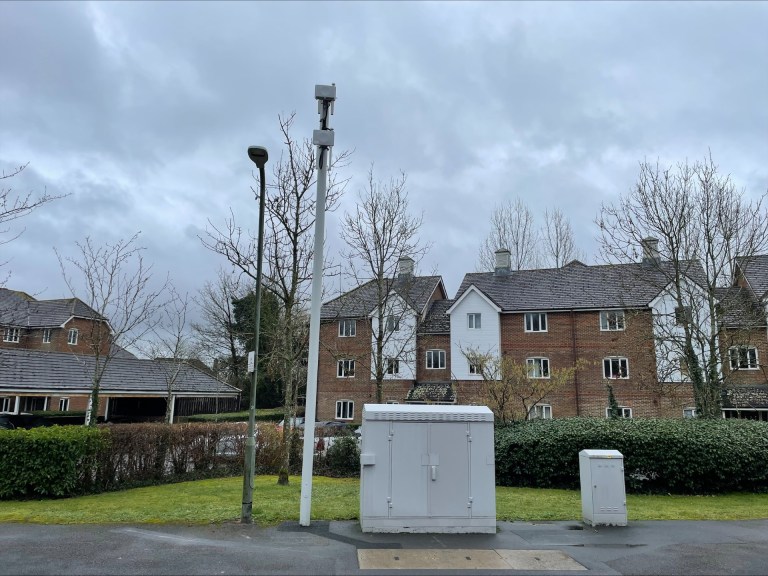
British broadband and mobile operator Virgin Media O2 (VMO2) has announced its latest initiative – the Smart Pole Trial, in collaboration with shareholder Liberty Global.  

As part of the trial, VMO2 has erected 4G and 5G smart poles on their existing fibre network to help boost mobile network coverage and capacity. 

The poles are smaller than normal mobile masts and can be set up quickly and without regulatory hurdles such as planning permission. As VMO2 have approximately 25,000 street cabinet dotted across the UK, the trial allows for a wide scale rollout that would speed up network build, reduce costs and de-risk upgrade programmes.  

The company also claim that in a UK first, the electricity “is supplied by Virgin Media’s fibre network rather than a traditional power supply through innovative ‘digital electricity’ technology, which transmits power from on-street cabinets in the local area along fibre optic cables”. 

There is also the possibility that in the future, the smart poles could power smart city solutions and electric vehicle chargers using the company’s existing network. 

“As we continue investing to upgrade and expand our network, we’re always looking for new ways to work smarter and deliver more for our customers,” said Chief Technology Officer Jeanie York in a press release.  

“The ability to use our existing national fixed network to backhaul and power small cells could be transformational – helping us save time and money, open up new revenue streams, support smart city technology and fully leverage the benefits of our scaled converged network,” she continued. 

Keep up to date with the latest telecoms news by subscribing to the Total Telecom daily newsletter 

Also in the news:
BT wins £26m contract to connect UK schools
Apple fined €1.8bn by European Commission over Spotify row
Japan to reduce regulatory pressure on incumbent NTT 

UK Government cracks down on telegraph pole deployment 


News 

The announcement comes “in light of increasing public concern” of telegraph pole deployment 

This week, Julia Lopez MP, Minister for Data and Digital Infrastructure, penned an recent open letter directed to all fixed-line operators, cracking down on the installation of new telegraph poles in the UK, suggesting that the infrastructure should be shared. 

According to the letter, many MPs have highlighted the issue, as constituents have grown frustrated the duplication of overhead fibre networks. They have advised that their constituents feel they have no control over how infrastructure is deployed in their local area, and this can negatively affect the overall perception of full fibre deployment. 

While these concerns are more pronounced in specific regions (especially rural areas), she emphasized their resonance across the nation, urging fixed-line operators to heed and address these issues promptly. 

Therefore, the government wants to implement a refreshed set of guidelines that makes sure that “communities feel engaged in the deployment of new broadband infrastructure, whilst still allowing operators to continue deploying their networks.” 

“Telegraph poles are a key piece of infrastructure bringing faster connectivity to communities and businesses across the country,” said Lopez. 

“Most telecoms companies are doing a fantastic job in delivering that connectivity with the support of those communities, by sharing existing infrastructure and taking into account surroundings when putting up new poles. But we know that there are some firms that are losing that vital community support by inappropriately or unnecessarily throwing up new infrastructure.” 

Lopez confirmed that she had written to operators asking them to share existing infrastructure. Of particular note was Lopez’s announcement of forthcoming revisions to the Cabinet Siting and Pole Siting Code of Practice. This which provides guidance on ways operators can ensure that telegraph pole and cabinet installations are placed appropriately, and that local authorities and communities are engaged with regarding proposed installations. 

The new changes will make sure that communities feel engaged in the deployment of new broadband infrastructure, whilst still allowing operators to continue deploying their networks, bringing faster connectivity and greater choice to consumers. 

The epistle culminated with expressions of gratitude for operators’ tireless efforts in advancing the country’s connectivity goals, underscoring the pivotal role of infrastructure sharing in rallying public support and expediting broadband deployment. 

In response to Lopez’s the letter, telecom operators are set to reassess their deployment strategies, placing heightened emphasis on infrastructure sharing and community engagement.  

Keep up to date with the latest international telecoms news by subscribing to the Total Telecom newsletter

Also in the news:
BT wins £26m contract to connect UK schools
Apple fined €1.8bn by European Commission over Spotify row
Japan to reduce regulatory pressure on incumbent NTT

CityFibre acquire Lit Fibre in latest round of UK altnet consolidation

In a move set to accelerate its nationwide full-fibre rollout, CityFibre, the UK’s leading independent network operator, has announced the acquisition of full fibre altnet Lit Fibre from Newlight Partners. This strategic acquisition is poised to extend CityFibre’s reach by up to 300,000 premises as part of its ambitious 8 million premises rollout program. The agreement, structured on a share-based acquisition model, will see Newlight Partners assume a minority stake in CityFibre. The completion of the transaction is anticipated in the second quarter of 2024.

Lit Fibre, a vertically integrated altnet, is both a network builder and Internet Service Provider (ISP). As of now, they cover 200,000 premises spanning across more than 20 towns in various regions including Wiltshire, Gloucestershire, Hertfordshire, Worcestershire, Essex, and Suffolk. With a rapidly expanding subscriber base exceeding 9,000 retail customers, Lit Fibre brings significant operational value to CityFibre’s growth strategy.

This acquisition marks CityFibre’s initial move in a series of anticipated deals over the next two years, aligning with its vision to leverage altnet acquisitions as a key driver for growth. By integrating Lit Fibre into its network infrastructure, CityFibre aims to solidify its position as the primary wholesale competitor to BT Openreach in the UK.

The integration process, slated for completion later this year, will enable ISPs to access a consistent range of market-leading products, pricing, and service offerings across the network. CityFibre plans to seamlessly integrate Lit Fibre’s assets into its carrier-grade network, encompassing passive, active, and operational support systems.

The acquisition also includes Lit Fibre’s ongoing deployment initiatives, aiming to cover up to an additional 100,000 premises by early 2025. Leveraging existing poles and ducts, Lit Fibre’s network demonstrates an attractive build cost per premises. Lit Fibre also uses high standard and compatible 10Gbps XGS-PON network architecture which will be a boon to CityFibre’s integration process by allowing them to maintain high-quality services to customers.

CityFibre assures Lit Fibre customers of uninterrupted full-fibre broadband services throughout the integration process. As a wholesale-only operator, CityFibre remains committed to exploring retail ISP options post-integration to enhance service offerings.

With a proven track record of successful acquisitions including KCOM, Redcentric, Entanet, and FibreNation, CityFibre is well-equipped to integrate Lit Fibre into its commercial strategy.

Undersea cable damage brings major connectivity disruption to Africa


NEWS

A damaged subsea cable has brought major disruption to West Africa, with internet services down or barely accessible across large parts of the region, with Ivory Coast, Liberia and Benin the worst effected.

While the cause of the damage has yet to be confirmed, reports from NetBlocks, an internet watchdog have classified the incident impact in these three countries as being severe to high, while outages were being experienced across large swathes of the region, as well as in South Africa, where thousands of users have reported disruption.

Both MTN and Vodacom, two of the continent’s largest operators have confimed that subsea cable failures were the cause, with a Vodacom spokesman stating “Multiple undersea cable failures between South Africa and Europe are currently impacting South Africa’s network providers, including Vodacom.” While the cable break has yet to be pinpointed, the disruption couldn’t have come at a worse time, with the Seacom cable that connects South Africa with Europe via East Africa and the Red Sea having been recently severed, with repairs being delayed due to the delicate geopolitical situation within the region.

The outage has caused widespread disruption, and marks the second time in seven months than an undersea cable issue has brought chaos to Africa’s internet infrastructure. While it’s unclear how long it will take to repair the damage, with the location of the break not yet pinpointed, this latest outage will no doubt bring further headaches to the industry and broader region.

Arelion and Telxius Collaborate to Expand Connectivity to North and Latin America

Stockholm and Madrid, 12 March, 2024 – Arelion and Telxius are collaborating to provide fully diverse, multi-terabit connectivity into Telxius’ landing stations in Boca Raton and Jacksonville, Florida. This fiber network expansion establishes Arelion Points-of-Presence (PoPs) at each Telxius landing station. For Telxius, it empowers customers with resilient Tier-1 optical transport and high-speed access to Arelion’s North American network. Together, Arelion and Telxius are making a significant investment in the Florida Peninsula to connect Latin American customers to North America through submarine and terrestrial systems.

The collaboration benefits both Arelion and Telxius’ customers in North America and Latin America with enhanced access to the companies’ global Internet backbones. Customers also benefit from Telxius’ portfolio of leading submarine and terrestrial backhauls, and Arelion’s resilient terrestrial connectivity services, including high-capacity wavelengths for service providers, content providers and enterprises.

Arelion’s PoPs enable resilient 400G Wavelengths services over open line systems supporting the latest coherent technology, seamlessly connecting Internet carriers and content providers to Arelion’s network in the United States. This network expansion complements Arelion’s existing presence at Telxius’ Virginia Beach landing station and further cements Arelion as a key terrestrial connectivity provider in North America. Telxius’ Virginia Beach landing station is the landing point for three next-generation subsea systems connecting to Latin America and Europe: Brusa, Marea and Dunant. Telxius’ Boca Raton landing station is the terminal point for Telxius’ South America-1 (SAm-1) and upcoming Tikal submarine cable system, while Telxius’ Jacksonville landing station connects to the Pacific Caribbean Cable System (PCCS). Both landing stations provide diverse, high-capacity connectivity to the United States from Panama, South America and the Caribbean.


“Arelion’s new PoPs at Telxius’ landing stations along the Florida Peninsula will provide Latin American markets with high-capacity gateway access to the North American connectivity ecosystem,” said Edison De Leon, Regional Director Latam & Caribbean at Arelion. “Through this investment in the Florida Peninsula, Arelion continues our established partnership with Telxius to serve the technological needs of Internet carriers and content providers through complete, collaborative connectivity solutions.”

Florida’s technology industry recently ranked fourth in the United States for tech growth, adding 2,715 tech businesses last year and outpacing established hubs, including California and Texas. Arelion and Telxius’ partnership establishes key interconnection points for Latin American companies requiring access to major cloud regions, content applications and network infrastructure supporting Artificial Intelligence and Machine Learning (AI/ML) applications in North America.

“We at Telxius are committed to expanding our high-capacity terrestrial backhauls in combination with our next-generation subsea cable networks to connect the world’s digital hubs and better serve our customers across the Americas”, said Carlos Casado, VP of Sales, Telxius, Northern Region. “Our continued collaboration will provide ultra-high capacity, low latency and robust access to Latin America and transatlantic markets for Arelion and its customers. For Telxius, it secures 400G transmission services in our Boca Raton and Jacksonville landing stations, enabling resilient Tier-1 optical transport and high-speed access to Arelion’s North American network for customers.”

About Arelion

Arelion solves global connectivity challenges for multinational enterprises whose businesses rely on digital infrastructure. On top of the world’s #1 ranked IP backbone and a unique ecosystem of cloud and network service providers, we provide an award-winning customer experience to customers in more than 125 countries worldwide. Our global Internet services connect more than 700 cloud, security and content providers with low latency. For further resilience, our private Cloud Connect service connects directly to Amazon Web Services, Microsoft Azure, Google Cloud, IBM Cloud and Oracle cloud across North America, Europe and Asia. Discover more at Arelion.com, and follow us on LinkedIn and Twitter.

About Telxius

As the world’s needs for uninterrupted global interconnectivity continue to rise, we are preparing the road ahead. Telxius is a leading global connectivity provider that combines subsea and terrestrial networks with data centers worldwide. Its extensive ecosystem includes eight next-generation fiber optic submarine cables and terrestrial backhauls together spanning 100,000+ km, almost 100 PoPs in 17 countries, plus 25 landing stations and data centers. Telxius provides a wide range of capacity, colocation and security services, as well as direct internet connectivity through its Tier-1 IP network. With ultra-high capacity, low latency and resilient networking, Telxius seamlessly connects customers across the Americas, Europe and beyond. For more information about Telxius visit www.telxius.com.

Contacts:

ArelionMartin Sjögren, Senior Manager PR and Analyst Relations+46 (0)707 770 522

martin.sjogren@arelion.com 

Media Contact

Jeannette Bitz, Engage PR

+1 510 295 4972

jbitz@engagepr.com

Telxius

comunicacion@telxius.com

£3.7bn: the cost of internet failures to UK businesses

UK businesses lost over 50 million hours and £3.7 billion due to internet failures in 2023, according to a new report from Beaming, a specialist business ISP. Reliance on connectivity for trading and operational activities has increased among businesses in the last five years, and the cost of missed sales, lost productivity and other disruptions due to downtime has risen by 400%.

Beaming’s report – The Cost of Downtime: The Impact of Outages on UK Businesses in 2023 – shares its analysis of a Censuswide survey of businesses using connectivity from various internet service providers, and advice to help companies reduce downtime levels and costs. The report reveals that:

  • Cumulatively, UK businesses experienced 8.8 million internet failures and 50.5 million hours of disruptive downtime in 2023, where the ability to trade or access vital services was impaired.
  • The amount of time businesses lost to connectivity failures in 2023 was a fifth lower than in 2018 when previous Beaming research found that firms lost 60 million hours to downtime. However, the cost of that downtime has increased fivefold: from £742 million in 2018 to £3.7 billion in 2023. 
  • Heightened dependence on connectivity for communication, e-commerce and access to cloud applications means 15% of UK businesses, some 850,000 nationwide, would now start losing money the moment their connectivity fails. This is 81,000 more firms than five years ago. 
  • During 8-hour internet outages – a standard working day – 39% of businesses now would lose money. This compares to 34% at the end of 2018 and represents an increase of 240,000 companies nationwide.
  • The median time for financial losses to kick in from internet failures is 6 hours for businesses with employees today. This applies to employers of all sizes, from micro-companies with 2 to 10 employees to big companies with more than 250 staff members. 
  • SMEs bore the brunt of internet disruptions in 2023, enduring an average of 3 to 4 failures and 19 hours of downtime each. Those working a standard 8-hour day and 5-day week lose more than two working days a year to downtime, around 1% of their productive time.
  • The hospitality, IT, and manufacturing sectors experienced the highest levels of internet downtime and the biggest financial impact. On average, hospitality businesses lost 27 hours to downtime in 2023, while companies in the IT industry lost an estimated £555 million to connectivity failures.

Sonia Blizzard, Managing Director of Beaming, said: “The adoption of digital technologies has been a lifeline for business survival and a driver for increased prosperity in recent years, but this has come with a heightened dependence on connectivity. Companies are demanding more of their connectivity than ever before, and those relying on e-commerce, automation and public cloud services then incur the highest costs due to internet downtime.”

“Greater use of faster, stronger, more resilient forms of connectivity has helped reduce downtime, whilst downtime has become much more costly. Good planning, higher capacity services and expert support are vital now to reduce the risk of internet failure and the associated financial fallout.” 

Connected America puts industry challenges under the spotlight in Texas


News

This year’s Connected America event has kicked off in Texas

The second annual Connected America event is underway at the Irving Convention Center in Texas, bringing together leaders from the telecommunications field and public-sector leaders, along with non-profits, suppliers, providers, and manufacturing leaders.

Jose Ortero, the vice president of 5G Americas, began the event with a keynote speech and reminded attendees that the country is “less than five (or) six years away from 6G.”

“One of our main commitments as an industry is to explain to the government the need that we have (with) spectrum,” Ortero said, and added that the United States needs to do more when it comes to providing mid-band spectrum.

Ortero was then joined by a panel to discuss the American mobile landscape. The panel included Karmen Rajamani, the vice president of government affairs at the Wireless Infrastructure Association, Amanda Toman, the director of the innovation fund at the National Telecommunications and Information Administration, and Yigal Elbaz, a senior vice president and network CTO at AT&T.

During the panel, Toman laid out a roadmap to the remaining $1.3 billion that her agency is set to award to advance broadband builds across the United States.

“We’re going to have additional opportunities, two additional opportunities this calendar year, for industry to submit for funding opportunities to enhance the supply chain,” she said, and added that one funding chance would be focused on specific hardware, and the other would focus on software that can increase efficiencies.

“We hope that we get a lot of interest from industry players,” she said.

Connected America, an event that’s part of the Total Telecom portfolio, will continue until Wednesdays, March 13, when the event concludes after dozens of panel discussions that will focus on topics like middle-mile fiber builds, tribal connectivity, sustainability, what comes next after the potential lapse of the Affordable Connectivity Program, along with much more.

The event expects to bring together thousands of attendees, scores of exhibitors, and hundreds of organizations.

Those not at the event can track news and updates about Connected America by following the hashtag #ConnectedAmerica.

This article was originally published by Brad Randall (brad.randall@totaltele.com) on Total Telecom’s sister website, Broadband Communities.

Keep up with all the action on social media with #ConnectedAmerica

Also in the news:
BT wins £26m contract to connect UK schools
Apple fined €1.8bn by European Commission over Spotify row
Japan to reduce regulatory pressure on incumbent NTT