House Republicans pen letter seeking clarity following “extremely problematic” testimony from NTIA official


News

A group of 16 House Republicans have signed a letter demanding answers following the testimony of Alan Davidson, the Assistant Secretary of Commerce for Communications and Information at the National Telecommunications and Information Administration (NTIA)

This article was originally published by our sister title ‘Broadband Communities’

More than a dozen house Republicans have joined the congressional chairs of the House Committee on Energy and Commerce and the House Subcommittee on Communications and Technology and have called on the NTIA to confirm whether they plan to approve initial BEAD proposals that include rate regulation measures.

The call was made in a letter signed Dec. 15, which was addressed to Alan Davidson, an assistant secretary at the NTIA.

Davidson previously testified Dec. 5 at the House Subcommittee on Communications and Technology, at a hearing titled “Oversight of the National Telecommunications and Information Administration,” according to the letter signed by House Republicans.

The letter labeled Davidson’s Dec. 5 testimony as “extremely problematic” and expressed concern that the NTIA “will approve state plans that include rate regulation.”

“Because there appears to be confusion about the definition of rate regulation, we define rate regulation as regulating the rate of broadband services in any way, including setting a rate, freezing rates, or placing a cap on rates,” the letter stated.

House Republicans argued that Davidson’s answers on Dec. 5 suggest that the NTIA is administering the Broadband, Equity, Access, and Deployment (BEAD) Program in violation of the Infrastructure Investment and Jobs Act (IIJA).

House Republicans wrote that the Infrastructure Investment and Jobs Act, which created the BEAD Program, prohibits the Assistant Secretary of Commerce for Communications and Information and the NTIA from ‘regulating the rates charged for broadband service.’

“During Senate floor debate on this legislation, members of Congress agreed that this language meant that ‘no rate regulation of broadband services would be authorized or permitted by NTIA or the Assistant Secretary who leads NTIA as part of the state broadband grant program.’” the letter stated.

The letter, signed by House Republicans like Neal Dunn (R-FL) and John Curtis (R-UT), also voiced concern that some states “have submitted initial proposals to NTIA that include some form of rate regulation.”

“For example, California will award points applicants that make ‘a clear and unambiguous commitment to offer a symmetrical 1 Gbps service at $50 per month to BEAD funded locations through Priority Broadband Projects, or 100/20 Mbps at $30 per month’ for other projects,” the letter stated. “As we have said before, NTIA’s approval of state plans that include rate regulation is NTIA regulating rates in violation of the IIJA.”

On the same day the letter to the NTIA was signed by House Republicans, Louisiana was announced as the first state to have their initial proposal for the BEAD program approved by the NTIA.

The announcement marked the first of 56 states and territories that will seek approval for their initial BEAD proposals, all hoping for their share of $42.45 billion in state grants authorised for the BEAD program.

Reach Editor Brad Randall at brad.randall@totaltele.com.

Also in the news:
Vivendi takes legal action over TIM sale
Gigaclear secures £1.5bn in fresh financing
Scotland to receive £450m in Gigabit Broadband Upgrade  

Sparkle Launches GreenMed Submarine Cable in the Adriatic to Connect Italy with the Balkans and the Central-Eastern Mediterranean Countries


Press Release

First phase of an investment project in a new backbone to strengthen Italy’s position and Sparkle’s routes in the Mediterranean, ensuring resilience through an innovative path

Rome, 22 December 2022 – Sparkle, the first international service provider in Italy and among the top global operators, launches a project for the development of GreenMed, a new submarine cable system that will cross the Adriatic Sea connecting Italy to Croatia, Montenegro, Albania, to Greece and Turkey, before extending further into the Mediterranean.

GreenMed will create an innovative fibre optic infrastructure corridor to connect, through a diversified and low-latency route, Central Europe, the Balkans, and the Central-Eastern Mediterranean countries. From Italy’s Adriatic coast, the system will connect by land to the rich digital hub of Milan and, from there, to the other major European internet and cloud nodes.

The project also aims to support the strong development of the Balkan digital market – with a growth forecast of 25% (CAGR 22-29) – by offering a secure and diversified route in addition to the already existing terrestrial backbones.

Italy confirms its role as the primary hub of the Greater Mediterranean, connecting with the GreenMed system also the island of Crete in Greece, which in recent years has become a significant digital gateway for the region and the landing point for Sparkle’s BlueMed cable which connects Italy with France, Greece and various countries bordering the Mediterranean until reaching Aqaba in Jordan.

Enrico Bagnasco, CEO of Sparkle, comments: “With GreenMed, Sparkle continues the expansion of its network by creating a route with highly innovative features that crosses the Mediterranean basin to support the demand for intercontinental connectivity and the growing digitalisation of the Balkan area.” 

About Sparkle

Sparkle is TIM Group’s Global Operator, first international service provider in Italy and among the top worldwide, offering a full range of infrastructure and global connectivity services – capacity, IP, SD-WAN, colocation, IoT connectivity, roaming and voice – to national and international Carriers, OTTs, ISPs, Media/Content Providers, and multinational enterprises. A major player in the submarine cable industry, Sparkle owns and manages a network of more than 600,000 km of fiber spanning from Europe to Africa and the Middle East, the Americas and Asia. Its sales force is active worldwide and distributed over 32 countries.

Find out more about Sparkle following its X and LinkedIn profiles or visiting the website tisparkle.com.

Keep up to date with the latest international telecoms news by subscribing to the Total Telecom daily newsletter.

Also in the news:
Vivendi takes legal action over TIM sale
Gigaclear secures £1.5bn in fresh financing
Scotland to receive £450m in Gigabit Broadband Upgrade  

Private 5G Networks Offer Enterprise a Reliable Alternative to Wi-Fi


Insight

Written by Paul McHugh, Area Director UK at Cradlepoint
For those who’ve been around wireless for a while, the cellular vs Wi-Fi debate may seem a little tired. However, the debate persists, and the technologies continue to co-exist, as both Wi-Fi and cellular continues to evolve.

Wi-Fi is a type of wireless local area network (WLAN) that is favoured for supplying wireless connectivity to the home, office, campus and other facilities with “best effort” connectivity. While it can work in many environments, it is best suited indoors. Meanwhile, cellular connectivity is the dominant player outdoors, on mobile phones and many other devices.

However, recent events and connectivity ecosystem evolution have triggered significant changes to the dynamic between the two. The roll out of 5G has brought increased capacity, coverage, mobility, speeds, and lower latency. Meanwhile, Wi-Fi 6 is getting closer to cellular with increased capacity, coverage, and higher speeds.

Another important shift is cellular has become an attractive alternative to Wi-Fi for enterprises — specifically for those looking for greater support for business critical applications, wanting complete control of their network. This is evident in the rise of private cellular networks (PCNs), among today’s enterprises. Helping drive this growth in enterprise PCN are changes to spectrum policy, including the allocation licensed spectrum for enterprises. This enables enterprise companies to operate their own PCNs and exercise complete control over the network more easily.

As the enterprise evolves, three major wireless technologies are increasingly co-existing: public cellular, private cellular and Wi-Fi.

However, thanks to PCNs and the enhanced performance they provide in the form of increased coverage, mobility, reliability, security, and predictable network performance — enterprises receive something they’ve never possessed before: choice.

The rise of PCN Deployments

So, why may some enterprises be opting for private 5G or LTE over Wi-Fi? One of Wi-Fis limitations includes reliability. Because Wi-Fi operates on unlicensed spectrum, it may be available but not necessarily useable because of signal interference, traffic congestion or a minimal coverage area. In terms of security and capacity, Wi-Fi also comes up short when compared to a private 5G network. For example, private cellular networks can eliminate

credential-based attacks thanks to SIM-based authentication. Network users must have approved physical SIMs or electronic SIMs to access the network, giving enterprises more control over who enters their network. Also, even if a bad actor gets their hands on a device with an approved SIM, they’d only have access to the portions of the network for which that device is approved.

In terms of mobility, cellular networks are deterministic – meaning the network determines how to assign cellular clients to the cellular network access points (APs), and when to handoff to another cellular AP based on signal strength, QoS (quality of service) standards assigned by the enterprise network administrator, and other identifiers. Since Wi-Fi networks are not deterministic, this vastly improves the network reliability for mobile devices that roam between cellular APs in a PCN.

Size matters

Providing connectivity for large areas isn’t easy. When it comes to coverage, in many situations private cellular networks make a lot more sense as well. Often, private cellular can cover 10x the space outdoors compared to traditional Wi-Fi.

A warehouse or an outdoor storage yard could require hundreds of Wi-Fi access points. That’s a lot of hardware to install and maintain. In contrast, a company could adequately cover the same area with a few dozen 5G private cellular access points. The same dynamics also apply for seaports, manufacturing facilities, campus environments, and mining operations.

Then, there’s the question of reliability. Many warehouses and industrial environments now use sensors and other devices to connect or have more visibility into their operations and machinery requiring the constant sharing of data between machinery and databases. When it comes to automation and robotics, the lower latency that private 5G offers means greater control for enterprise users.

Then there’s the way 5G combines with edge computing, which provides near real-time processing by bringing data processing to the point of data creation, such as a factory or warehouse floor instead of the cloud. The low latency necessary for real-time data transfer, the control of the network across which that data transfers, and the inherent security a PCN provides that data is why PCNs are more reliable.

Simple and Secure

Lastly, what’s become increasingly difficult for the enterprise to ignore is that with the maturation of private cellular solutions, the current value proposition for Wi-Fi to support business and mission critical applications continues to shrink. PCN solutions are not only more comprehensive, but enterprises will find it’s easier than ever to deploy and manage them after deployment.

AN Agent: A Revolutionary GenAI Solution for Advanced Telecom Fault Management


VIEWPOINT

The expanding size of networks, enhancements in capacity, and the need for decarbonization present significant challenges for network O&M. One of the biggest challenges is the management of vast amounts of information. The emergence of Generative AI (GenAI) offers solutions to these problems. GenAI has been used to develop Autonomous Networks Agent (AN Agent) to enhance the human ability to manage large-scale complex operations in the world’s largest telecom network, China Mobile.

China Mobile’s network O&M is both costly and labor-intensive. For example, one branch of China Mobile experiences over 2,500 alarms each month, with an average ticket handling duration of over 7 hours. Additionally, the annual core network evaluation takes an entire month to complete. To address these challenges, China Mobile and Huawei have collaborated on the development of telecom large language models and autonomous networks.

Compared to traditional network fault management solutions, China Mobile Guangzhou’s new solution has three distinct core capabilities:

  1. Solution upgrade from alarm management to fault management

This solution streamlines the resource and service modules and uses machine learning algorithms to reduce noise in alarm data. It then associates and clusters alarms, significantly reducing the number of alarms and tickets. Additionally, the solution uses In-situ Flow Information Telemetry (IFIT) to perform association analysis on the impact of poor-QoS base stations on services, which helps determine troubleshooting priorities.

  1. O&M mode upgrade driven by scenario-specific foundation models

This new solution covers the entire SPN O&M process, from fault identification to analysis and rectification. It has a strong semantic understanding and can be used as an intelligent chatbot for dialog-based interaction and flexible search based on fault scenarios. This significantly reduces the need for complex manual configuration, simplifies troubleshooting procedures, and assists service decision-making. This solution increases the fault diagnosis automation rate from 60% to 80%.

  1. Fault closure process improved through small- and medium-screen linkage

The solution builds small- and medium-screen linkage that allows the mobile app (the small-screen assistant) to receive real-time information about network resources and faults through intent-oriented APIs. This eliminates repetitive network management tasks and ensures quick responses from both network operations center (NOC) engineers and field maintenance engineers by freeing them from frequent communication through chat apps and phone calls. It also makes the troubleshooting process visible and manageable, significantly shortening the average fault response time by 83%.

We are conducting region-specific tests and have received positive feedback on the effectiveness of the AN Agent solution for telecom digital transformation. This feedback indicates that we can provide an enhanced network experience for a significant number of users. This success is particularly promising for our city network support efforts, as it allows us to safeguard the execution of large-scale exhibitions and concerts effectively.

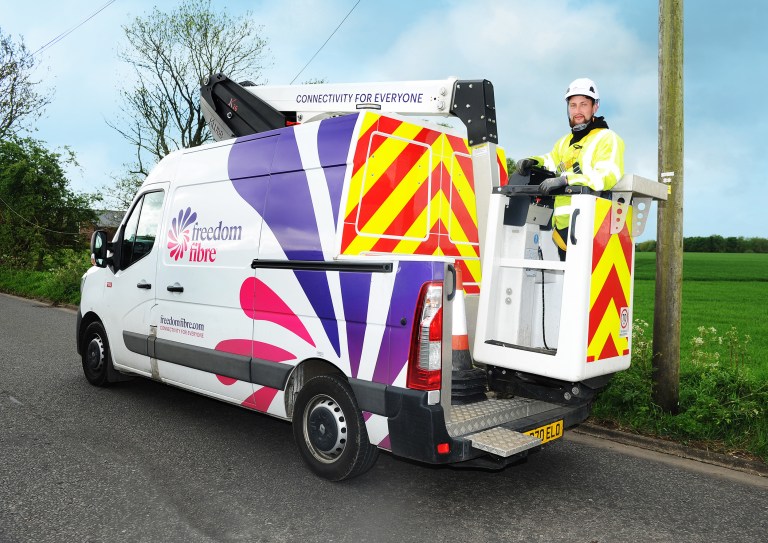
UK altnets Freedom Fibre and VX agree merger 


News

UK altnets Freedom Fibre and VX UK / VX Fibre, which is backed by infrastructure manager InfraBridge have signed an agreement this week to merge their businesses

The newly combined group will operate as name Freedom Fibre under their CEO Neil McArthur and his management team, and will have a network of 285,000 premises. 

VX UK mainly operates in and around Stoke-on-Trent, but has fibre assets in Bristol and Colchester. Freedom Fibre, which was launched in 2020, offers wholesale-only services on its network, and had a long-term partnership with leading UK broadband provider TalkTalk. 

“This is a strategic merger which leverages the strengths of both Freedom Fibre and VX UK to create a larger, stronger and more diverse business backed by two significant investors with ambitions for growth,” said McArthur. 

Market consolidation is a hot topic in the UK industry at the moment – especially in the case of altnets. Currently, the UK has over 100 altnets rolling out fibre countrywide. The UK incumbent BT has long claimed that the current altnet landscape is too saturated and thus unsustainable. Therefore, it’s likely that more consolidation will occur looking into 2024. 

Back in September, Virgin Media O2 (VMO2)’s nexfibre, acquired UK altnet Upp, a firm founded in 2021 who secured £1 billion of funding to rollout fibre broadband in the East of England. 

“The UK broadband market is set to enter an era of scaled connectivity challengers, after first a period of dominance from the incumbent followed by a proliferation of altnets,” said Matthew Howett, Founder and CEO of Assembly research. “Altnets are a key piece of the connectivity jigsaw, but consolidation has been inevitable as new sources of funding dry up, focus on take-up intensifies and investors increasingly demand returns.” 

The deal is subject to regulatory approval, but is expected to close by the end of next years’ first quarter. 

Telecoms network will make or break the UK’s AI ambitions  


Contributed Article

Written by Lee Myall, CEO of Neos Networks 

It hardly needs to be said that AI has become the dominant force in technology this year, seizing the attention and investment of businesses, individuals, and government entities alike. For telecoms, like many other industries, that is unlikely to change going into next year. Juniper Research recently published its ‘Top 10 Telco Trends 2024’ with AI making an appearance in three.  

But this list, and indeed, much of the conversation around AI and telecoms, is missing something. There’s so much focus on what AI can enable, from network intelligence to voice bots, but few seem to recognise how important telecom networks are going to be for AI to live up to its huge hype. NVIDIA and their GPU chips have been the star of the show so far when it comes to the enabling infrastructure, but you cannot cash in on your NVIDIA chips without connectivity.  

The data age? You’ve seen nothing yet  

Forecasts from IDC earlier in the year predicted global spending on AI-centric systems would reach $154 billion in 2023, with this due to almost double to $300 billion by 2026. If this happens, then we are currently only scratching the surface of AI’s explosive growth. The UK government is adamant about being a major player in the space and is two years into a ten-year national strategy to make the UK a ‘global AI superpower.’ Again, however, there is no mention of ensuring telecom networks are ready to deliver on all of this promise.   

Gartner predicts that by 2025, generative AI will account for 10% of all data produced worldwide. It is less than 1% today. As more businesses start to leverage and build AI applications and generative AI tools like ChatGPT and DALL-E, the amount of data travelling through networks back to data centres will explode. IDC says generative AI alone will create zettabytes of technology in the next five years.  

Rise of the data centre  

Telecom networks will need to carry and backhaul all this extra traffic back to data centres, this is before even considering the continued growth of other data-hungry technologies like 5G or the IoT.  

To support this, building a dynamic computational infrastructure will be key, supporting AI from the network edge to data centres.  

According to research from 650 Group, almost 1 in 5 ethernet switch ports that data centres purchase will be related to AI/ML and accelerated computing by 2027. Adequate Points of Presence and strategically placed data centres will be essential to manage this rapid information flow in a cost-effective and sustainable manner. Some hyperscalers have already recognised this, with Microsoft announcing plans to invest £2.5 billion to build “next-generation AI data centres” in the UK. 

The placement of these data centres will also be crucial to maintaining the high speeds and low latencies that modern networks and real-time applications demand. This will require further data centre investment around London and further afield. For the former, however, the increasing cost of land and lack of access to adequate power could halt investment by an alleged £500 million.  

Investment in new facilities is already moving North to cache data near hubs like Liverpool and Manchester but expanding AI data centres in the Nordics are expected to generate substantial data traffic to the North West of the UK, prompting further investment in data centres in Northern England as AI evolves. If London’s data centre investment becomes too untenable, the balance of power (or data, to be precise) could shift.  

AI ready networks  

However, to ensure AI works effectively across the UK, it’s not enough to just build data centres. The ability of the networks to transport large amounts of data back and forth to these data centres for processing will also be key. This means having a network infrastructure that is not only widespread but also able to handle the heavy data traffic necessary for AI applications. Additionally, internet service providers will need to store data close to the user so that services can be provided quickly and efficiently, tailored to their specific location.  

 As large data centres transition to faster, more scalable infrastructures, high-capacity connectivity will be essential to keep pace with the ever-expanding number of users, devices, and applications. The OEM ecosystem has done a great job at pushing the boundaries of what is achievable by pushing the laws of physics, and 400G proliferation continues at pace, but the industry will increasingly embed 800G and even 1.6TB solutions.  

So, despite all the exciting and potentially transformative applications of AI for telecom networks, the two have a far more codependent relationship than many realise. If the nation’s fixed infrastructure is not equipped to manage the increasing volume of data, its AI ambitions could flounder. Telecom providers must then prepare to support the growing demands of AI. Businesses investing in AI will also need to consider network partners capable of meeting their needs. Likewise, the government need to recognise and consider supporting the vital role these networks will play in shaping the UK’s AI future. 

Keep up to date with the latest international telecoms news by subscribing to the Total Telecom newsletter

Also in the news:
First Elizabeth line stations get high-speed mobile coverage
57% of the UK premises have full-fibre access, says Ofcom
Nokia’s 5G drone-in-a-box certified by FCC

Spain to purchase a 10% stake in Telefónica following STC’s acquisition 


News

At the current market value, the stake is estimated to be worth €2 billion 

The Spanish government is set to acquire a 10% stake in Telefónica through the state holding company Sociedad Estatal de Participaciones Industriales (SEP)I, following Saudi Arabia based STC group’s acquisition of a large stake earlier this year. 

Back in September, STC group acquired a 9.9% stake in Telefonica which was worth €2.1 billion, then becoming the company’s largest shareholder. The deal includes the acquisition of 4.9% of Telefonica’s shares, with the remaining 5% stake derived from various financial instruments. However, a stake of this size is subject to government approval, which is expected to happen early next year. 

At the time, STC confirmed that they do not intend to acquire a majority stake in Telefónica, but instead see the move as a “compelling investment opportunity to use our strong balance sheet whilst maintaining our dividend policy,” according to a statement by STC CEO Olayan Alwetaid. 

Spain’s ministry of economy, commerce and business stated that the acquisition would give “stability to the company and the development of its plans in our country.” 

Yesterday, Spain’s deputy Prime Minister Nadia Calviño said that the purchase was “in line with other large European countries, such as France and Germany, which have and are increasing their shareholdings in big and strategic telecommunications operators”. 

Indeed, the move represents a partial renationalisation of the Telefónica, which has been a fully private company since 1997. 

Upon the news, Telefónica shares were up 3.6%. 

Want to keep up to date with all of the latest international telecoms news? Sign up for Total Telecom’s daily newsletter  

Also in the news:
Vivendi takes legal action over TIM sale
Gigaclear secures £1.5bn in fresh financing
Scotland to receive £450m in Gigabit Broadband Upgrade  

First Elizabeth line stations get high-speed mobile coverage


News

Four central London stations on the Elizabeth line have been provided with mobile coverage for the first time this week

The four stations, Bond Street, Tottenham Court Road, Farringdon and Liverpool Street have all now been equipped with high speed mobile coverage from the ticket halls to the platforms.

All four mobile network operators – Three UK, EE, Vodafone, and Virgin Media O2 (VMO2) – are taking part in the rollout, which has so far delivered 4G on sections of the Jubilee, Northern and Central lines. 

Boldyn Networks, who are working on the rollout as part of a 25 year-long strategic partnership with TFL, claim that by the end of spring next year, the whole 73 of the Elizabeth line will have mobile coverage. Boldyn Networks were formerly known as BAI Communications up until they rebranded in June this year. The company’s partnership with TFL was signed in 2021, and is worth £2.2 billion.

“The new mobile coverage at these stations will be a major boost for those travelling around London – connecting key business centres and some of the popular parts of Central London and the West End,” said London Mayor Sadiq Khan.

“This is another important milestone in our mission to deploy a new digital infrastructure across London that connects businesses and people, and helps to make the city a safer and smarter place to live, work and travel,” said Billy D’Arcy CEO of of UK & Ireland at Boldyn Networks.

Want to keep up to date with all of the latest international telecoms news? Sign up for Total Telecom’s daily newsletter 

Also in the news:
Vivendi takes legal action over TIM sale
Gigaclear secures £1.5bn in fresh financing
Scotland to receive £450m in Gigabit Broadband Upgrade  
57% of the UK premises have full-fibre access, says Ofcom


News 

Ofcom’s annual Connected Nations report, which provides progress update on the availability of broadband and mobile services in the UK has been released today

The report found that 78% of the UK is now covered by gigabit-capable broadband, which is an 8% increase on last year, when there was 70% coverage.  

The number of premises without access to what Ofcom class as “decent” broadband is just 61,000, or 0.2% of the UK. Additionally, it was found that 57%, or 17.1 million premises have access to a full-fibre network, which is a huge increase of 4.6 million premises, or 15 percentage points on last year. Northern Ireland takes the lead in terms of full-fibre, with 91% of homes having access. However, according to broadband expert at Broadband Genies Alex Tofts, this figure means the UK is lagging behind other European countries such as Portugal, Spain, Sweden, Norway and France. 

For clarification, Ofcom defines “decent” broadband as 10Mbps+, “Superfast” as 30Mbps+ and “Gigabit” equates to 1Gbps+. 

In the mobile category, in the case of outdoor 5G coverage provided by at least one Mobile Network Operator (MNO), this rose from 67-78% in 2022, to 85-93% this year. However, 81% of all mobile traffic is still carried by 4G. Meanwhile, many MNOs have begun the switch off of their 3G networks, which carry less that 3% of all mobile data traffic.  

“The rapid rise in availability of full-fibre broadband is good news for people and businesses across the UK, with millions more able to benefit from fast, reliable and future-proof internet,” said Lindsay Fussel, Ofcom’s Network and Communications Group Director. 

“When the time comes to take out a new broadband contract, we encourage people to shop around and find out what options are available to make sure they are on the best package for their needs,” she continued. 

In addition to the report, Ofcom released their interactive International Broadband Scorecard for 2023, which compares the UK to other nations in relation to broadband availability. For example, out of eleven key global markets, the UK ranks sixth in terms of the percentage of households with access to gigabit speeds. 

The full Connected Nations report can be found here. 

Want to keep up to date with all of the latest international telecoms news? Sign up for Total Telecom’s daily newsletter 

Also in the news:
Vivendi takes legal action over TIM sale
Gigaclear secures £1.5bn in fresh financing
Scotland to receive £450m in Gigabit Broadband Upgrade  

Nokia extends partner program to accelerate Drones-as-a-Service business in North America


Espoo, Finland – Nokia today announced the extension of a Drones-as-a-Service partner program with existing private wireless partners to provide Nokia Drone Networks benefits to industries in North America. Through this collaboration, enterprises and service providers will be able to rapidly realize the capabilities of drones, in a way that meets the needs of their business as well as benefit from new use cases and revenue streams.

Enterprises can opt to purchase the Nokia Drone Networks industrial grade drone-in-a-box solution or minimise upfront capital expense by leasing, sharing or simply hiring drones for one-off or regularly scheduled flights. Nokia and the members of its partner program will offer bundled service packages tailored to the needs of enterprises, including managing data analytics or drone maintenance. The companies will also manage flight scheduling, working with relevant spectrum and airspace regulators to gain approvals, where required.

Drone service providers will benefit from being able to diversify their offering to more industries and realise new revenue streams. This is made possible through Nokia’s commitment to collaborating with industry partners, allowing users to customise the payloads, to meet their business needs.

Companies that choose to deploy or lease Nokia Drone Networks will benefit from an end-to-end solution, which has recently received certification from the Federal Communications Commission (FCC) for operation in North America.

Nokia Drone Networks uses public and private 4G/LTE and 5G network connectivity for the greatest reliability and safety of Beyond Visual Line of Sight (BVLOS) operations. Operated remotely for one-off or scheduled flights, the solution benefits from a highly ruggedised docking station that doubles as a recharging station. This makes it possible for enterprises to rely on the solution to realise new efficiencies and capabilities such as surveillance at remote facilities, environmental or stockpile monitoring at a mine, managing inspections in hazardous locations or for public safety search and rescue operations.

Deployed in conjunction with Nokia Digital Automation Cloud (DAC) and Nokia MX Industrial Edge at their campus network, enterprises will be able to leverage robust, reliable connectivity, service predictability and the ability to process data obtained from the drones in real-time, on-premises to open the door to an array of innovative use cases and accelerate their return on investment.

Stephan Litjens, Vice President of Enterprise Campus Edge Solutions at Nokia, says: “We are pleased to leverage our existing private wireless partnerships, such as the one with DXC Technology to offer Drones-as-a-Service to the North American market. This allows us to offer our innovative solution in a way that meets the complex needs of any enterprise or industry. Through our work with partners across all regions, we’ll maintain a strong collaboration with spectrum and airspace regulators and the ecosystem to ensure we balance innovation with safety for customer flights.”

While visiting Nokia in Espoo, to witness the Drone use cases firsthand, the DXC Team stated: “We want our customers to book a drone flight with the simplicity of hailing a ride-share. Enterprises will benefit from simplicity, leveraging a complete FCC certified drone-in-a-box solution provided by a single vendor without headaches as we manage the flight approval for them working with the relevant authorities. They can adopt drones however it makes sense for their business. And those that choose to deploy the drone-in-a-box solution alongside Nokia DAC private wireless will leverage the greatest capabilities, unlocking new use cases for the fastest return on investment.”

Resources and additional information