Verizon doubles down with second private 5G deployment at Port of Virginia


News

The private 5G network will enable new technologies including drones, autonomous vehicles, and push-to-talk mobile capabilities

In the summer of last year, Verizon Business stuck up a deal with the Port of Virginia, pledging to deploy a private 5G network at the Virginia International Terminal (VIT), one of the port’s main container terminals.

The partners said the deal would allow the port operator to explore the use of cutting-edge technologies throughout the location, most notably autonomous over-the-road trucks to drop-off and pick-up shipping containers.

Now, roughly 18 months later, it seems that the deployment has been a major success, with Verizon announcing its intention to repeat the deployment at another of the port’s neighbouring locations, the Norfolk International Terminal (NIT).

The new deployment will cover 270 acres of the NIT, replacing the existing Wi-Fi solution. The network’s hardware will be provided by Ericsson.

As before, Verizon says the private 5G network will facilitate the use of a wide range of modern industrial solutions, including safety and surveillance drones, autonomous trucks, and remotely controlled cranes. Combined, these new technologies should greatly improve the port’s operational efficiency and reduce downtime, as well as increasing worker safety.

It will also incorporate Verizon’s Push-to-Talk (PTT) solution – an app-based solution that essentially turns the user’s smartphone into a walkie-talkie. PTT can reportedly allow up to 250 people to communicate via the push of a button, not only transmitting voice data but also files, photographs, and video.

“The expansion of Verizon’s private 5G presence at the Port of Virginia shows that companies can modernize and improve their operations by starting small with new technology, proving out the use cases and applications that are right for their business, and then scaling up to do even more,” said Kyle Malady, CEO of Verizon Business. “The Port of Virginia, through the private 5G journeys at VIT and NIT, epitomize how to adopt cutting edge technology to transform a business efficiently and productively.”

Verizon has been deploying private 5G networks in ports for almost two years now, the first of which having taken place in the UK at the Port of Southampton.

The fact that the Port of Virginia is seemingly satisfied enough with Verizon’s private 5G solution to essentially buy it twice is surely a major feather in Verizon Business’s cap. It also vouches for the solution’s scalability – a factor which is often bragged about in company press releases but rarely demonstrated when it comes to private networks.

Are private networks delivering on the industrial promise of 5G? Join the operators in discussion at this year’s Connected America conference live in Dallas

Also in the news:
Globe Telecom plagued by network battery theft
Digital Infrastructure: Riding the resurgent wave of telecom investment
Boldyn Networks snaps up Cellnex’s private networks business unit 
Telxius joins Google on the Firmina Subsea Cable System, connecting US, Brazil and Argentina


Press Release

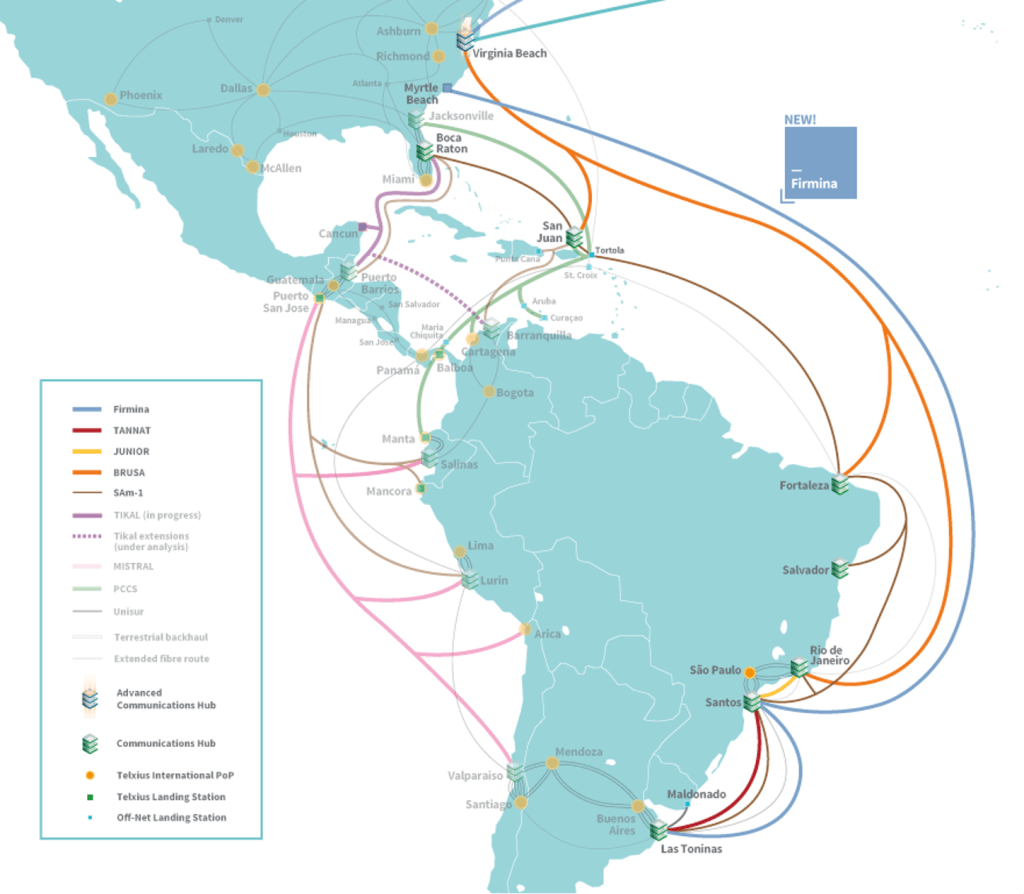
Telxius, the leading global connectivity provider, is joining the Firmina subsea cable system. Firmina will connect the East Coast of the USA to Las Toninas (Argentina), with additional landings in Praia Grande (Brazil) and Punta del Este (Uruguay). Telxius will subsequently host Firmina in its Santos digital hub in Brazil.

Telxius customers will benefit from three redundant routes between the US and Brazil (Firmina, Brusa, SAm-1) as well as three redundant routes extending to Argentina (Firmina, Tannat, SAm-1). These routes bolster the Telxius network’s resilience, ensuring robust and low-latency connectivity spanning the Americas. Together, these network routes will increase international connectivity and are expected to boost the digital economy, opening new opportunities for businesses.

“We are excited about joining Firmina which demonstrates our commitment to delivering low latency, enhanced diversity and high-capacity networking across the Americas for our customers and partners. In today’s rapidly evolving business landscape, we believe in the continuous growth of our international submarine cable network to create major business opportunities for all of us involved. We are also thrilled to announce the expansion of our collaboration with Google and confirm our shared mission to jointly invest in internet infrastructure”, said Mario Martín, CEO at Telxius.

The Telxius network has been designed to connect the main digital data hubs on both sides of the Atlantic with a multiterabit, robust set of next-generation subsea cables fully serving the Americas and Europe while enhancing Telxius traditional routes. The Telxius network spans over 100,000 km of submarine and terrestrial fiber, including eight next-generation subsea systems: Marea, Brusa, Dunant, Tannat, Junior, Mistral, Tikal, and now Firmina. Telxius also has a Tier-1 international IP network (AS 12956) offering direct Internet connectivity to major carriers and ISPs, with a capacity of more than 20 Tbps plus a wide-ranging portfolio of capacity, colocation and security services across the globe.

The submarine cable landscape is evolving rapidly. Keep up to date with all the action at Submarine Networks EMEA 2024

Also in the news:
Globe Telecom plagued by network battery theft
Digital Infrastructure: Riding the resurgent wave of telecom investment
Boldyn Networks snaps up Cellnex’s private networks business unit 

How 5G advanced has the capability to increase workplace efficiency worldwide


Insight 

Huawei and China Unicom, one of China’s largest mobile operators, have recently entered into a partnership to deploy a 5G Advanced on production line at Exquisite Automotive Systems (EA), a Chinese car manufacturer, to help improve their workplace efficiency

EA is a subsidiary of Great Wall Motors, and is responsible for the development of intelligent equipment and the design and integration of automated production lines for Great Wall Motors and other car companies. It has an annual turnover of around CNY 2 billion (£225 million).

At the Great Wall Motors factory 5G advanced equipment was set up on the car roof production line.

Normally, the line requires a wired network to connect and control the terminal equipment, such as the robotic arms, slide units and swivelling tables. Due to their intensive usage, these wires can often get worn down, which results in the interruption of production, with an average outage time of 60 hours per year.

The introduction of a 5G advanced network provides the line with a very low latency and highly reliable network that can combat issues that a traditionally wired production line faces, as the constraints of wires are eliminated.

“Digitalisation is a must for the transformation and upgrade of manufacturing enterprises. 5G-Advanced features ultra-high reliability, low latency, and easy deployment,” said, Yuan Zhanjiang, Deputy General Manager of the EA Industry Intelligence Department in a press conference.

“These features have been verified in EA’s 5G-Advanced industrial Internet lab, and will soon start supporting our commercial production lines.”

“We are working with all industry partners to build a 5G-powered industrial Internet that will help enterprises address pain points during their transformations, and ultimately facilitate upgrades to smart manufacturing,” said Fan Ji’an, Chief Big Data Scientist of China Unicom.

He also noted that more and more 5G advanced applications are implemented in these key scenarios, which is driving the manufacturing system further towards digitalisation. In turn, this creates a more efficient factory allowing for increases in productivity and potential profits. Fan added that together with Huawei China Unicom want to “begin a new chapter in China’s modernisation journey.”

5G advanced is well on the way to be deployed globally, such that 2024 will mark the first year of 5G-Advanced’s commercial use. At the Mobile Broadband Forum held in Dubai last month, 13 global operators (including China Unicom) launched the first wave of 5G-Advanced networks, marking the transition of 5G-Advanced from technical verification to commercial deployment.

Want to keep up to date with all the latest news from the international telecoms sector? Click here to receive Total Telecom’s daily newsletter direct to your inbox   

Read more about 5G advanced here:
Ensuring the future of 5G development for its continuous success
Industry mulls strategy to unleash the potential of 5G at Global Mobile Broadband Forum 2023
Why the industry must accelerate the adoption of 5.5G

DOCOMO targets Scope 3 with new Net Zero goals

NTT DOCOMO Group has announced its “Net-Zero by 2040” plan for achieving Net-Zero carbon emissions across the company’s entire supply chain by 2040. The plan builds on DOCOMO Group’s existing 2030 Carbon Neutrality Declaration, which commits the company to effectively reducing greenhouse gas emissions from its business operations to Net-Zero by 2030 under the slogan “Saving Our Planet With You.”

To achieve its expanded carbon-neutrality target by 2040, DOCOMO Group will work to reduce greenhouse gas emissions throughout its supply chain, which currently accounts for about 80% of the company’s total greenhouse gas emissions. The plan includes reducing Scope 1 (direct) and Scope 2 (indirect) greenhouse gas emissions from DOCOMO Group’s own fuel and electricity consumption, as well as Scope 3 emissions from the business activities of suppliers and product users in DOCOMO Group’s supply chain.

As part of its commitment to achieve carbon neutrality by 2030, DOCOMO Group has been actively working to use renewable energy, including non-fossil fuel certificates designated as renewable energy, through measures such as securing off-site power purchase agreements,*1 powering all DOCOMO-owned telecommunications buildings and offices with green electricity within fiscal 2023 (ends March 2024), and introducing virtualized wireless base stations equipped with power-saving devices to reduce network power consumption.

Specific measures under Net-Zero by 2040 include the goal of converting all DOCOMO Shops to green power by fiscal 2030 and prioritizing environmentally friendly products when procuring telecommunications equipment and other items. In addition, DOCOMO Group will collaborate with suppliers to provide companies within its supply chain with CO2MOSTM, a CO2 emissions visualization tool, analytical consulting services, as well as Green NexcenterTM, a service that will support the use of liquid-cooled equipment in ultra-energy-saving data centers.

DOCOMO Group is also contributing to global decarbonization through its Caboneu program for collaborating with customers and partners on various initiatives, including the Caboneu Record® visualization tool, the Green Program for EmployeesTM and other eco-friendly services, and the creation of J-credits with partner companies.

Going forward, DOCOMO Group is committed to contributing to the realization of carbon neutrality in collaboration with its partner companies.

Also in the news:
Globe Telecom plagued by network battery theft
Digital Infrastructure: Riding the resurgent wave of telecom investment
Boldyn Networks snaps up Cellnex’s private networks business unit 

Vodafone and Accenture announce strategic partnership 


News 

The move is Vodafone’s latest step towards consolidating and simplifying operations, after new CEO Margherita Della Valle described the company’s recent performance as “not good enough” 

Vodafone has announced that it intends to form a strategic partnership with Accenture, signing a Memorandum of Understanding (MoU) confirming their objectives. 

According to the duo, the purpose of the partnership is to “commercialise Vodafone’s shared operations to accelerate growth, enhance customer service and drive significant efficiencies for Vodafone’s operating companies and partner markets, as well as create new career opportunities for its people.” 

Specifically, the partnership will develop Vodafone’s internal IT and networking unit “Vodafone Intelligent Solutions” (VOIS), which supports Vodafone’s operating units and service provider partners, and has over 31,000 staff in various locations. This will be achieved through the use of Accenture’s digital solutions and platforms, as well as their expertise in the field of AI. 

As part of the partnership, Accenture will invest €150 million in VOIS, giving them an undisclosed stake in the business. Vodafone will retain both majority ownership and control of the business unit. 

“Today’s announcement is a significant development for Vodafone as we change and simplify the way we work to better serve our customers and drive growth,” said Margherita Della Valle, Group CEO, Vodafone. 

“This move speaks to their ambition to work in entirely new ways, reduce structural complexity, open avenues for growth, create better experiences for their customers and provide additional career paths for their people,” said Julie Sweet, Chair and CEO of Accenture in a statement. 

As noted in the press release, the partnership will leverage the brands, investments, scale, strengths, and expertise of both companies to build a more agile and efficient organisation that will enable its strategy to focus on customers, simplicity, and growth. 

The partnership is subject to the completion of final agreements, which are expected to close in Spring next year. 

Want to keep up to date with all the latest news from the international telecoms sector? Click here to receive Total Telecom’s daily newsletter direct to your inbox  

Also in the news:
Globe Telecom plagued by network battery theft
Digital Infrastructure: Riding the resurgent wave of telecom investment
Boldyn Networks snaps up Cellnex’s private networks business unit 

FCC queries SpaceX over direct-to-mobile satellite services


News

The Federal Communications Commission (FCC) is asking SpaceX to provide extra information to assure the regulator their new services will not interfere with existing terrestrial mobile networks

Earlier this week, the FCC sent a list of additional questions to SpaceX as part of their ongoing review of whether to approve the satellite operator’s direct-to-mobile service in the 1,990–1,995MHz (space-to-Earth) and 1,910–1,915MHz (Earth-to-space) spectrum bands.

Chief among these concerns is whether these new services would cause interference for existing terrestrial mobile networks, particularly in geographic areas where T-Mobile is licensed to operate on the same bands. As a result, the FCC is asking SpaceX to conduct an interference analysis and provide a map with projected beam coverage for the US.

The FCC is also asking the operator for more information about how SpaceX would turn off satellites if they were found to be causing interference with terrestrial services, as well as how this switch off would affect customers in adjacent areas.

“If SpaceX is required to cease operations due to harmful interference when the satellites are serving populated areas that already have full terrestrial coverage, how will this be accomplished with multiple satellites or multiple coverage areas simultaneously? How would the cessation of service in those areas potentially affect service to adjacent unserved or underserved areas? How will SpaceX prevent operation of a handset that is outside the service area of its partner terrestrial operator?” asked the FCC.

The FCC had been reviewing SpaceX’s application for its Starlink constellation since February this year, when SpaceX first revealed its ambitions for commercialising direct-to-mobile services.

Since then, SpaceX has pushed for rapid approvals from the FCC, posting on its website that it hopes to launch the new services as early as next year. The service will initially support only text messaging, with voice and internet services to be added in 2025.

However, SpaceX has received opposition to its plans from various players in the US telecoms market, most notably DISH and AT&T, who argue that SpaceX is not following correct regulatory procedure in its attempt to fast track its service to commercialisation.

Also in the news:
KPN outlines new €4.5bn network investment plan
Vodafone Germany accelerates railway 5G deployment 
nexfibre releases rollout plans

Qualcomm ends satellite partnership with Iridium 


News 

The termination will be effective from 3 December  

Qualcomm and Iridium Communications have ended a deal that was set to provide satellite communication services to mobile phones. 

The partnership, which was confirmed in January, had planned to enable satellite messaging and emergency services in smartphones powered by Qualcomm’s Snapdragon Mobile Platforms, which would be delivered through Iridium’s satellite constellation. 

The emergency messaging was expected to launch in the second half of this year for premium Android smartphones in select regions.  

However, although the technology developed by the partnership was successful, smartphone manufacturers have not included the new technology in their new devices, so the partnership has been terminated by Qualcomm. 

“While I’m disappointed that this partnership didn’t bear immediate fruit, we believe the direction of the industry is clear toward increased satellite connectivity in consumer devices,” said Iridium CEO Matt Desch in a press release. 

“Led by Apple today, MNOs and device manufacturers still plan, over time, to provide their customers with expanded coverage and new satellite-based features, and our global coverage and regulatory certainty make us well suited to be a key player in this emerging market. User experience will be critical to their success,” the statement continued. 

Iridium also confirmed that they are now seeking to work directly with smartphone manufacturers, developers, and chipmakers for existing and future service plans. 

The Iridium share price fell by 8% upon the news. 

Direct-to-mobile satellite services are becoming an increasingly hot topic across the telecoms ecosystem. Elon Musk’s SpaceX is currently seeking the approval of the Federal Communications Commission to fast-track its own direct-to-mobile satellite service. Meanwhile, the company’s rival AST SpaceMobile continues to make its own breakthroughs, notably making the first 5G call from space back in September. 

Keep up to date with international telecoms news by subscribing to the Total Telecom daily newsletter – subscribe here.   

Also in the news:
Transforming anonymised data into valuable business insights
Orange makes fresh FTTH rollout pledges to French government
BT talks up tech adoption as solution to NHS wait time woes 

Boldyn Networks snaps up Cellnex’s private networks business unit 


News 

The financial size of the deal has not been disclosed 

Cellnex and Boldyn Networks have reached an agreement that will se Boldyn will acquire Cellnex’s private networks business unit. 

The acquisition will primarily consist of Cellnex’s Finnish subsidiary Edzcom, which designs, builds, and operates private 4G and 5G networks. The company already has operations in various industrial sectors including oil and gas, mining, energy, ports, and manufacturing across multiple European markets.  

Cellnex itself only acquired Edzcom in 2020. 

Boldyn Networks, meanwhile, are one of the largest neutral host providers in the world. As such the company is well positioned to further accelerate Edzcom’s growth, according to Cellnex’s global innovation, business development and technology director Oscar Pallarols. 

“Boldyn Networks is the ideal operator to usher Edzcom into a new phase of expansive growth. Given that private networks are among Boldyn’s core activities, they are undoubtedly the ideal partner for Edzcom in this next phase of their growth,” said Pallarols. 

“Edzcom’s team capabilities, impeccable reputation and recognised expertise are an important addition to our team to capture the potential of this market across continents,” addd Igor Leprince, Group CEO of Boldyn Networks in a press release. 

“From venues and wind farms to ports and manufacturing sites, we are building upon being the partner of choice for 5G private and converged network infrastructure projects.” 

The move will serve to further enhance Boldyn Networks’ presence in multiple European markets, most notably in Finland, Spain, Germany, Sweden, and France. 

The sale seems a natural fit for Cellnex, which is seeking to reduce its large debt pile, which stood at €17.2 billion in Q2 after years of intense M&A. This including major acquisitions such as the takeover of CK Hutchinson’s European towers in 2020 (worth €10 billion).  

More recently, however, the company has shifted focus on consolidating its existing business units. In September, Investment company Stonepeak acquired a 49% stake in Cellnex Nordics, which raised €730 million of capital for Cellnex. 

The deal is subject to standard regulatory approval and is set to be completed by the end of Q1 next year. 

Want to keep up to date with the latest developments in the world of telecoms? Subscriber to receive Total Telecom’s daily newsletter here      

Also in the news:
Transforming anonymised data into valuable business insights
Orange makes fresh FTTH rollout pledges to French government
BT talks up tech adoption as solution to NHS wait time woes 

Orange makes fresh FTTH rollout pledges to French government


News 

The deal will be submitted to the French telecoms regulator, just after it had fined the company €26 million for failing to meet its deployment targets 

French mobile operator Orange has announced a deal with the French government, that will see Orange increasing its fibre deployment to 1.12 million homes by 2025. 

The deployment deal will include areas which are the least densely populated in the country, named AMII zones. The company acknowledged the stark disparity between rural and urban areas, promising to provide over 140,000 homes with fibre in the areas with the least connectivity. 

In urban areas, deployments will continue, with the aim of connecting 300,000 premises by 2025. 

“After making a major contribution to the success of the France Très Haut Débit plan (France’s superfast broadband plan) in 2022, Orange is once again working with the government to ensure the widespread deployment of fibre by 2025,” said Orange CEO Christel Heydemann. 

“Having already covered 21 million of the 36 million eligible premises in France, we’re determined to make this major project a national success, benefiting as many people as possible.” 

The announcement comes after Orange ran into legal issues concerning the rate of their fibre deployment. The French Authority for Regulation of Electronic Communications, Mail and Press Distribution (ARCEP), fined Orange €26 million for missing the first deadline of deploying fibre for broadband in 3,000 municipalities across France. The first deadline was missed in 2020, and the company was put on notice in March last year. 

ARCEP noted that Orange’s non-compliance was “particularly serious” because it harmed the interests of end users in their access to networks. 

Arguing against the claim and fine, Orange said “the fine imposed by ARCEP could further reduce the amount of investments made in the deployment of fibre, to the detriment of households waiting for connection.” 

The company will refer the issue to France’s highest administrative jurisdiction, the Council of State. 

Keep up to date with international telecoms news by subscribing to the Total Telecom daily newsletter – subscribe here.  

Also in the news:
KPN outlines new €4.5bn network investment plan
Vodafone Germany accelerates railway 5G deployment 
nexfibre releases rollout plans  

Lumen wins $110 million contract to provide network services for defense department

News

The company, which has provided 11,000 miles of fiber in support of the U.S. Department of Defense Information Network, will provide “mission-critical network services to the U.S. Department of Defense.”

Lumen Technologies has won a $110 million contract from the U.S. Defense Information Systems Agency (DISA) operate and maintain DISA’s fibre backbone.

The contract, which is the latest in a series won by Lumen, will see the company operating and maintaining colocation facilities, dark fibre, end-to-end network infrastructure, new fibre builds, and system updates “that use new technologies to improve network resilience, decrease latency and increase availability,” according to Lumen’s announcement about the contract.

The recent contract is an extension of an existing network services contract DISA previously awarded to Lumen, the company said.

Jason Schulman, Lumen national vice president, federal sales, said Lumen delivers always-on services that power the U.S. Department of Defense.

“DISA leverages the Lumen network’s strength, diversity and resiliency to achieve its mission of connecting and protecting America’s service men and women who help defend our nation,” he said.

The contract has a ceiling of approximately $110 million over a five-year period of performance until September 2028, according to Lumen’s Nov. 7 announcement.

Previously, Lumen won a $223 million contract with DISA, which was announced in Feb. 2023. In that contract, Lumen was selected to deliver voice communications services for the U.S. Department of Defense (DoD), according to Zain Ahmed, senior vice president, Lumen public sector, whose comments were included in a Feb. 2 announcement.

“DoD is modernising its network and leveraging cloud-based technologies like the new voice system enabled by Lumen that securely connects our troops with modern communications tools wherever they are,” he said at the time.

Other government contracts recently awarded to Lumen include a $1.5 billion contract from DISA to provide essential network transport and communications services in the U.S. Indo-Pacific Command Area of Responsibility and a $1.2 billion contract to deliver a fully integrated wide area data transport service with secure remote access, contact centre and cloud connectivity solutions to more than 9,500 USDA locations across the country, according to Lumen.

Before those contracts, both awarded in 2022, Lumen was awarded a $1.6 billion contract to provide secure network services and IT modernisation solutions to the U.S. Department of the Interior in 2020, according to information provided by the company.

Published by our sister title, Broadband Communities. Reach editor Brad Randall at brad.randall@totaltele.com.

Also in the news:
KPN outlines new €4.5bn network investment plan
Vodafone Germany accelerates railway 5G deployment
nexfibre releases rollout plans