Huawei and Ericsson sign global patent licensing deal


News 

Huawei is currently the world’s largest 5G patent owner with 20% of global patents 

Chinese tech giant Huawei has signed a deal with Sweden’s Ericsson to renew their patent cross-licensing agreement.  

The deal, which was last renewed in January 2016, allows each company to access each other’s patented technologies deemed vital to product standards set by 3GPP, ITU, IEEE, and IETF, covering 3G, 4G, and 5G cellular technologies. 

 “We need to pay Ericsson and Ericsson need to pay Huawei, so there is some net payment from one company to the other company,” explained Emil Zhang, Head of European Intellectual Property Rights (IPR) at Huawei. 

Financial details of the deal have not been disclosed. 

“This agreement demonstrates the commitment of both parties that intellectual property should be respected and rewarded, and that leading technological innovations should be shared across the industry,” said Christina Petersson, Ericsson’s Chief Intellectual Property Officer. 

“We are delighted to reach a long-term global cross-licensing agreement with Ericsson,” said Alan Fan, Head of Huawei’s Intellectual Property Department. 

“As major contributors of standard essential patents (SEPs) for mobile communication, the companies recognize the value of each other’s intellectual property, and this agreement creates a stronger patent environment. It demonstrates the commitment both parties have forged that intellectual property should be properly respected and protected.” 

Under the agreement made in 2016, Huawei would make “ongoing royalty payments” to Ericsson based on the sale of products using the Swedish vendor’s patents. 

Today, Ericsson says the new deal will contribute to it increasing its IPR revenues for 2023 to approximately SEK 11 billion ($1 billion). Huawei, similarly, has been a major contributor to mainstream ICT standards for over 20 years, including cellular, Wi-Fi, and multimedia codecs. Last year, the company filed 4,505 patents to the European Patent Office, the most of any company.  

Patent licencing is a major revenue stream for the company, which reportedly made between $1.2 billion and $1.3 billion from licencing between 2019 and 2021. Since then, the company has only increased its research efforts, claiming to have spent  $125 billion on R&D in the last decade. 

This revenue stream has not been without controversy, however. Back in May, it was announced that US-based network equipment maker ADVA Optical Networking would sue Huawei for charging “grossly excessive” fees for the use of their intellectual property , and asking ADVA to pay for patents not required by international standards. ADVA argue that Huawei is using its dominant position in the IP area to apply disproportionate influence over the market. 

Want to keep up to date with all of the latest international telecoms news? Click here to receive Total Telecom’s daily newsletter direct to your inbox 

Also in the news: 

Huawei’s secret semiconductor strategy to skirt sanctions
Battle for Ethiopia’s mobile money market begins as Safaricom’s M-Pesa takes on TeleBirr
What’s in a name? 6G Internet falls foul of advertising regulator over consumer confusion 

Brazil making rapid 5G progress but challenges remain on the horizon


News

According to statements from the National Telecommunications Agency (Anatel)’s president Carlos Baigorri, standalone 5G coverage now reaches almost 46% of the country’s population

Brazil’s road to 5G has been a bumpy one, full of delays, regulatory clashes, and spectrum clearing issues.

But now, just over one year since standalone 5G services were first switched on in the nation’s capital of Brasilia, the nation’s mobile network operators are surging ahead with their infrastructure deployments, with coverage reportedly now reaching almost 46% of the country’s population.

According to figures published by Brazilian consultancy firm Teleco, population coverage for 5G in the 3.5GHz band reached 45.7%, with Vivo covering 40.2%, Claro 39.7%, TIM Brasil 36.8%, and Algar 0.7%.

This encompasses 180 municipalities around the country as of July, up from just eight the same time last year.

The coverage has been achieved via the deployment of 14,796 5G base stations, almost a thousand of which had been deployed between June and July this year.

Achieving this level of coverage in such a short span of time is no small feat. The GSMA recently forecast that Brazil would only reach 47% population coverage by 2025, increasing to 84% by 2030, hence the country is already proceeding far faster than anticipated.

In the same report, the GSMA expected 5G subscribers to increase to 36.2 million by 2025 and 179 million by 2030. As of July, the country currently has just over 10 million 5G subscribers.

“The growing coverage of 5G networks in Brazil should drive take-up of the service, which accounted for around 3% of connections at the end of 2022. 5G adoption will also be supported by the increased availability of 5G smartphones. For example, TIM claimed in September 2022 that 75% of devices on sale in its stores were 5G-ready,” read the GSMA report.

Naturally, this is all very positive for the Brazilian mobile sector, reflecting a group of operators highly committed to modernising their networks and unlocking new services for customers.

Whether the operators can maintain the pace of this rollout, however, is a different story. As is always the case with infrastructure deployments, the most commercially viable areas – typically the largest cities – will be covered first, typically leaving more expensive and complicated hard-to-reach areas for last. Extending 5G coverage to these areas economically represents a challenge even in highly urbanised countries, but in Brazil – where various estimates put the rural population at between 24% and 46% of the total population – reaching the upper percentiles of population coverage will be almost impossible.

In addition to this rural challenge, it is also worth noting that Brazil is notorious for its outdated municipal legislation, which can lead to delays in deploying antennae even in some of the country’s largest cities. Operators have long called for clearer and more uniform rules regarding site deployment, but it is unlikely legislation will be introduced in time to simply the majority of the 5G rollout process.

To conclude, great progress so far for Brazilian 5G, but there are still many challenges to overcome down the road.

Want to keep up to date with all the latest telecoms news from around the globe? Sign up to receive Total Telecom’s daily newsletter direct to you inbox

Also in the news:
Dish seeks extension for purchase of T-Mobile’s low-band spectrum
Battle for Ethiopia’s mobile money market begins as Safaricom’s M-Pesa takes on TeleBirr
What’s in a name? 6G Internet falls foul of advertising regulator over consumer confusion

Huawei’s secret semiconductor strategy to skirt sanctions


News

Chinese telecoms equipment company is accused by the Semiconductor Industry Association (SIA) of building numerous new chip fabs in China under different company names in order to circumvent US sanctions

According to a report from Bloomberg, Huawei may be seeking to sidestep US sanctions by operating a network of semiconductor facilities under different company names.

U.S. Commerce Department added Huawei to its export control list back in 2019, with the company having been deemed a risk national security risk. As a result of this designation, US companies can now only sell products to Huawei if they are granted specific licences from the government.

Matters were made worse in late October, when President Joe Biden levied additional restrictions on chip technology exports,

Combined, the various sanctions in place have left Huawei largely cut off from accessing US semiconductor technology – a major blow to almost all of Huawei’s core business units, particularly smartphone manufacturing.

Huawei, meanwhile, maintains that they pose no security risk, arguing that they are simply caught in the middle of the geopolitical tug-of-war between China and the US.

Nonetheless, it launched its own semiconductor business last year, seeking to solve its chip supply issues through domestic production.

This move was largely in line with the policies set out by the Chinese government, which has made bolstering its domestic semiconductor research and production industries a major priority in recent years, seeking to remove the industry’s heavy reliance on US tech.

Indeed, these measures appear to be working for Huawei, with the company noting in recent months that they could soon return to the 5G smartphone business by procuring 5G chips domestically.

In fact, according to the SIA, Huawei has received around $30 billion in government subsidies to expand this new business. Using these funds, the SIA says Huawei has already acquired two chip-making facilities and is in the process of building three more.

By operating these businesses under new names – such as Fujian Jinhua Integrated Circuit Co. and Pengxinwei IC Manufacturing Co. (PXW), in the cases of the acquired plants – Huawei can potentially bypass at least some of the sanctions against them and retain access to key US technologies.

Naturally, such tactics are sure to draw the ire of the US government, who say they are monitoring the situation carefully.

“Given the severe restrictions placed on Huawei, Fujian Jinhua, PXW and others, it is no surprise that they have sought substantial state support to attempt to develop indigenous technologies,” a speaker from the Commerce Department’s Bureau of Industry and Security (BIS) told Bloomberg. “BIS is continually reviewing and updating its export controls based on the evolving threat environment and, as evidenced by the Oct. 7, 2022 rules, will not hesitate to take appropriate action to protect US national security.”

Want to keep up to date with all the latest telecoms news from around the globe? Sign up to receive Total Telecom’s daily newsletter direct to you inbox

Also in the news:
Dish seeks extension for purchase of T-Mobile’s low-band spectrum
Battle for Ethiopia’s mobile money market begins as Safaricom’s M-Pesa takes on TeleBirr
What’s in a name? 6G Internet falls foul of advertising regulator over consumer confusion

Why 25G PON is right for the 10G era


VIEWPOINT

Fiber broadband technology evolution is not really about technology: it is about business opportunity. Successive generations of PON technology have increased performance levels, providing the opportunity for PON to deliver unbeatable residential services and go beyond residential broadband into higher ARPU 10G services for businesses, factories, mobile backhaul, smart cities, and more.

In the UK, for example, there are more than 50 altnets building fiber networks. Competition is driving down residential broadband prices to as little as £25 per month in central London. Interestingly, Gigabit business services with a reasonable level of service agreement creates 10x more revenues, at around £270 per month. So, by adding only three business customers, a service provider can roughly double their income on a PON. Take that service level up to 10Gb/s, and ARPU goes beyond £700 per month.

10G opportunities are here today and make for an extremely compelling ROI for fiber network operators. So, what is the best way to deliver 10G?

Until recently, that speed could only be delivered by point-to-point (P2P) fiber. P2P is more costly than PON: it requires more equipment, more real estate, more fiber cabling, and consumes more energy. P2P is also an overlay network, so operators end up running both PON and P2P, which increases costs. Hence, there is a growing appetite for converging business services onto PON networks.

How can this be done successfully? XGS-PON (10G symmetrical PON) networks are becoming more widely deployed, already delivering multi-gigabit connectivity to businesses worldwide. But XGS-PON cannot reach true 10Gb/s because its capacity is limited to 8.5Gb/s due to standard specified overhead. The good news is that XGS-PON can easily run faster with 25G PON, delivering true 10G speeds and beyond from the same hardware that is being deployed today for XGS-PON. And this is already happening. There are now 1 million PON lines worldwide capable of 25G PON, enabling operators to address 10G opportunities very efficiently, and that number is growing fast.

More good news is that 25G PON can be complemented with 50G PON in the future, because the two technologies can co-exist. This will enable the delivery of even higher speeds to more customers, but that is not quite the case yet.

A fully mature 50G symmetrical solution ready for volume deployments will take many more years. Unlike 25G PON which is a straightforward evolution from the current solutions, 50G PON is a technology leap involving a new generation of components that need to mature and reach high volumes to become cost-effective. In addition, the migration to 50G PON requires the introduction of new hardware, which takes time and money. The first demonstrations of 50G PON are asymmetrical with 50Gb/s in downstream and 25Gb/s in upstream. Business services are defined as symmetric, so asymmetrical 50G PON brings no advantage over 25G PON. And finally, since both symmetrical and asymmetrical 50G PON variants share the same wavelengths, operators will need to consider swapping all 50G ONTs when they introduce the symmetrical variant. The industry has seen this kind of issue before with 10G PON, which was one of the reasons operators skipped asymmetrical XG-PON and preferred to wait for symmetrical XGS-PON.

So, is it worth considering 50G PON? Absolutely! But it doesn’t mean you have to make hard decisions between 25G PON and 50G PON, because one doesn’t exclude the other. Every operator should evaluate if they can afford to wait for fully mature and deployable symmetric 50G PON, or address the real opportunities today with 25G PON, while having an open path to 50G PON in the future.

25G PON is the most optimized solution for 10G era, and here’s why:

  • It is available, mature and being deployed today. No need to wait and lose opportunities to competitors.
  • It is easy to introduce. The OLTs and line cards in use today for GPON and XGS-PON can also support 25G PON. It’s just a case of plugging in the 25G transceiver.
  • There’s huge capacity for 10G business services and beyond, with enough bandwidth left over for residential broadband and mobile backhaul.
  • It’s the most power efficient technology for the 10G era. 25G PON delivers a 10-fold capacity boost over GPON for only a 2.5-fold power increase, consuming 0.25 watts per gigabit. 25G PON’s limited power consumption allows an ONU to be integrated in an SFP form factor (aka ONU on stick) for business and mobile transport applications, while this is not sure for 50G PON.
  • Backward compatibility with GPON and XGS-PON and forward compatibility with 50G PON make for assured migration paths.
  • It’s cost-efficient as 25G optics and electronics are mature, with component prices coming down faster than 10G components. Since 25G PON is available on existing hardware, there is very little additional investment to be made.

The industry’s experience with GPON also tells us about commercial sweet spots. Operators successfully deploy 1 Gigabit services on 2.5G GPON networks. This 1:2.5 ratio holds true for 10G business services on 25G PON.

As ever, the decision on which technology an operator will adopt comes down to the business case: when does an operator need it, and at what cost. With 25G PON offering an immediate path into highly lucrative 10G business services, the return on an investment in 25G PON looks highly appealing. All the benefits now, while leaving an open path to symmetrical 50G PON in the future.

Learn more about our 25G PON solution.

This article was written by Ana Pesovic
Ana heads the Fixed Networks Fiber marketing activities in Nokia. She built up extensive international telecom experience, with positions in sales, pre-sales and R&D in Germany, Spain, Portugal, Belgium and India. Ana has a Masters Degree in Informatics and Computer Science from the University of Belgrade. As member of the Board of Directors of the FTTH Council Europe, she’s a strong advocate of Fiber.

Nokia are Diamond sponsors of Connected Britain being held at ExCel London on the 20-21 September 2023. Get your ticket here

Granite Telecommunications deepens partnership with Juniper Networks


Press Release

Juniper Networks, a leading provider of secure, AI-driven networks, today announced that its customer and partner, Granite Telecommunications, a $1.8 billion provider of communications and technology solutions, has expanded its service offerings to include Juniper Networks’ full-stack of campus and branch services, including Wired Access, Wireless Access and SD-WAN, all driven by Mist AI™. This move will enhance Granite’s ability to support its customers’ unique verticals, such as healthcare, retail, education, manufacturing, hospitality and financial.

Granite has been working closely with Juniper for several years, and with this expanded AI-driven enterprise portfolio they now offer Juniper’s full suite of campus and branch networking solutions. By leveraging Mist AI and a single cloud across the wired, wireless and SD-WAN domains, Granite saves time and money with client-to-cloud automation and assurance, while accelerating deployments with Zero Touch Provisioning and automated configurations. In addition, Granite delivers more value to its customers with a broadened service portfolio that offers new highly differentiated services.

“Granite stands as Juniper’s largest AI-Driven SD-WAN partner in Managed Services within the Americas, underscoring the strength of our relationship and confidence in Juniper’s cutting-edge networking technology,” said Rob Hale, President and CEO at Granite. “As we expand our partnership, we are poised to elevate the customer experience to new heights by offering a full suite of Juniper solutions, imbued with the defining qualities of reliability, performance and security that characterize Juniper.”

Granite has been expanding its nationwide support to address the changing and growing needs of its customers. The company is committed to delivering specialized services for the unique requirements of its customers’ verticals. The addition of Juniper’s software-defined branch and wireless services is expected to be a significant benefit to many of its customer sectors. These services are designed to improve the performance and security of networks in various industries and make it easier for businesses to manage their network infrastructure.

“We are very excited to take our relationship with Granite Telecommunications to the next level,” said Sujai Hajela, Executive Vice President, AI-Driven Enterprise at Juniper Networks. “They have proven to be an exceptional partner and leader in the communications industry, who is especially adept at leveraging AI and the cloud to deliver high value managed services to their customers. With the full AI-driven enterprise portfolio, Granite can truly differentiate from their competition with exceptional client-to-cloud user experiences.”

With this expansion, Granite continues to demonstrate its commitment to providing customers with the best possible network experience. The addition of Juniper’s full-stack solutions will enable Granite to enhance its capabilities and better serve its customers, while also providing the company with a competitive edge in the market.

How are the latest breakthroughs in communications technologies shaking up the US enterprise space? Join the ecosystem in discussion at Connected America 2024

Also in the news:
Dish seeks extension for purchase of T-Mobile’s low-band spectrum
Battle for Ethiopia’s mobile money market begins as Safaricom’s M-Pesa takes on TeleBirr
What’s in a name? 6G Internet falls foul of advertising regulator over consumer confusion

GlobalData: FWA’s broadband market share to double in US by 2028


News

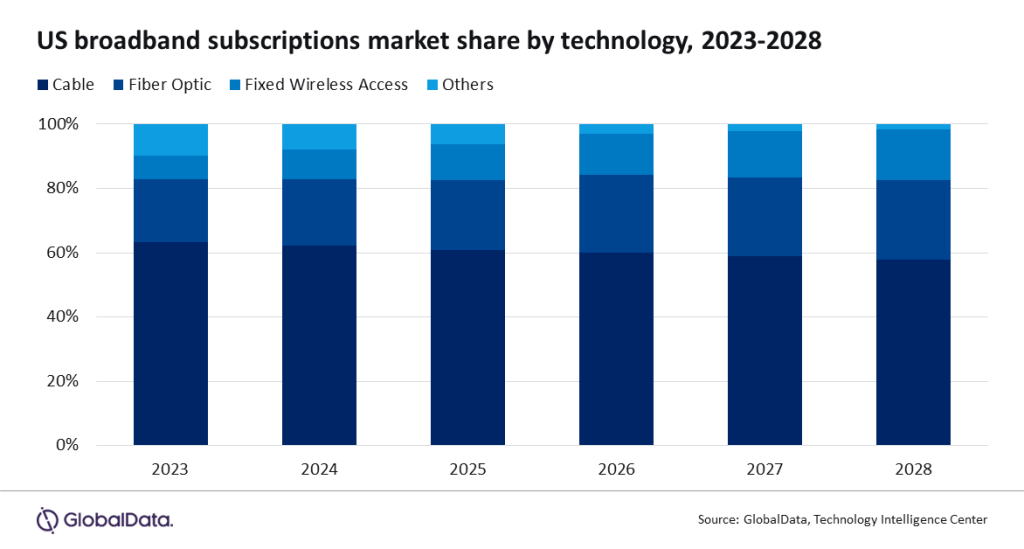
A forecast by GlobalData suggests fixed wireless access (FWA) technology will more than double its subscription market share among US broadband technologies

Since the onset of the 5G era roughly three years ago, success stories for the new technology have been few and far between.

In fact, one of the biggest successes of 5G is not using the technology in conjunction with a smartphone at all, but rather using the more powerful mobile network to provide home broadband services in the form of FWA.

Reports earlier this year suggested that interest in FWA is booming in US, with the technology accounting for roughly 90% of the 3.5 million new broadband subscriptions added in 2022.

Now, an updated report from GobalData exploring the US broadband market suggests that this growth will continue, with FWA set to amount for 15.8% of all US broadband connections in 2028, up from for 7.2% in 2023.

The report noted the technology’s easy installation and flexibility as key advantages, noting that the technology is an increasingly viable option for homes and businesses that do not yet have access to fibre networks.

“Easy self-installation and affordability, combined with high reliability and performance, thanks to underlying 5G technology, are among FWA’s selling points, but so is the fact that FWA offers a new service choice versus existing solutions from incumbent service providers. Additionally, FWA is suitable for both primary and backup internet service and can be deployed in locations where internet service may only be needed temporarily,” explained GlobalData’s Principal Analyst Tammy Parker.

The report also noted, however, that FWA will ultimately have a hard time competing with the speed and reliability of fibre broadband – a technology that is set to become increasingly available throughout the US in the next five years due to the enormous amount of public funding being delivered as part of the Infrastructure Investment and Jobs Act.

“Fiber presents a significant challenge as it is highly reliable and can deliver the symmetrical multigigabit speeds that are increasingly demanded by consumers and businesses. Additionally, fibre deployment is gaining momentum as government subsidies lead to an unprecedented expansion of the nation’s fibre broadband infrastructure, leading this technology’s share of the market to grow from 19.5% in 2023 to 24.7% in 2028,” added Parker.

But despite the rise of fibre, FWA is sure to remain a complementary technology for many years to come, particularly in hard-to-reach areas where deploying fibre is unfeasible.

This increase in FWA’s popularity is not a purely US phenomenon. In India, for example, Bharti Airtel recently launched the country’s first 5G FWA offering, noting that just 34 million of the 303 million households in the country currently had access to fibre and so presented a major opportunity for FWA.

How is the rise of FWA impacting the US broadband market? Join the operators in discussion at Connected America 2024

Also in the news:
Dish seeks extension for purchase of T-Mobile’s low-band spectrum
Battle for Ethiopia’s mobile money market begins as Safaricom’s M-Pesa takes on TeleBirr
What’s in a name? 6G Internet falls foul of advertising regulator over consumer confusion
Dish seeks extension for purchase of T-Mobile’s low-band spectrum


News

Dish Network and T-Mobile have jointly asked the Federal Communications Commission (FCC) to reallocate the 800MHz spectrum, but Dish wants more time to pay for it

This week, Dish has confirmed to the FCC that it intends to purchase spectrum in the 800MHz band from T-Mobile, saying that it will play a key role in accelerating their 5G network coverage.

“As Dish continues to deploy and increase coverage with this first-of-its-kind network, it will expand the availability of competitive services offered to both consumer and business customers,” said Dish in the filing. “The 800MHz spectrum licenses contemplated by this transaction will substantially enhance Dish’s ability to do so.”

The purchase relates to the Sprint–T-Mobile merger back in 2020, with Dish having agreed to build out its own 5G network and become a national mobile operator as part of the deal to appease regulatory authorities. As part of this process, the mobile newcomer was given the option to pay T-Mobile $3.59 billion for a 13.5MHz block of nationwide spectrum in the 800MHz band.

If Dish instead decided not purchase these spectrum licences from T-Mobile, it will owe the latter $72 million.

While unable to offer the same level of 5G performance as mid-band (C-band) spectrum, this low-band spectrum was nonetheless seen as invaluable for rolling out services due to its long-range.

The prearranged deadline for Dish to make its decision on the spectrum passed earlier this year, with the two companies locked in negotiations for many months.

Now, the filing from both Dish and T-Mobile to the FCC indicates that the spectrum purchase will indeed go ahead, though the exact financial details of the deal have not been revealed.

However, there is a catch: Dish is asking the US government that it be given ten more months to make the requisite payments to T-Mobile.

The company argues that the global economic downturn has made paying for the spectrum more difficult than anticipated.

“The dramatic increase in interest rates has made it significantly more expensive for Dish to finance a purchase of the 800MHz Spectrum Licenses, rendering its ability to responsibly do so within the timeline provided by the Final Judgment substantially more difficult than Dish – or other parties to the Final Judgment – ever could have anticipated,” Dish told the U.S. District Court for the District of Columbia.

Indeed, Dish’s finances have been strained for some time, with the company currently carrying around $21 billion in debt.

The company recently announced that it would merge with its previous parent company EchoStar, in a move largely seen as an effort to bolster the company’s balance sheet.

T-Mobile has not said whether it will oppose the requested extension.

How will the growth of Dish’s 5G network impact the US wireless market? Join the operators in discussion at Connected America 2024 live in Dallas, Texas

Also in the news:
Sky Business considers buying up TalkTalk B2B unit
Australian govt launches Telecommunications Disaster Resilience Innovation programme
SK Telecom to invest $100m in AI firm Anthropic  

Ericsson hits 5G carrier aggregation milestone with world’s first 6CC data call


Press Release

Ericsson revs up the tempo on 5G Carrier Aggregation by combining six component carriers to set a record download speed of 5.7Gbps for the world’s first 6CC (component carrier) data call

The data call was achieved using three FDD (frequency division duplex) bands combined with three TDD (time division duplex) bands in sub-6GHz, enabled by Ericsson RAN Compute hardware, state-of the-art carrier aggregation software, and innovative Advanced RAN Coordination functionality.

The 3FDD + 3TDD carrier aggregation testing was carried out in an Ericsson lab with a user equipment (UE) simulator. By combining FDD spectrum with TDD spectrum, more users can benefit from carrier aggregation gains.

In total, 400MHz of bandwidth was aggregated with FDD bandwidths ranging 20MHz to 50MHz to achieve the 5.7Gbps throughput. With six-component carrier capability, communications service providers can optimize use of network and spectrum assets to deliver higher data speeds and capacity that improve the experience of downlink-heavy applications. This can mean better audio and video quality for streaming users, faster file downloads, and a better working environment for digital nomads.

Sibel Tombaz, Head of Product Line 5G RAN at Ericsson Networks, says: “We are keeping the momentum on carrier aggregation by continuously stretching its potential to boost capacity and speed. Our successful 6CC data call shows how versatile our solution is and that we are poised to work with ecosystem partners to make this new band combination a reality. Our goal, as always, is to help customers meet end users’ growing appetite for high-capacity, ultrahigh-speed 5G.”

“Carrier Aggregation is crucial to getting the best possible 5G performance out of scattered spectrum assets,” Tombaz adds. “And with 6CC, service providers will be able to maximize use of allocated spectrum and optimize the combined bandwidth for superior mobile experience.”

Also in the news:
Sky Business considers buying up TalkTalk B2B unit
Australian govt launches Telecommunications Disaster Resilience Innovation programme
SK Telecom to invest $100m in AI firm Anthropic  

Huawei Network Summit 2023 (Asia Pacific): Innovations Never Stop, Unleashing Digital Productivity


VIEWPOINT

The Asia Pacific stop of Huawei Network Summit (HNS) 2023 was held successfully in Jakarta, Indonesia. With the theme of “Innovations Never Stop”, HNS attracted more than 800 customers and partners from Indonesia, Thailand, the Philippines, Malaysia, and many other Asia Pacific countries.

At HNS, Leon Wang, President of Huawei’s Data Communication Product Line, delivered a keynote speech titled “Innovations Never Stop”, shedding light on how Huawei’s Intelligent Cloud-Network Solution takes network quality to new levels. Specifically, Huawei further enhances its CloudCampus, CloudFabric, and CloudWAN solutions from the perspectives of experience, intelligence, and convergence, respectively. On top of that, Huawei unveiled many groundbreaking products, including a first-of-its-kind experience assurance card (used on flagship campus switches), CloudEngine 16800-X (a 400GE data center network switch), NetEngine F8/M14 (converged transport routers), and iMaster NCE Network Digital Map. All of these offerings empower networks with innovations and unleash digital productivity at an accelerated pace.

Launching Huawei’s groundbreaking network innovations

Leon Wang pointed out that Asia Pacific countries attach great importance to digital transformation and therefore greatly accelerate digital transformation across diverse industries. Against this backdrop, data communication networks — a cornerstone for digitalization — need to constantly innovate to meet diversified needs of industries. For example, as governments accelerate digital transformation, there is a huge demand for HD video conferencing to ensure seamless communication experience. Likewise, the finance industry is digitally evolving to Bank 4.0. As such, multi-cloud and multi-vendor become the new norm, requiring data center network operations and maintenance (O&M) capabilities to be constantly upgraded. Another example is the Internet service provider (ISP) sector. ISPs need to provide high-quality network support capabilities to assist enterprises as they enter a period of rapid growth and increasingly demand stable services and bandwidth growth.

Leon Wang, President of Huawei’s Data Communication Product Line, delivering a keynote speech

In response, Huawei constantly innovates its Intelligent Cloud-Network Solution by enhancing CloudCampus, CloudFabric, and CloudWAN from the perspectives of experience, intelligence, and convergence, respectively.

  • CloudCampus 3.0 + Experience: Huawei’s high-quality 10 Gbps CloudCampus solution focuses on user experience and stands out with four unique features: ultra-high-speed access, simplified architecture, ultimate experience, and simplified O&M. This solution is a great fit for public service, education, finance, transportation, and other industries, where it can help to build a non-blocking office network. The resulting benefits include smooth video conferencing, 50% lower network construction costs, and fast fault recovery in minutes.
  • CloudFabric 3.0 + Intelligence: Huawei’s CloudFabric data center network solution becomes more intelligent than ever, and takes on three distinctive features: ultra-powerful performance, ultra-fast deployment, and ultra-intelligent O&M. In diverse industries like finance, public service, and education, this solution can improve AI training efficiency by 20%, provision services across clouds and data centers in minutes, locate network root causes for application exceptions with one click, and demarcate faults in minutes.
  • CloudWAN 3.0 + Convergence: Huawei’s converged CloudWAN solution creates new value for customers through converged networks, converged devices, and converged management. Leveraging Huawei’s solution, customers in industries such as ISP, urban rail, and energy can reduce the total cost of ownership (TCO) by 65% and capital expenditure (CAPEX) by 50% while increasing O&M efficiency by 60%.

Looking ahead, Huawei will continue to innovate and overcome technical bottlenecks through more R&D investments. Furthermore, Huawei will keep aligning best-in-class products and solutions with customers’ future business development. Doing so will help a wide range of industry customers to bridge technical divides and stay ahead of the competition. Huawei’s extensive training and communication platforms help customers gain fresh insight into leading products and solutions, and explore unique ways to unleash digital productivity.

Vincent Liu, President of Huawei’s Enterprise Network Marketing & Solution Sales Dept, announcing the IP Club member program

At HNS, Vincent Liu, President of Huawei’s Enterprise Network Marketing & Solution Sales Dept, announced the kick-off of the first IP Club member recruitment program in the Asia Pacific region, recruiting more than 350 members during the event.

IP Club is an IP industry peer communication platform initiated by Huawei. IP Club members can enjoy diversified member-only activities, such as in-person technical workshops, face-to-face meetings with industry experts, IP Club Carnival, and peer interaction in the online community. The IP Club program helps build an IP industry community in the Asia Pacific region that unites more IP industry experts and opinion leaders. To date, Huawei has brought together over 2800 IP Club members worldwide.

Battle for Ethiopia’s mobile money market begins as Safaricom’s M-Pesa takes on TeleBirr


News

The mobile money platform, the largest in Africa, will take on incumbent operator Ethio Telecom’s own fintech service, Telebirr

This week. Kenyan operator giant Safaricom has launched their M-Pesa mobile money platform in Ethiopia.

The move marks a key part of newcomer Safaricom’s Ethiopian strategy, seeking to replicate the success that their M-Pesa already enjoys in numerous markets across the African continent.

M-Pesa was first introduced by Safaricom in Kenya in 2007. Since then, the service has grown almost exponentially, expanding into six additional African markets and processing transactions worth over three times Kenya’s GDP every year.

Safaricom grows Ethiopian subscriber base

The consortium now known as Safaricom Ethiopia (at the time called ‘The Global Partnership for Ethiopia’) first entered the market back in 2021, having paid the government $850 million for a mobile operating licence.

Since then, the company has been racing to rollout mobile infrastructure, as well as signing a network sharing deal with incumbent Ethio Telecom in April 2022 to begin offering services across the country.

Today, the company’s own infrastructure covers over 21 cities, with the company having attracted over two million subscribers.

The path to launching their own mobile financial services, however, has been less clear.

A rivalry brewing with Ethio Telecom’s TeleBirr

Launching M-Pesa in Ethiopia was one of the key attractions for Safaricom in battling for a mobile operating licence, with the country’s population of 120 million presenting extraordinary potential for revenue growth. However, the company was restricted from launching M-Pesa immediately, with the Ethiopian government forcing them to wait a year in order to give incumbent Ethio Telecom a chance to launch their mobile money platform first.

This Ethio Telecom did in 2021 in the form of TeleBirr, allowing customers to make cashless transactions using their mobile device, including sending and receiving money, depositing and withdrawing cash from selected locations, paying bills, and receiving cash sent from abroad.

With no local competition, TeleBirr quickly racked up customers in Ethiopia’s mobile money space, earlier this year reporting roughly 34 million active users of its platform. In the six months from July 2022 to January 2023, the platform reportedly processed roughly $3 billion in transactions, generating around $1.5 million in revenue for Ethio Telecom.

The scale of TeleBirr’s lead in the Ethiopian market should not be underestimated – M-Pesa’s entire user base across all seven of its existing markets is roughly 53 million users.

Nonetheless, the addressable market in Ethiopia continues to grow at an impressive pace, with Safaricom noting M-Pesa’s role as a key enabler for expanding financial inclusion, just as it has done in Kenya.

“M-Pesa is known to be a game-changer for financial inclusion,” said Stanley Njoroge, Safaricom Ethiopia’s interim CEO. “We will continue to broaden the services our customers receive from the M-Pesa platform.”

Next steps for Ethiopia

The Ethiopian government is only part way through its telecoms liberalisation journey, with plans to sell off a 40% stake in Ethio Telecom recently drawing attention from major international operators, including Orange and e&.

The government has also indicated that it still has plans to relaunch an auction process for an additional telco operating licence in the country, potentially increasing the number of national operators from two to three.

However, both the stake sale and the licence auction have been delayed numerous times, both by the global economic situation and civil unrest in the country’s Tigray region. Even now, with the economy somewhat more settled and the cessation of hostilities, no concrete timeline has been proposed for either process.

Want to keep up to date with all the latest telecoms news? Sign up now to receive Total Telecom’s daily newsletter direct to your inbox

Also in the news:
Sky Business considers buying up TalkTalk B2B unit
Australian govt launches Telecommunications Disaster Resilience Innovation programme
SK Telecom to invest $100m in AI firm Anthropic