

Three bits of regional connectivity news from around the US worth catching up with at midweek: … [visit site to read more]

Three bits of regional connectivity news from around the US worth catching up with at midweek: … [visit site to read more]
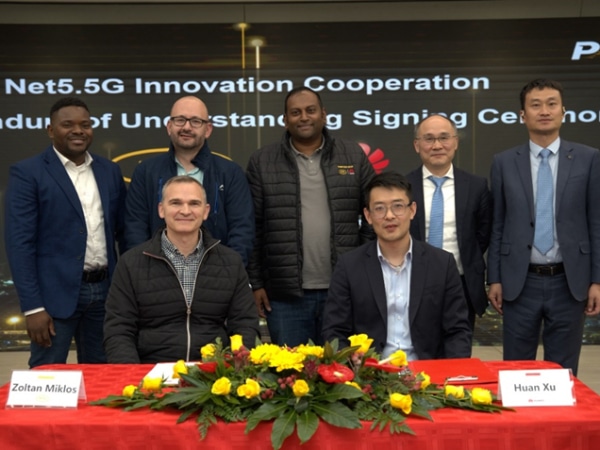
MTN South Africa and Huawei co-hosted the IP Day Summit themed « Net5.5G Network Development.”
The summit brought together top experts from MTN’s network planning and Huawei’s data communications teams. They discussed global network construction concepts, latest innovative technologies, and business insights in the IP field, aiming to further improve MTN’s network resilience and service experience.
At the summit, MTN and Huawei signed a memorandum of understanding (MoU) for strategic cooperation on Net5.5G. Through this MoU, they will jointly promote the large-scale application of key capabilities of Net5.5G, such as 400GE, SRv6, slicing, and the Network Digital Map, to continuously improve MTN’s service experience and network availability in the mobile and B2B fields, and improve its O&M efficiency.
Rami Farah, CTO of MTN SA, said that innovation is important for MTN and forms a key pillar in MTN network strategy.
Zoltan Miklos, General Manager of Access Planning and Architecture, MTN SA, said that healthy and stable networks have long been the focus of MTN. He pointed out that the application of SRv6 and Network Digital Map has helped MTN build an IP transport network with optimal experience. He also noted that in the cloud and 5G era, MTN still faces a range of challenges in terms of service and network operations, security, reliability, and other areas, and that MTN looks forward to deepening cooperation with Huawei.
Feng Su, President of Huawei’s IP Marketing and Solution Sales Dept., emphasised that Net5.5G is the future of IP networks and that Huawei has made long-term investments in ultra-broadband products, network servitisation, network intelligence, and more. He added that Huawei looks forward to helping MTN build a leading IP transport network featuring ultra-broadband, high reliability, and ultimate experience so as to help MTN achieve greater business success.
Xu Huan, Vice President of Metro Router Domain of Huawei’s Data Communication Product Line, said Huawei will work with MTN to accelerate the commercial use of the next-generation IP transport network under the guidance of the Net5.5G target network.
According to the MoU, MTN and Huawei will continue to define the Net5.5G target network and support the sustainable development of MTN’s mobile, enterprise, and home broadband services. The cooperation between MTN and Huawei will set a good example in the region, accelerate the implementation of new technologies and applications, and drive the sustainable development of regional carriers.

Smartphone shipments have for the first time surpassed feature phone stock in Africa, showcasing the rise in adoption of more advanced handsets across the region.
Analyst house IDC detailed in its report smartphone units grew 17.9% year-on-year reaching 20.2 million units in the first quarter of this year, as feature phones declined 15.9% to 18.8 million units.
IDC senior research analyst Arnold Ponela noted South Africa and Nigeria, the largest smartphone markets in Africa, drove growth due to popularity of Chinese brands. Kenya was the third-largest smartphone market in Africa by driving sales growth with financing schemes.
Transsion, which houses the Tecno, Itel and Infinix smartphone brands was the leading smartphone vendor in Africa due to its “compelling entry-level portfolio” that are “tailored” to the African market. However, Samsung and Xiaomi gained market share on the previous quarter, driven by mid-range ($200 to $400) models. Market share numbers were not broken down by IDC.
Shipments of mid-range smartphones increased in Q1 while sub-$100 devices declined, “indicating a growing consumer preference for feature-rich models”.
Looking ahead for this year, IDC predicted the smartphone market in Africa will see 5.7% YoY growth in 2024. Growth is expected to sustain over the next five years.
« Africa remains a market with a high share of feature phones, although they are expected to gradually decline as the transition to smartphones gains momentum, » said IDC Research Manager, Akash Balachandran.
“This shift, coupled with rising demand, will be the key driver of overall growth in the smartphone market. Persistent inflationary pressures and escalating macroeconomic uncertainties may cause short-term fluctuations but will not impede the long-term transition. »
One vendor win under the ocean, another on land, and a shift in the data center market in Canada: … [visit site to read more]

There was an interesting M&A in the infrastructure space this morning. Lightpath has announced the acquisition of the assets of United Fiber & Data. The deal takes Lightpath south all the way to Ashburn in one fell swoop. … [visit site to read more]
Three international projects that each touch the continent of Africa, and a federal contract. … [visit site to read more]

Indonesian operator Telkomsel says it has completed the first validation of Wi-Fi 7 in Indonesia together with the Ministry of Communication and Information (Kominfo) as it makes plans to adopt the technology for its fixed broadband services.
Telkomsel said on Thursday that it has carried out trials of Wi-Fi 7 with Kominfo and several unnamed global technology partners, which it says opens up opportunities for internet speeds of up to 10 Gbps, as well as more user capacity, lower latency, and better energy savings.
“In trials along with Low Power Indoor (LPI) device specifications, the functionality and capabilities of Wi-Fi 7 have demonstrated performance and stability that can significantly improve the network experience and exceed expectations,” Telkomsel said.
Wi-Fi 7 (a.k.a. 802.11be) promises theoretical peak download speeds of over 40 Gbps. Like its predecessor, Wi-Fi 6E, Wi-Fi 7 uses the 2.4-GHz, 5-GHz and 6-GHz bands. Unlike Wi-Fi 6E, Wi-Fi 7 allows wider bands for 5 GHz and 6 GHz, as well as multi-link operation that enables channels to be combined for faster speeds and more efficient performance. However, while Wi-Fi 7 is backwards compatible with Wi-Fi 6E, users need WiFi 7 routers and devices to get the full benefits of the latest version.
Telkomsel VP of Technology Strategy and Consumer Product Innovation Ronald Limoa said Wi-Fi 7 was a core technology that can complement home internet network solutions by increasing smoothness and efficiency to provide a better network experience in homes or offices.
While Telkomsel says it’s completed the first validation of Wi-Fi 7 in Indonesia, it’s not the first service provider in the country to announce it will adopt it. On May 30, multinational ISP MyRepublic teamed with Chinese vendor ZTE to launch what they said was the first Wi-Fi 7 product in Indonesia. ZTE and MyRepublic said they would collaborate to promote commercial implementation of Wi-Fi 7.
MyRepublic Indonesia, which is owned by Indonesian conglomerate Sinar Mas, first launched services in the country in 2015 and currently offers ISP services in 45 cities and 61 regencies.
ZTE Corporation, a global leading provider of integrated information and communication technology solutions, recently released the company’s Sustainability Report 2023, detailing its strategies, actions and progress in green innovations, social contributions and corporate governance.
As a Driver of Digital Economy, ZTE has been releasing sustainability reports for 16 consecutive years, highlighting its unwavering commitment to sustainable business.
Xu Ziyang, CEO at ZTE, stated in the report: « We uphold the Human-Centric and Tech for Good philosophy, and constantly explore new fields, applications, and value of digital and intelligent transformation. Together with global customers, partners, investors, and people from all walks of life, we will build a digital and intelligent ecosystem, making efforts and contributions to promote industrial revolution, accelerate social development, and enhance the well-being of all humanity. »
The report highlights ZTE’s dedicated efforts in building its digital intelligence capabilities and continuous innovation in underlying technologies. The company has been enhancing its investments in main business fields, including chipset, algorithm, architecture, database and operating system. As of 2023, ZTE has filed over 89,500 patent applications and obtained over 45,000 granted patents globally. Additionally, ZTE has been advancing phygital innovation, successfully implementing benchmark projects in multiple industries to promote high-quality development across diverse sectors.
Driving green innovations to shape an eco-friendly ecosystem
ZTE is committed to green development, driving green innovation to shape an eco-friendly ecosystem. This commitment is underpinned by four dimensions: green operations, green supply chain, green digital infrastructure and green empowerment, contributing to net zero emission.
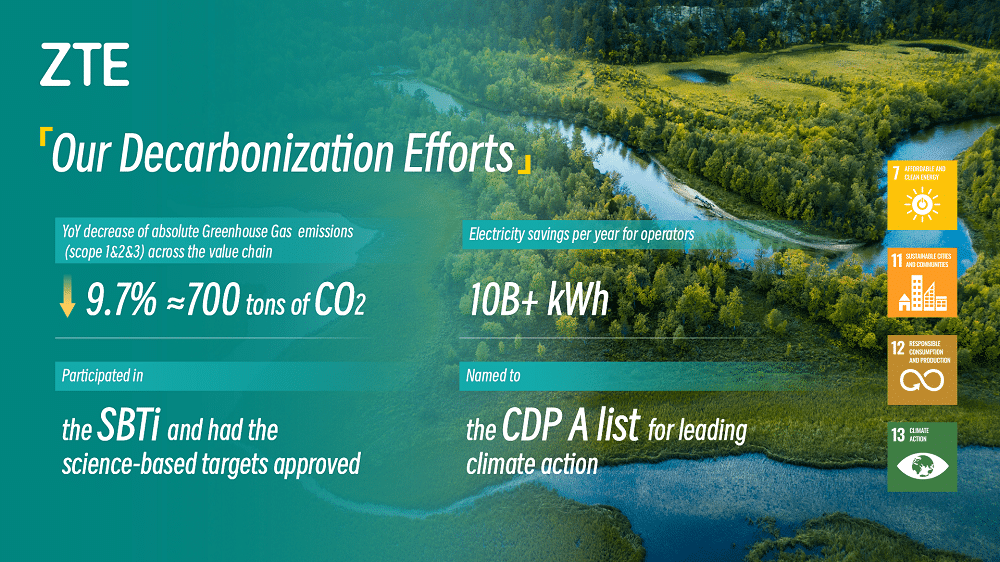
In green operations, ZTE achieved a 9.7% YoY decrease of absolute GHG emissions (scope 1&2&3) throughout the value chain, a 14.58% YoY decrease in the physical intensity of GHG emissions during the use and maintenance phases of the company’s sold telecom products, and over 700% YoY growth of PV power generation installed capacity in 2023.
In terms of green supply chain, the company has completed carbon reduction audit for more than 150 suppliers, and achieved a 3.26% reduction in carbon emissions intensity through its green logistics efforts. Moreover, ZTE was rewarded « National Level Green Supply Chain Management Enterprise » and ZTE Heyuan Base was recognized as a « National Green Factory » in 2023.
For green digital infrastructure, ZTE currently holds over 650 green patents, has conducted carbon footprint assessments for 101 products, encompassing all product categories. The company has helped global operators save more than 10 billion kilowatt-hours in electricity consumption annually.
In the realm of green empowerment, ZTE has introduced a green precision cloud-network solution based on its « Digital Nebula » architecture. Collaborating with over 1000 global top industry partners across diverse sectors, the company has launched more than 100 application scenarios for 5G+ innovative green initiatives. Through these efforts, the company continues to support various industries in their digital transformation and sustainability goals, promoting cost reduction, efficiency improvement, and quality enhancement to drive energy conservation and emission reduction.
Thanks to its sustained efforts in green development, ZTE’s science-based targets, achieving greenhouse gas emissions reduction in line with the 1.5°C temperature rise limitation pathway and reaching net-zero emissions by 2050 at the latest, have been approved by the Science Based Targets initiative (SBTi) in April 2024. This makes ZTE the first large-scale ICT tech company in China to receive official approval for both near-term and long-term GHG emission reduction targets and to make CDP A List for leading climate action, the highest level of recognition for corporate environmental transparency and performance. Additionally, the company recently unveiled « ZTE Zero-Carbon Strategy » white paper at ZTE Sustainable Development Forum, outlining the implementation roadmap of its zero-carbon strategy, demonstrating the company’s commitment to collaborating with various sectors to advance global zero-carbon endeavors.
Embracing Tech for Good to bridge global digital divide
Xie Junshi, Executive Vice President and Chief Operating Officer at ZTE, said: » ZTE incorporates sustainability and ESG into corporate operations and governance, sticks to the philosophy of Tech for Good, and takes on the responsibility and role of a leading ICT player, to bridge the digital divide and enable connectivity and trust everywhere. »
As a global enterprise, ZTE has been engaging in building high-performance « superb networks » across over 100 countries and regions, facilitating the bridging of global digital divide. ZTE has been actively responding to the International Telecommunication Union’s (ITU) call for support in global digital transformation efforts through its Partner2Connect (P2C) Digital Coalition and was recognized as one of the first P2C Champions by ITU. Specifically, ZTE pledged to construct ICT infrastructure annually for Least Developed Countries (LDCs), Landlocked Developing Countries (LLDCs), and Small Island Developing States (SIDS) by 2025, and to dedicate 50,000 hours of ICT lectures globally for the benefits of local workforces in need, as part of its efforts to drive global meaningful connectivity.
Supplier capability building is key for ZTE to ensure supply chain resilience and product quality. In 2023, the company released the SPIRE 2.0 strategy to boost resilience of its supply chain, and carried out diverse training programs to promote capability enhancement of suppliers, jointly contributing to sustainable development.
ZTE puts people first and front, prioritizing the welfare and development of its employees and fostering a nurturing and inclusive workplace environment. In 2023, the average training hours per employee reached 144.7. ZTE was honored with LinkedIn MostIn Awards – Global Talent Magnet Employer in 2023, recognizing its global talent attraction efforts.
ZTE actively fulfills its corporate social responsibility by engaging in public welfare initiatives worldwide, including educational support, medical aid, and care for vulnerable groups. As of 2023, the company has registered 10,754 employee volunteers, accumulating a total of 29,024 volunteer hours. The company’s influence on green development was further extended through welfare activities. For example, the pilot project of forest management and carbon sequestration, which marked milestone progress of the « ZTE Ecosystem Conservation Fund, » was successfully implemented.
Strengthening corporate governance to build a highly resilient organization
ZTE places significant emphasis on internal controls, compliance, social credibility, and business continuity management (BCM). The company continually enhances its corporate governance system, standardizes operations, and ensures continuous and robust business performance.
In 2023, ZTE successfully passed the re-certification audit of the company’s anti-bribery management system and maintained the ISO 37001 Anti-Bribery Management System certification. It conducted 214 joint Business Continuity Plan (BCP) drills in high risk fields. Additionally, the company continuously improves its quality management system. In 2023, ZTE Global Certification and Testing Center conducted 1,372 safety tests throughout the year with a test pass rate of 100%.
As a member of the United Nations Global Compact (UNGC) and the Global Enabling Sustainability Initiative (GeSI), ZTE’s achievements in sustainable development and ESG have gained widespread recognition. For instance, ZTE was selected in UNGC Private Sector Case Studies for achieving Sustainable Development Goals (SDGs) in 2023, and has been included in the FTSE4Good Index Series for eight years and Fortune China ESG Impact List for three consecutive years. Additionally, ZTE was honored among Top 30 ESG Excellence Practices in China and recognized as 2023 IDC China Sustainable Development Pioneer Case.
Moving forward, ZTE will remain committed to its vision « To Enable Connectivity and Trust Everywhere, » leading the way in digital innovation to ensure that the benefits of innovations reach all industries and sectors, contributing new momentum to sustainable development.
For more details of ZTE Sustainability Report 2023, please download:
To discover more updates about our commitment to the sustainability, please visit ZTE Sustainability website:
https://www.zte.com.cn/global/about/sustainability.html

This Industry Viewpoint was authored by Iceotope’s Dr. Kelley Mullick
Artificial intelligence (AI) is transforming our interactions with technology. From personalized streaming recommendations to autonomous vehicles, it is pervasive and rapidly evolving, and requires support from the digital infrastructure industry to continue its meteoric adoption. This raises a critical question: How are data center operators managing the impact of AI on their operations? … [visit site to read more]
Keep up-to-date with all the latest news, articles, event and product updates posted on Developing Telecoms.
Subscribe to our FREE weekly email newsletters for the latest telecom info in developing and emerging markets globally.