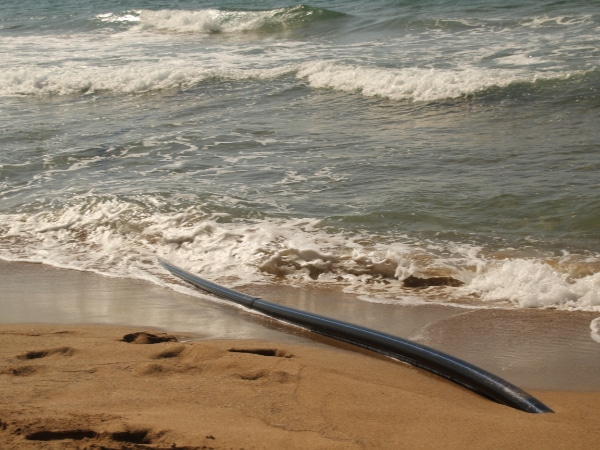
Transmitting about 99% of the world’s telecommunications, submarine cables have emerged as critical infrastructure necessary for systems to function. In recent months, there have been two “extraordinary” outages that have brought submarine cable damage and protection issues to the fore.
Three cables in the Red Sea were severed by an anchor drag followed by the West African subsea cable outage where four cable systems were damaged by an undersea canyon avalanche incident. While these incidents led to widespread connectivity disruption, they also demonstrated the need for robust redundancy measures to manage outages.
A key question that arises out of these incidents of submarine cable damage is whether cable owners have legal recourse to claim losses, including consequential losses. In this article, we attempt to unpack some knotty legal issues regarding submarine cable damage claims and remedies.
Protection of submarine cables
The first submarine cable laid across the English Channel between Dover and Calais in 1850 was reportedly put out of action almost immediately by a fisherman who hooked the line near shore and cut out a section as a souvenir. Over the past 175 years, as telecommunications technology has advanced, the number of subsea cable systems has surged, accompanied by an increase in damage risks.
The causes of submarine cable damage include natural hazards, as in the case of the West African subsea landslide, as well as man-made activities ranging from fishing, undersea mining, oil and gas activities, and dredging – the cause of the outage in the Red Sea. Increasingly, deliberate actions by state and non-state actors also pose a threat to cable systems; early reporting around the Red Sea outage incorrectly posited that violent activity from the Houthi rebel group could have damaged the cables in question.
Given the critical nature of submarine cables, it is surprising that their protection under international law is limited and in parts antiquated. There are two key treaties protecting submarine cables:
- The 1884 Convention for the Protection of Submarine Telegraph Cables (“Paris Convention”) criminsalises “break[ing] or injur[ing] a submarine cable, wilfully or by culpable negligence, in such manner as might interrupt or obstruct telegraphic communication, either wholly or partially, such punishment being without prejudice to any civil action for damages.” However, many state parties have failed to translate the Paris Convention’s requirements into their criminal law.
- or injury caused by persons who acted merely with the legitimate object of saving their lives or their ships, after having taken all necessary precautions to avoid such break or injury.”
While both the Paris Convention and the UNCLOS require States to criminalise conduct of private parties leading to submarine cable damage, there is no express prohibition in international law preventing States from deliberately damaging submarine cables – such as for undersea warfare. The need to address this is urgent; early reporting that the Houthi rebels were responsible for the Red Sea cable outage proved inaccurate, but era of subsea warfare is upon us. Naval News notes that Russia has invested heavily in offensive seabed warfare capabilities, and that Hamas has built UUVs (uncrewed underwater vehicles) to target Israeli offshore natural gas infrastructure – the threat is real.
Potential claims and remedies by cable owners
If damage is incurred by submarine cables, their owners can be entitled to various claims or remedies depending on several factors. These include where the damage occurs, as this varies depending on if the cable is located in the high seas, an exclusive economic zone, a continental shelf, or territorial waters. Whether the damage was caused by a natural event or human activity is of course another factor, as well as the intent behind the damage – whether it was deliberate or negligent.
The law is clearer if the damage occurs within territorial waters (within 12 nautical miles from the coast) – in such instances, national courts can exercise ordinary admiralty jurisdiction. However, damage that occurs in the high seas or a continental shelf can be subject to different legislation depending on national laws – state courts may not have jurisdiction in such instances.
If damage is caused by human activity, cable owners can potentially seek damages from the wrongdoer but must consider general principles of damage in tort (criminal wrongdoing) law – for example, to recover any damages, the damage itself must be reasonably foreseeable – and limitations of liability under maritime law.
Any liability claim would ultimately depend on the circumstances. For example, if a wrongdoer caused damage after noticing the position of a cable – and if the damage caused monetary losses for repairs or similar – then they would be in breach of a duty of care to the cable provider. A good illustration of such a claim would be the Canadian case of The Realice where the vessel’s captain snagged a fibreoptic cable in his anchors. Believing – based on having glimpsed a map of active cables years before – that the cable was inactive, he cut it and was found liable for USD 1 million in damages.
Potential claims against cable owners
Given the role that subsea cables play in global connectivity, there are many players in the value chain who will be affected by any cable damage. For instance, an internet service provider might seek to recoup damages for internet outage arising from a damaged cable. To ensure that cable owners are protected by such claims, it is important to review contracts with third parties to ensure that there are adequate safeguards in place to manage liability.
Limitation of liability provisions are standard in contracts between mobile service providers and customers. In contracts between cable owners and users of cable services, it is important to specify the forum to resolve disputes and the law applicable to the dispute. in instances of naturally occurring damage as in the case of the East African subsea landslide, there should be workable force majeure provisions that exclude liability of the cable owners.
Managing liability: the way forward
Telecommunications companies might consider investing in monitoring equipment for submarine cables and to ensuring the development of backup and redundant cable systems. Another key exercise for private players is to review their contracts and ensure that they have robust protections in case of cable failure (for instance, carving out consequential losses and including workable force majeure clauses in contracts). Finally, cable systems owners and operators must ensure forensic data collection in instances of cable damage in support of any claims.
In the international sphere, states need to come together to formulate a clear and comprehensive international legal framework for the protection of submarine cables. The 1884 Paris Convention and 1982 UNCLOS are unfit for purpose to address the protection of submarine cables in the 21st century.
David Hunt is a partner and Sagar Gupta is an associate at the London offices of Boies Schiller Flexner. They specialise in international dispute resolution with a focus on the telecoms industry. The opinions expressed in the article are those of the authors and do not necessarily reflect the views of Boies Schiller Flexner or its clients, or any of its or their respective affiliates. This article is for general information purposes and is not intended to be and should not be taken as legal advice.