Huawei, a global leader in technology and telecommunications, is propelling the industry into a new era with the announcement of the world’s first comprehensive suite of solutions for 5.5G technology.
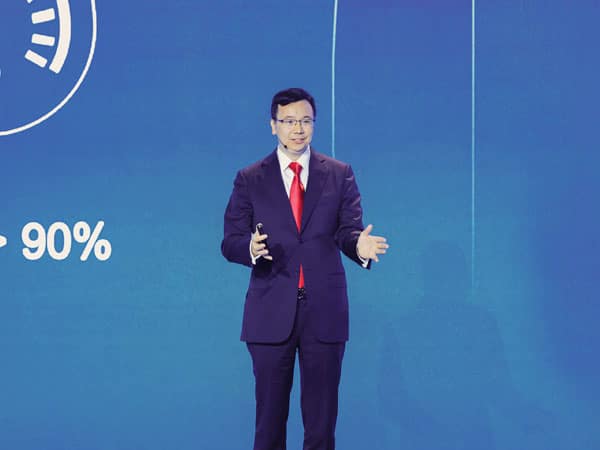
This comes at a time when the adoption and utilisation of 5G by businesses and consumers has surged and continues expanding into new experiences, new connections, and new applications, noted Cao Ming, President of Wireless Solution at Huawei, during an International Media Roundtable at the 14th Global Mobile Broadband Forum held in Dubai in October.
This 5.5G network boasts remarkable features, including a 10 Gbps downlink, 1 Gbps uplink, a huge capacity of 100 billion-level connections, and native intelligence. “Huawei is at the forefront of innovation to ensure the solutions help operators deliver full-scenario tenfold capabilities and enable ultra-high energy efficiency, spectrum utilization, and O&M efficiency » said Cao. Speaking to journalists from across the world, Cao stressed the potential of this technology and the change it can usher into our societies.
A Network Beyond Expectations
Telecommunications companies worldwide have been deploying 5G networks at an accelerated rate, far surpassing the pace of any previous generation of mobile communications technology. Over the past five years, approximately 260 commercial 5G networks have been deployed globally, and the global 5G user base has reached an impressive 1.5 billion individuals.
The most exciting aspect of 5G lies in its capabilities, explained Cao. “The network’s strength, being ten times more potent than its 4G predecessor, is driving remarkable advancements in high-definition videos and cloud gaming. The limitations experienced during video playback, gaming, and HD video calls on 4G networks are gradually becoming a thing of the past, thanks to 5G. This represents just the beginning of 5G adoption, » he replied to a question on how 5G will benefit the gaming industry.
Indeed, with the upgrade of experiences, connections, and services, it is the time for 5.5G – a network which features capabilities of 10 Gbps downlink, 1 Gbps uplink, 100 billion-level connections, and native intelligence.
To help operators build 5.5G networks efficiently and enable full-scenario ten-fold capabilities, Huawei is releasing the industry’s first 5.5G solutions. Five fundamental technological pillars support these enhancements, explained Cao:
- Ultra-wideband: A capability to accommodate wide-range non-contiguous bands , reducing the need for deploying multiple pieces of equipment and thereby lowering deployment costs.
- Multi-band: Huawei’s solutions offer the ability to support multiple bands using one box, drastically reducing deployment costs and antenna space, which translates to lower tower rental costs.
- Multi-antenna technology: This technology significantly enhances spectral efficiency, leading to an improved user experience and reduced spectrum licensing costs for telcos.
- Energy efficiency: Innovative solutions aimed at minimizing energy consumption during varying traffic loads, ensuring a greener and more sustainable network.
- IntelligentRAN: Advanced, intelligent network management to reduce the complexity and costs associated with operations and maintenance, enhancing network efficiency and user experience.
These pillars of innovation collectively empower 5.5G networks to deliver on their promises, ensuring a future-ready, efficient, and user-centric network.
In the realm of cellular Internet of Things (IoT), two mainstream 5.5G IoT technologies, Red Cap and passive IoT, have gained traction, with module developers and chipset manufacturers actively rolling out their offerings.
Redefining User Experience
In the past, video-related services, including video calls and games, predominantly operated in 2D. However, with the advent of 5G, a shift towards 3D and extended reality (XR) services is becoming evident. “The rise of 3D services and applications will exert substantial demand on network capabilities”, noted Cao.
As 5.5G networks are set to bring robust capabilities, telcos and various businesses can broaden their scopes, providing an opportunity for content providers, device manufacturers, and chip makers to expand their business horizons and identify new revenue streams. The potential for growth and innovation in this domain is vast, explained Cao.
However, as 5G adoption continues at an unprecedented pace, concerns have arisen about the need to upgrade existing infrastructure. Cao stated that Huawei is committed to helping operators evolve their networks seamlessly to protect the investments of telcos.
Readiness of Countries
Talking about the future uses of 5.5G technology, Cao stressed that the technology is rapidly gaining momentum worldwide and is on the brink of accelerated commercialisation. « Several factors contribute to this large-scale commercialisation. Release 18, slated to be frozen next year, will mark the completion of the 5.5G specification, affirming the industry’s readiness for the imminent transition. Moreover, 5.5G chipsets and devices have already hit the market, exemplified by Qualcomm’s release of the 5G Advanced chipset with a 10 Gbps downlink capacity, » noted Cao.
Regarding spectrum readiness, 20 countries worldwide have already auctioned the millimeter wave, paving the way for substantial progress in 5.5G deployment. The sub-6 gigahertz band is scheduled for discussion and identification in November this year at the World Radiocommunication Conference (WRC 23) in Dubai.
Cao noted: « The Middle East is expected to maintain its leading position in the 5.5G era. There have been many collaborations and initiatives like the MoU and innovative projects between Huawei and leading operators in the Middle East for the past one year, showcasing the region’s commitment to embracing and leveraging the potential of 5.5G technology. »
On the digital divide across geographies, Huawei realises that the development of technology is uneven in different territories. While the first wave 5G markets – including the Middle East, Europe, China, and countries in the Asia Pacific – deployed 5G nearly five years ago, countries in Africa are not at the same pace. Some critical points along the deployment journey of 5G include ecosystem maturity and market development.
Cao added that Huawei has been collaborating in different regions and hopes that through the efforts, countries and regions can enjoy the convenience brought by 5G sooner.
Empowering Industries through 5.5G
One of the pivotal aspects of 5.5G’s evolution is its transformative impact on various industries. The business-to-business (B2B) capabilities of 5G networks have already been embraced on a massive scale in the 5G era. Cao shared a few examples from China where fully connected factories are leveraging 5G to drive digitalisation within their operations.
Industries like automobile manufacturing are primed for significant enhancements, Cao stated. 5G and 5.5G technologies offer the potential to revolutionise productivity and facilitate digital transformation within the industry. “Huawei envisions a future where ICT solutions will enable automakers to build better, smarter vehicles, ensuring a seamless integration of technology into the automobile sector, » Cao said.
Huawei’s foray into the realm of 5.5G technology represents a significant leap forward for the telecommunications industry. As 5G adoption accelerates and industries continue to embrace digital transformation, the advent of 5.5G promises an even more connected and technologically empowered future.