Tech firms commit $45 million to scale AI-native RAN

ORAN Development Corporation (ODC) has secured $45 million in Series A funding to accelerate deployment of its AI-native radio access network (RAN) platform and expand commercial engagements.

The round was backed by a syndicate of technology companies and telecom operators, including Nvidia, Cisco and Nokia, alongside operators such as AT&T, MTN Group and Telecom Italia. Investment firm Booz Allen Hamilton also participated, with additional backing from Phoenix Venture Partners and existing investor Cerberus Capital Management.

ODC is developing what it describes as an AI-native, open-architecture RAN platform designed to combine communications, sensing and edge computing. The company said it is already working with a number of customers and plans to scale deployments through 2026.

At the core of its strategy is a “distributed compute grid” concept, which aims to transform traditional mobile infrastructure into a platform capable of supporting AI workloads at the network edge. By integrating Nvidia’s Aerial RAN technology, ODC is positioning its platform to move beyond connectivity and enable real-time, low-latency processing for applications such as autonomous systems and industrial automation.

The funding reflects growing industry interest in AI-driven network architectures, as operators and vendors look to evolve 5G infrastructure to support new use cases and future 6G development.

Backers highlighted the potential for AI-native RAN to reshape telecom networks. Executives from Nvidia, Cisco and Nokia pointed to increasing demand for software-driven, edge-based intelligence, while operators including MTN and Telecom Italia emphasised the opportunity to deliver new services and expand digital capabilities.

ODC said the investment will be used to accelerate platform development and expand partnerships, with a focus on scaling deployments of its AI-enabled infrastructure.

How connectivity is powering rural revival in Guangxi

Connectivity has long been praised for linking remote communities to the global economy, lifting populations out of poverty and revitalising once-isolated regions.

For years, however, rapid urbanisation shifted attention toward global megacities such as Shanghai, Tokyo, London and New York.

That narrative is now changing. Advances in 5G, fibre and satellite connectivity are redistributing opportunity – bringing digital infrastructure to places once considered too remote or too difficult to develop.

Breaking barriers in a challenging landscape

In southern China, Huawei and China Mobile have partnered to transform Buhua Village, located in the Guangxi Zhuang Autonomous Region under the jurisdiction of Chongzuo City.

Chongzuo is famed for its dramatic karst landforms – landscapes shaped by dissolved rock that create stunning but infrastructure-resistant terrain. These natural features, while visually striking, have historically made large-scale network deployment difficult.

Before 2017, Buhua Village lacked reliable modern infrastructure. Muddy, unpaved roads make transportation difficult and inefficient, while underdeveloped telecom infrastructure further limits the sales for sugar cane – the region’s primary agricultural product.

Guangxi is widely recognised as China’s sugar cane heartland, with around 266,000 hectares of farmland producing roughly one-fifth of the country’s total output. Yet despite this agricultural importance, areas like Chongzuo were long considered economically disadvantaged.

Digital infrastructure sparks economic transformation

The rollout of connectivity infrastructure has triggered a dramatic turnaround. Villages like Buhua are now being held up as models of rural revitalisation.

The village generates more than CNY500,000 (US$72,000) in annual collective income, while per capita earnings have increased by CNY18,000 (US$2,600). Average household income now exceeds CNY80,000 – roughly three times higher than traditional sugar cane farming alone.

Across Chongzuo, all administrative villages now benefit from connectivity levels comparable to tier-one cities such as Shanghai and Chongqing.

5G coverage has reached 94% since upgrades began in 2021, while 4G coverage stands at nearly 99%.

Ecommerce and livestreaming drive new revenue streams

Connectivity has been a catalyst for digital commerce in Xinhe Town, where Buhua Village is located. A local ecommerce ecosystem has emerged, with 65 collectively owned online stores operating on platforms such as JD.com and Douyin.

Livestreaming has also taken hold, with 27 local streamers promoting regional products to wider audiences.

Together, these initiatives generate more than CNY300,000 (US$44,000) annually. Among the standout products is Buhua brown sugar – a handcrafted, culturally significant good that sells for around 150% more than standard alternatives in major Chinese cities and international markets including Japan and South Korea.

Tourism and smart infrastructure take off

Improved connectivity has also sparked a surge in tourism, drawing visitors to Chongzuo’s once-overlooked karst landscapes.

At the Heishui River scenic area, China Mobile has deployed an intelligent ticketing system for activities such as rafting, boat tours and paddleboarding. Waiting times have dropped from 20 minutes to just three, while online bookings now account for 30% of total ticket sales.

AI and connectivity strengthen environmental management

The region’s digital upgrade extends beyond commerce and tourism into environmental protection.

Following a CNY100 million investment, a safety monitoring and IT system has been introduced along the Heishui River. Powered by the Bianjiang Zhizhou open AI platform, the system spans 13 towns across four districts in Chongzuo.

Once fully operational, it will enable real-time water quality monitoring and environmental management, supporting safe irrigation across 60,000 hectares of farmland.

Industry voices on bridging the digital divide

Zhou Peng, General Manager of China Mobile Guangxi’s Chongzuo Branch, said:

“By bridging the digital divide, we are helping remote villages like Buhua develop digital trade alongside traditional agriculture. This is transforming resources that were not fully used in the past due to geographical limitations into strong momentum for economic growth in the digital age.”

Tian Yongsheng, Deputy General Manager of Huawei Guangxi, added:

“Huawei is supporting China Mobile in building a solid digital foundation for Chongzuo with innovative solutions. We look forward to seeing technology overcome geographical limitations and enable more remote villages to achieve leapfrog development in the 5G and AI era.”

A blueprint for rural connectivity

Buhua Village’s transformation highlights a broader shift in the telecoms industry – one where connectivity is no longer just about linking cities, but about unlocking the economic potential of rural regions.

Or put simply – the future of connectivity might not be built in skyscrapers, but in places where the roads used to wash away.

Beyond Unicast: Rearchitecting Connectivity for the Frontier Edge

Beyond Unicast: Rearchitecting Connectivity for the Frontier Edge

This Industry Viewpoint was authored by Apoorva Jain, Chief Product Officer at EdgeBeam Wireless

The telecommunications industry has relied on a relatively stable definition of “the Edge” for decades. We’ve treated it as a manageable extension of the cloud or the perimeter of a corporate network, essentially a gateway where a router connects to a local line or a fiber hookup. However, this definition is quickly failing as we move deeper into 2026. We’re no longer managing the “Edge” — we’ve entered the era of the “Frontier Edge.” … [visit site to read more]

Turkcell adds 10 Gbps package to fibre broadband service

Turkcell announced that it has added a 10 Gbps option for its Superonline fibre broadband service, which it says makes it the first such broadband offer in Turkey.

As of Wednesday, Superonline UltraFiber now offer home broadband connectivity packages of 2 Gbps, 5 Gbps and 10 Gbps.

“We take the 1000 Mbps experience, which was previously the highest speed in home internet, to the next level,” said Turkcell GM Dr. Ali Taha Koç in a statement. “For the first time in Turkey, we offer a much stronger and more efficient connection experience by bringing speeds of up to 10 Gbps together with homes.”

The service is supported by UltraFiber’s Wi-Fi 7 Premium modem, launched by Turkcell last year, which supports upload speeds of up to 1 Gbps.

Turkcell said its UltraFiber service combined with Wi-Fi 7 offers a powerful connection infrastructure in cloud-based workflows, live broadcasts and home environments where a large number of devices are connected to the Internet at the same time.

Earlier this month, Turkcell said in its full-year financial results for 2025 that its gained 119,000 net fibre broadband subscribers last year, bringing its total fixed broadband subscriber base to 2.6 million. The operator also said it added 405,000 new households during the year, increasing its total fibre coverage to 6.3 million homes.

Turkcell also reported a fibre take-up ratio of 42%, while its residential fibre ARPU grew 10.3% year on year.

Veon bets on “AI 1440” future as telcos race beyond connectivity

Veon is making an increasingly bold claim about the future of telecoms: the industry’s next battleground is not networks or even digital services, but intelligence itself.

In an interview with Developing Telecoms, Lasha Tabidze (pictured, left), Chief Digital Operations Officer at Veon, and Ilya Polshakov (pictured, right), Director of New Business Development at Kyivstar, outlined how the group is evolving from a traditional operator into what it calls an “AI-native” service provider – one aiming to be relevant to customers every minute of the day.

From digital telco to “AI 1440”

Veon’s transformation began with its “Digital Operator 1440” strategy – named after the number of minutes in a day – designed to shift the company away from selling connectivity bundles towards embedding itself into customers’ daily lives.

That meant building services across four core verticals: financial services, healthcare, education and entertainment. Crucially, these were not positioned as add-ons, but as standalone businesses with their own value propositions.

The results, according to Tabidze, are already visible. By the third quarter of 2025, Veon’s digital monthly active users surpassed its traditional telecom user base for the first time. The company now counts more than 45 million super app users, alongside tens of millions using its fintech, health and entertainment platforms.

But the group is already moving beyond that phase.

“Now we are shifting from digital services to intelligent services,” Tabidze said. “For us, AI is not artificial – it is augmented intelligence.”

Sovereign AI as telecom infrastructure

At the core of Veon’s next phase is what it calls “AI 1440” – embedding augmented intelligence across its ecosystem while building locally trained large language models (LLMs) in each market.

This is not just a technology play, but a strategic positioning around sovereignty.

Rather than relying solely on global models from players like Google or Meta, Veon is developing proprietary layers trained on local languages, dialects and datasets, often in partnership with governments and institutions.

The rationale is twofold: relevance and trust.

“These models must be trained locally, governed locally and aligned with national priorities,” Tabidze said. “That creates digital confidence.”

Polshakov added that telecom operators are uniquely positioned to deliver this, thanks to their existing infrastructure footprint. Data centres, fibre networks and low-latency environments – traditionally used for connectivity – are becoming critical for AI inference and deployment.

“AI infrastructure is complementary to telecom infrastructure,” he said. “We already have the backbone.”

Super apps, satellite and scale

Veon’s ecosystem approach is also being reinforced by its super app strategy, which aggregates services into a single interface while supporting a wider partner ecosystem.

While super apps have struggled to gain traction in Western markets, Veon sees strong adoption across its footprint in Asia and Eastern Europe, where smartphones are often the primary – and sometimes only – digital access point.

This is being combined with expanded connectivity models, including satellite partnerships such as direct-to-cell initiatives with Starlink.

In Ukraine, Kyivstar has already registered up to five million users on its direct-to-cell service within months of launch, using it to extend coverage and ensure service continuity during outages.

“Even if terrestrial networks are disrupted, customers can still access digital services, payments and emergency tools,” Polshakov said.

Ukraine as a testbed for resilience

Nowhere is Veon’s strategy being tested more intensely than in Ukraine, where Kyivstar continues to operate under wartime conditions.

The operator has invested heavily in energy resilience – deploying thousands of batteries and generators to keep base stations running amid infrastructure attacks – while accelerating its push into non-terrestrial connectivity.

But beyond connectivity, the crisis has reinforced the importance of digital services.

“With only a few hours of electricity per day, people still need access to healthcare, payments and information,” Polshakov said. “This is where the digital ecosystem becomes critical.”

Kyivstar is also expanding into enterprise and government services, including data analytics, agricultural technologies and real-time positioning systems, positioning itself as a broader digital infrastructure provider.

Growth markets, not “challenging” ones

Veon’s geographic footprint – spanning countries such as Pakistan, Bangladesh and Uzbekistan – is often described as complex or high-risk. Tabidze rejects that framing.

“These are not just challenging markets – they are exciting markets,” he said, pointing to their scale, young populations and high levels of digital demand.

In many of these regions, smartphones serve as the primary gateway to the internet, creating an opportunity for telecom operators to play a central role in economic and social development.

This is particularly evident in fintech. Veon’s JazzCash platform in Pakistan now processes transactions equivalent to more than 10% of the country’s GDP, while enabling microcredit for everyday needs – from small business inputs to daily fuel costs.

The next three years: scale and integration

Looking ahead, Veon expects its digital ecosystem to continue growing at over 30% annually, with a goal of at least doubling its user base within two to three years.

But executives emphasise that long-term targets are secondary to immediate execution – particularly in volatile markets like Ukraine.

“We don’t know what will happen in three years,” Polshakov said. “We invest now. We build resilience now.”

For Veon, the direction of travel is clear: telecom operators are no longer just connectivity providers or even digital platforms. They are becoming orchestrators of national-scale digital ecosystems – layered with AI, anchored in local infrastructure, and increasingly intertwined with government and economic development.

If that vision holds, the industry’s future may not be defined by faster networks, but by smarter ones.


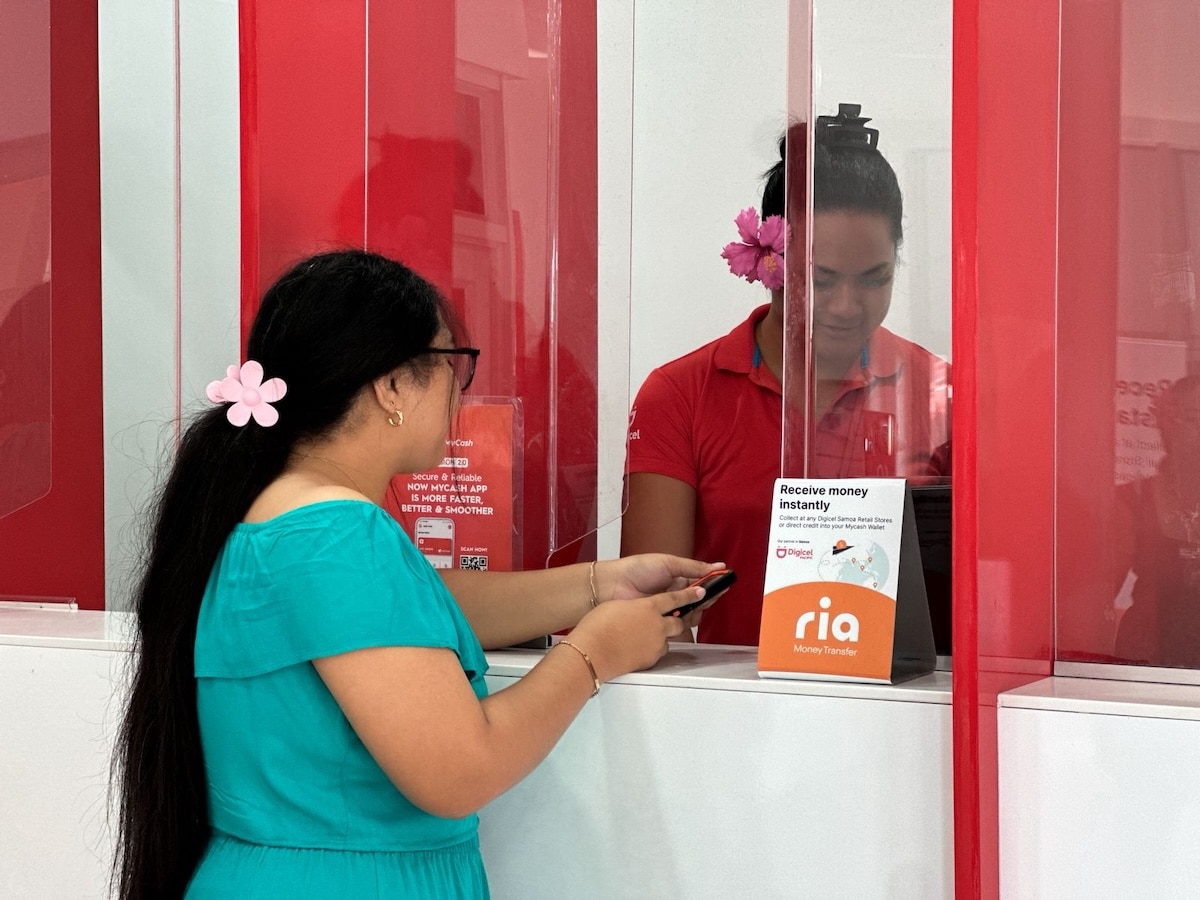
Digicel Samoa connects MyCash mobile wallets to Ria network

Digicel Samoa announced on Tuesday it’s teamed up with Euronet Worldwide subsidiary Ria Money Transfer to enable people outside of Samoa to transfer money to Digicel’s MyCash mobile wallets.

The collaboration deal offers an alternative to traditional cash pickup, although Digicel Samoa said users who prefer cash will still have the option of collecting the money transferred via Ria from participating Digicel Samoa retail stores.

As part of the initial launch, Digicel Samoa said, the services will be available at three of its retail locations: SNPF Plaza, Faleolo International Airport, and Salelologa in Savai’i, with additional locations expected to roll out soon.

Ria said its global network includes over 635,000 locations worldwide – including Australia, New Zealand and the US – and digital connections to 4.1 billion bank accounts, 3.4 billion digital wallet accounts and 4 billion Visa debit cards through Visa Direct payments.

Digicel Samoa CEO Karl Vizvary said the Ria service will serve growing demand for quick, safe, and easy digital payment options, and simplify remittance for customers.

“Our collaboration with Ria makes it easier and more convenient for families and friends overseas to send money to people in Samoa,” Vizvary said in a statement. “By enabling transfers to the MyCash mobile wallet, as well as cash pickup at Digicel Samoa’s retail locations, we are providing our customers with more flexibility, security, and access to modern financial services.”

AI-powered solution launched to support Zimbabwean farmers

Two Zimbabwean companies, Hurudza AI and Paltech Africa, have announced a strategic partnership to launch The Farmers’ Bench, an AI-powered solution aimed at transforming access to agricultural knowledge across Zimbabwe and beyond.

Paltech describes itself as a technology company democratising AI and sustainable energy through smart infrastructure. Hurudza AI is an artificial intelligence-powered multilingual agricultural contact centre.

Together, the two companies say they are building a unified system that delivers data-driven insights to farmers on the ground, helping them make better decisions and improve productivity.

At the core of the initiative is The Farmers’ Bench, a hybrid physical and digital innovation hub that provides farmers with actionable insights, climate-smart recommendations, and tailored support.

By integrating AI with accessible infrastructure, the platform aims to bridge information gaps and ensure that smallholder farmers can make informed decisions in real time. This is expected to improve yields, reduce risks linked to climate change and support more sustainable farming practices across the country.

Paltech Africa will provide the hardware backbone, including solar-powered systems and edge AI infrastructure. The company will also oversee installation, site selection and maintenance of the smart units deployed in farming communities.

Hurudza AI will power the software side, offering its conversational AI platform that delivers accurate, multilingual agricultural advice. The system will be continuously updated to ensure farmers receive relevant and timely information.

This integration of hardware and software is important. Instead of relying on internet-heavy solutions, the platform works at the edge, meaning it can function effectively even in areas with limited connectivity. Embedding Hurudza AI’s capabilities into solar-powered infrastructure allows farmers to access knowledge directly where they work, without needing advanced devices or constant internet access. For many farmers, this could mark a shift from delayed or unavailable information to instant, reliable support.

The partnership reflects a broader ambition to democratise access to artificial intelligence across the agricultural sector. The initiative is expected to contribute to improved food security, empower rural communities, and support scalable, locally driven solutions for agricultural development.

The project is now at the pilot phase but there are plans to expand the platform across provinces.