AI: Front and centre at GITEX Global 2024

At GITEX Global 2024 in Dubai, artificial intelligence (AI) was the most talked-about topic, with companies from across industries showcased how AI and machine learning are reshaping business operations and consumer experiences.

With over 6,500 exhibitors, 1,800 startups, and 1,200 investors from 180 countries, GITEX Global 2024 smashed previous records, attracting more than 200,000 visitors. For the first time, GITEX welcomed countries like South Africa, Vietnam, and Puerto Rico, while Europe had its largest representation to date. The event’s theme, Global collaboration to forge a future AI economy, underscored the central role AI plays in transforming industries across sectors.

AI in telecommunications: Ericsson and e& take the lead

At the heart of GITEX Global’s AI focus, Ericsson and e& (formerly Etisalat) stood out with a Memorandum of Understanding (MoU) to explore AI-driven autonomous networks. This three-year agreement aims to transform e&’s mobile networks through AI, fostering innovation, network autonomy, and sustainability.

Ekow Nelson, Vice President and Head of Global Customer Unit at Ericsson Middle East and Africa, highlighted the importance of AI in shaping future networks, “Artificial intelligence and automation will play pivotal roles in shaping the networks of the future.

“By combining Ericsson’s global expertise with e&’s forward-thinking strategy, we aim to pioneer the development of autonomous networks to enhance operational efficiency and contribute to environmental sustainability.”

For e&, this MoU represents a significant step toward responsible AI deployment. Sabri Yehya, Chief Technology Officer at e& international, emphasised that this collaboration goes beyond technology: “Our MoU with Ericsson marks a critical step toward autonomous networks, which will not only transform the way we operate but also help meet our ambitious net-zero targets.”

The partnership aligns with e&’s commitment to achieving net-zero emissions in its UAE operations by 2030.

By focusing on AI-driven autonomous networks, this collaboration is expected to enhance customer experiences while reducing carbon emissions and contributing to environmental sustainability.

Huawei: vision for digital and intelligent transformation

Huawei underscored its commitment to leading the next wave of industrial digitalisation with its innovative approach to ICT infrastructure. In his keynote at the Industrial Digital and Intelligent Transformation Summit, David Shi, Huawei’s Vice President of ICT Marketing and Solution Sales, outlined the company’s vision of building an intelligent world, one in which industrial digitalisation and AI play a crucial role in productivity and societal transformation.

Shi stressed the importance of collaboration with partners to accelerate the adoption of next-generation technologies: “We believe new technologies are emerging even faster, and the only way to bring intelligence to all industries is through collaboration with our customers and partners.” Huawei’s approach focuses on making ICT infrastructure more accessible, user-friendly, and scalable by adhering to four guiding principles: easy to integrate, easy to access, easy to use, and easy to evolve.

Key to Huawei’s vision are its flagship products such as Huawei eKit, designed for SMEs. These products simplify ICT infrastructure, making it more accessible to smaller businesses, and help reduce installation and operational costs. Huawei also emphasised the growing importance of WANs as the “highways in the digital world” and how its IP and optical technologies have reduced total cost of ownership by 30% in key projects, such as its collaboration with BoFiNet.

Huawei’s presence at GITEX 2024 showcased its innovative solutions for digital transformation, focusing on data centres, campus management, and WAN technologies. 

Fortinet: AI-Powered solutions and strategic alliances

At GITEX Global 2024, Fortinet demonstrated its leadership in AI-powered cybersecurity by presenting a range of advanced solutions aimed at mitigating the ever-growing complexity of cyber threats. Shane Grennan, Senior Channel Director for MEA, highlighted Fortinet’s AI-driven cybersecurity solutions, designed to navigate the modern hypercomplex threat landscape. He explained: “Our solutions use AI to address labour shortages in cybersecurity and enable organisations to manage risks more effectively.”

Fortinet also emphasised the importance of managed security services in bolstering business resilience. According to Grennan, the expansion of cloud computing presents opportunities for companies to shift their focus towards comprehensive cloud-based security strategies. Fortinet’s participation at GITEX 2024 also featured a second stand dedicated to operational technology (OT) security, highlighting the importance of protecting industrial control systems.

One of the key emerging technologies on display was Fortinet’s Secure Access Service Edge (SASE), combining SD-WAN and security services into a unified solution for modern enterprises. Fortinet’s leadership in SD-WAN gives it a unique edge in providing customers with hybrid solutions that enhance both security and operational efficiency. 

Green Circle and SearchInform: strengthening data protection in Saudi Arabia

During GITEX 2024, Green Circle, a leading Saudi cybersecurity firm, signed a strategic cooperation agreement with SearchInform to offer advanced Data Loss Prevention (DLP) solutions to customers in the Kingdom of Saudi Arabia (KSA). This partnership enables Green Circle to deliver comprehensive data protection solutions that ensure compliance with KSA’s regulatory frameworks, including the National Cybersecurity Authority’s guidelines.

Mohammad Alkhudari, CEO of Green Circle, highlighted the importance of DLP in safeguarding businesses from internal threats, fraud, and data leaks. “Our clients have long sought such comprehensive solutions, and this partnership marks a significant step in enhancing data protection standards across the Kingdom,” he said. 

Sergey Ozhegov, CEO of SearchInform, added that the fast-growing Saudi market presents an opportunity for significant business growth in the cybersecurity domain. The partnership between Green Circle and SearchInform is set to strengthen the defence capabilities of KSA’s organisations, especially in the face of rising internal threats.

YangoGPT: AI at your service

Yango Group introduced its latest generative AI model, YangoGPT, with its first implementation in the AI assistant ‘Yasmina’. Designed to assist users in decision-making, generating ideas, and simplifying complex concepts, Yasmina represents the future of human-like AI interaction.

Yasmina’s enhanced capabilities were on full display at GITEX Global 2024, demonstrating its ability to assist users with everyday tasks, generate content ideas, and explain complex concepts in simple terms. From helping with vacation planning to breaking down scientific principles for children, Yasmina showcased the power of AI to simplify and enrich lives.

“Yasmina can spark users’ creativity, whether they need help brainstorming birthday gift ideas or crafting poems in Arabic,” stated a spokesperson from Yango Group. With its ability to maintain conversation context and provide real-time responses, Yasmina exemplifies the next evolution in AI assistants.

The road ahead for AI

GITEX Global 2024 underscored the vast potential AI holds for industries across the globe. From telecommunications to customer engagement, and from enterprise solutions to home automation, AI is no longer a distant future—it’s transforming how we live and work today.

As GITEX continues to grow, expanding its global footprint with upcoming events in Africa, Asia, and Europe, the future of AI looks even more promising. With initiatives like Ericsson and e&’s MoU for autonomous networks, companies across the world are poised to lead the way in developing responsible, sustainable AI solutions that drive progress for generations to come.

GITEX Global 2024 has set the stage for a future driven by AI—one that promises to be smarter, more connected, and more sustainable.

MORE ARTICLES YOU MAY BE INTERESTED IN…

M-Pesa and tappi join forces to boost Kenya’s SMEs

Kenyan operator Safaricom’s M-Pesa mobile money service has teamed up with Kenyan start-up tappi to digitise 650,000 business users in the country.

Described as a full digital commerce SaaS solution for small and medium-sized businesses, tappi helps small businesses grow by connecting them with customers and establishing online credibility through user reviews.

The partners say this alliance will deliver digital solutions to help these SMEs improve their online credibility and visibility.

The agreement also underlines M-Pesa efforts to broaden its portfolio of services for 650,000 registered businesses and over 50 million monthly active individual users in many African countries. 

As one of the first mini apps to feature on the M-Pesa for Business service, tappi will be able to deliver a subsidised package equipping merchants to build their online presence, capture verified reviews and strengthen engagement with an expanded customer base.

As Kenfield Griffith, CEO and co-founder of tappi, points out, with over 35 million subscribers, M-Pesa has long established itself as the engine through which millions of local entrepreneurs handle their transactions. He adds: “With many of these businesses constantly looking for new customers, our tools will be a crucial springboard in driving them to achieve this within an online setting.”

For a nominal sum, merchants will receive access to a free webpage and 50 SMS/WhatsApp reviews, which will be integrated into the merchant’s websites, as well as 250 bulk SMS marketing credits.

As part of the collaboration, M-Peta Ratiba, a new solution allowing M-Pesa users to automate their online payments, has also been included in the tappi mini app, enabling business owners to seamlessly pay their monthly subscriptions without disruptions.

Targeted to reach at least 300,000 M-Pesa for Business app users, the partnership has officially launched with an initial cohort of over 250 M-Pesa For Business app users across the food, fashion, health and beauty sectors throughout Kenya.

tappi’s solutions will build on the M-Pesa For Business app’s existing functionalities, which include viewing collections, statements and payments as well as transacting directly from the M-Pesa till number. 

In May 2024, tappi signed a memorandum of understanding (MoU) with the Kenya National Chamber of Commerce and Industry to drive digital services for 30,000 Kenyan MSMEs. The company has also partnered with MTN in Cote d’Ivoire and Nigeria.

MORE ARTICLES YOU MAY BE INTERESTED IN…

Fibre optic cable among Chinese imports hit by new Brazilian tariffs

Keep up-to-date with all the latest news, articles, event and product updates posted on Developing Telecoms.
Subscribe to our FREE weekly email newsletters for the latest telecom info in developing and emerging markets globally.

Sending occasional e-mail from 3rd parties about industry white papers, online and live events relevant to subscribers helps us fund this website and free weekly newsletter. We never sell your personal data. Click here to view our privacy policy.

Industry Spotlight:  1547’s John Bonczek on the Carrier Hotel Opportunity

Industry Spotlight:  1547’s John Bonczek on the Carrier Hotel Opportunity

The data center business is not a monolithic collection of servers and power, there are many types of facilities out there making up the broader infrastructure ecosystem. One of the longest running but too often neglected in the AI era is that of the carrier hotel and interconnection hub. With us today is John Bonczek, CRO at 1547 Critical Systems Realty. Early on in 1547 CSR’s development we had the company’s CEO and Managing Director J. Todd Raymond here for a chat about their plans. Let’s find out what the company has been up to since. … [visit site to read more]

Intelsat 33e covering Africa, ME and APAC destroyed after power failure

The Intelsat 33e geostationary high-throughput satellite (HTS) covering Europe, Africa, the Middle East and parts of the Asia-Pacific experienced a permanent power failure on Saturday and has since broken up.

According to a statement from Intelsat, the satellite “experienced an anomaly on October 19” that resulted in loss of power, consequently cutting service to all customers.

Intelsat said in the statement that while it was working with the satellite’s manufacturer, Boeing Space Systems, to address the problem, “we believe it is unlikely that the satellite will be recoverable.”

On Sunday, in a post on X (formerly Twitter), U.S. Space Command confirmed that Intelsat 33e had broken up, and that it was “currently tracking around 20 associated pieces.”

Intelsat 33e’s payload included C-band, Ku-band and Ka-band transponders. The C-band spot beams covered Europe, Central Africa, Middle East, Central South Asia, eastern China, part of southeast Asia and Australia. A wide C-band beam covered sub-Saharan Africa.

The Ku-band spot beams covered most of Europe, Africa, the Middle East and Asia. The Ka-band transponder had a single beam covering those regions.

Intelsat said It is in contact with all affected customers as well as third-party providers to mitigate service interruptions while it looks for back-up connectivity options within its satellite fleet.

Intelsat 33e – which occupied the 60 degrees East orbital slot – was launched in August 2016, but didn’t enter service until January 2017 due to a problem with its primary thruster. The satellite was designed with a lifespan of 15 years, but that was reduced by 3.5 years after another propulsion problem occurred during orbit tests.

Intelsat 33e was the second of Intelsat’s EpicNG HTS satellites to be launched following Intelsat 29e, which was launched in January 2016. Intelsat 29e lasted a little over three years before developing a fuel leak, which eventually resulted in total loss of the satellite in April 2019.

MORE ARTICLES YOU MAY BE INTERESTED IN…

Hormuud bolsters mobile money platform with bank partnerships

Hormuud Telecom strengthened its EVC Plus mobile money platform by making it interoperable with MyBank and Agro Bank, with plans to onboard more banks in 2025.

Responding to questions from Developing Telecoms, Hormuud Telecom CEO Ahmed Yusef (pictured) described this deal as the first of many towards achieving full interoperability between financial platforms and institutions in Somalia.

“For full interoperability, we need to ensure that every mobile money platform and banking system allows for seamless transactions,” said Yusef.

The partnerships represent a “critical step” in building trust between citizens and financial institutions, promoting financial stability. Somalia, having suffered decades of civil war that decimated its economy, saw a rise in mistrust toward institutions.

EVC Plus customers will now be able to perform banking functions with MyBank and Agro Bank directly from their mobile devices.

The Somalian Central Bank launched the National Payment System in 2021, laying the necessary groundwork for integration between banks and mobile money providers.

According to the Central Bank, 70% of Somalians use mobile money, while only 15% have a traditional bank account. Hormuud reports that around 90% of Somalis now use mobile money platforms.

Hormuud Telecom is also working with the GSMA to extend its mobile services to remote areas in Somalia, connecting the last segment of unbanked Somalis.

Hormuud’s CEO Yusef stated that making EVC Plus compatible with formal banking services enhances financial inclusion. “Small businesses can access credit, aid beneficiaries can build financial histories, and cross-border transactions become easier for everyone. This is a significant step toward a fully interconnected financial system in Somalia,” Yusef said.

Hormuud Telecom currently has four million customers on its EVC Plus mobile money platform.

MORE ARTICLES YOU MAY BE INTERESTED IN…

HGC launches DCI clusters to offer data centre connectivity across SEA

Hong Kong-based HGC Global Communications (HGC) says it has officially launched data centre interconnect (DCI) clusters in key data hubs across Asia to position itself as a major regional provider of in-country and inter-country data centre connectivity.

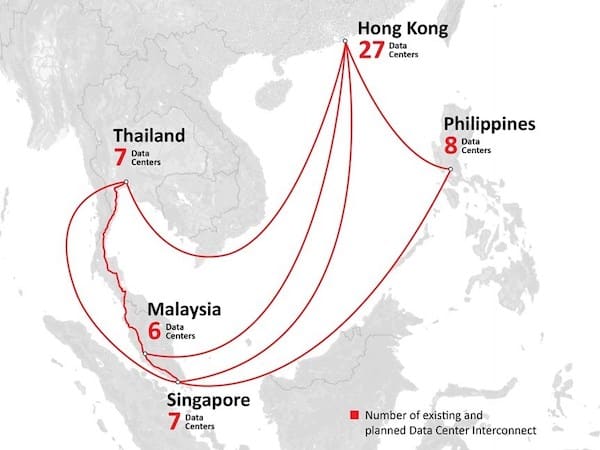
Having launched DCI solutions in Malaysia, the Philippines and (most recently) Thailand, HGC aims to combine those DCI clusters with mature DCI hubs in Hong Kong and Singapore to offer an extensive DCI infrastructure connecting major data centres across Southeast Asia.

The DCI clusters currently comprise existing and planned six data centres in Malaysia, seven in Thailand and Singapore (each), and six in Malaysia, as well as 27 in Hong Kong.

Earlier this week, HGC beefed up its data centre PoP in the Philippines by joining PLDT Enterprise’s Vitro Partner Network (VPN), which enabled it to expand its footprint to the new Vitro Sta. Rosa data centre.

HGC plans to leverage its DCI infrastructure to enable in-country and inter-country connectivity for enterprise solutions customers from Africa, the Americas, Europe and the Middle East looking to enter the region.

The DCI clusters will be offered to its carriers partners, who will be able to integrate them with their own networks and DCI infrastructure.

HGC said the clusters will also enable it to offer customized low-latency cross-border connectivity, ICT services, and cybersecurity solutions to its own customers. Such services include IP-related services, AMS-IX’s internet exchange solution, and HGC’s “Eyeball-as-a-Service” (a platform that leverages 5G edge computing to enable OTT players, content providers and e-commerce companies to expand their geographical footprints quickly).

“Our unique strengths in Asia, combined with our global reputation and network, position this solution to effectively address the challenges of shifting the emerging economies to modernize inclusively in the rapidly digitalising era,” said Ravindran Mahalingam, SVP of HGC’s international business in a statement.

MORE ARTICLES YOU MAY BE INTERESTED IN…