Partner Article
If you have attended any Mobile World Congress event in recent years, you will never have been far away from a robot. From mechanical dogs prowling the halls at trade shows to robotic baristas serving coffee, robots have long been a novel way to demonstrate the power of mobile technology.
With the advent of AI, however, the embodied AI is being springboarded towards practical deployments, with autonomous operations becoming increasingly viable. From Honor’s humanoid robot ‘Lightning’, which broke the human world record for a half-marathon earlier this year, to robot dogs helping provide security at the FIFA World Cup, the robotic era is almost upon us. AI that had once been confined to a phone or laptop screen will soon be making the leap to the physical world.
What does that boom in physical AI mean for networks?
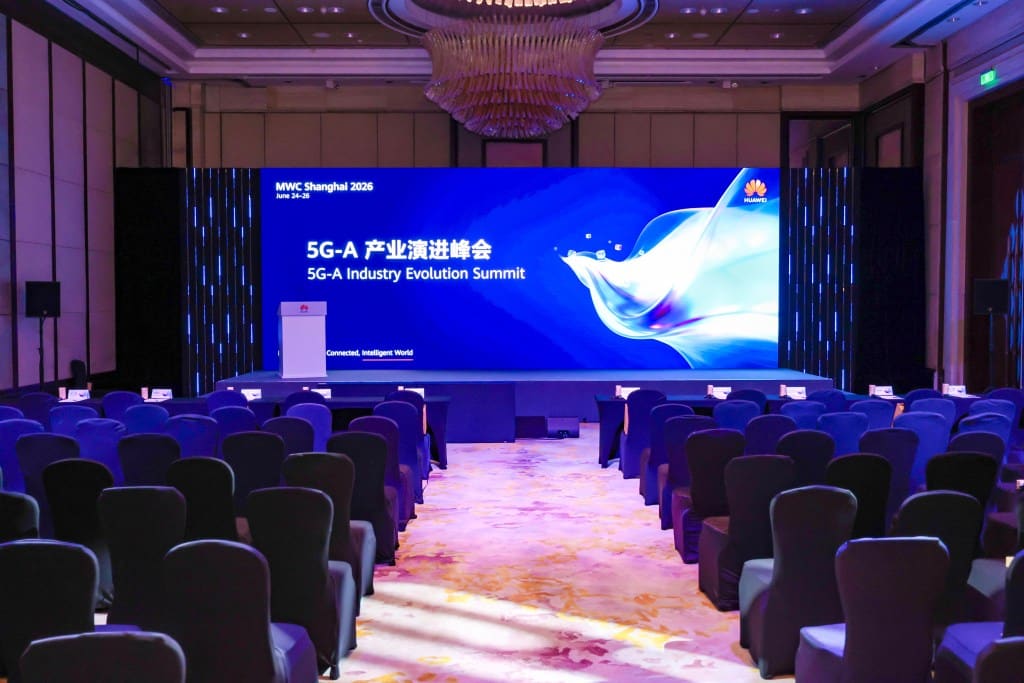
At MWC Shanghai 2026’s 5G-A Industry Evolution Summit, discussions around 5G-Advanced (5G-A) were no longer focussed on simply greater speed and capacity, instead presenting the technology as a foundational layer upon which the emerging physical AI ecosystem would be built.
But fully supporting multi-modal agents, real-time digital twins, and autonomous humanoid robotics will rely on more than a simple upgrade. Operators will be required to radically re-engineer the underlying 5G network, prioritising low latency, uplink and efficiency more than ever before.
This paradigm shift will be a major challenge for the mobile industry, but it could offer a huge reward: the creation of a token-based business model that could lead a path to growth.
Building symmetrical networks for happy robots
Perhaps the most significant change represented by the advent of embodied AI is the greater demand for uplink.
For many years, mobile networks have been designed for a downlink-heavy world dominated by consumer video streaming and web browsing. With the rapid rise of AI, however, this architectural norm is being overthrown.
Humanoid robotics, autonomous industrial vehicles, and multi-modal AI terminals will all rely on evaluating large amounts of data – often from numerous sources in varied media – in real-time. This will require rapid compute capabilities to ensure the near-instant response times crucial for autonomous activity.
The most basic solution for this would be to simply place the required compute capabilities on the device itself, whether that is a customer smartphone or a robotic sentry dog. The problem, however, is that running power-hungry GPUs directly on these devices destroys their battery life and commercial viability.
“High energy consumption and the resulting short battery life is a limiting factor,” said Chen Qi, president of AI product line at TD Tech, a company she described as “a robotic brain business”. “Using a robotic brain [in the device] takes around 20-times more energy during autonomous activity than operating it remotely. We shouldn’t be putting that pressure on terminals – we should use the cloud and put that pressure on the networks.”
Networks will therefore be required to balancing downlink and uplink, ensuring that a minimum level of uplink capacity is delivered to all connected AI terminal devices. Global operators are gradually reaching a consensus that 20Mbps uplink will become the baseline technical requirement to sustain real-time AI modelling, situational awareness, and digital twins.
In a world full of AI terminals – 15 billion by 2035, according to Huawei’s Intelligent World 2035 report – 5G-A will be essential to ensuring that level of uplink at scale and maintaining cloud-edge synergy.
“Scaling autonomous intelligence puts a lot of pressure on our networks,” said Yang Lifan, Deputy General Manager of China Unicom Beijing. “We can handle two cameras per robot, but what about eight? We can support five robots at the site, but what about a hundred operating simultaneously? We need to highly optimise our 5G-A networks for these conditions and that means a much greater focus on uplink.”
It is no coincidence that Huawei launched its GigaUplink solution at the event, using multi-antenna technology upgrades and new algorithms to deliver a five-fold increase in uplink capacity.
Beyond changes to throughput demand, the latency requirements of embodied AI are fundamentally different from consumer internet use. When a robot or autonomous vehicle interacts with human environments, it requires human-like response latencies – around 650ms – to ensure safety and precision. As a result, best-effort network delivery will soon be obsolete for B2B industrial use cases, with deterministic performance becoming an essential network feature.
“Big bandwidth, uplink expansion, and user experience guarantee. Those will be the key network features that enable the mobile AI era,” said Eric Yang, President of Huawei Carrier Business.
A call for Upper 6GHz spectrum
Shifting network architecture strategy is only half of the battle for delivering continuous coverage for a rapidly AI ecosystem. Spectrum bottlenecks are a major concern, with additional capacity required to ensure ubiquitous smooth service.
At the Summit, securing continuous midband spectrum was seen as foundational for delivering multidimensional experiences, with the upper 6GHz (U6G, 6.425–7.125 GHz) band positioned as a key resource. It offers a strong combination of both coverage and capacity, complementing existing mid-band 5G spectrum and bridging the gap to 6G.
This call for access to U6G comes during an ongoing global debate about the future of the band. U6G is highly coveted by the Wi-Fi industry to relieve pressure on the crowded 2.4 GHz and 5 GHz bands. However, as Tim Hatt, Head of Research and Consulting at GSMA Intelligence, points out “mobile is much more likely to be capacity constrained than Wi-Fi.”
“We should actively promote U6G and align it with C-band, while refarming lower bands for even more capacity,” argued David Li, President of Huawei’s TDD Product Line. “U6G is the second-best spectrum for widespread 5G-A deployment after C-band (3.4–4.0 GHz). With improvements to our technology, we will soon be able to make the U6G coverage as good as C-band.”
In tandem with U6G access, refarming spectrum in the legacy 2G and 4G bands will also be a priority. By pooling these frequencies through advanced carrier aggregation, they can deliver the ultra-wide bands that 5G-A demands, creating a robust foundation for mobile AI use.
Tokens: A way out of the ‘volume trap’?
Monetising 5G often appears to be an evergreen challenge for the mobile industry. Despite widespread 5G deployment and coverage reaching over 99% in premium testbeds like Hong Kong, global ARPU has consistently stagnated. The boom in AI terminals, however, is set to expose a fundamental economic disparity between raw data transmission and AI computational workloads.
Under the traditional volume-based business model, operators generate minimal revenue from a gigabyte of data, even though transmitting the millions of AI tokens inside that data requires immense network resources and drives up computational electricity costs. By re-engineering network pipelines around token transmission rather than bytes, telcos can bundle, resell, route, secure, and bill for AI capacity in ways that reduce friction for customers and create new recurring revenue.
“The industry is moving towards token monetisation models,” said Yang, noting that Network-as-a-Service (NaaS) frameworks would allow operators to offer tier-based, deterministic service guarantees based on user location, application profiles, and precise latency requirements.
In this way, Huawei argues that operators need to evolve beyond the pure connectivity layer, becoming an orchestrator of not only data traffic but of compute power.
“A byte-plus-token strategy will redefine commercial value for operators. In the future, the difference between data traffic and tokens will continue to grow. We must be ready to embrace that, both with how we build networks and how we monetise them,” said Li.
Using 5G-A to embrace the future
The consensus from MWC Shanghai 2026 suggests that an AI-native ecosystem requires a fundamental realignment of the mobile ecosystem, requiring both infrastructure upgrades and a shift to new commercial models. The additional speed, capacity, flexibility, and reliability of 5G-A – supported by additional spectrum in the U6G band – will provide an ideal foundation for the monetisation of the token economy.
By acting as the unified orchestrators of both spectrum and computational power, telcos can step out of the volume trap and secure their place as the indispensable backbone of the physical AI revolution.