MTN Uganda aims to double loans

Keep up-to-date with all the latest news, articles, event and product updates posted on Developing Telecoms.
Subscribe to our FREE weekly email newsletters for the latest telecom info in developing and emerging markets globally.

Sending occasional e-mail from 3rd parties about industry white papers, online and live events relevant to subscribers helps us fund this website and free weekly newsletter. We never sell your personal data. Click here to view our privacy policy.

Vantage secures $64m data centre loan for Taiwan campus 


News 

The campus is set to put Taiwan on the map as a global data centre player 

Colorado-based Vantage Data Centers, a global provider of large-scale data centre campuses, has announced that is has secured a $64 million loan from two Taiwanese banks (CTBC Bank and Cathay United Bank) to support the development of its first data centre in Taipei, Taiwan. 

The announcement marks the first financing deal for a hyperscale data centre in Taiwan and is Vantage’s first collaboration with Cathay United and its third transaction with CTBC globally.  

The company’s Taiwan data centre campus was initially announced in December last year, and is currently under development, expecting to open in the summer. The campus will offer 16MW of IT capacity across a 215,000 square foot facility, catering to hyperscalers, cloud providers, and large enterprises, contributing to Taiwan’s emergence as a significant digital infrastructure hub in the region. 

“Vantage is proud to lead the way in marking the first financing of a greenfield data centre project in Taiwan,” said Joel Cheah, Vantage’s CFO in the Asia-Pacific region in a press release. “We appreciate CTBC Bank’s continued confidence in Vantage’s data centre platform and are pleased to have the Cathay United Bank team join us in this innovative financial milestone in the next phase of Taiwan’s growth as a regional data centre market.” 

According to Vantage, the Taipei data centre market is expected to more than double from $1.42 billion in 2022 to $3.21 billion by 2028, which it says is driven by growing cloud service adoption and demand for AI. 

Throughout 2023, Vantage raised $10 billion in incremental debt and equity to support the growing data centre demand from the world’s largest hyperscalers. 

“In 2023, we entered emerging and high-demand data centre markets to meet the needs of our customers as artificial intelligence and other innovative technologies continue to advance,” said Sureel Choksi, president and CEO of Vantage Data Centers. 

Keep up to date with the latest international telecoms news by subscribing to the Total Telecom daily newsletter 

Also in the news:
BT wins £26m contract to connect UK schools
Apple fined €1.8bn by European Commission over Spotify row
Japan to reduce regulatory pressure on incumbent NTT

Colt DCS buys land in Chennai for new hyperscale data centre

Keep up-to-date with all the latest news, articles, event and product updates posted on Developing Telecoms.
Subscribe to our FREE weekly email newsletters for the latest telecom info in developing and emerging markets globally.

Sending occasional e-mail from 3rd parties about industry white papers, online and live events relevant to subscribers helps us fund this website and free weekly newsletter. We never sell your personal data. Click here to view our privacy policy.

Vodafone launches GenAI chatbot on VOXI


News

The operator says the bot can deliver ‘human-like interactions with customers’ and is able to handle sophisticated consumer requests

Today, Vodafone UK has become the first operator in the country to launch a large language model (LLM) chatbot, introducing the novel technology for its VOXI customers.

The chatbot, which has been developed in conjunction with Accenture UK, is built on ChatGPT architecture and will reportedly be used to deliver more nuanced customer service.

According to Vodafone, the new chatbot can successfully handle ‘sophisticated consumer requests’ delivered in naturalistic language. The example provided below shows the chatbot handling a relatively sophisticated request around pricing, which would typically be hard for a more generic chatbot to answer accurately.

“VOXI is using generative AI to fundamentally reinvent its business. The customer experience is only the start of how this technology can be adopted at scale across the organisation,” said Accenture UK’s Generative AI Lead, Mark Farbrace.

Vodafone also notes that the AI has been developed using an AI safety framework aimed at protecting customers and ensuring ‘the responsible and ethical deployment of AI technology’.

The chatbot will initially be trialled with a small number of customers, with a wider rollout expected to follow once any initial issues have been identified and corrected.

Chatbots are certainly nothing new for the telecoms industry, which has used them to various degrees of success for many years. GenAI-based chatbots, however, are potentially far more exciting, offering not only a more flexible and personable experience for the customer, but also the potential for individually personalised consumer offerings.

Is AI going to reshape what it means to be a telco in 2024? Join the discussion at Connected North 2024, live in Manchester

Also in the news:
BT wins £26m contract to connect UK schools
Apple fined €1.8bn by European Commission over Spotify row
Japan to reduce regulatory pressure on incumbent NTT

Fixed-line demand is spiking in North Korean border towns

Demand for fixed-line telephone services has reportedly spiked in North Korea’s North Pyongan Province due to the easing of border restrictions with China, which has also led to a spike in installation prices.

According to Daily NK, citing anonymous sources, the relaxation of border controls has led to an increase in traffic in provincial areas like Sinuiju, Ryongchon, Uiju, and Cholsan. As much of that traffic is commercial (to allegedly include smugglers), wholesalers in those areas are starting to install two phones at home, as fixed-line services cost less than mobile phones.

The report also said that demand for fixed-line in North Pyongan has been driven by an increase in families who want to install their own home phone instead of sharing one with another family, mainly due to privacy concerns.

Consequently, post offices in the province have been swamped with requests for phone installations since the beginning of this year – so much so that the North Pyongan Province Post and Telecommunications Bureau has brought forward its annual revenue targets, the report said.

However, this also means provincial post offices have raised installation costs to take advantage of the spike in demand and hit those targets. The report claims the cost of fixed-line phone installation now costs between US$350-450 in Sinuiju and US$400-500 in Ryongchon. By comparison, installing a telephone in the capital Pyongyang costs between US$100-250.

The report’s source said the price of installation is particularly high in Ryongchon County because it has become a major bottleneck for shipping, as goods imported from China must pass through customs in Sinuiju before being distributed throughout the country.

“Since it’s the area where goods are distributed the fastest and wholesale prices are set, home phones are in high demand and installation prices are also high,” the source said.

The source also told NK Daily that Ryongchon County residents filed a complaint with the provincial party committee over the price hike, “but the matter was closed without results.”

According to the latest available figures from the CIA’s World Factbook, North Korea had 1.18 million fixed lines at the end of 2021, which works out to a market penetration of 5%. Figures from the World Bank (also for the end of 2021) say there are 6 million mobile subscriptions in North Korea, which comes to 23% market penetration.

MORE ARTICLES YOU MAY BE INTERESTED IN…

Phoenix Tower International to acquire Cellnex Ireland for nearly €1 bn 


News

Cellnex revealed late last year that its Irish unit was likely to be sold 

Florida-based wireless infrastructure company Phoenix Tower International (PTI) has announced a deal with Cellnex to acquire 100% of the latter’s Irish business for €971 million. 

Cellnex has been operating in Ireland since 2019, when it when it acquired tower operator Cignal as part of an agreement with CK Hutchinson to acquire its infrastructure portfolio in six European countries (which included Ireland). Since then, the number of towers Cellnex owns and operates in Ireland has grown to around 1,900 sites all of which will now be handed over to PTI. 

“The sale of our business in Ireland – at an appropriate valuation– is one further step within the company’s ‘Next Chapter’, in line with our strategy, to achieve the goal of consolidating, simplifying our corporate structure and focusing our efforts in the existing growth opportunities in the main markets in which we operate,” said Cellnex CEO Marco Patuano in a press release. 

Cellnex is on a mission to get its finances in order after its major M&A activities in recent years have left it  with a debt of €17.2 billion. 

This new focus was one of the main topics at Cellnex’s Capital Markets day in London this week, outlining its plans for the year ahead as the company switches its focus towards capital preservation. The company unveiled four new strategic pillars for their future organic expansion: 

  1. Simple: Cellnex will undertake a strategic portfolio review to focus on core markets and divest from non-core business lines.
  2. Focused: Towers will remain at the core of the business, but Cellnex will invest in selected business lines – DAS (Distributed Antenna Systems), SCs (Small Cells) & RAN (Radio Access Network) as a service; and wholesale fibre, connectivity & housing services – aiming to grow these from 11% to 15% of total revenues by 2027.
  3. Efficient: Cellnex will launch a comprehensive efficiency plan to improve the EBITDAaL margin by 500 basis points to 64% in 2027.
  4. Responsible: Cellnex will continue to commit to its Environmental, Social, and Governance (ESG) principles within its strategic framework.

The full Capital Markets Day details can be found here. 

For PTI, on the other hand, appears to be on the opposite trajectory, with this purchase the latest in a number of moves in the European tower sector.  

Back in September, PTI announced the acquisition of 2,000 cell sites in urban France, now making it the largest market of the 21 in which PTI operates. In 2020, the PTI also struck a deal with Bouygues Telecom to build and operate 4,000 new tower sites in France over the next 12 years. 

The closing of the deal is subject to standards regulatory approvals. 

Keep up to date with the latest international telecoms news by subscribing to the Total Telecom daily newsletter 

Also in the news:
BT wins £26m contract to connect UK schools
Apple fined €1.8bn by European Commission over Spotify row
Japan to reduce regulatory pressure on incumbent NTT

AIS and True say emergency cell broadcast service is ready to go

Thai operators AIS and True Corp announced separately on Tuesday that they are ready to implement an emergency cell broadcast service commissioned by the National Broadcasting and Telecommunications Commission (NBTC).

The cell broadcast service is designed to immediately pinpoint specific areas affected by urgent and critical incidents, including violence, shootings, and natural disasters.

The service comprises two parts: a Cell Broadcast Entities (CBE) system, managed and overseen by the central command center of the government, and the Cell Broadcast Center (CBC) system, managed and overseen by mobile 0perators.

The CBE system defines content and delivery areas for messages, consisting of various functions such as system management, message creation and approval. The CBC system is responsible for delivering message content to base stations according to specified areas, comprising system management and configuration, message deployment function, and network management.

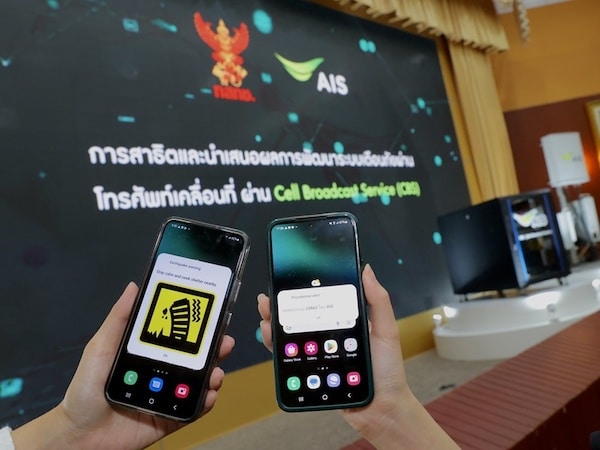
The cell broadcast service will send direct warning messages from area base stations to all mobile phones within that region. The message is displayed on the mobile phone screen as a near real-time triggering pop-up notification.

The system differs from regular SMS in that it doesn’t require phone numbers, allowing for rapid and efficient communication of emergency information across the entire affected area. This also means the public doesn’t need to download any specific applications. Additionally, users will receive messages even if the even if the device is switched off.

The Ministry of Digital Economy and Society (DES) first proposed establishing a cell broadcast system for emergency alerts in October 2023 following a shooting at Siam Paragon Mall in which two people were killed and five others injured. Since then, the NBTC has collaborated with DES, the Department of Disaster Prevention and Mitigation (DDPM), the Royal Thai Police, and mobile operators to develop the system.

AIS demonstrated the cell broadcast service on Tuesday at the NBTC office. Clinical professor Sarana Boonbaichaiyapruck, chairman of the NBTC, said the results were satisfactory. “[The system] is ready to connect with the central government’s command cente to serve as a tool or channel for swift and efficient disaster warnings.”

“The latest testing of this technology has successfully achieved its intended goals, and we are ready to expand its integration with the country’s emergency alert system efficiently going forward,” said AIS head of business relations Waroonthep Watcharaporn.

Also on Tuesday, True Corp announced that it was ready to support the service, having successfully testing it on January 15.

“Currently, negotiations are underway with the government to put this system into practice … marking a first step of success for True Corp in developing and cooperating towards the Ministry of Digital Economy and Society, the NBTC, and the DDPM for immediate deployment,” said Chakkrit Urairat, True Corp’s chief corporate affairs officer.

Chakkrit also said that True’s cell broadcast system supports five levels of alerts based on severity:

  • National Alert: The highest level of alert, immediately informing everyone within the coverage area
  • Emergency Alert: Alerts for various disasters like tsunamis, earthquakes and flash floods, as well as criminal threats
  • Amber Alert: Alerts for information when a child is missing or abducted to help the public stay alert and assist government officials in monitoring and reporting if suspects are spotted
  • Public Safety: Public safety alerts in areas or for monitoring cases involving residents, communities, and passersby
  • Test Alert: A system for testing alerts for specific purposes before expanding to monitoring and alerts at different levels.

True also said its system supports five languages: Thai, English, Chinese, Japanese, and Russian.

Neither True nor AIS said how much the implementation would cost. A report in the Bangkok Post last month quoted DES minister Prasert Jantararuangthong as saying the CBE would cost around 400 million baht (US$11 million) to set up. He also said mobile operators may have to spend 300 million baht each to install their own CBCs.

On Tuesday, the NBTC’s Sarana said in a joint statement with AIS that funding for the system would be supported by the Universal Service Obligation (USO) and Telecommunications Infrastructure Fund.


MORE ARTICLES YOU MAY BE INTERESTED IN…